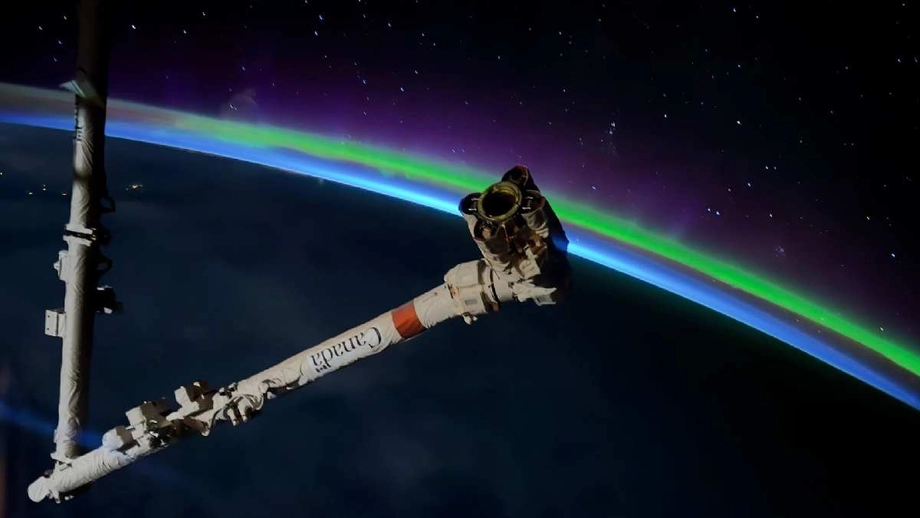
A picture taken with a phone, not a camera
Anil Menon held an iPhone to the window of the International Space Station and photographed something that usually arrives with a case of lenses: a bright blue band along Earth's curved edge, a green strip fading into purple against the stars, and the white body of Canadarm2 bending across the frame with Canada printed on it.
Contents
- A picture taken with a phone, not a camera
- The two astronauts who will drive the arm
- A Sunday liftoff at 10:47 a.m. and a ninth flight for one booster
- Tuesday's capture: near zero contact velocity, then 16 bolts
- Eleven thousand pounds, gingerbread and hatch seals
- What the cargo hold is carrying for science
- A freighter named for the commander of Apollo 13
- Cygnus can also push the station higher
- Why a SpaceX rocket is carrying a Northrop ship
- What Cygnus cannot do
- Key Points
He posted the image on X with a caption that pointed to this week's work at the outpost. "iPhone right now. The aurora and Canada arm are back and make an amazing duo. We will use the arm to capture Cygnus this week. Tune in as Luke Delaney and Jessica Watkins do the capture," Menon wrote.
Asked by another user whether he had used specific settings or editing to get those colours, Menon replied.
This was just an iPhone. No editing. It did a 3 second night exposure. Sometimes that makes the aurora pop but in this case it looked exactly like that from the cupola.
NASA Administrator Jared Isaacman answered the post with a single word: "Excellent." The photo joins a short run of phone imagery from the agency's crews. During April's Artemis II mission around the Moon, Reid Wiseman and Christina Koch were pictured looking back at Earth in shots taken with an iPhone 17 Pro Max front camera, and Wiseman also used an iPhone to photograph the Moon.
Menon, who has Indian and Ukrainian roots, is an emergency physician and a U.S. Space Force colonel. He was SpaceX's first flight surgeon before NASA selected him in 2021, and his first spaceflight began on July 14.
The two astronauts who will drive the arm
Watkins is set to operate Canadarm2 on Tuesday, with Delaney monitoring the incoming spacecraft. She is a geologist with a doctorate from UCLA who joined NASA's astronaut class in 2017, spent 170 days in orbit on Crew-4 in 2022, has worked with the Curiosity rover science team, and came back to the station in October as commander of Crew-13.
Delaney is on his first spaceflight and holds degrees in mechanical and aerospace engineering. He grew up in Central Florida.
Both belong to the seven-member Expedition 75 crew that has kept the laboratory running while cargo arrives from two directions. In the days before the freighter's launch, Watkins and Delaney underwent ultrasound scans of their organs in an investigation supported by augmented reality tools and computational algorithms, while Russian cosmonauts sampled the station's air for microbial growth and ran biomedical experiments.
A Sunday liftoff at 10:47 a.m. and a ninth flight for one booster
A SpaceX Falcon 9 lifted off from Space Launch Complex 40 at Cape Canaveral Space Force Station in Florida at 10:47 a.m. EST on Sunday, Nov. 29 (9:17 p.m. India time), climbing through a thick deck of overcast cloud. NASA had put the chance of acceptable weather at 60 percent, with thick clouds the concern, and the window was instantaneous, so a hold at the target moment would have pushed the attempt to a backup slot at 10:24 a.m. the next day.
The first stage, booster B1096, made its ninth trip to space and landed back at Landing Zone 40 beside the pad about eight minutes after liftoff. That was the ninth landing at the site and the third by this booster, which had previously flown Kuiper Falcon 1, NASA's IMAP, NROL-77, GPS III-9, CRS-34, CRS-35, NROL-95 and a Starlink mission. Cygnus separated from the Falcon 9 upper stage about 14 and a half minutes into the flight.
Jared Metter, SpaceX's director of flight reliability, described the company's place in the resupply program at a prelaunch teleconference.
This will be the fifth overall launch by Falcon 9 on behalf of Northrop Grumman. We continue to be honored to have these missions on our manifest. These are critical mission that help provide the necessary science, food, supplies, and equipment to help maintain the orbiting laboratory of the ISS.
Sunday's flight was the 62nd launch from the Space Coast in 2026, all but eight of them by SpaceX, against the record 109 flown from the same coast in 2025. The booster's return sent sonic booms across Central Florida.
Tuesday's capture: near zero contact velocity, then 16 bolts
Capture is targeted for 2:35 a.m. EST on Tuesday, Dec. 1 (1:05 p.m. India time), with NASA's arrival coverage beginning at 1:10 a.m. The spacecraft is the S.S. James "Jim" A. Lovell, and the robotic arm that takes hold of it is about 17 meters (58 feet) long, has seven joints and has been in orbit since 2001.
Watkins and Delaney will use the arm to seize the freighter as it closes to within reach. Ground controllers then move it to the Earth-facing port of the Unity module, where the crew can open it up and unload. The port is a Common Berthing Mechanism: the arm places the spacecraft with near zero contact velocity and 16 powered bolts pull the two halves together and seal the joint. Docking, the alternative used by some vehicles, relies on a visiting craft's own momentum to trip latches, which this connector's speed limits rule out.
NASA's launch advisory gives no time for the installation itself, only the capture. Cygnus is one of four robotic supply ships serving the station, alongside Russia's Progress, Japan's HTV-X and SpaceX's Dragon, and it is the only one of the four that needs a crew on the arm rather than flying itself in.
Eleven thousand pounds, gingerbread and hatch seals
The freighter is carrying about 11,000 pounds (4,990 kilograms) of supplies, hardware and experiments, its heaviest kind of load and roughly the same figure as the debut flight of this larger design. Gaurang Patel, operations integration manager for NASA's space station program, set out the food count at the same prelaunch briefing.
Overall, we will be delivering 42 standard menu BOBs (Bulk Overwrap Bags) and 65 crew-specific menu and coffee/tea preference BOBs and four fluid loading kits.
The holiday shipment adds gingerbread house kits, spicy carne asada tacos, taco and pizza kits, apples, carrots and sweet peppers, along with hatch seal covers and tools for coming spacewalks. Anna Schneider of the Johnson Space Center's public affairs office explained what such deliveries do for a crew working through a holiday far from home.
Providing variety, familiar favorites, and special meals gives astronauts opportunities to share meals and mark holidays and other occasions while they're away from home.
Food reaches orbit in specially packaged form and is usually rehydrated once aboard. Trays hold the containers down with fabric fasteners so nothing drifts off before it can be eaten. Earlier holiday menus have run to duck, seafood and Mediterranean dishes alongside the traditional turkey and cranberry sauce.
What the cargo hold is carrying for science
NASA's advisory groups the research under five aims: improving drug delivery for cancer and osteoarthritis, predicting how cancer spreads, advancing treatments for muscle loss, improving radiation sensing, and advancing food production for future long-duration missions. The advisory does not name the individual investigations, which were described separately.
- Lockheed Martin's JOining demonstration IN-Space (JOINS) will test two welding techniques in microgravity.
- Utah State University's Ohalo 3 module will study how plants take up water and how crops can be grown in orbit.
- The University of Connecticut's DNA Nano B will manufacture particles intended for medicine delivery.
The ISS National Laboratory is sponsoring more than 35 payloads on the same flight, among them an autonomous assembly demonstration from Rendezvous Robotics, a study of radiation's effects on rubber compounds from Dunlop Tires, and a radiation shielding technology demonstration from Malagen Labs. NASA chief scientist Jennifer Buchli described a muscle-loss follow-up experiment first flown during Expedition 65 and a nanomedicine study aimed at cancer and osteoarthritis.
The medical work leans on the station's microgravity, where cells and tissues behave differently than they do under Earth's gravity. Muscle wasting research has a double audience: astronauts on long stays and patients on the ground who lose muscle to illness or age. Radiation sensing addresses the main hazard of travel beyond low Earth orbit, and food production work aims to cut how much a distant crew must haul from home.
A freighter named for the commander of Apollo 13
Northrop Grumman names each of its Cygnus ships after someone who shaped human spaceflight, and this one honours James "Jim" A. Lovell, who flew Gemini VII, Gemini XII, Apollo 8 and Apollo 13. Lovell died on Aug. 7, 2025, at 97 in Lake Forest, Illinois.
Sean Duffy, then acting NASA administrator, said in a statement the next day that Lovell's "calm strength under pressure helped return the crew safely to Earth" when Apollo 13 turned into a rescue, and that "his life and work inspired millions of people across the decades." Fellow astronauts called him Smilin' Jim. On Apollo 8 he was part of the first crew to launch on a Saturn V and orbit the Moon.
Northrop Grumman's own link to the name runs through Apollo 13's lifeboat. Grumman built the lunar module that the crew used after an oxygen tank failed, a craft designed to keep two astronauts alive for 45 hours and which ended up supporting three for about 90. Northrop inherited that heritage when it bought Grumman in 1994.
The previous Cygnus XL, which flew the NG-24 mission in April 2026, carried the name S.S. Steven R. Nagel, a four-time shuttle flier. This is the third flight of the enlarged design, following NG-23 in September 2025 and NG-24, though several mission previews count it as the fourth. Across 13 years of flights the program has delivered more than 169,000 pounds of cargo to the station, with one launch preview putting the total above 159,000 pounds since 2013.
Cygnus can also push the station higher
The station does not hold its altitude on its own. Atmospheric drag pulls it down by about 1.2 miles a month, and a berthed freighter with its own engine is one of the ways NASA counteracts that. Cygnus XL carries a BT-4 main engine that burns hydrazine and nitrogen tetroxide, a pair of propellants that ignite on contact.
The performance of the earlier ship shows what is possible. NASA reported that on Aug. 27 the previous Cygnus XL, berthed to Unity, fired its thrusters for 20 minutes and 43 seconds, raising the low point of the station's orbit by 2.6 miles and the high point by 0.2 miles to an orbit of 266.5 by 254.9 miles, which set up the Progress 96 launch. A second burn announced Sept. 25 ran 18 minutes, lifting the high point by 1.5 miles and the low point by 0.8 miles to 265.5 by 256.8 miles, a change NASA said set up phasing for Crew-13, the flight that brought Watkins and Delaney up.
Dave Schiller, Northrop Grumman's vice president for civil space and sciences, said this Cygnus may be used for one or more reboosts, with the timing and the number left to NASA and its international partners. Northrop's mission page lists precision reboost services, while NASA's launch advisory does not mention reboost at all, and no date for a burn has been given.
Why a SpaceX rocket is carrying a Northrop ship
Northrop Grumman's own Antares rocket has not flown since August 2023, when the Antares 230+ made its last launch using Russian-built RD-181 engines. Russia's 2022 invasion of Ukraine disrupted supplies of both those engines and the Ukrainian-built stages, and in August 2022 the company contracted Firefly Aerospace to build a replacement first stage with seven Miranda engines producing 7,200 kilonewtons, about 1.6 million pounds of force.
Falcon 9 has filled the gap. It has now carried every Cygnus launch since 2024, including NG-20, NG-21, NG-23, NG-24 and NG-25. Schiller said on Nov. 23 that the arrangement has one more flight left on the books and declined to put a date on Antares 330.
We do have one additional Falcon 9 on the manifest for Cygnus.
Northrop says it does not expect a gap in Cygnus launches and will keep matching missions to whatever rocket is ready. Firefly's Eclipse medium-lift rocket, which Northrop co-develops, now targets a first flight no earlier than 2027, a slip from 2026, and Antares 330 has no committed readiness date. Repairs on the Cygnus built for the NG-22 mission are also still under way, with no timeline announced.
Cygnus can change rockets because it carries its own propulsion: Thales Alenia Space builds the pressurized cargo module in Turin, Italy, and Northrop builds the service module with its main engine, 32 attitude thrusters and hypergolic propellant. The rocket only has to deliver it to a preliminary orbit. The same design has moved between launchers before. After an Antares failure on Oct. 28, 2014, Cygnus flights shifted to Atlas V rockets and later returned to Antares.
What Cygnus cannot do
The freighter is designed to end its life in the atmosphere. It is scheduled to stay attached to the station until May 2027, then depart loaded with several thousand pounds of waste and unneeded gear and burn up on re-entry. Dragon, the other U.S. commercial cargo ship, is the exception among station freighters: it splashes down under parachutes and brings cargo home. Cygnus, Progress and HTV-X all dispose of theirs.
The larger design is what makes room for a load this size. Cygnus XL stretches the pressurized module to about 26 feet and roughly 1,300 cubic feet of volume, against about 950 cubic feet on the Enhanced version, and Northrop says it carries about 30 percent more than the earlier ship, a figure Ryan Tinter, the company's vice president for civil space systems, put at "33 percent more capacity than the prior Cygnus spacecraft had." NASA's Commercial Resupply Services contracts cover Northrop flights through NG-35.
The station's other delivery already landed. Roscosmos's Progress 97 lifted off at 5:17 a.m. EST on Nov. 25 from the Baikonur Cosmodrome in Kazakhstan and docked at the Rassvet module shortly after 7:00 a.m. EST, bringing close to three tons of food, fuel and supplies for the Expedition 75 crew. Sunday's launch was the last cargo flight of 2026 to the station.
Key Points
- NASA astronaut Anil Menon's iPhone photo of Canadarm2 and an aurora, taken with a 3 second night exposure and no editing, drew a reply from NASA Administrator Jared Isaacman.
- A SpaceX Falcon 9 launched Northrop Grumman's Cygnus XL, named S.S. James "Jim" A. Lovell, from Cape Canaveral at 10:47 a.m. EST on Nov. 29.
- Booster B1096 made its ninth flight and landed at Landing Zone 40 about eight minutes after liftoff.
- The freighter carries about 11,000 pounds (4,990 kilograms) of supplies, holiday food and experiments, including welding, plant growth and nanomedicine payloads.
- Jessica Watkins and Luke Delaney are to capture Cygnus with Canadarm2 at 2:35 a.m. EST on Dec. 1 and berth it to the Earth-facing port of the Unity module.
- This is the 25th Cygnus resupply mission and the third flight of the enlarged Cygnus XL design.
- The spacecraft may perform one or more reboosts of the station at NASA's request, with no date set.
- Northrop has one more Falcon 9 booked for Cygnus and no date for its own Antares 330 rocket.
- Cygnus is to stay at the station until May 2027, then burn up on re-entry carrying station waste.