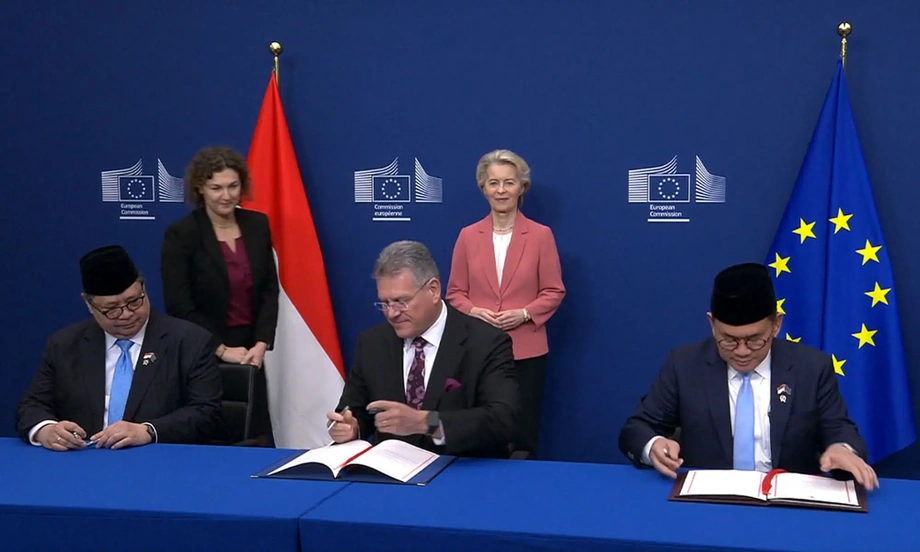
A signing in Brussels, and a clock already running
On 21 November 2026, in Brussels, Coordinating Minister for Economic Affairs Airlangga Hartarto and European Commissioner for Trade and Economic Security Maroš Šefčovič signed the Indonesia-European Union Comprehensive Economic Partnership Agreement, known as IEU-CEPA, together with an Investment Protection Agreement. Negotiators had closed the substantive talks on 23 September 2025, nine years after negotiations opened in July 2016 and after at least 19 rounds.
Contents
- A signing in Brussels, and a clock already running
- What the tariff numbers mean for a shipment of shoes
- What Europe gets beyond the tariff cuts
- Why 1 January decides whether exporters win or lose
- From $40 billion to $60 billion in three years
- Palm oil, deforestation rules and the ISPO argument
- Nickel for European batteries
- Danantara and the price written on an invoice
- MSCI, a 1 percent ownership rule and $92 billion of MoUs
- Chips, AI and 15,000 engineers
- The paperwork that decides whether any of it works
- Key Points
The treaty joins a European Union of about 450 million people to Indonesia, a country of 283 million that generates 35 percent of ASEAN's gross domestic product. Officials on both sides describe the combined market as roughly 730 million consumers. Indonesia's economy is worth about €1.4 trillion a year, the 12th largest outside the EU, according to the European Commission.
European Commission President Ursula von der Leyen put the agreement at the top of the bloc's deals in the region.
This is the most ambitious agreement concluded by the European Union in Asia, connecting our 450 million people with the largest economy in Southeast Asia, as well as the fourth most populous country in the world.
Trade Minister Budi Santoso, who travelled to Brussels for the ceremony, called it Indonesia's most modern and comprehensive trade agreement, with 25 chapters covering goods, services, investment, intellectual property, government procurement, competition policy and sustainable development. A comprehensive economic partnership agreement is a treaty that cuts or removes import duties and sets shared rules on customs, services, investment and product standards.
The route to the signature was long, and the final stretch was fast:
- July 2016: formal negotiations begin.
- 25 June 2024: the trade ministry reports progress at 90 percent after a meeting at the presidential palace.
- 23 September 2025: both sides finalise negotiations.
- 21 November 2026: the CEPA and the Investment Protection Agreement are signed in Brussels.
- 23 November 2026: the documents enter the EU's internal procedure.
- 31 December 2026: Indonesia's tariff preferences under the EU's Generalised Scheme of Preferences expire.
- 1 January 2027: the target date for the agreement to take effect.
What the tariff numbers mean for a shipment of shoes
Of the European Union's 9,754 tariff lines, 8,820, or 90.4 percent, fall to zero duty the day the agreement takes effect, Budi said after the ceremony. Another 7.92 percent will be reduced over three to 15 years or handled through tariff rate quotas, which allow a set volume of goods in at a lower duty, lifting total preferential coverage to 98.35 percent. A tariff line is a single product category in a customs schedule, so the percentage measures how much of the schedule is covered rather than how much trade.
The immediate cuts reach named products: 1,143 tariff lines for textiles and garments, 78 for footwear, and all 14 lines for crude palm oil and palm kernel oil, plus downstream goods such as oleochemicals, margarine and glycerol. Frozen shrimp and whole tuna for industrial processing enter with no duty, while processed tuna, surimi and sardines get tariff cuts or quotas at lower duty. Textiles and fisheries have faced duties of about 7 to 12 percent in Europe, Airlangga said, and those rates fall to zero.
Indonesia's own duties move in the other direction. The European Commission estimates that 98.5 percent of Indonesian tariffs on EU goods will be removed, against an average of 10 percent today and individual rates as high as 150 percent, saving EU exporters more than €650 million a year in customs duties. Cars face 50 percent now, chemicals up to 25 percent, machinery up to 15 percent and pharmaceuticals up to 15 percent. Jakarta kept rice, sugar and ethanol out of its cuts and will spread the removal of duties on half of EU vehicle tariff lines over five years.
Airlangga has put the wider saving in trade costs at about €600 million a year, in an interview with France 24.
What Europe gets beyond the tariff cuts
EU exports to Indonesia were worth €10.2 billion in 2025, EU investment holdings in the country stood at €24.7 billion, more than 15,000 EU small and medium enterprises export there, and those exports support almost 200,000 jobs in Europe, according to the Commission's factsheet.
The same document sets out the openings for services and digital trade. For the first time Indonesia will allow 100 percent foreign ownership in telecommunications and computer services, and it commits to banning customs duties on electronic transmissions such as software, messages and digital media. Europe's farmers win lower duties on dairy, meats, fruit, vegetables and processed foods, a sector where EU exports to Indonesia already reach about €1 billion a year.
Names are protected in both directions. The deal shields 221 EU geographical indications, among them Roquefort cheese, Kalamata olive oil and Lübecker Marzipan, and 72 Indonesian ones, including Gayo Arabica, Toraja and Java Preanger coffee, Banda nutmeg, Lampung black pepper, Amed Bali salt and Alor vanilla. The Paris Agreement is written into the partnership as an essential element, with enforceable commitments on labour, environment and climate.
Why 1 January decides whether exporters win or lose
Indonesia's preferences under the EU's Generalised Scheme of Preferences end on 31 December 2026. That scheme covered about 44 percent of tariff lines, Budi said, while IEU-CEPA covers more than 90 percent at zero duty. Any gap between the two would push Indonesian goods back to standard most favoured nation rates, which is the duty the EU applies to countries without a special arrangement.
Budi said ratification has to be finished by the end of December, and that Brussels promised its own process would close by mid December. The documents went into the EU's internal procedure on Monday 23 November, two days after the signing, a timetable Airlangga said the EU proposed so the paperwork could move at once. The European Parliament must give its consent, and the texts still face legal scrubbing and translation into the official languages.
In Jakarta, the government has consulted the House of Representatives and expects to ratify through a presidential regulation, alongside a trade ministry regulation and a finance ministry regulation. Budi said the documents were prepared and a letter sent to Commission VI of the House for a working meeting. The trade ministry reported in June 2024 that progress had reached 90 percent, when Zulkifli Hasan held the trade portfolio and the talks were being pushed from the presidential palace, as the ministry's June 2024 update recorded.
Šefčovič warned that the ceremony was a beginning rather than an end, and that the gains depend on how well the deal is promoted and used.
We are once again turning shared ambitions into tangible benefits. This is an important step towards a more prosperous economic future in the EU and Indonesia, opening new doors for businesses and giving momentum to our cooperation in key sectors such as agri-food and advanced manufacturing.
From $40 billion to $60 billion in three years
Airlangga set the target for two way trade in an interview with Euronews on Friday 27 November, and repeated it in a statement released in Jakarta the next day.
So, our goal is to increase our trade from $40 billion to $60 billion within a three-year period. Then, of course, we hope to increase it even further because the potential of those 730 million people is very large.
Trade in goods between the two sides was about €28.9 billion in 2025, roughly Rp580 trillion, according to European Commission data cited by the Indonesian Employers Association, Apindo. Indonesian exports to the bloc reached $18.7 billion, against $63.9 billion for Vietnam, $30.3 billion for Malaysia and $29.9 billion for Thailand, the economist Wijayanto Samirin noted.
Sales are concentrated in three countries. The Netherlands, Italy and Germany take about 56 percent of Indonesia's exports to the EU. Budi said lower duties give exporters room to widen that map, backed by seven trade attaches and four Indonesian Trade Promotion Centres in the bloc.
Well, that is actually an opportunity for us to diversify our products to European countries and diversify our markets. If yesterday it was dominated by those three, then now with the same opportunity at lower tariffs they can directly enter other countries.
The government projects exports to the EU will rise 14.4 percent, about €2.6 billion or $2.85 billion. Garments account for the largest expected gain at €779 million, leather and footwear €652 million and vegetable oils €512 million, and the deal is expected to add €26.8 billion to Indonesia's gross domestic product by 2042. EU exports to Indonesia are projected to rise nearly 40 percent over 15 years, led by machinery, motor vehicles and metals.
Palm oil, deforestation rules and the ISPO argument
Palm oil was one of the last obstacles in the talks, and it comes with conditions attached. Crude palm oil and palm kernel oil will enter the EU with no duty inside an export quota, and a dedicated palm oil protocol covers sustainability cooperation. Palm oil shipments also face a tariff rate quota that sets a volume ceiling, and the text separates food grade from fuel grade oil.
Airlangga said talks on the European Union Deforestation Regulation run on a separate track from IEU-CEPA. Indonesia accepts the EU requirements in principle, he said, while pressing for its own certification systems, Indonesian Sustainable Palm Oil and the Roundtable on Sustainable Palm Oil, to count when compliance is verified. Those discussions are still running. The EU has already postponed application of the deforestation rules by two years, and Indonesia has a deforestation moratorium in place.
Palm oil producers are watching the outcome closely because Europe is a high value market for processed derivatives, and the quota system means the benefit depends on volumes as much as on the duty rate.
Nickel for European batteries
Critical minerals were part of the conversation around the deal. Indonesia and the EU have discussed European access to Indonesian nickel, including nickel pig iron and precursors used to make battery components, to feed Europe's battery and electric vehicle industries. Nickel pig iron is a lower grade ferronickel product that Indonesian smelters make from laterite ore, and precursors are the chemical building blocks of battery cathodes.
Airlangga said Jakarta is open to such supply arrangements if they come with agreements on investment and industrial development in Indonesia. The Commission's factsheet makes the same link from the European side, noting that Indonesia is a world leading producer of critical raw materials such as nickel and cobalt and that the deal offers EU manufacturers stability and predictability, with a commitment to environmental impact assessments so that mining does not harm the environment.
Indonesia's mining rules already require good mining practice, with compliance audited and reported in company accounts, a standard Airlangga said international miners operating in the country, including Freeport-McMoRan and Vale, have followed for years.
Danantara and the price written on an invoice
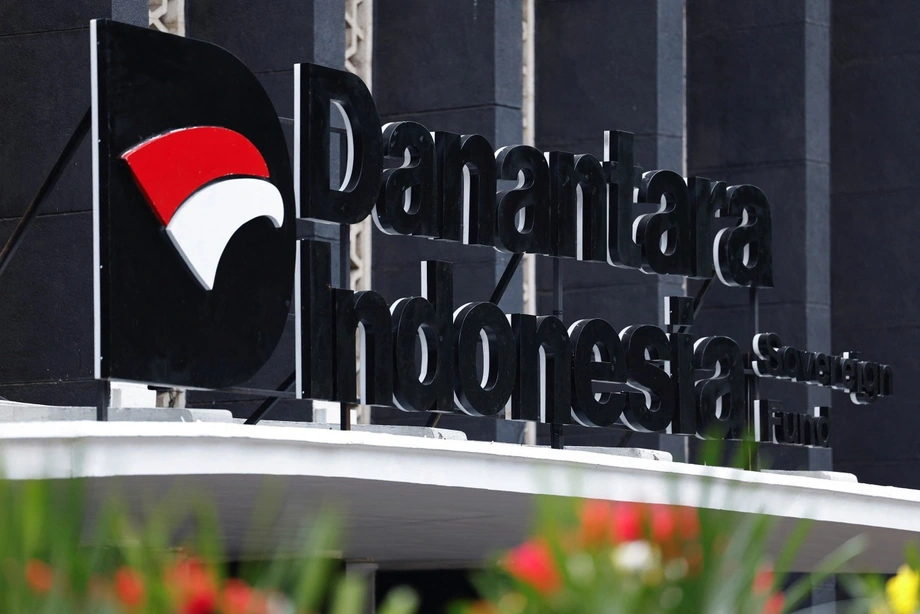
Trade rules do not settle the question of what a shipment is declared to be worth. Airlangga pointed to PT Danantara Sumberdaya Indonesia, the state resources company, as the body keeping export prices aligned with international benchmarks, with the aim of stopping under-invoicing, tax avoidance and the build up of trading margins in third countries.
Under-invoicing means declaring a lower value than the goods actually fetch, which trims the tax and royalty a producer pays at home while the profit appears in a trading hub abroad. Airlangga said the mechanism follows Organisation for Economic Co-operation and Development standards on transparency and fairness, so that the value of a transaction reflects a fair market price.
MSCI, a 1 percent ownership rule and $92 billion of MoUs
Financial markets have their own reading of Indonesia's direction. Airlangga described recent assessments and warnings from MSCI about the country's capital market as shifts in sentiment rather than a verdict on macroeconomic fundamentals, and said international rating agencies still rate Indonesia positively.
The government is pushing disclosure reforms, including Ultimate Beneficial Ownership reporting for shareholdings down to 1 percent, which means investors must reveal the real people behind a holding however small it is. Airlangga also pointed to investment commitments gathered abroad: memorandums of understanding worth close to $92 billion signed in the presence of President Prabowo Subianto during the Asia-Pacific Economic Cooperation meetings in China.
On the European side, Jakarta is exploring a joint Indonesia-EU investment forum to convert interest into projects. European investment in Indonesia reached about $25 billion over the past five years, Airlangga said, while separate figures put the 2021 to 2026 total at $14.8 billion. BP Batam, which runs the free trade zone on the Strait of Malacca, said it will court investors from Germany, the Netherlands and France and position the island as a manufacturing hub, according to its deputy for investment, Fary Djemy Francis.
Chips, AI and 15,000 engineers
Beyond trade, Indonesia has signed a partnership with Arm Limited, the British company whose chip designs sit inside most of the world's smartphones, to train 15,000 young engineers in artificial intelligence and semiconductor technology and to secure access to six pieces of semiconductor intellectual property. Those blocks are licensed designs that a chip developer can build into its own product, which shortens the path from an idea to a working chip. The programme is meant to build skills and a domestic semiconductor industry rather than a single factory.
The paperwork that decides whether any of it works
Economists and business groups are treating the tariff cuts as an opportunity that has to be claimed, invoice by invoice. A survey by Apindo found about 79 percent of Indonesian businesses have not used the trade agreements the country already has, according to the Center of Reform on Economics economist Yusuf Rendy Manilet, so lower duties will not translate into exports unless firms master rules of origin, technical standards and certification procedures.
Wijayanto Samirin of Paramadina University said the government needs a dedicated team to keep the agreement from drifting.
Agreements are often signed, then everything goes on as business as usual. Various obstacles that emerge are not addressed with quick solutions, marketing of our products to the EU is not well coordinated, and so on. As a result, various important agreements fail to deliver benefits.
Apindo chairwoman Shinta Kamdani said firms already exporting are best placed to use the cuts at once, while smaller companies face limits on production capacity, quality consistency, compliance with EU standards, financing and access to supply chains. Apindo asked the government to keep customs procedures simple, publish clear technical guidance early and allow a transition period. Even after the deal takes effect, businesses estimate it could take six to 18 months for exporters to enter the EU market and benefit, and the deal offers small firms simpler proof of origin through self declaration and dedicated information channels on tariffs and requirements.
Competition is the other pressure. Budi said the bigger risk for Indonesian manufacturers is not European goods arriving at home but losing European market share to exporters in India, the Philippines and Mexico, which are still negotiating their own deals with Brussels. Esther Sri Astuti, executive director of the Institute for Development of Economics and Finance, said spreading the benefits to micro, small and medium enterprises is what will decide how much Indonesia gains.
Key Points
- Indonesia and the EU signed IEU-CEPA and an Investment Protection Agreement in Brussels on 21 November 2026, after finalising talks on 23 September 2025.
- 90.4 percent of the EU's 9,754 tariff lines, or 8,820 lines, fall to zero duty on entry into force, with 7.92 percent cut over three to 15 years, for total coverage of 98.35 percent.
- Indonesia's GSP preferences expire on 31 December 2026, making ratification by 1 January 2027 the target on both sides; Jakarta plans a presidential regulation.
- Airlangga Hartarto targets two way trade of $60 billion within three years, up from $40 billion, with exports projected to rise 14.4 percent.
- Deforestation rules are handled outside the trade deal, and Jakarta wants ISPO and RSPO certification recognised for compliance.
- Nickel pig iron and battery precursors are part of the discussion, tied to investment and industrial development in Indonesia.
- Trade Minister Budi Santoso said only about 44 percent of tariff lines were covered under GSP, against more than 90 percent under the new deal.
- Business groups warn that about 79 percent of Indonesian firms have not used existing trade agreements, so the gains depend on readiness.