Tokyo Rewrites the Line on China
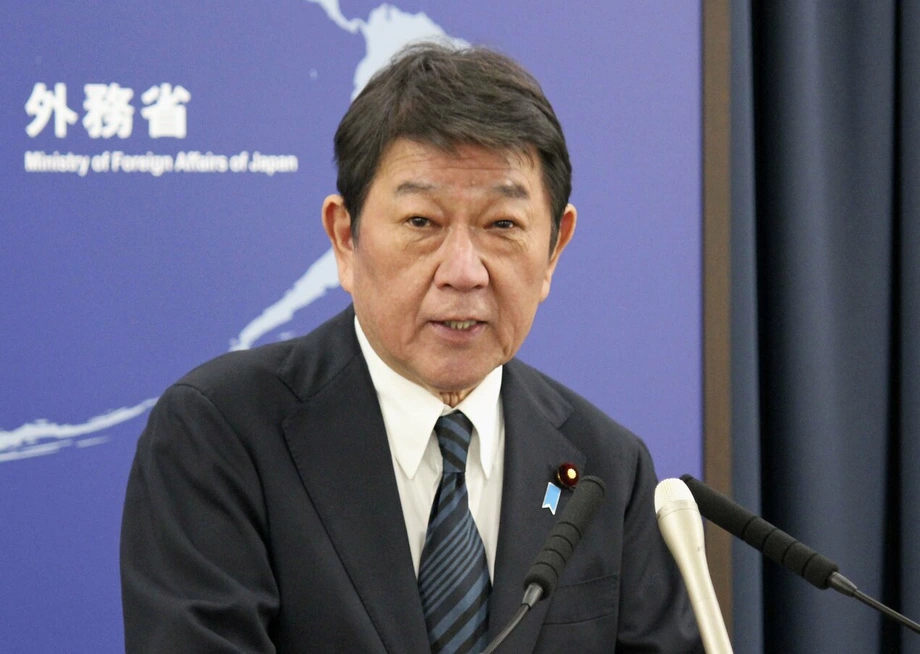
Japan's foreign ministry has demoted China in the document that sets the tone for its diplomacy. The 2026 Diplomatic Bluebook, presented by Foreign Minister Toshimitsu Motegi and released on 10 April, calls China an "important neighboring country." The 2025 edition had gone further, describing the relationship with China as "the most important bilateral relationship."
Contents
- Tokyo Rewrites the Line on China
- Seoul Gets a Warmer Paragraph
- Fences Go Up Along the Track at Dandong
- Why a Second Meeting This Year Would Count
- Pyongyang Sends a Nuclear Reminder First
- The Calendar Tightens for Seoul
- Taiwan's Ruling Party Gains Ground, Taipei Holds
- Two Capitals Read the Same Ballot
- A Rare Meeting at the Great Hall of the People
- Mousse Meals for a Fast Aging Market
- Key Points
The demotion follows a year of friction that began in parliament. Prime Minister Sanae Takaichi's remarks in November 2025 about a possible Taiwan contingency drew protests from Beijing, and the bluebook says China has since intensified unilateral criticism and coercive measures against Japan.
Two of those measures are named in the report. Chinese military aircraft illuminated Japanese Self-Defense Force aircraft with radar, and China imposed export controls on dual-use goods bound for Japan. Radar illumination means pointing a targeting radar at another aircraft, a move militaries treat as a warning or a rehearsal for attack. Dual-use goods are products with both civilian and military uses, from precision machine tools to advanced electronics, and restricting them can slow a country's defence work without a formal embargo.
A Taiwan contingency, the phrase at the centre of the dispute, is Japanese security shorthand for a crisis around Taiwan that draws Japan in, whether through the US bases hosted on Japanese soil or through the danger to nearby Japanese islands and sea lanes. Takaichi raised the scenario in the Diet, and Beijing read the remarks as a signal that Japan could join a conflict over Taiwan.
The report stops short of closing the door. It says Japan remains open to dialogue and has not shut off engagement with China.
Seoul Gets a Warmer Paragraph
South Korea fares better in the same document. The bluebook calls it "an important neighboring country with which Japan continues to cooperate as a partner," a formulation that now sits a clear step above the label given to China.
The report also sets out the security worries that shape Tokyo's planning: rising tension in the Taiwan Strait, North Korea's nuclear and missile programmes, and expanding military cooperation between Russia and North Korea. Japan says it will strengthen cooperation through the U.S.-Japan alliance and with partners including the G7, Australia, India and South Korea.
Tokyo has tied its security more tightly to Seoul and Washington in the same period in which it has cooled its language on Beijing, and the bluebook puts all of those relationships on the same page.
Fences Go Up Along the Track at Dandong
More than 1,000 kilometres west of Tokyo, a different set of signals appeared in a Chinese border city. On the evening of 28 November, construction barriers went up along the railway tracks in Dandong, the crossing point that Kim Jong Un's private train would use on a journey to Beijing. Reporters who visited the same stretch on the morning of 27 November found no barriers. The screens were removed again by the afternoon of 29 November, a day after they appeared.
Dandong residents say such barriers are often installed when cruise boats or commercial buildings along the Yalu River are renovated, and that the railway itself could be seen as normal.
A hotel whose rooms look straight onto the China-North Korea Friendship Bridge stopped accepting bookings through 4 December. Staff at the Zhonglian Hotel said it had taken a group reservation for a conference and that the timetable had not been settled. The hotel has blocked bookings ahead of earlier visits by North Korean leaders.
Diplomatic sources say a schedule is under consideration for Kim to tour several Chinese cities, with a meeting with President Xi Jinping in early December. Chinese officials say they cannot rule out a visit and are monitoring developments, while declining to confirm one.
- 24 October: Kim spends a day in Dandong and meets Wang Huning, the fourth-ranking official in the Communist Party, without seeing Xi.
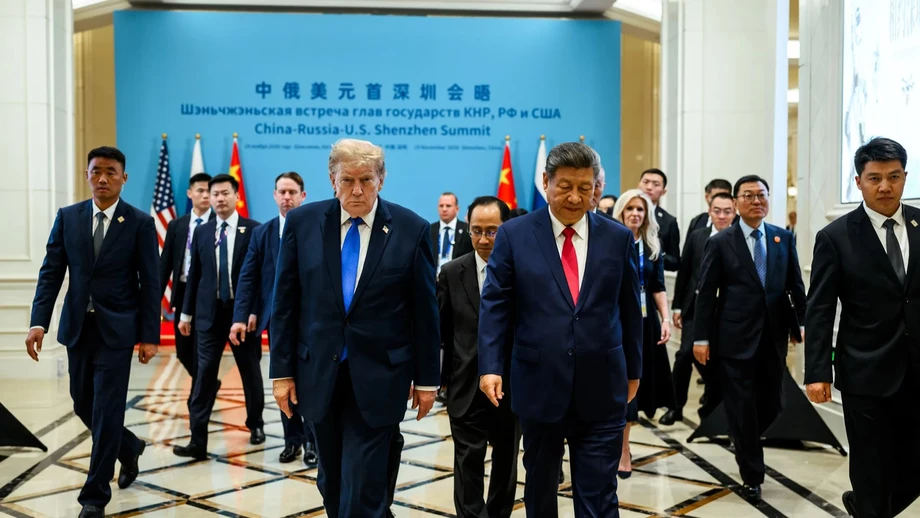
- 19 November: the leaders of the United States, China and Russia hold their first trilateral summit in Shenzhen, on the sidelines of the APEC summit.
- 25 November: Kim visits the nuclear weapons institute and announces record production of nuclear weapons.
- 28 November: barriers appear along the Dandong railway in the evening.
- 29 November: the barriers are removed, and South Korea's president says a summit cannot be reliably predicted.
- 4 December: the last date covered by the Dandong hotel's booking block.
- Mid-December: Xi and US President Donald Trump are due to meet for the fourth time this year at the G20 summit in Miami.
Why a Second Meeting This Year Would Count
Xi travelled to Pyongyang in June, when the two leaders agreed to expand cooperation and strengthen strategic communication. A December visit would be their second encounter of 2026 and would put Kim in China for a summit for the first time this year.
Kim's October trip to Dandong was his most recent visit to China. He spent a single day there, held talks with Wang Huning and did not meet Xi. The trip also quieted speculation about his health that had circulated before it.
Park Won-gon, a professor of North Korean studies at Ewha Womans University in Seoul, said the value of such a summit lies in the message it sends to audiences at home and abroad.
(North Korea-China relations) being fully normalized is meaningful in terms of political messaging to promote internally and externally. Through a North Korea-China summit, they can secure their backing and solidify their conditions.
Pyongyang has lately stressed regional economic development and industrial modernisation, and some analyses suggest the visit could be a chance to draw on Chinese experience in both.
Pyongyang Sends a Nuclear Reminder First
Kim's nuclear messaging has run in parallel with the travel plans. On 25 November he visited the Institute of Nuclear Weapons, reviewed its work for 2026, announced that the country had reached record volumes of nuclear weapons production and stressed the need to be able to use tactical nuclear weapons. He has also unveiled three types of nuclear warhead in recent weeks.
His language toward foreign governments has been softer. At a ceremony where ambassadors of 10 states presented credentials, Kim said Pyongyang does not seek hegemony or expansion and wants friendly ties with countries that respect its sovereignty, describing peace, development and prosperity as the core values of its foreign policy.
The Calendar Tightens for Seoul
The diplomatic sequence has left South Korea with little room to shape events. At the Shenzhen meeting on 19 November, Trump offered no public position on denuclearising the Korean Peninsula and called only for cooperation on nuclear non-proliferation, part of China's APEC host year.
Xi is scheduled to meet Trump for the fourth time this year at the G20 summit in Miami in mid-December. A Kim-Xi summit before then would let Pyongyang gauge the direction of US-China talks in advance and pass its demands through Beijing.
President Lee Jae-myung has played down Seoul's ability to steer the outcome. Speaking to reporters during a hike in Seoul on 29 November, he said there were too many variables for a reliable forecast.
There are so many variables, and it is not a situation that can be reliably predicted.
He also said South Korea could prepare for either outcome.
We can calmly prepare for both the case where he goes and the case where he does not. There is no need to agonize over it.
On Seoul's leverage he was plainer still: "It would be different if we could exert influence, but there is not much room for us to get involved."
Lee has replaced the director of the National Intelligence Service and the unification minister, both criticised over friction with Washington, and some of his nominees for the posts have drawn concern about thin experience in the field.
Taiwan's Ruling Party Gains Ground, Taipei Holds
Taiwan's governing Democratic Progressive Party took at least nine mayoral and magistrate seats in the 28 November local elections, up from five before the vote, but it failed to take the capital. The Kuomintang, which favours closer engagement with the mainland, won 11 of the 22 city and county leadership races, down from 15, and an independent candidate held one seat.
A major gain for the DPP led by President Lai Ching-te was Taichung, where it defeated the Kuomintang, leaving the two parties evenly split across Taiwan's six special municipalities, Taipei among them.
In Taipei, Mayor Chiang Wan-an, great-grandson of the former Nationalist leader Chiang Kai-shek, defeated Puma Shen, a scholar turned lawmaker whose research focused on disinformation and alleged Chinese influence operations. Shen's campaign energised the party's grassroots and was widely seen as helping other DPP candidates across the island.
Lai offered "heartfelt apologies" to supporters that night and said Shen had earned the "public's respect and recognition through his campaign," urging members to stay united and promising another chance to win.
The Yunlin race remained unresolved. The Central Election Commission said the DPP candidate won the most votes, while the Kuomintang rival was set to request a recount.
Two Capitals Read the Same Ballot
Zhang Han, a spokeswoman for the mainland's Taiwan Affairs Office, which oversees Beijing's policy toward the island, said changes in its political landscape would not alter the overall direction of cross-strait relations or halt what she called the "historical trend" of reunification.
We will resolutely combat separatist forces advocating Taiwan independence, oppose interference by external forces, and firmly promote the peaceful development of cross-strait relations.
Taiwan's Mainland Affairs Council, which handles the island's cross-strait policy, urged Beijing to "pragmatically accept" the results by respecting its democratic system and the choices of its people, adding that its position of maintaining the status quo of peace and stability across the Taiwan Strait is unchanged.
The vote was widely read as a midterm test of Lai, who took office in 2024 and is likely to seek a second term of four years in 2028. Beijing claims Taiwan as its territory and has denounced Lai as a separatist. The two sides have been governed separately since 1949, when the Nationalist government retreated to the island after losing the civil war.
A Rare Meeting at the Great Hall of the People
In Beijing, Premier Li Qiang received Masato Kanda, president of the Asian Development Bank, at the Great Hall of the People on the afternoon of 26 November. Li said growing instability and uncertainty in the international environment had affected Asian economies and that the ADB had long been an important driver of regional economic integration. China would keep supporting the bank's work and steadily strengthen cooperation, he said.
Li described an economy that had withstood pressure this year and said China would pursue high quality development, unlock demand in its domestic market and tie technological and industrial innovation more closely together. He named the bank's next country partnership strategy, along with regional integration, connectivity and emerging industries, as areas for joint work.
The encounter drew notice because Kanda is Japanese and it was rare for Li to meet a Japanese national at that level after Takaichi's remarks in November 2025. Li had also received Kanda in Beijing in March last year.
A forum the same day marked 40 years of cooperation between China and the ADB. Finance Minister Lan Fo'an said the bank had witnessed and taken part in four decades of Chinese reform and development, contributing to poverty reduction, opening up and the country's integration into the global economy. He noted that the ADB is drawing up its next country partnership strategy for China and said the anniversary should be used to widen financial and knowledge cooperation and deepen regional work.
Mousse Meals for a Fast Aging Market
The diplomatic chill has not stopped Japanese companies from selling into China. About 140 Chinese visitors sampled easy to chew meals made by Umios Corp., a major Japanese seafood company, at an event the Japanese embassy in Beijing organised on 2 November.
Three dishes carried fish, chicken and pork flavours. The ingredients were processed into chunks with a mousse texture that keeps the colour and shape of the original food, a soft paste that needs little chewing, and the three together supply 50 grams of protein.
Yoshihiro Kono, a sales official at the company, told the gathering that many older people lose their ability to chew and swallow gradually, which makes it necessary to develop food that lowers the risk of choking while still delivering enough nutrition.
Umios says Japan's market for food aimed at older people has developed over two decades and that it wants to "share the expertise gained" there so Chinese seniors can "eat safely and enjoyably."
The company entered China four years ago and ships frozen dishes made at a factory in Shandong province to nursing homes and hospitals, mainly in the northeast. One woman who tried the food called the texture "great" and asked whether the dishes were sold online to individual buyers.
Kono said the size of China's aging population makes the market promising, while profitability and local tastes remain obstacles in a food culture that prefers freshly cooked dishes to frozen ones.
Key Points
- Japan's 2026 Diplomatic Bluebook, presented by Foreign Minister Toshimitsu Motegi and released on 10 April, downgrades China from "the most important bilateral relationship" to "important neighboring country."
- The report cites Chinese radar illumination of Self-Defense Force aircraft and export controls on dual-use goods, while saying Japan remains open to dialogue.
- Barriers appeared along the Dandong railway on 28 November and were removed the next day, and a hotel overlooking the border bridge blocked bookings through 4 December.
- Diplomatic sources say Kim Jong Un may tour several Chinese cities and meet Xi Jinping in early December, after their June meeting in Pyongyang.
- Kim announced record nuclear weapons production on 25 November and has unveiled three types of nuclear warhead.
- President Lee Jae-myung said a summit cannot be reliably predicted and that Seoul has little room to get involved.
- The DPP took at least nine of Taiwan's 22 local leadership posts, up from five, but lost Taipei, while the Kuomintang fell from 15 seats to 11.
- Li Qiang met ADB president Masato Kanda on 26 November, a rare engagement with a Japanese national, as the two sides marked 40 years of cooperation.