A Rp 400 billion office that will not be built
Anggito Abimanyu, chairman of the board of commissioners of Indonesia's deposit insurance agency, came to a working meeting with the House of Representatives' Commission XI in Senayan, Jakarta, on Monday, 23 November 2026, with a budget announcement that reached well beyond his own institution. The agency, known as LPS, had set aside Rp 400 billion for an office building in Nusantara, the capital under construction in East Kalimantan. The money will not be spent there.
Contents
- A Rp 400 billion office that will not be built
- What leaving the work plan does and does not mean
- The groundbreaking that came before the reversal
- The budget line shrinks but does not disappear
- Where the concrete actually stands
- A city planned for 1.9 million that houses 1,800 in its core
- The fiscal arithmetic behind the doubt
- Questions still without answers
- Key Points
Last year we allocated funds for a building in IKN, Rp 400 billion. But after the new administration, IKN is no longer part of the Government Work Plan. So we have just revoked it now and moved it to something else.
His reason was the Rencana Kerja Pemerintah, the annual government work plan that sets out what each ministry and agency will prioritise in the coming budget year under President Prabowo Subianto. IKN, he said, is no longer listed in it.
A replacement office is now planned for Jakarta. Anggito told the commission that LPS has written to the Ministry of Finance asking for land in the Sudirman Central Business District, known as SCBD, and that the request has gone nowhere, with the parcel likely to be allocated to another institution. A study puts the cost of land and a building there at Rp 1.465 trillion.
The options are not firm yet, whether we will buy a building or buy land. But this will most likely run over several years.
The new figure is almost four times the Nusantara one, and the difference has a plain explanation. In the new capital the state was offering land it already owns. In Jakarta's financial district, the land has to be bought.
What leaving the work plan does and does not mean
The RKP is a planning document, not a law. It ranks what the government intends to push in one budget year, so dropping out of it changes the standing of a project, not the regulations that created it. Two presidential regulations from 2025 remain in force. Presidential Regulation No. 12 of 2025 carries the 2025 to 2029 National Medium Term Development Plan, which commits the government to continue and accelerate IKN. Presidential Regulation No. 79 of 2025, signed on 30 June 2025, sets the target of IKN working as the country's political capital by 2028, supported by the transfer of civil servants and the preparation of adequate offices.
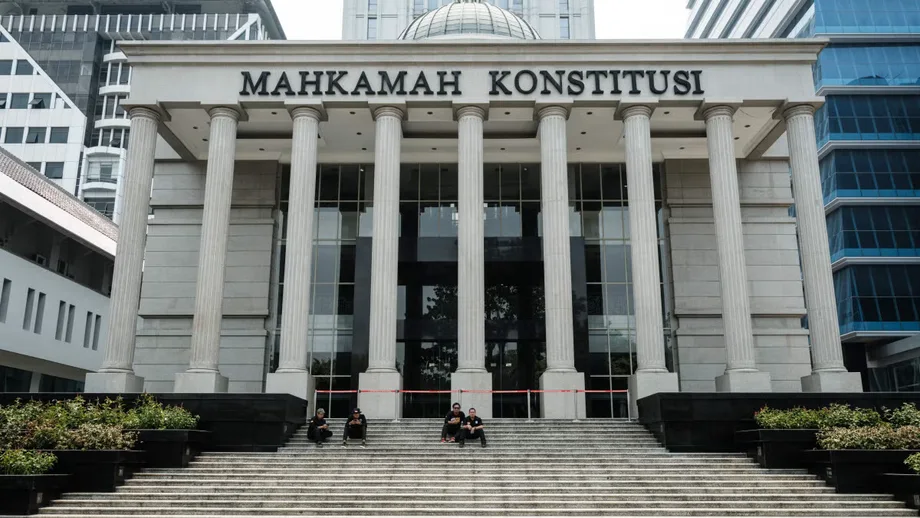
Legal status is a separate matter and remains open. The Constitutional Court has held that Jakarta stays the official capital until a presidential decree says otherwise. No such decree has been issued, and no date has been given for one.
Basuki Hadimuljono, head of the IKN Authority, has described the project as beyond reversal. Speaking in Jakarta on 30 October 2025, as the Prabowo administration marked its first year, he tied every step to a single deadline.
There is no doubt in the process of building IKN. Every step taken is fully aligned with achieving the President's directive to make the new capital the country's Political Capital by 2028.
He put the work in larger terms than buildings.
What we are creating is not merely a new city, but the future of Indonesia. And that future is being built together.
The groundbreaking that came before the reversal
LPS was an early believer. Jokowi, president until October 2024, broke ground on the agency's first Nusantara tower in January 2024. The building, Gedung Arthadhyaksa, was the first of three LPS buildings planned for the new capital. The agency's chairman at the time, Purbaya Yudhi Sadewa, put total investment for the three at Rp 841 billion, with Rp 230 billion for the first phase.
Anggito told the commission that the Rp 400 billion came from that earlier plan, carried over from the previous administration. Its withdrawal is the first public case of an institution taking money out of Nusantara and naming the work plan as the reason.
The budget line shrinks but does not disappear
State money for the capital has fallen quickly. The allocation was Rp 43 trillion in 2024, Rp 13 trillion in 2025 and Rp 6.3 trillion in 2026.
Money is still moving. The authority's Budget Implementation List, the document that formally allows an agency to spend, was issued on 2 January 2026 for about Rp 6 trillion, alongside the appointment of treasury officials, including budget users and commitment makers. The definitive ceiling for the IKN Authority this year is Rp 6.262 trillion, split into Rp 5.618 trillion for strategic area development and Rp 644 billion for management support.
Commission II of the House approved a 2027 ceiling of Rp 6.72 trillion for the authority on 16 September 2026, and a request for an additional Rp 15.80 trillion is still to be negotiated. Over the longer horizon, Prabowo has approved Rp 48.8 trillion of state funding for 2025 to 2029. The authority says it has secured Rp 225.02 trillion in investment commitments, made up of Rp 66.3 trillion from private investors and Rp 158.72 trillion through public private partnership schemes, known in Indonesia as KPBU, for projects including multi utility roads, tunnels and housing.
Budget efficiency ordered by presidential instruction in 2025, Inpres No. 1 of 2025, has been presented as no obstacle to IKN infrastructure. The same instruction gives agencies a reason to rethink smaller commitments, and a Rp 400 billion office in a city no longer named in the work plan is an easy one to drop.
Where the concrete actually stands
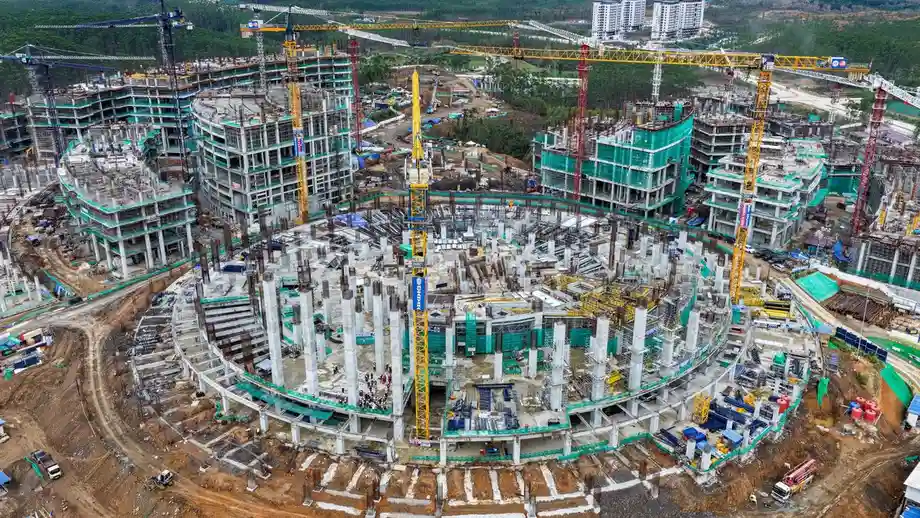
Physical progress is countable. As of 15 November 2026, the authority reported that the legislative building and its supporting infrastructure had reached an average of 25.40 percent, and the judicial area 32.83 percent. Retention ponds, roads and utilities are under construction. A July 2026 authority report listed 40 work packages under its management, with 15 being built and 16 preparing for tender. The Ministry of Public Works is running 90 packages of its own, 12 of them still under construction.
Basuki has said the legislative and judicial complexes are designed to be finished physically by the end of 2027, on plans approved directly by Prabowo.
Roads, drinking water, electricity of 50 MW from solar, potable water, we have prepared. Now in the second stage we are preparing the legislative and judicial offices, whose designs were approved directly by President Prabowo. Hopefully we can finish at the end of 2027.
Institutions are already inspecting the premises. Abdul Chair Ramadhan, chairman of the Judicial Commission, toured the judicial zone and his agency's building with his staff on 22 November 2026.
Our presence here is to strengthen ties and to see for ourselves the progress of development in IKN, especially the judicial area, which they say has reached an average progress of 30 percent. We are also ready to settle here, live here and grow the Judicial Commission here.
Elok Delima Angraini, a civil servant at the commission, went further than her chairman's readiness.
After going around and looking, the facilities are really impressive. Everything seems well accommodated. For me, I am very interested in moving to IKN, because I see it as a new challenge and a new life in a new environment.
A city planned for 1.9 million that houses 1,800 in its core
Nusantara was designed for about 1.9 million residents by 2045, at an estimated cost of US$45 billion, as a counterweight to Java's dominance. About 147,000 people now live across the wider IKN area. In the central government core, roughly 1,800 civil servants and defence and security personnel occupy the apartment blocks built for them, a gap that has drawn attention from media in neighbouring Malaysia and questions about whether the city could end up as a ghost town.
Political mentions have thinned. IKN appeared once in Prabowo's 2025 state address and not at all in the 2026 address. The authority's answer is the 2028 deadline written into Presidential Regulation No. 79 of 2025, which ties the city's future to the arrival of the officials who will staff the ministries.
The fiscal arithmetic behind the doubt
Ministry of Finance figures to 31 August 2026 put state revenue at Rp 2,055.6 trillion against spending of Rp 2,295.7 trillion, a deficit equal to 0.93 percent of gross domestic product. Against that gap, the government is financing Makan Bergizi Gratis, the free nutritious meals programme for schoolchildren, and Koperasi Desa/Kelurahan Merah Putih, a network of village and ward cooperatives, both of which need money in the same years as the capital.
An economic concept sits under the argument, and a Universitas Muhammadiyah Yogyakarta journal paper on the project applies it directly. Opportunity cost is the value of the next best use of money. Every rupiah committed to Nusantara is a rupiah that cannot repair a school, staff a clinic, raise farm yields or open a factory. The paper's argument is that the question about IKN is not how much has already been spent, but what the country gives up by continuing.
Riko Noviantoro, a researcher and public policy analyst at the Institute for Development of Policy and Local Partnership, argued on 25 November 2026 that the trouble begins with the project's origins.
We need to start from the origins of the IKN policy, which in fact carries serious problems, from the basis of its considerations to the scheme of its development.
He said IKN had become a public enemy for parts of the public, academia, policy observers and even state officials, and linked that to public trust and political stability. On funding, he was blunt.
The risk to IKN's continuity is now at stake. In other words, the possibility that IKN stops is very real.
It cannot be denied that IKN is heading toward being abandoned.
He traced the damage through a chain of consequences.
Policy uncertainty that triggers budget inefficiency, investor uncertainty and discontinuity of development.
A counterargument comes from East Kalimantan. Isradi Zainal, rector of Universitas Balikpapan and director of the Institute of Survey, Research, Innovation and Education, wrote that equating a change in political ranking with a halted project is an error of analysis, and set out the objective tests: an authorised budget, a ceiling already approved for 2027 and work packages still being built. On that reading, Nusantara is not stalled, only less favoured.
Questions still without answers
Several decisions are pending. No date has been set for the presidential decree that would settle Jakarta's status, and the authority's request for an extra Rp 15.80 trillion for 2027 still has to be discussed with the House. LPS has not chosen between buying an existing building and buying land in SCBD. The House is due to elect and inaugurate a new vice president on 9 December 2026, following Gibran Rakabuming Raka's resignation, and that vote will decide who in the leadership keeps watch on the capital file.
Key Points
- LPS chairman Anggito Abimanyu told House Commission XI on 23 November 2026 that IKN is no longer in the government work plan, and cancelled Rp 400 billion set aside for an office in Nusantara.
- LPS now proposes Rp 1.465 trillion for land and a building in Jakarta's SCBD area, a plan likely to run over several years.
- Jokowi broke ground on the agency's first IKN tower, Gedung Arthadhyaksa, in January 2024, under a Rp 841 billion plan for three buildings, with Rp 230 billion for the first phase.
- IKN funding fell from Rp 43 trillion in 2024 to Rp 13 trillion in 2025 and Rp 6.3 trillion in 2026.
- The IKN Authority has a 2026 ceiling of Rp 6.262 trillion and a 2027 ceiling of Rp 6.72 trillion, with a further Rp 15.80 trillion under discussion.
- Legislative construction stood at 25.40 percent and the judicial area at 32.83 percent on 15 November 2026, with physical completion targeted for late 2027.
- Presidential Regulation No. 79 of 2025 keeps the 2028 target for IKN as the political capital, while the Constitutional Court leaves Jakarta as the official capital until a presidential decree.
- About 147,000 people live across the IKN area, with roughly 1,800 in the central core, against a 2045 target of 1.9 million residents.
- State revenue reached Rp 2,055.6 trillion by 31 August 2026 against spending of Rp 2,295.7 trillion, a deficit of 0.93 percent of GDP.