Registration begins with a focus on national priorities
Indonesia opened registration for its 2026 civil service recruitment on Friday, 27 November 2026. Applications will remain open until 21 December through SSCASN, the National Civil Service Candidate Selection System, at sscasn.bkn.go.id. The process covers 154,052 prospective civil servant positions, known as CPNS, across 24 central government institutions.
Contents
- Registration begins with a focus on national priorities
- How the 154,052 vacancies are divided
- Why forestry dominates this recruitment
- Which institutions are hiring, and why are regional governments absent?
- What documents are simpler this time?
- Who can apply, and how will candidates be tested?
- How to complete SSCASN registration
- What is the full schedule through June 2027?
- How will BKN handle millions of candidates?
- How did the plan develop, and what scams should applicants avoid?
- What to Know
The National Civil Service Agency (BKN) also gives a larger figure of 167,113. That is the government's total requirement for State Civil Apparatus employees, or ASN, while 154,052 is the number of CPNS vacancies in this recruitment. ASN is the broad category for state employees; CPNS refers to candidates seeking appointment as civil servants.
In BKN's recruitment announcement, the agency said 118,208 vacancies would support the Program Hasil Terbaik Cepat (PHTC) and other presidential priorities. PHTC is a group of programmes intended to deliver rapid results. The remaining 35,844 CPNS vacancies cover other national priority sectors.
Every CPNS vacancy in this round is in a central ministry or agency. People hoping to work for a provincial, regency or city administration will not find a regional government vacancy here. The government has also reduced several document requirements, while promising wider access to examination centres and greater transparency during testing.
How the 154,052 vacancies are divided
Rini Widyantini, the Minister of Administrative and Bureaucratic Reform, said the National Selection Committee, or Panselnas, settled the CPNS quota at its meeting on 25 November 2026.
Panselnas has agreed to 154,052 CPNS formations for national priority programmes in 2026.
The first group contains 118,208 vacancies for PHTC and presidential priorities. Its detailed allocation is:
- Forestry: 70,000 positions.
- Lecturers and technical staff for higher education: 26,614.
- Health workers: 13,362.
- Teachers and education personnel: 3,621.
- Government internal auditors: 2,007.
- Nutrition service personnel: 1,618.
- Cooperative supervision personnel: 986.
The second group contains 35,844 vacancies. Law, human rights, the judiciary and corrections receive 19,016; statistics and development data receive 7,285; food self sufficiency and the blue economy receive 4,496; revenue and financial supervision receive 2,867; development of the next generation receives 1,395; and security, cyber affairs and diplomacy receive 785.
Forestry is therefore the dominant employer. Its 70,000 positions represent about 45 percent of all 154,052 CPNS vacancies. The next largest single allocation in the first group, higher education, is less than half that size at 26,614. Detailed job titles, educational qualifications and placements must be checked through SSCASN because the schedule letter does not enumerate every vacancy within each institution.
Why forestry dominates this recruitment
Forestry Minister Raja Juli Antoni confirmed on 27 November that his ministry would fill all 70,000 forestry positions. He said field protection and fire control were at the centre of the plan.
The priority for these 70,000 CPNS positions is for Polhut and Manggala Agni.
Polhut are Forest Police, while Manggala Agni is the ministry's force for preventing and controlling forest and land fires. The full allocation comprises:
- Forest Police: 60,000 positions.
- Manggala Agni personnel: 5,465.
- Forest Ecosystem Controllers: 1,136.
- Forestry Extension Workers, who provide guidance and community assistance: 1,147.
- Wildlife Trainers and Caretakers: 1,000.
- Other forestry support positions: 1,252, including veterinary staff, health personnel and administrative employees.
Forest Police and Manggala Agni together account for 65,465 of the 70,000 positions, or about 93.5 percent. The remainder shows that the ministry also needs specialists to manage ecosystems, assist communities and care for wildlife.
Raja linked the recruitment to President Prabowo Subianto's instruction that the state must genuinely protect forests. He also encouraged young people concerned about Indonesia's biodiversity to join the forestry service.
Ristianto Pribadi, the ministry's Head of Public Relations and International Cooperation, said the recruitment would strengthen personnel involved in fire control as well as ecosystem management and wildlife protection. Forestry vacancies are open to Indonesian citizens aged 18 to 35, with education ranging from a forestry vocational school or equivalent secondary education to Diploma III and bachelor's degrees, depending on the position. Relevant disciplines outside forestry are also accepted where the job requires them. Ministry updates are available at casn.kehutanan.go.id.
Which institutions are hiring, and why are regional governments absent?
Ministerial Decree Number 613 of 2026 on ASN requirements provides the basis for the allocations. BKN's official letter Number 7758/B-KS.04.01/SD/K/2026, dated 24 November, was sent to the personnel supervisors of the 24 participating institutions.
The list includes the ministries responsible for higher education, primary and secondary education, health, religious affairs, forestry, cooperatives, youth and sports, marine affairs and fisheries, law, immigration and corrections, human rights, population and family development, foreign affairs, finance and agriculture. It also includes the Financial and Development Supervisory Agency, National Nutrition Agency, Supreme Court, Attorney General's Office, Statistics Indonesia, Audit Board of Indonesia, State Intelligence Agency, National Cyber and Crypto Agency and Indonesian National Police.
Rini addressed the absence of provincial, regency and city vacancies during the announcement.
There are no regional formations yet. This recruitment is intended for the President's Program Hasil Terbaik Cepat.
Rini also noted that employee spending in some regional administrations still exceeded limits under the Law on Financial Relations between the Central and Regional Governments, commonly called HKPD. The stated reason at the announcement was the concentration of this round on central institutions delivering presidential priorities. No date was given for a future CPNS round for regional governments.
What documents are simpler this time?
BKN Head Zudan Arif Fakrulloh said the changes rest on three principles: simpler documents, easier access to registration, and selection that is fair, transparent and objective. The aim is to stop applicants from uploading material that repeats information already contained elsewhere.
- The application letter and personal declaration are combined into one document.
- Applicants upload an academic transcript without also having to upload a diploma for the academic requirement. The transcript already identifies the study programme and academic results.
- A formal portrait photograph, or pasfoto, is no longer a required application upload.
- A meterai may be physical or electronic. A meterai is Indonesia's stamp duty, paid with an adhesive stamp or through an electronic system.
- Signatures may be handwritten with a pen, applied as an ordinary scanned signature or supplied digitally, subject to the applicable rules.
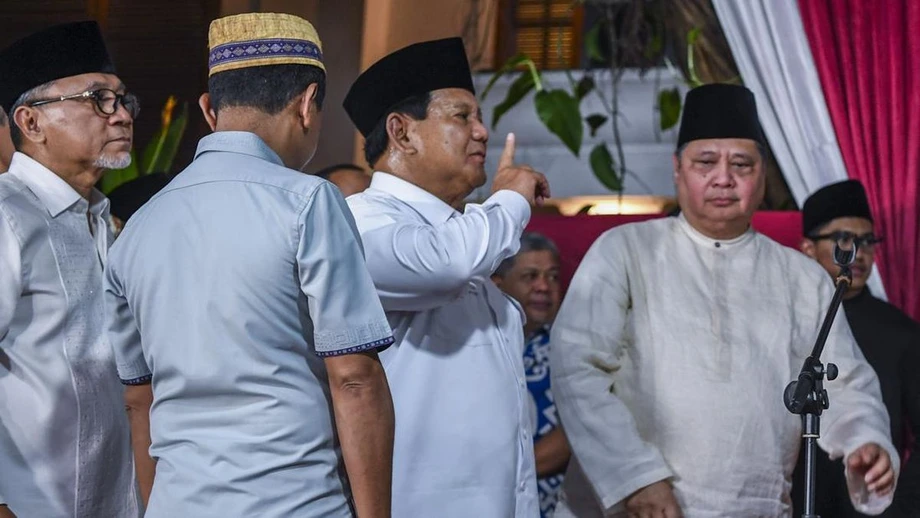
Zudan explained the merger of the two letters at the 25 November press conference.
The declaration is now combined with the application letter, so only one document is uploaded.
Removing the pasfoto upload does not remove identity checks. Creating an SSCASN account still requires an image of the applicant's identity card and a live selfie for facial verification. Vacancy notices may also request documents needed for particular work, such as professional registration for health personnel, a skills certificate, an English test certificate or study programme accreditation. Applicants should follow the current notice for their chosen position rather than an older checklist.
Who can apply, and how will candidates be tested?
Article 23(1) of PANRB Ministerial Regulation Number 6 of 2024 on ASN Procurement supplies the general eligibility rules. An applicant must:
- Be an Indonesian citizen aged at least 18 and no more than 35 when applying.
- Have no final court conviction punishable by imprisonment for two years or more.
- Meet the rules barring specified previous dismissals from the civil service, government work agreements, the military, the police or private employment.
- Not currently serve as a prospective or full civil servant, a member of the military or a police officer.
- Not be a member or official of a political party or take part in practical politics.
- Hold the education, competence and any current professional certification required by the position, and meet its physical and mental health requirements.
- Be willing to serve anywhere in Indonesia or in another country when the employing institution requires it.
Institutions can add conditions tied to the job. The first selection stage checks registration data and documents. Candidates who pass then take the Basic Competence Selection, or SKD, which measures abilities expected of a prospective state employee. The Field Competence Selection, or SKB, examines knowledge and skills connected to the chosen job and can involve practical work, interviews or other assessments.
Many examinations use BKN's Computer Assisted Test (CAT), which delivers questions and processes scores through a computer system. Some SKB assessments do not use CAT. SKD and SKB scores are subsequently integrated before the final result is announced.
How to complete SSCASN registration
Zudan said there would be a single registration channel, with a BKN help desk available for technical difficulties.
For registration, everything is online through SSCASN. There is only one portal, and no other portal.
The account and application process works as follows:
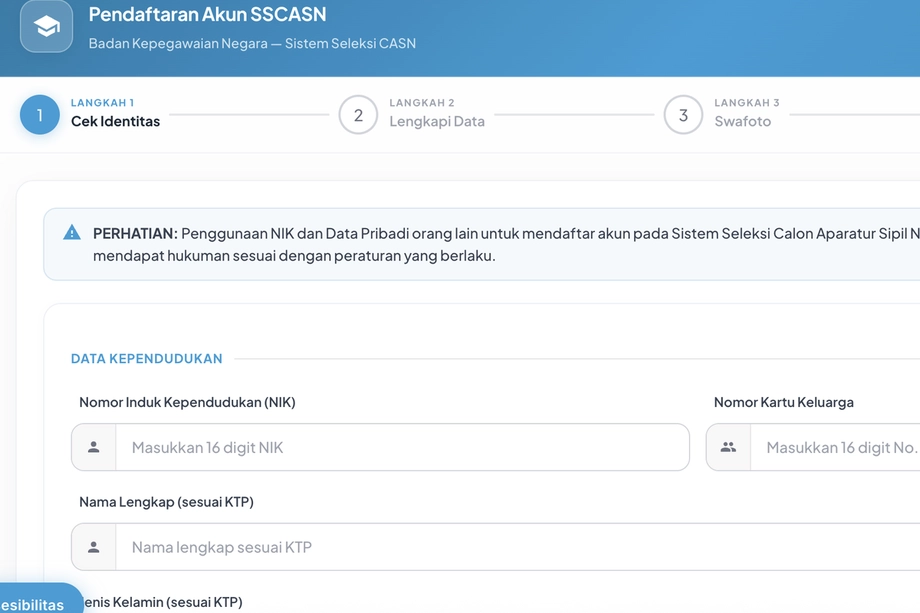
- Prepare the national identity number (NIK), family card number (KK), full name and birth details as shown on the identity card, an active telephone number, an active email address and education information.
- Create an account at sscasn.bkn.go.id or daftar-sscasn.bkn.go.id/akun. Complete the identity validation and security check, enter the regency or city that issued the identity card, upload its image in a file no larger than 200 KB and complete the live selfie verification.
- Create a password and security questions. Review the identity summary carefully before processing the account, because confirmed identity data cannot simply be edited afterwards. Download the account information card.
- Log in, complete personal, address, disability and education information, select CPNS and choose a formation. A formation is an authorised vacancy with stated qualifications and placement. Each applicant may choose only one formation at one institution.
- Upload the required documents in the format and size specified by that institution. Inspect the scans and the application summary, then finish the registration. Final submission is permanent, so the registration card should be downloaded only after every entry has been checked.
BKN has urged people not to wait until the final day. Early registration gives applicants more time to resolve congestion, incorrect data or a document that does not meet the vacancy's specifications.
What is the full schedule through June 2027?
BKN's 24 November letter provides the detailed calendar and describes it as a guide and shared commitment for the institutions conducting selection. Its public announcement had given broader periods, including competence tests from January to March 2027. The dated letter supplies more precise dates, with SKB continuing into April.
- Selection announcements run from 25 November to 9 December 2026. Registration runs from 27 November to 21 December, and administrative screening continues until 4 January 2027.
- Administrative results are announced from 5 to 8 January. Candidates may lodge objections from 9 to 11 January, institutions answer from 9 to 13 January, and revised results follow from 14 to 16 January.
- SKD locations are mapped from 17 to 22 January, followed by scheduling from 23 to 26 January. Participants, times and places are announced from 27 January to 1 February.
- SKD takes place from 2 to 21 February. Score processing runs from 17 to 28 February, with results announced from 1 to 7 March.
- For SKB using CAT, locations are mapped on 16 and 17 March, participants choose locations from 18 to 20 March, scheduling follows from 21 to 23 March, and examination details are published from 24 to 29 March.
- SKB using CAT runs from 30 March to 6 April. Assessments that do not use CAT run from 3 to 12 April. SKD and SKB scores are integrated from 13 to 17 April.
- Final CPNS results are announced from 15 to 20 April. Objections run from 21 to 23 April, responses from 21 to 24 April, and processing of those objections from 25 to 28 April.
- The announcement after objections runs from 29 April to 2 May. Successful candidates complete their DRH, a personal history form used for appointment administration, from 3 to 17 May.
- Proposals to establish each NIP, or civil servant identification number, run from 8 to 22 May. Ministry information schedules the establishment of CPNS identification numbers for 1 June 2027.
These dates show that passing the final announcement does not complete the appointment process immediately. Successful candidates still have administrative forms and appointment steps extending into May and June.
How will BKN handle millions of candidates?
BKN has projected that participation could reach about three million people. At the 25 November announcement, Zudan said 435,000 people had already opened SSCASN accounts before formal applications began.
The agency has prepared 3,995 examination devices. With four examination sessions a day, it estimates that these can serve 15,980 participants daily. Testing will use 36 BKN locations and 107 independently managed locations across 35 provinces, giving a combined 143 sites. The additional locations are intended to reduce travel for candidates who live far from a BKN office.
CAT will include facial recognition, and scores can be displayed immediately after an examination. BKN says these measures, together with technology audits, system security and data protection, are intended to keep scoring objective and allow participants to see their results. Panselnas has also prepared infrastructure, networks and complaint channels for the selection period.
How did the plan develop, and what scams should applicants avoid?
The recruitment took shape over most of 2026. A PANRB circular numbered B/1553/M.SM.01.00/2026, issued on 12 March, asked personnel officials in central and regional institutions to submit their ASN requirements for the 2026 budget year. Those submissions were used to map the number and types of positions needed.
In April, Rini spoke of around 160,000 formations being prepared to replace retiring employees, while stressing that recruitment planning was still underway. By mid June, no official timetable had been announced. BKN was already warning that posters claiming registration had opened, accompanied by supposed registration links, did not come from the government.
Such notices often used urgent language, addresses outside government domains or requests for personal information before official verification. Those are warning signs of phishing, in which a fake page or message tricks someone into surrendering personal data. The final recruitment details should therefore be checked against SSCASN, BKN and PANRB announcements.
Rini said every stage would be competitive, fair, objective and free of charge. She directly rejected claims that payments or connections could secure a position.
There is no room for corruption, collusion and nepotism, including favours and connections. No party can guarantee that a candidate will pass.
Applicants with technical problems can use the BKN help desk. Suspicious information or offers of guaranteed passage can be reported through the government's SP4N-LAPOR! complaint channel instead of being forwarded to other prospective candidates.
What to Know
- CPNS registration runs from 27 November to 21 December 2026 through the single SSCASN portal.
- The round offers 154,052 CPNS vacancies within a total ASN staffing requirement of 167,113.
- All vacancies are at 24 central institutions; no date has been announced for regional government recruitment.
- Forestry receives 70,000 positions, about 45 percent of the CPNS total, including 60,000 Forest Police and 5,465 Manggala Agni personnel.
- Application paperwork is reduced: one combined application and declaration, a transcript for the academic requirement, and no formal portrait upload.
- SKD runs from 2 to 21 February 2027, SKB continues into April, and final results are scheduled for 15 to 20 April.
- Selection is free. BKN expects as many as three million participants and has prepared 143 examination locations.