A Higher Grade, and a Longer Runway
On Friday, November 27, 2026, S&P Global Ratings raised Sri Lanka's long-term foreign and local currency sovereign credit ratings to B- from CCC+, with a stable outlook. The agency also lifted the country's short-term foreign and local currency ratings to B from C. A separate transfer and convertibility assessment, which measures how easily investors can move money in and out of the country, stayed at B-, the level set in July. The move was S&P's first upgrade in more than a year. The decision was announced in a statement that pointed to stronger fiscal and external buffers.
Contents
- A Higher Grade, and a Longer Runway
- Why S&P Says the Recovery Is More Entrenched
- The Debt Numbers Behind the Grade
- The Government's Case: Preparation Before the Shock
- What Still Worries S&P: Oil, Remittances and El Nino
- A Budget Gap That Is Set to Grow
- What the Upgrade Changes for Sri Lankans
- How Sri Lanka Reached This Point
- What Would Push the Rating Higher or Lower
- Key Points
The step from CCC+ to B- is small on paper and large in practice. A sovereign rating is a grade for a government's ability to repay its debt, and it helps set the interest rate the country pays on foreign loans. CCC+ describes a borrower highly vulnerable to default, while B- still sits in speculative territory, six notches below investment grade. S&P said the risk of a default over the next two years had fallen.
We believe Sri Lanka's willingness and capacity to repay debt obligations is less vulnerable to unfavorable external financing conditions, and that a default scenario over the next two years is unlikely.
Sri Lanka defaulted on $46 billion of external debt in 2022 and later secured a $2.9 billion International Monetary Fund bailout. S&P removed the country from selective default status in September 2025 and assigned a CCC+ rating. A selective default rating applies when a borrower misses payments on some obligations but not all. Fitch Ratings raised Sri Lanka to B- with a stable outlook in September 2026, making S&P's move the second major upgrade by a top agency in two months.
Why S&P Says the Recovery Is More Entrenched
S&P pointed to a 20 percent rise in government revenue in the first nine months of 2026, putting full-year revenue above 17 percent of GDP, roughly double the level in 2022. Foreign reserves recovered to $7.09 billion in October from $6.5 billion in June. Manufacturing industrial production expanded for nine months through September. The agency expects growth of 4 percent in 2026 and 4.5 percent in 2027, after what the government says was 4.7 percent in the first half of this year.
S&P put first-quarter growth at 5.1 percent and second-quarter growth at 4.2 percent, while the finance ministry cited 5.2 percent for the first quarter and 4.7 percent for the half year. S&P also said the government's parliamentary majority supports policy continuity, and that fuel rationing and a shorter work week helped preserve supply after the Middle East war broke out.
We expect Sri Lanka's economic growth to slow to 4% in 2026 and rebound to 4.5% in 2027. We forecast Sri Lanka's 10-year weighted average per capita real GDP growth at 3.2%. This is in line with peers with similar income levels and indicates that Sri Lanka has largely shaken off the effects of its 2022 economic crisis.
S&P expects GDP per capita to reach $5,200 in 2026 despite a weaker rupee. Remittances from Sri Lankans working abroad reached $7.6 billion by October and are expected to top $9 billion by the end of 2026, according to the finance ministry. Tourism earnings fell 9.2 percent in the first nine months, a reminder that the recovery is uneven.
The Debt Numbers Behind the Grade
The government's debt ratio has fallen from about 114 percent of GDP in 2022 to 95 percent at the end of 2025. Public Debt Management Office Director General Udeni Udugahapattuwa said the government aims to cut it to 89 percent by the end of 2026 and 78 percent by 2031. Net general government debt, including guarantees for state-owned enterprises, is forecast at about 92 percent of GDP in 2026.
Interest payments now take about 40 percent of government revenue, down from 80 percent previously. The medium-term goal is to bring that share to about 30 percent by 2031. S&P said the burden is still heavy, and a lower interest bill is one of the conditions it set for another upgrade.
In these credit ratings, special attention is given to the optimality of the country's debt management.
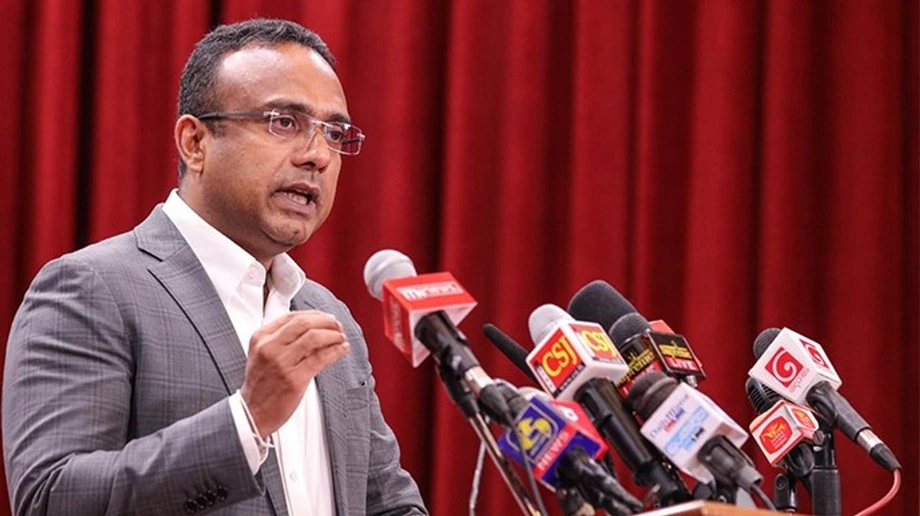
Udugahapattuwa spoke after the upgrade, at a briefing where she described the Public Debt Management Act, enacted at the end of 2024. The law created her office to identify portfolio risks and prepare a Medium-Term Debt Management Strategy and an Annual Debt Borrowing Plan using foreign expertise and international methods. Local banks hold more than 20 percent of system assets in government exposure, tying lenders' fortunes closely to the state's borrowing costs.
The Government's Case: Preparation Before the Shock
Treasury Secretary Harshana Suriyapperuma said S&P and Fitch upgraded Sri Lanka after reviewing steady progress across consecutive quarters and faster-than-expected growth in state revenue. He said government debt is now growing more slowly than the economy, even after higher foreign exchange outflows for motor vehicle imports, extra fuel import costs and investigations into unnecessary banking outflows.
Treasury funds built through careful management allowed the government to provide fuel relief during the Middle East war in April and to support recovery after Cyclone Ditwah, Suriyapperuma said. The government released about 97 billion rupees in 2026 to help small and medium-sized entrepreneurs expand exports, with a similar program planned for 2027. It also spent about 200 billion rupees on capital investment and plans a 30 percent salary increase from January 1, 2027.
Rather than waiting until something happens, the government's program of assessing timing and acting with advance preparation was recognized by these institutions.
The Finance, Planning and Economic Development Ministry said the upgrade showed the country could meet its debt obligations with less strain. Deputy Finance Minister Anil Jayantha Fernando said the recognition came from fiscal discipline and economic policy, and he noted that Fitch had already raised Sri Lanka to B- before S&P followed.
The rating upgrade demonstrates Sri Lanka's willingness and capacity to meet its debt obligations, making it less vulnerable to unfavourable external financing conditions.
What Still Worries S&P: Oil, Remittances and El Nino
S&P kept a stable outlook but described the risks as high. The agency said Sri Lanka remains vulnerable to global shortages of crude oil and petrochemicals, and that the prolonged war in the Middle East will keep pressure on the external balance, particularly if remittances falter. An impending El Nino could hit hydropower generation and agricultural production, worsening inflation and dampening growth.
Risks remain high, as Sri Lanka is vulnerable to global shortages of crude oil and petrochemicals. The prolonged war in the Middle East will maintain pressure on the external balance, particularly if remittances falter.
Foreign exchange tells the same story. S&P expects the current account, a broad measure of money earned from exports, remittances and tourism minus payments for imports, to swing to a deficit of 1.4 percent of GDP in 2026. Gross external financing needs will widen to about 109 percent of current account receipts and usable reserves from 104 percent in 2025, before improving to 104 percent by 2029. External debt net of external assets is expected to average 96 percent of current account receipts over 2026 to 2029.
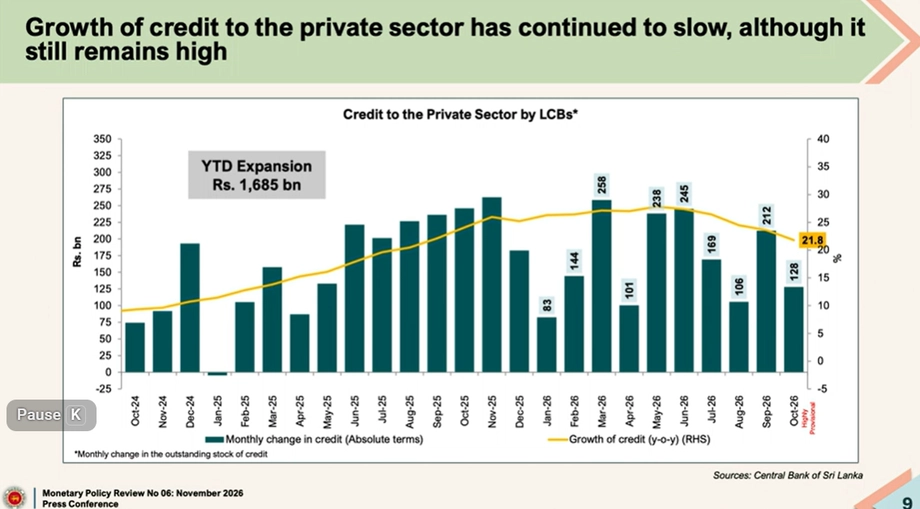
Colombo inflation reached 8.3 percent year on year in October, prompting the central bank to raise rates. The rupee weakened by about 6.8 percent in the first ten months. Strong growth or a stronger rupee could also raise payouts on Sri Lanka's macro-linked bonds, which tie some repayments to the economy's performance.
A Budget Gap That Is Set to Grow
Sri Lanka's fiscal deficit is projected at 1.8 percent of GDP in 2026, even though the government ran a surplus in the first nine months. The primary balance, which excludes interest payments, has been in surplus for four consecutive years. S&P expects the deficit to widen to 4.5 percent of GDP in 2027.
The budget raised personal income tax thresholds, removed value-added tax on school supplies and cut targeted levies, including those on solar batteries. Capital spending is rising, relief and reconstruction costs from Cyclone Ditwah are carrying into 2027, and a planned property tax was dropped shortly before the IMF program ends in March 2027.
The IMF Extended Fund Facility ends in March 2027. S&P said the government has met most quantitative targets and structural benchmarks, some with delays, and expects the reform agenda to continue after the program ends, including revenue-based budget repair and cost recovery pricing for utilities. The Finance Ministry pledged to maintain fiscal discipline, build reserves and advance structural reforms.
What the Upgrade Changes for Sri Lankans
A B- rating changes the price and availability of foreign borrowing for the government and for companies that borrow abroad, and it tells investors that the risk of another default has fallen. For a country that still spends about 40 rupees of every 100 rupees of revenue on interest, that signal can help refinance old debt and fund the budget at less punishing terms.
Some benefits are already in the budget. The 97 billion rupees for small and medium enterprises is meant to help exporters expand, and the 30 percent salary increase takes effect on January 1, 2027. The government used Treasury funds for fuel relief in April and for recovery after Cyclone Ditwah. The 2027 budget, presented by President Anura Kumara Dissanayake in November, projects $2.08 billion in foreign funding.
A weaker rupee makes imports and foreign debt more expensive, inflation has climbed, and tourism earnings have fallen. The debt ratio is falling, but at 95 percent of GDP it is still high, and the interest bill leaves little room for schools, hospitals or roads without more revenue or cheaper loans.
How Sri Lanka Reached This Point
- 2022: Sri Lanka defaults on $46 billion of external debt.
- End of 2024: The Public Debt Management Act creates a dedicated debt office and a medium-term borrowing plan.
- September 2025: S&P removes Sri Lanka from selective default and assigns CCC+.
- September 2026: Fitch raises Sri Lanka to B- with a stable outlook.
- November 27, 2026: S&P raises the long-term rating to B- and the short-term rating to B.
- March 2027: The $2.9 billion IMF Extended Fund Facility is due to end.
Sri Lanka spent years locked out of normal international borrowing after the default and relied on the IMF, multilateral lenders and domestic banks. The two upgrades in 2026 mark a return to borrowing conditions that are still expensive but no longer emergency territory.
What Would Push the Rating Higher or Lower
S&P said it could raise the rating if the interest burden falls substantially toward levels common in countries it rates, if net external debt falls below current account receipts on a sustained basis, if net general government debt changes by consistently about 3 percent of GDP, and if macroeconomic stability becomes more entrenched. It could lower the rating if funding and liquidity stresses return, preceded by weaker external or fiscal performance.
The IMF program ends in March 2027, the budget tax measures take full effect in 2027, and a stronger El Nino is expected that year. S&P did not say when it would next review the rating. The government's task is to keep revenue growing while the deficit widens and to show that reserves can keep rising even as debt repayments increase.
Key Points
- S&P raised Sri Lanka's long-term rating to B- from CCC+ on November 27, 2026, with a stable outlook.
- The short-term foreign and local currency ratings rose to B from C.
- S&P said a default over the next two years is unlikely, citing stronger revenue, reserves and growth.
- Government revenue grew 20 percent in the first nine months and is set to exceed 17 percent of GDP in 2026.
- Debt has fallen to 95 percent of GDP from 114 percent in 2022, with targets of 89 percent in 2026 and 78 percent in 2031.
- Interest payments take about 40 percent of revenue, down from 80 percent.
- The fiscal deficit is forecast at 1.8 percent of GDP in 2026 but 4.5 percent in 2027.
- Risks include oil shortages, the Middle East war, weaker remittances, a tourism slump and El Nino.