A Rare Monopoly Survives Its Sixth Test
South Korea's Constitutional Court ruled on Nov. 26 that only people with visual impairments may hold a professional massage licence, turning back a challenge from operators who ran massage businesses without one. Eight of the nine justices held that Article 82(1) of the Medical Service Act, the clause that sets the qualification, and the penalty provisions tied to it do not breach the Constitution. Article 82(3), which forbids anyone without the qualification from opening a massage establishment, was upheld by all nine.
Contents
- A Rare Monopoly Survives Its Sixth Test
- The Franchise Owners Who Went to Court
- Why the Justices Kept the Licence as It Is
- A Second Clause, Upheld Without a Dissent
- The Lone Dissent
- From Colonial Rule to Constitutional Fixture
- The Market the Statute Cannot Reach
- What Changes for the People in the Trade
- What the Ruling Leaves Open
- Key Points
The court decided two complaints together, registered as 2021Hun-Ma573 and 2024Hun-Ba128. Giving an unlicensed massage for profit is punishable under Article 88 with up to three years in prison or a fine of 30 million won (about $21,700). Opening a massage establishment without the qualification carries up to five years or a fine of 50 million won under Article 87-2.
The licence itself has two routes. A candidate either completes a physical therapy course at a special school at high school level, or holds education above middle school level and trains for two years or more at an institute designated by the health minister. A city mayor or provincial governor issues the certificate, and in both cases the applicant must be visually impaired under the Act on Welfare of Persons with Disabilities. No foreign certificate substitutes for the Korean licence.
The dispute came down to work. One group, people who are blind, has a foothold in a single trade. Everyone else has the whole labour market and wants this corner of it as well.
The Franchise Owners Who Went to Court
Skin care and foot massage franchise companies, among them The Foot Shop, and their franchisees lodged a constitutional complaint in May 2021. Their argument was that entry to a trade cannot be made to depend on a disability that no amount of effort can change, and that the rule breaks the right to equality and the freedom to choose an occupation.
Of the 120 people who joined, the court dismissed 104 claims on procedure. Those operators had begun trading before Nov. 18, 2019, when the provisions last took effect, and they filed more than a year after that date. A constitutional complaint must be lodged within 90 days of learning that a law has taken effect and within one year of the law entering into force. The remaining 16 claims failed on their merits.
The court joined that complaint to a second one, filed on April 18, 2024 by a man surnamed Jeong. He had hired foreign workers at a massage business between March 2021 and May 2022 without a licence, and Gwangju District Court sentenced him on March 21, 2024 to eight months in prison, suspended for two years. His request for a constitutional review of the law was turned down with his conviction in February 2024, and he brought the question to the court himself.
Why the Justices Kept the Licence as It Is
Employment figures decided the case. A survey of economic activity among people with disabilities, conducted in the second half of 2025, put the employment rate for the population aged 15 and older at 63.4%. For people with visual impairments it was 39.3%, and for people with severe visual impairments 25%. The same data counts 9,968 licensed massage therapists with visual impairments in the country.
The court also weighed when sight is lost. A 2023 survey of people with disabilities found that 97.7% of people with visual impairments acquired the impairment later in life, often in their 30s, 40s and 50s. Free training in massage, the justices noted, gives people who lose a career along with their sight a route back into work.
Set against those numbers, the court found the case for the licence stronger than the case against it.
The public interest in promoting the economic and social participation of visually impaired people and supporting their independent lives, the goals this licensing provision seeks to achieve, outweighs the restriction on non-visually impaired people's freedom to choose an occupation.
The justices described the trade as the floor beneath a group that has few other options.
In reality, visually impaired and non-visually impaired people do not enjoy equal opportunities in choosing an occupation. The massage therapist system for the visually impaired still functions as a framework for vocational training and employment that sustains the minimum livelihood of visually impaired people, particularly those with severe impairments or those who lost their sight later in life.
Five years of drift appear in the court's own record. When it last ruled on the question in December 2021, it cited 11,305 licensed massage therapists with visual impairments, 93.9% of them with severe impairments, and an employment rate of 42.3% for people with visual impairments against 60.2% for the whole population. The latest survey shows fewer licensed therapists and a lower employment rate. The court said the public interest behind the clause stays weighty until other means are created for people with visual impairments to take part in the economy and in society, and that limits on everyone else's occupational freedom could be loosened once genuinely equal chances exist elsewhere.
A Second Clause, Upheld Without a Dissent
Article 82(3) stops anyone without the qualification from opening a massage establishment, and not one justice objected to it. The court held that owners who have not been through the training cannot keep the quality of treatment in check, which puts public health at risk. It also warned of a structural effect: if owners without visual impairments were allowed in, blind therapists would end up working for them rather than running their own premises, exposed to low pay and poor conditions, while existing blind owners would be pulled into a fight for customers they cannot win.
Softer versions of the rule have been floated by lawyers and lawmakers. The court examined two of them, obliging establishments to hire a fixed share of blind therapists, and limiting the monopoly to businesses above a certain size. It rejected both, saying they would push blind therapists toward waiting for a wage instead of running a shop, and would protect livelihoods less well than the current law. Penalties, it added, are not out of proportion to the offence, given how often unlicensed massage still goes on despite them.
The Lone Dissent
Justice Kim Bok-hyeong voted against the qualification clause and the penalties attached to it. Her figures point the other way. The employment rate for people with visual impairments stood at 39.6% in 2010 and 39.3% last year, she noted, and the share of people with visual impairments who work in massage has not grown. In the same survey, 36.1% of people with visual impairments said they wanted work in skilled trades or machine operation, while 12.5% named service and sales jobs, the category that includes massage.
Industry estimates cited in her opinion put the market at about 80,000 establishments and 300,000 workers, roughly 27 times the number of licensed therapists with visual impairments.
The social consensus that massage is a business exceptionally permitted only to visually impaired people is fundamentally shaking, and the constraints that non-visually impaired people face over their freedom to choose an occupation have grown much heavier, so it is hard to say that a balance is kept between the public interest this clause pursues and the private interest it restricts.
She argued that lawmakers who settle for the licence without testing alternatives are neglecting a duty the state owes. Her proposals include quotas that would reserve a share of telephone counsellor or stenographer posts for people with visual impairments, easier examination requirements for blind candidates, and training and job placement across a wider range of industries. Easing the licence rules could protect livelihoods as well, she wrote, a claim the majority did not accept.
From Colonial Rule to Constitutional Fixture
Japan's colonial administration introduced the licensed massage trade in Korea in 1913, and the South Korean state kept the arrangement five decades later as a way of giving blind people an income in a society that offered them few. For most of that time the restriction sat in a ministerial regulation, the Rules on Massage Therapists, until the court examined that regulation in 2006.
- 1913: colonial authorities create the licence, limited to blind practitioners.
- May 25, 2006: the Constitutional Court rules the regulation unconstitutional (2003Hun-Ma715 and related cases), because a limit on a basic right had been imposed by a ministerial rule rather than by statute.
- 2006: blind masseurs protest, some jumping from Mapo Bridge over the Han River. Two died, and a tally published at the time counted four jumpers and three suicides.
- August 2006: the National Assembly writes the requirement into the Medical Service Act, restoring almost the same exclusive right.
- Oct. 30, 2008: the court upholds the statutory version, with six of nine justices in the majority (2006Hun-Ma1098).
- July 29, 2010: a second upholding (2008Hun-Ma664).
- June 27, 2013: the ban on unlicensed people opening massage parlours is upheld (2011Hun-Ga39).
- Dec. 28, 2017: qualification, opening and penalty clauses upheld together (2017Hun-Ga15).
- Dec. 23, 2021: a unanimous upholding (2019Hun-Ma656), with 11,305 licensed blind therapists on the rolls.
- Nov. 26, 2026: the sixth upholding, 8 to 1, with 9,968 licensed blind therapists.
The 2006 sequence explains why the court keeps returning to the question. When the regulation fell, the National Assembly did not drop the restriction. It moved the restriction into the statute, which is why later challenges have attacked the Medical Service Act rather than a rule written by a ministry.
The Market the Statute Cannot Reach
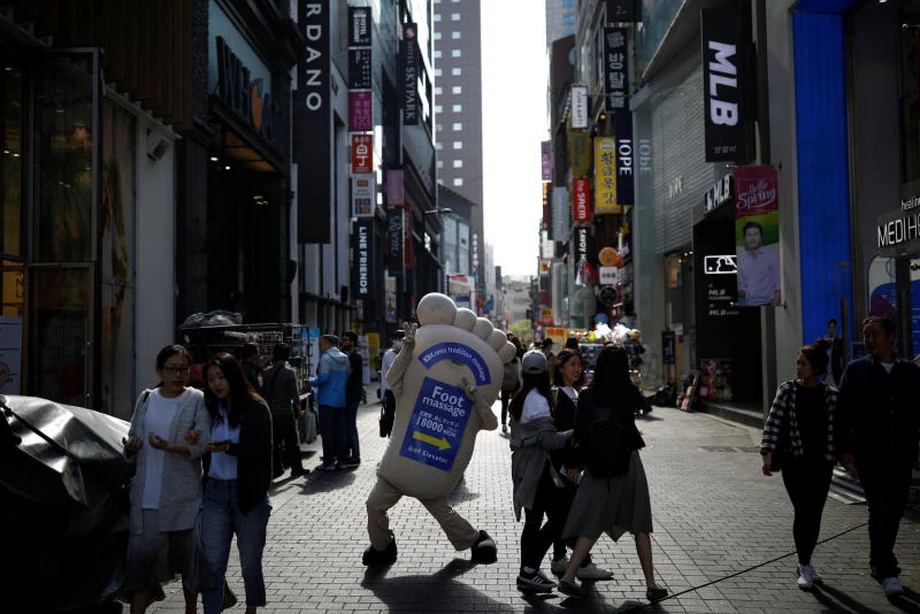
Reality on the street looks little like the statute book. Many of the shops behind the 80,000 estimate hire workers from China and Thailand, and when the health ministry last published a count of the legal trade it found 1,300 licensed massage parlours employing 9,742 blind masseuses.
The legal definition of massage is broad. In a 2009 ruling (2007Do5531) the Supreme Court described massage as physical treatment of the body through kneading, pressing, pulling or tapping with the hands or a device, enough to loosen knotted muscles by promoting blood circulation, and held that treatment remains massage without a therapeutic purpose and without risk of harm. Thai, Chinese, Swedish, sports and foot massage therefore sit inside the licensed trade on paper. A 2014 ruling (2014Do10051) allowed full confiscation of proceeds from shops where massage and sexual services were sold together.
Customers are not the target of any of it. Neither the Medical Service Act nor the Public Health Control Act punishes a person for receiving a massage; penalties fall on the practitioner and the owner. Enforcement concentrates on shops that employ undocumented foreign workers, on premises tied to the sex trade, and on businesses reported by the massage therapists' association. Skin care salons, which work on faces rather than muscles, register under a different law and operate legally.
Licensed practitioners also work within limits set by the Rules on Massage Therapists. An anmawon may cover 300 square metres and employ four people, an anma sisulso 830 square metres and ten, and neither may open in a building used for lodging. That is why hotel desks arrange massages for guests rather than running their own parlours. The gap between the licensed trade and the rest of the market is what the dissent meant by a shaken consensus.
What Changes for the People in the Trade
The Korean Association of Massage Therapists for the Visually Impaired held an emergency general assembly of its national membership in front of Unhyeongung in Jongno-gu, Seoul, as the news arrived, and the crowd chanted, "We held on." The association had campaigned outside the court ahead of the verdict, alongside lawmakers who attended the hearing.
What we sought to protect was the right to work with our own hands, support our families, and live with dignity. We will continue to defend our workplace to the end.
Kim Ye-ji, a People Power Party lawmaker who is visually impaired and sat in the courtroom, said the court had "confirmed the constitutional value of protecting the right to survival of visually impaired people, even if it partially restricts non-disabled people's freedom to choose an occupation."
Protecting the right of people with disabilities to work is not a favour the state grants but a constitutional duty it must carry out.
She added that the "encroachment on the massage therapy sector by unlicensed, illegal massage operators and the exhausting debate over it must now be brought to an end," and said she would keep pressing for legislation against illegal massage businesses. Seo Mi-hwa of the Democratic Party, who also attended, framed the arrangement as a promise rather than a privilege.
The visually impaired massage therapist system is not a privilege but a social promise our community made so that visually impaired people can keep a minimum of life amid a discriminatory reality.
What the Ruling Leaves Open
The court left a door ajar. It said limits on other people's occupational freedom could be eased once people with visual impairments are guaranteed equal opportunities in fields beyond massage, and its reasoning on the opening clause rests on the same condition. No lawmaker has published a bill, no date has been set for a vote, and the six rulings since 2008 have each closed with that advice and left the statute where it was.
For the operators who challenged the law, the practical result is the same as before. Jeong's sentence stands, the fine and prison ceilings are unchanged, and any new complaint must clear the filing deadlines the court enforced here. For the 9,968 licence holders, the ruling protects a market they share with tens of thousands of unlicensed shops, and with a state that has not found a way to shut those shops down.
Key Points
- The Constitutional Court ruled 8 to 1 on Nov. 26, 2026 to uphold Article 82(1) of the Medical Service Act, which reserves the massage licence for people with visual impairments.
- Article 82(3), which bars unlicensed people from opening massage establishments, was upheld unanimously.
- Unlicensed massage for profit carries up to three years in prison or a 30 million won fine; opening an unlicensed establishment carries up to five years or 50 million won.
- The court cited employment rates of 39.3% for people with visual impairments and 25% for those with severe impairments, against 63.4% for the population aged 15 and older, from a survey in the second half of 2025.
- Licensed massage therapists with visual impairments number 9,968, down from the 11,305 the court cited in 2021.
- Justice Kim Bok-hyeong dissented, noting the employment rate has barely moved since 2010 and proposing hiring quotas in telephone counselling and stenography.
- Of 120 claims from skin care and foot massage franchise operators, 104 were dismissed as filed too late and 16 failed on their merits.
- The case was consolidated with a separate complaint by a man sentenced to eight months, suspended for two years, in Gwangju in March 2024.
- This is the sixth upholding since the National Assembly wrote the restriction into law in August 2006, after a May 2006 ruling struck down the earlier ministerial rule.