A Steel Wave Above Bãi Đất Đỏ
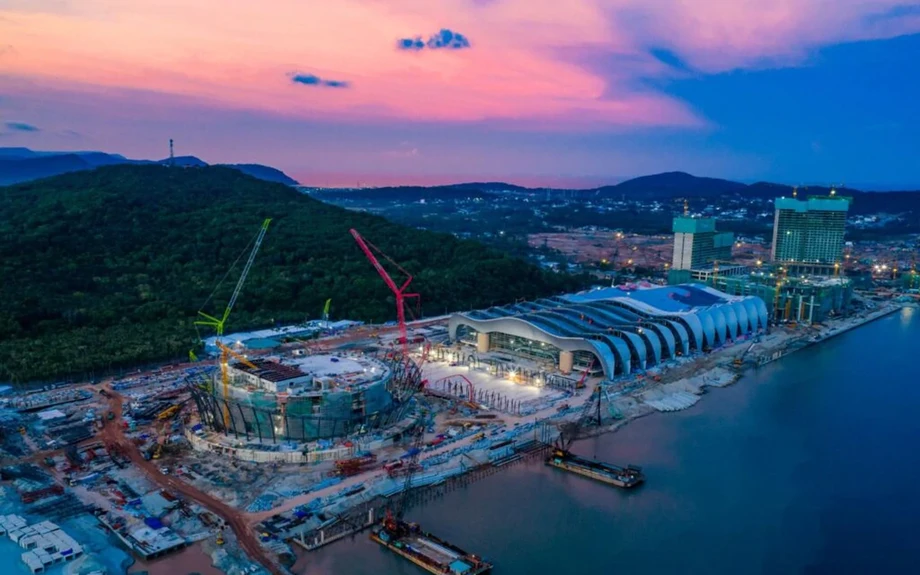
Engineers on Phú Quốc have lifted about 12,000 metric tons of steel more than 40 meters into the air to form 13 roof spans shaped like ocean waves. The steel weighs roughly 1.2 times the commonly cited weight of the Eiffel Tower. Stretching more than 300 meters in length and about 165 meters in width, the roof covers approximately 52,000 square meters above the APEC Convention and Exhibition Center at Bãi Đất Đỏ, on the island's southern coast.
Contents
- A Steel Wave Above Bãi Đất Đỏ
- How Engineers Lifted Hundreds of Tons at a Time
- Why an 81 Meter Span Matters
- A Theater Built Around Vietnamese Symbols
- Fixed Dates and a Harder Line on Site Clearance
- The Airport and Railway Take Shape
- Power Must Be Ready Before the Delegates Arrive
- A Construction Sprint Becomes a Staffing Challenge
- The Event Ends, but the Infrastructure Stays
- What to Know
The building is the centerpiece of a convention complex with investment of about 21,860 billion Vietnamese dong. Sun Group is developing the project through a partnership between public and private investors, a model known as PPP. Construction began in the middle of 2025 at Khu S3 in An Giang province. By late November 2026, all 13 roof spans had been installed, the reinforced concrete structure was about 98 percent complete, and both the steel structure and roof sheeting were finished. The An Giang Department of Finance put the wider convention center project at 79.3 percent of construction volume during a November 20 progress meeting.
Contractors are now working on the glass facade, exterior enclosures, mechanical and electrical systems, and interior spaces. The exterior is targeted for completion in the fourth quarter of 2026, with interior work due before March 31, 2027. The schedule serves a much larger event: Phú Quốc is to host APEC Economic Leaders' Week in November 2027. APEC is a forum of 21 Pacific Rim economies, and the gathering is expected to bring more than 10,000 delegates and about 3,000 journalists to the island.
How Engineers Lifted Hundreds of Tons at a Time
The largest roof span, at the gable end, weighs 722 metric tons. The middle spans range from 677 to 703 metric tons each. Their size made conventional assembly at full height especially difficult, so workers divided the roof into modules, some weighing nearly 250 metric tons, and assembled them at ground level before raising them.
Sun Group and its contractors used hydraulic strand jacking equipment from Hebetec, a Swiss specialist within France's VINCI group. In this method, bundles of high strength steel cables pass through hollow jacks and are anchored at different levels. The jacks pull the cables in controlled increments, lifting the attached structure. Groups of jacks operate together under central monitoring, allowing engineers to manage the load, distribute forces and check movement to millimeter precision.
The first 81 meter span was successfully raised by the middle of April 2026, when installation of the 13 spans on the U axis facing the sea was also completed. Six months later, at the end of October, the project reached 100 percent completion of its steel structure. Hebetec's previous work includes raising the San Mamés stadium roof in Spain by 50 meters using 160 jacks, lowering five bridge trusses weighing 1,600 metric tons each at the San Francisco-Oakland Bay Bridge, and lifting bridge sections for Scotland's Forth Crossing. The company says its LAO system, with 48 independent hydraulic lines, has handled a 100,000 metric ton lift with an accuracy of 0.3 millimeters.
Island logistics added another layer of difficulty. Large roof sections were fabricated at factories and brought to Phú Quốc by barge. Facade glass, electrical equipment and other materials also had to arrive by sea. Rough weather in the Gulf of Thailand could delay several deliveries in succession, so contractors established storage areas near the site and timed shipments around favorable weather. Thousands of engineers, specialists and workers have operated in three shifts with four crews, continuing through holidays and the Tết festival.
Why an 81 Meter Span Matters
Beneath the roof, the main ballroom covers about 11,050 square meters and crosses 81 meters without columns interrupting the floor. A clear span is the distance between structural supports. Removing columns from such a large room gives organizers unobstructed sightlines and freedom to arrange stages, seating, exhibitions and banquet tables for different events.
The project team says this span exceeds the comparable conference space at Caesars Forum in Las Vegas, placing the Phú Quốc ballroom among the world's largest conference halls built without internal columns. Instead of supporting the roof on posts throughout the room, the structural design distributes its forces and supports the system from the two sides.
The convention center contains about 153,130 square meters of floor space across one basement, three main floors and a technical roof level. Its stated height is 39.25 meters. A contractor update in late November described 12 large meeting rooms on the second floor that can be subdivided, while the broader design counts about 30 large and small rooms when flexible partitions are used. The third floor contains a conference and banquet space of roughly 3,000 square meters for formal leaders' sessions, which can also be converted for receptions.
The architecture draws on ocean waves and Phú Quốc's fishing village heritage. A veranda about 15 meters wide and more than 300 meters long wraps around the building. It creates a sheltered transition between the exterior and the conference halls while providing additional space for art and exhibitions.
A Theater Built Around Vietnamese Symbols
The neighboring APEC multipurpose performance house will seat 4,030 people and contain approximately 54,680 square meters of floor space across six upper floors and one basement. It is intended for artistic performances, cultural programs and large events during APEC and after the summit.
Fifty exterior columns evoke a Vietnamese bamboo grove and represent the 50 children who, in the legend of Lạc Long Quân and Âu Cơ, followed their father toward the sea. Planned exterior layers suggest dragon scales, continuing the cultural story known as Con Rồng cháu Tiên. In early November, crews were installing 35 roof modules weighing about 1,140 metric tons in total. By late November, more than 98 percent of the reinforced concrete structure was complete, all 50 roof support columns had been installed, and work was proceeding on their decorative cladding and the facade glass. The theater shares the convention center's targets for exterior completion in the fourth quarter of 2026 and interior completion before March 31, 2027.
Fixed Dates and a Harder Line on Site Clearance
Phú Quốc's preparations cover 21 projects approved under Decision 948/QĐ-TTg, comprising 11 publicly funded projects and 10 developed through PPP or business investment. Their preliminary combined value exceeds 186,000 billion dong. Sun Group is directly implementing eight strategic projects. Seven of the 21 had passed 60 percent of construction volume by the November 20 meeting.
On November 27, Hồ Văn Mừng, chairman of the An Giang Provincial People's Committee, led an inspection of eight projects: the convention complex, its seawall and site works, the Bãi Đất Đỏ urban area, An Thới underground utilities, APEC Boulevard, the first section of the urban railway, provincial road ĐT.975 and the airport expansion. He ordered agencies to assign a firm completion date to every component, including the theater, meeting rooms, reception rooms and connecting roads. He also demanded action against illegal construction and holdouts obstructing land handover.
For cases that deliberately violate construction order or refuse to hand over land, the authorities must resolutely handle violations, order the demolition of illegal works and carry out enforcement in accordance with the law, creating clear sites so key projects can accelerate.
At the November 20 meeting, Hồ instructed investors to finish all 21 projects before May 30, 2027. That is one month earlier than the June 30 provincial target cited during an October inspection. The next milestones are tightly spaced:
- Before December 25, 2026: completion of the An Thới underground technical infrastructure project.
- Fourth quarter of 2026: exterior completion targets for the convention center and performance house.
- January and February 2027: arrival of the first light rail trains for installation, checks and trial running.
- Before March 10, 2027: completion of three direct power supply projects.
- Before March 31, 2027: interior completion at the convention center and performance house.
- Second quarter of 2027: targeted opening of the expanded ĐT.975 corridor.
- Before May 30, 2027: completion deadline for the full APEC project list.
- November 2027: APEC Economic Leaders' Week in Phú Quốc.
The Airport and Railway Take Shape
Phú Quốc International Airport already has one major new asset in service. Its second runway, measuring 3,300 meters by 45 meters, entered commercial operation on October 29 after about eight months of construction. At 7:05 that morning, Sun PhuQuoc Airways flight 9G1955 from Ho Chi Minh City became the first commercial flight to land on it. The runway meets ICAO Code E, an international classification used to match airport dimensions and equipment to larger aircraft.
The second runway allows the existing runway to close for about six months while it is extended to 3,500 meters, without stopping all airport operations. By November 20, the runway was listed at 100 percent completion, the VIP terminal at 99.85 percent and Passenger Terminal T2 at 84.45 percent. The 9,890 square meter VIP terminal is designed to receive up to 300 passengers and is being prepared for senior leaders and international delegations. T2 is planned for 2027 and is intended to handle 20 million to 24 million passengers annually. Its roof evokes a phoenix spreading its wings, while an automated baggage system extending more than eight kilometers was about 75 percent complete at the end of October.
The island's first urban railway has advanced considerably since its approval in 2025. The current design runs for 17.59 kilometers on double track, equivalent to about 35 kilometers of individual rail, and costs nearly 9,000 billion dong. Trains are designed for 70 to 100 kilometers per hour, with an airport to convention center journey of about 20 minutes. More than 11 kilometers of rail had been laid by early November, with about 1,300 workers across seven construction fronts. A 33 metric ton automatic welding machine entered service on November 5, completing each weld in roughly three to four minutes. A start date for passenger service was not given.
The railway will run in the median of the expanded ĐT.975, a 19.26 kilometer corridor that will be 62 meters wide with 10 traffic lanes. About half the road foundations and 65 percent of its technical trenches were complete in early November. Asphalt work was planned for late 2026 and early 2027. Separately, the 2.81 kilometer new section of APEC Boulevard had reached about 42.6 percent progress by October 20. At Bãi Đất Đỏ, 17 hotel towers facing the sea are rising across 88.4 hectares, with nearly 7,000 rooms planned in the first phase. The tower expected to be managed by W Hotels had reached floor 32 in early November, while the JW Marriott Marquis tower had reached floor 22.
Power Must Be Ready Before the Delegates Arrive
An Giang's electricity utility has already commissioned three grid projects costing about 2,165 billion dong: the 220 kilovolt Phú Quốc 2 substation and its connection, plus 110 kilovolt lines serving northern and southern Phú Quốc. Together, they help create a 110 kilovolt ring, giving operators alternative routes for electricity if part of the network fails.
Three additional supply projects worth 386.3 billion dong are in contractor selection. They include 223.4 billion dong for underground and distribution networks along ĐT.975, 106.9 billion dong for the airport and the railway's airport end, and 56 billion dong for the convention center and the railway's center end. All three are due to finish construction and acceptance before March 10, 2027. The utility has also estimated 165.6 billion dong for repairs to the existing distribution network and identified 347 problems on customer owned equipment that must be resolved with their owners.
Nguyễn Phước Quý Hùng, director of An Giang Power Company, described reliable supply for APEC as a key political task. Plans call for electricity from multiple directions, supported at important sites by generators and battery systems that keep essential equipment running during interruptions. Operating crews are to remain on duty around the clock during the conference. Repair of the 110 kilovolt cable linking Hà Tiên and Phú Quốc is targeted before March 30, 2027.
Progress still depends on roads and buildings handing over cable trenches and connection points. By November 20, crews had installed 8.15 kilometers of cable along an 11.7 kilometer trench route on ĐT.975. Phú Quốc's special zone administration was separately assigned to submit a transitional operating plan for the convention center before November 30, allowing the utility to identify electricity users and backup requirements.
A Construction Sprint Becomes a Staffing Challenge
Sun Group expects its tourism, entertainment, aviation and healthcare operations in Phú Quốc to recruit more than 14,000 additional workers in 2027. A preliminary survey of local training institutions found 8,681 students expected to graduate that year. Of them, 3,289 are studying trades directly sought by the company and another 1,849 are in related fields. That produces 5,138 potential candidates, enough for only about 36 percent of the anticipated demand.
The An Giang Department of Education and Training and Sun Group signed a cooperation memorandum on November 19 covering workforce development from 2026 through 2031. Sun Group members also signed agreements with eight universities, colleges and vocational institutions covering trades, languages, service skills, internships and recruitment. Hồ Văn Mừng told businesses and schools to specify which occupations they would teach, how many people they would train and which jobs the training would serve, backed by commitments on hiring and employee treatment.
Training under standards associated with Switzerland's EHL Hospitality Business School is expected to devote about 70 percent of instruction to practical work. The Phú Quốc Hello World program for 2026 through 2030 will teach communication skills to drivers, small traders, service workers and students. An Giang is also providing APEC and international integration instruction to 150 officials, young volunteers and community representatives.
National preparations extend beyond hospitality. Vietnam accepted the APEC chair on November 19, 2026, marking its third hosting term after 2006 and 2017. More than 200 events are planned during 2027, including 11 ministerial meetings and dialogues among senior officials across seven localities. The University of Economics Ho Chi Minh City expects to conduct about 17 training sessions for between 1,600 and 2,300 participants in protocol, event management and languages. The Ministry of Public Security leads the Security and Healthcare Subcommittee, which is preparing responses to emerging threats, including those in digital space.
The Event Ends, but the Infrastructure Stays
The convention center, theater, airport, railway, hotels and power network are intended to remain in use long after Leaders' Week. For residents, that means a larger electricity network, new public transport capacity and a wider road corridor. For the tourism industry, it creates venues for meetings, incentives, conferences and exhibitions, commonly called MICE tourism. Project backers have pointed to Marina Bay Sands in Singapore and Sydney's International Convention Centre as benchmarks for the kind of international events business they hope to attract.
The construction push also forms the backdrop to Phu Quoc's tourism recognition as one of nine Asian places recommended for visits in 2027. The island's challenge is to convert new buildings and transport links into year round activity, skilled employment and services that remain useful outside a single diplomatic event.
For younger workers, the project already carries personal meaning. Thanh, a supervisor aged 26 working at the convention center site, described its place in his career.
Not many people my age have the chance to work on a project this large. APEC will certainly be a mark I remember throughout my career.
What to Know
- Phú Quốc's APEC convention center has a 12,000 metric ton steel roof formed into 13 spans resembling waves.
- Hydraulic strand jacks raised modules weighing nearly 250 metric tons each to millimeter precision.
- The 11,050 square meter ballroom crosses 81 meters without internal columns.
- Convention center steelwork and roof sheeting are complete, with interior finishing due before March 31, 2027.
- The neighboring performance house will seat 4,030 people and draws its design from Vietnamese legends.
- Phú Quốc is implementing 21 APEC projects worth more than 186,000 billion dong, with completion ordered before May 30, 2027.
- A second airport runway is operating, while a 17.59 kilometer railway promises a journey of about 20 minutes to the convention center.
- More than 14,000 additional workers may be needed in 2027, but identified local graduates cover only about 36 percent of expected demand.