Why a Governance Debate Became a Fight Over Medical Bills
Two bills that would amend Thailand's 2002 National Health Security Act have prompted a national campaign by patient groups, consumer networks and community organizations. Both drafts were submitted to parliament on October 22, 2026. Their shared wording would create a new legal category called basic benefits and permit charges for services outside that category, with the rules and rates decided later.
Contents
- Why a Governance Debate Became a Fight Over Medical Bills
- What the Two Drafts Actually Say
- Why Regular Benefit Reviews Alarm Patient Groups
- Who Would Control the Health Security Board
- What a New Charge Could Mean at the Clinic
- Hospital Deficits and the Demand for Open Accounts
- Why Four Other Funds Are Part of the Protest
- How the Campaign Spread Across Thailand
- What Happens Next
- Key Points
On November 28, Saensiri Treemracha, coordinator of the Universal Health Coverage Lover Group, rejected the assurance that the proposals would leave benefits and patient payments untouched. She was responding to a November 18 interview by Associate Professor Dr Sanan Wisutthisakchai, a sponsor of one draft, who said his proposal did not change copayments or reduce benefits and was instead concerned with good governance. Saensiri said the objections came directly from the language of the two bills. Her response was distributed to journalists through a National Health Security Office communications channel.
The Gold Card is the common name for coverage under the Universal Coverage Scheme, which is managed by the National Health Security Office (NHSO). The office has allocated the scheme's national budget since 2002. A copayment is the part of a medical charge that a patient must pay when receiving care. For households already paying for transport and losing wages during hospital visits, even a modest new charge could affect whether they seek treatment. That is why a debate about administration has become a debate about what happens at the clinic door.
What the Two Drafts Actually Say
Both proposals would repeal the existing Section 5 and write it again. They would also add a definition of basic benefits to Section 3. The definition covers public health services necessary for health and daily life, and for preventing household bankruptcy caused by illness.
The identical third paragraph proposed for Section 5 describes what could happen when someone seeks care outside that package:
In cases where a person wishes to receive public health services beyond the basic benefits under paragraph two, that person may share in paying the service costs on each occasion, according to the rules and rates announced by the committee, unless the person is destitute or belongs to another group announced by the minister.
The wording would permit charges, but it does not itself set an amount in baht. The clauses being challenged also do not name the treatments that would sit inside or outside the basic package. Those decisions would depend on later announcements, while exemptions would cover destitute people and any additional groups specified by the minister.
Saensiri said the central change was the legal trigger for asking patients to pay. Her group acknowledges that the present law already contains provisions concerning copayments.
Civil society has never denied that the current law already provides for copayments. The new drafts change the criteria by tying copayments to basic benefits. If a service that people now receive free of charge is later placed outside basic benefits, people may have to share the cost, even when that service is still necessary for their health.
Why Regular Benefit Reviews Alarm Patient Groups
The Sanan draft would require the basic benefit package to be reviewed at least once every two years. The rival draft sponsored by Dr Anukul Thaithanan sets the interval at least once every three years. A review would give decision makers recurring opportunities to reconsider which services belong inside the package.
Saensiri accepted that a review would not automatically reduce coverage. Her concern is the absence of a guarantee that services now available without patient charges would remain inside the protected package. A service could remain medically necessary yet become subject to a payment if its legal classification changed.
A family would experience that boundary in practical terms. Treatment inside the package would remain covered under the scheme, while treatment outside it could bring a charge at each visit. The dispute therefore concerns both the future content of the package and the power to reset its boundary every two or three years.
Who Would Control the Health Security Board
The board dispute is just as concrete. Saensiri said the drafts would remove all five seats reserved for civil society representatives, who are drawn from organizations covering nine statutory areas. Those seats would be replaced by delegates selected by committees of 13 Provincial Health Assemblies. At the same time, service provider representation would increase to nine people.
The purchaser and provider distinction explains why this matters. The NHSO uses public money to purchase care for Gold Card members, while hospitals and other service providers receive that money for delivering treatment. Keeping independent public voices on the board is intended to balance the institutions that receive funds. Good governance, in this setting, means accountable decisions, transparent reasoning and safeguards against conflicts of interest.
Saensiri asked the sponsors to identify the specific governance failures that justified removing the existing civil society seats. She also questioned the effect of giving providers a larger role in decisions about payment rates.
Removing civil society seats while increasing service provider representation to nine raises concern about the balance of the NHSO board and the separation of purchasers from providers. When recipients of fund money help set payment rates themselves, what mechanism will prevent conflicts of interest?
Somchai Krachangsaeng, a member of the Consumers Council subcommittee on health services, described the restructuring as reducing public representation from nine sectors to five and shifting selection to 13 Regional Health Assemblies for Citizens. Saensiri's account focuses on the removal of the five existing civil society seats. Both objected to moving selection away from the organizations that currently supply public representatives.
What a New Charge Could Mean at the Clinic
On November 22, Tueanjai Kasemsri, a leader of the Four Region Slum Network, set out the experience of people who directly use the Gold Card. Her network opposes the amendment outright. She said members already contend with a 30 baht service fee, transport expenses, lost time and missed opportunities to earn income when they visit a doctor.
She warned that additional payments could revive dependence on hospital welfare and leave patients with medical debts.
Even today, when there is no copayment and we pay only a 30 baht service fee, each visit to the doctor brings transport costs, lost time and lost opportunities to earn income. If there is a copayment as well, what will happen? It will be like returning to the old days, when people depended on hospital welfare and accepted being in debt to the hospital. The Gold Card system has developed well and protects poorer people from bankruptcy caused by illness.
Thitinadda Rakkutchai, who chairs a Gold Card rights protection center in Bangkok, said economic hardship and recovery from floods had already left patients struggling with travel and medical expenses. Prachuap Thithong, a community slum coordinator, made a related point: poverty does not protect anyone from illnesses that are expensive to treat.
In Songkhla, Juta Sangchart, secretary of the Songkhla Consumer Association and an adviser to the Songkhla Civic Health Network, warned that treatment for complex conditions including HIV, cancer and heart disease could fall outside a narrow basic package. Her network met Democrat Party MP Juree Numkaew and urged political parties to oppose provisions that limit basic benefits or open the way to copayments.
Hospital Deficits and the Demand for Open Accounts
Pracharn Meesri, chairman of the Sing Buri Provincial Health Assembly and coordinator of the Sing Buri Gold Card Rights Protection Center, said attempts to amend the law began before the current administration. He argued that the size of the health fund had attracted interest and that hospital deficits were frequently cited while the human purpose of the scheme received less attention. He also said copayments would raise little income for hospitals while weakening health equity, and warned that board restructuring could invite political interference.
Tueanjai demanded a fuller financial explanation. Hospitals treat Gold Card members, patients who pay themselves, people covered by civil servant medical benefits and members of the social security system. She said any claim of losses should identify which part of hospital operations produced them. Information she had heard at academic forums suggested that relatively few hospitals were operating at a loss, while other claims did not establish whether the cause was Gold Card funding or internal management.
Part of the answer lies in capitation, a payment method under which providers receive an allocation based on the number of people registered with them rather than a separate full payment for every treatment. This pools the costs of healthy and sick members. Tueanjai also pointed to a central fund intended for expensive diseases when treatment costs exceed set budgets. She argued that these arrangements must be included in any honest account of hospital finances.
Board representatives have requested a complete accounting of hospital revenues under the Universal Coverage Scheme before structural changes to patient rights are settled. The public statements in the dispute provide no consolidated hospital deficit figure. Pracharn's position is that charging patients at the point of care would not be a meaningful solution to the financial problems being described.
Why Four Other Funds Are Part of the Protest
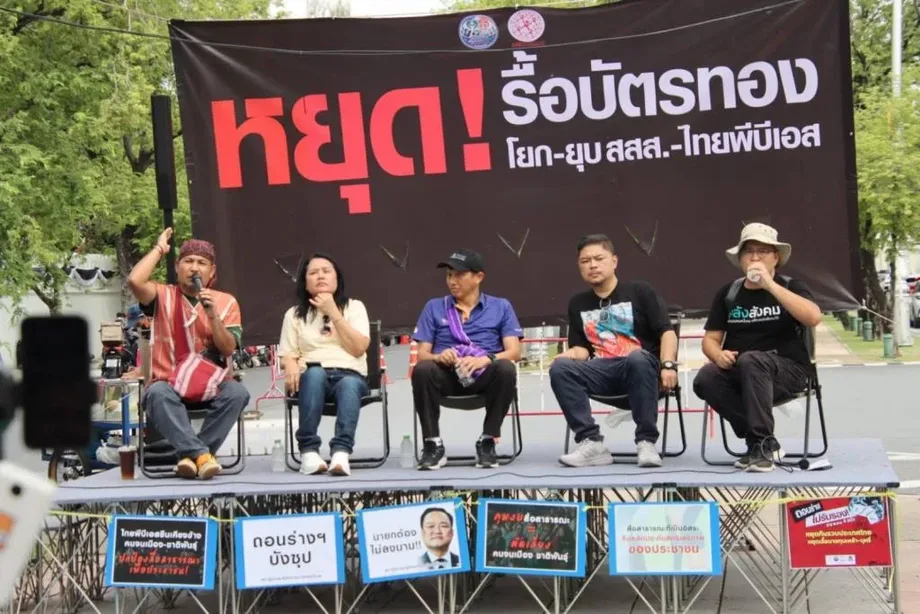
On November 17, roughly 1,000 people marched to Government House to oppose changes affecting the national health security system and what campaigners call the 4+1 funds. The coalition included the Indigenous Peoples Network of Thailand, community councils, former Thai PBS audience representatives, the Stop Drink Network and the People's Health Promotion Movement. Pracharn said the funds encourage public participation, give communities a sense of ownership and help reduce health disparities.
Prayoon Jongkaichak, president of the national committee responsible for carrying out resolutions of subdistrict community councils, objected to replacing earmarked tax arrangements with ordinary annual budgeting. Earmarked revenue is money legally assigned to a particular purpose. He argued that dismantling these structures would benefit tobacco and alcohol operators by sparing them an estimated 14 billion baht in contributions.
Teerapat Kahawong, secretary of the People's Health Promotion Movement, separately asked a committee chaired by Deputy Prime Minister Songsak Thongsri to address public questions about preferential treatment. He also asked whether political influence was driving the push to amend the ThaiHealth law. These objections broaden the campaign from hospital charges to control of public health money and the independence of the bodies that spend it.
How the Campaign Spread Across Thailand
Opposition developed through local petitions and public meetings rather than a single Bangkok event. The main steps during October and November were:
- In October, on World Habitat Day, the Four Region Slum Network petitioned the prime minister against payments at the point of service. Tueanjai said he assured the network that he had never intended to make the public copay.
- On October 22, the two draft amendments to the 2002 Act were submitted to parliament.
- On November 7, the Songkhla Civic Health Network submitted its petition to local political parties, followed by the meeting with Juree Numkaew.
- On November 17, about 1,000 demonstrators went to Government House. On November 18, Sanan gave his assurance that his proposal concerned governance rather than benefit cuts.
- On November 19, the Foundation for Consumers, the Consumers Council and representatives from Bangkok's 50 districts and eight zone mechanisms gathered to oppose the health security and fund amendments.
- On November 22, Tueanjai restated the slum network's opposition. On November 25, civil society organizations, public health volunteers and local administrative bodies in Nan province held a forum that formally rejected the bills.
- On November 28, Saensiri issued her detailed response addressing the legal text, benefit reviews and board membership.
The petition totals belong to different campaign efforts. The wider coalition opposing the health security and fund changes said it had gathered more than 1.76 million signatures by November 19. Consumer petitions across Bangkok's 50 districts and regional networks were separately described as having more than 176,000 online signatures. The Four Region Slum Network said its partner organizations had collected more than 100,000 names. Each count covers a different network and scope.
Nan residents sent petition letters through MPs Chaowawich Innnoi, Prasit Notha and Charoen Aphiphatkosol, as well as Senator Mangkorn Sridecharoenkul. Their request was for parliament to reject the bills at the first reading.
What Happens Next
The immediate demand from the petition campaigns is withdrawal of the drafts or a vote against their principle. A first reading is the initial parliamentary decision on whether a bill should proceed to detailed examination. Rejection at that stage would stop the current proposal from advancing. No date for the first reading or a final vote was given in the campaign announcements.
Several practical details also remain undecided. The disputed clauses do not provide a treatment list, a schedule of patient charges or the rates that a future committee might announce. The breadth of ministerial exemptions would only become clear when the relevant groups were named.
Saensiri said civil society supports efforts to solve hospital problems and improve governance. Its condition is that those changes must not reduce existing rights or increase treatment costs for patients. For Gold Card members, the decisive issues are now the final wording of Section 5, the services included in basic benefits and who will hold the public seats when those decisions are made.
Key Points
- Two bills to amend the 2002 National Health Security Act were submitted to parliament on October 22, 2026.
- Both define basic benefits and permit copayments for services outside that package, subject to later rules and exemptions.
- The drafts require benefit reviews at least every two years or every three years, depending on the proposal.
- Critics say five civil society board seats would be replaced and service provider representation would rise to nine.
- Patient networks cite existing transport costs, lost income and a 30 baht service fee as reasons to oppose new charges.
- Campaigners want hospitals to publish accounts showing the causes of claimed losses before patient rights are changed.
- Different petition efforts reported more than 100,000, 176,000 and 1.76 million signatures, covering distinct networks and scopes.
- Opponents want the drafts withdrawn or rejected at the first reading, for which no date was given.