A Crash Scene 193.5 Million Kilometres Away
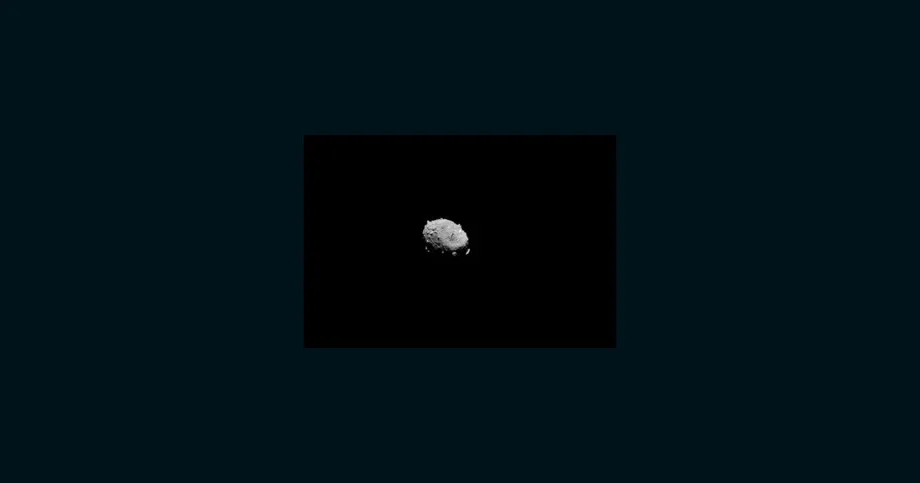
The European Space Agency's Hera spacecraft has returned the first close look at the asteroid that NASA deliberately struck four years ago, and the scene is more dramatic than the distant telescope view could show. Dimorphos, a rocky body about 151 metres wide, now has one face flattened into a crater the size of a sports stadium. The asteroid is also tumbling as it circles its larger companion, Didymos, while hundreds of small boulders move around the pair.
Contents
- A Crash Scene 193.5 Million Kilometres Away
- What DART Actually Did
- The Hit Left a Crater, a New Shape and Old Rocks
- Why Dimorphos Is Tumbling
- Hundreds of Boulders Circle the Pair
- A Slow Motion Flight Through a Rocky Neighbourhood
- What Hera Is Measuring Now
- Which Missions Go Closer in January
- Why a Small Asteroid Test Matters for Earth
- What Scientists Still Need to Learn
- Key Points
The images were unveiled on 25 November 2026 in the dinosaur hall of the Museum für Naturkunde Berlin, a setting chosen to connect the experiment with the asteroid impact that ended the reign of the dinosaurs 66 million years ago. The first close view was taken from about 29 km on 7 November. The boulder view was made from 11 long exposure frames captured by the HyperScout H camera on 6 November from about 29.9 km, with the bright asteroids digitally removed so the dim rocks could be seen.
Ian Carnelli, Hera's mission manager, said the museum setting was a reminder of what is at stake.
Sixty-six million years ago, an asteroid impact changed the course of life on Earth. Today, for the first time in history, humanity is validating how to prevent such an event from happening again.
Didymos is about 730 metres wide. The pair orbits the Sun about 193.5 million km from Earth. Neither asteroid threatens Earth, which is why scientists could use them as a test target. What happened there now matters because it offers a real example of how a rubble pile asteroid responds when a spacecraft hits it.
What DART Actually Did
NASA's Double Asteroid Redirection Test, known as DART, hit Dimorphos on 26 September 2022 after a little over 10 months of travel. It struck at about 6.1 km/s, or roughly 22,000 km/h. The Instituto de Astrofísica de Canarias gives the spacecraft's mass as 576 kg. Other mission figures put the speed at about 22,530 km/h, and the impact released about 10 billion joules of energy.
Before the hit, Dimorphos took 11 hours 55 minutes to circle Didymos. Afterward, the orbit took about 11 hours 23 minutes. ESA gives the change as 33 minutes. NASA had set 73 seconds as the minimum success threshold, so the result was about 27 times that benchmark. A March study in Science Advances found that the pair's 770 day orbit around the Sun also changed by a fraction of a second, the first time a human made object changed the solar orbit of a natural body.
The method is called a kinetic impactor. A spacecraft crashes into an asteroid and transfers momentum, like a fast billiard ball nudging another object. The debris thrown off the asteroid can add to the push, much as exhaust adds thrust to a rocket.
The key dates show how the investigation unfolded:
- 26 September 2022: DART struck Dimorphos and ended its own mission.
- 2023: Hubble observations identified 37 boulders apparently linked to the impact.
- 7 October 2024: ESA launched Hera on a two year journey to the pair.
- 4 November 2026: Hera reached the asteroid system.
- 25 November 2026: ESA released the first close up images in Berlin.
- December 2026: Hera is due to approach to about 13 km.
- January 2027: Hera plans to release Juventas and Milani.
- June 2027: Hera's study of the system is due to end.
The Hit Left a Crater, a New Shape and Old Rocks
For years, scientists could measure that DART had moved Dimorphos, but they could not see the damage beneath the dust. Computer work before Hera's arrival suggested several possibilities. The impact might have carved a neat crater, reshaped the whole body or left a surface that looked much the same as before.
Patrick Michel, Hera principal investigator and Director of Research at CNRS and the Observatoire de la Côte d'Azur, said the team expected a debate among those options. He said the images answered the question in an unexpected way.
Scientists debated whether Dimorphos had sustained an impact crater, changed its shape or stayed the same. Much to our surprise the answer turns out to be all three at once! The face struck by DART has been flattened into an impact crater the size of a sports stadium, which extends across the asteroid's entire width.
A cigar shaped structure sits inside the crater. Julia de León, instrument scientist for HyperScout H at the Instituto de Astrofísica de Canarias, said the crater looked unusual close up.
The crater is very big, and seems to have some weird structures inside it.
Other parts of Dimorphos look familiar. Hera found boulder fields outside the crater that match those seen in DART's 2022 images. Didymos also appears unchanged, keeping its boulder fields and central equatorial ridge. Naomi Murdoch, a planetary scientist at ISAE-SUPAERO, described Didymos as resembling a giant walnut, with a central ridge that may form as fast rotation moves surface material toward the equator.
Why Dimorphos Is Tumbling
Before DART, Dimorphos behaved much like Earth's Moon. It was locked to Didymos, always showing the same face as it orbited. That state is called tidal locking, and it happens when gravity gradually settles a smaller body into a regular spin.
Michael Kueppers, ESA's Hera mission scientist, said the new images show that this tidy pattern ended after the impact. He said Hera watched the change as more views arrived.
As Hera returned more images, it became clear that the DART impact has left Dimorphos tumbling wildly in its orbit.
Michel said at a press conference that Dimorphos now appears to be the most chaotically rotating object in the Solar System. Sabina Raducan, a planetary scientist at the International Space Science Institute in Bern and a Hera science team member, used a simpler picture.
Raducan described the moonlet's motion in everyday terms for the press briefing.
Before the DART impact, Dimorphos was more like our own moon. So it was always showing the same face to Didymos. It was behaving quite nicely. Now it's very chaotic.
The tumble matters because it records how the impact transferred energy into the whole asteroid. DART did not push a solid rock on a frictionless surface. It struck a loose collection of rocks and dust held together by weak gravity. Material blasted into space acted partly like exhaust from a rocket, giving Dimorphos an extra push beyond the spacecraft's own momentum.
Low gravity can produce surprising effects. NASA's OSIRIS-REx mission stirred up an estimated six tonnes of rock and dust when it gently collected a sample from Bennu in 2020. Scientists on Hera say the same lesson applies here: surfaces on small asteroids do not respond the way people expect from daily life on Earth.
Hundreds of Boulders Circle the Pair
The most crowded surprise came from the space around the asteroids. Kueppers said the first images revealed many objects that had not been mapped before. He explained that their presence changes the work ahead.
Another big surprise is that Hera is showing that the asteroids are surrounded by hundreds of orbiting boulders, just a few metres in size.
Some rocks appear only tens of centimetres across, while others are about the size of footballs, washing machines or small cars. Some extend about 7 to 10 km from the pair. Naomi Murdoch said the long exposure image looked like a crowd of dim points around the bright binary pair. Hubble had seen 37 likely boulders in 2023, but Hera's wider view found hundreds.
Scientists do not yet know whether all the boulders came from DART, were thrown from Didymos when debris hit it, or were already moving around the pair before 2022. Hera's closer imaging and trajectory data should help measure their sizes and paths. That will show whether they are fresh impact debris or older material from the formation of Dimorphos.
A Slow Motion Flight Through a Rocky Neighbourhood
Hera is about the size of a small car. It is observing from roughly 25 km to 30 km away, flying around the two tiny bodies in rectangular paths. The spacecraft uses its thrusters to hold those paths at an average relative speed of just 12 cm per second, slower than a person walking.
That slow pace helps. The boulders and the spacecraft are all moving in a very weak gravity field, so a collision would not happen at the high speeds usually meant by the term hypervelocity impact. Naomi Murdoch said surface gravity on Didymos is about 40,000 times weaker than Earth's. At the current image scale, the smallest visible rocks on Didymos are about 3 metres across, with some about 10 metres.
Margherita Cardi, project manager for the Milani CubeSat, said the boulder images changed the mood of the team as it prepared the next flight phase.
There is a mix of excitement and panic.
Claudia Balossi, spacecraft systems engineer for Juventas, said the planned route would carry her small spacecraft through the boulder zone before any landing attempt. She said the sizes of the objects were hard to ignore.
We are right in the middle of it.
Kueppers said the team must plan around the rocks as Hera closes in. The next imaging passes should sharpen the map and reduce the risk to the small satellites.
What Hera Is Measuring Now
The European Space Agency's ESA mission update says Hera began work in an early characterisation phase with three instruments. The Asteroid Framing Camera provides black and white images. HyperScout H observes in 25 separate colours. JAXA's Thermal Infrared Imager, known as TIRI, measures surface temperatures. Hera carries 12 instruments in all.
The IAC instrument briefing gives more detail on HyperScout H. Its detector uses 25 interference filters arranged in a 5x5 pixel matrix, covering wavelengths from 661 to 952 nanometres, from the red light people can see into the near infrared. That lets the camera map minerals and surface alteration while also identifying boulders and craters.
George Prodan, a member of the HyperScout H instrument team at the Instituto de Astrofísica de Canarias, explained why that combination is useful.
This is a very powerful instrument: we can obtain an image with a good spatial resolution to identify surface features (boulders, craters, etc) and, at the same time, information on the minerals and the degree of alteration they have experienced.
Hera itself was built by a consortium of 18 ESA states led by OHB in Germany. DART cost about $330 million and Hera about €360 million. Those sums show how a short collision was only the start of a much longer scientific investigation.
The early images came from about 31.6 km to 32.8 km at a resolution of roughly 3 to 4 metres per pixel in some views. The spacecraft is now expected to gather images with details down to several centimetres as it moves closer and continues through June 2027.
Which Missions Go Closer in January
Hera's next move is to reduce the distance from about 25 km to 30 km to around 13 km in December. In January 2027, it plans to release Juventas and Milani, two CubeSats about the size of shoeboxes. Each will take a different kind of measurement that Hera cannot make from its safer orbit.
Juventas is led from Luxembourg. It will use low frequency radar to probe Dimorphos's interior, the first such sounding of an asteroid, and later attempt a landing to measure the moonlet's weak gravity. Milani is led from Italy and will study material and dust around the pair. Together with Hera, the three spacecraft will form a small fleet studying the same two bodies from different angles. At mission end, the CubeSats and Hera are expected to descend to the surface.
Holger Krag, head of ESA's Space Safety programme, said Hera and the later Ramses mission address two different ways an asteroid can change. He described Hera's role in direct terms.
Hera is helping us understand the consequences of deliberately striking an asteroid.
Krag added that the future Ramses mission will study how an asteroid responds to a planet's gravity. ESA is developing Ramses with JAXA for asteroid Apophis, a body about 450 metres wide, which will pass about 32,000 km above Earth on 13 April 2029. The flyby is close by space standards but is not expected to put Earth in danger. NASA's OSIRIS-APEX spacecraft, which sampled Bennu, will also study Apophis.
Why a Small Asteroid Test Matters for Earth
DART proved that a spacecraft could change an asteroid's orbit. Hera is answering the harder question of how and why that change happened. Those answers are needed because an asteroid's composition can change the result of an impact. A dense rock, a loose pile of rubble and a body with buried voids would not respond in the same way.
Michaël Marsset, an astronomer at the European Southern Observatory, said the images mark a turning point for both science and planetary defence. He said scientists had a rare scientific setup: they knew the projectile's mass, speed and path, and they had pictures before and after.
This offers a unique opportunity to study the physics of impacts at the scale of an asteroid.
Marsset said the impact may also have exposed material that had been hidden beneath Dimorphos's weathered surface. He gave a warning about trying to plan a real deflection mission without knowing the target.
If we ever have to deflect another asteroid, this time on a collision course with Earth, we need to know what we are shooting at.
Ian Whittaker, a senior lecturer in physics at Nottingham Trent University, said the basic idea of deflection sounds simple but depends on the target's response. He said the new images will improve later calculations.
These images will help with understanding what is present after the impact and make for more accurate calculations in the future.
Early warning is the other half of planetary defence. There is no known asteroid on a collision course with Earth. If scientists find a dangerous asteroid years ahead, a tiny change in speed can grow into a large miss distance. Marsset pointed to the Vera C Rubin Observatory in Chile and NASA's Near-Earth Object Surveyor space telescope as surveys that should find more objects earlier. NASA plans to launch NEO Surveyor in 2027.
Josef Aschbacher, ESA Director-General, said the DART and Hera pairing shows countries combining their strengths. He described the division of work and the role of international partners.
This is international collaboration at its best: NASA having demonstrated that an asteroid can be deflected, ESA is now providing the detailed scientific investigation needed to understand how that deflection worked, along with valuable contributions from international partners, including Japan's JAXA.
Ian Carnelli, Hera's mission manager, made the same point from the Berlin stage. He said DART showed that deflection works and Hera is showing what happened to the asteroid itself.
By combining these two missions, humanity is taking a decisive step towards making asteroid deflection a reliable tool for protecting our planet.
Carnelli also connected the science to the dinosaurs, but his point was practical. An impact large enough to cause global damage is rare, while an asteroid the size of Dimorphos could still devastate a city. Knowing how to redirect such an object turns a one off experiment into a method that could be used with planning.
What Scientists Still Need to Learn
Michel cautioned that Hera has only begun its work. The crater is visible, but the full depth of excavation, the internal structure and the amount of momentum transferred are still being measured. Those numbers will determine how well computer models predicted the event.
The boulders are another puzzle. Their origin remains open, and their paths could affect how close Juventas and Milani can safely fly. Hera's closer images in December and its CubeSat data in January should give sharper sizes, positions and movement rates.
The wider question is whether Dimorphos is a good guide for other asteroids. It is a binary moonlet with weak gravity, and many dangerous asteroids could be different. Hera's measurements of mass, surface properties and interior structure will help scientists put DART's result into a broader family of asteroid types.
For now, the first images have changed the picture from a successful hit to a detailed physical case study. NASA moved Dimorphos. Hera is showing the dent, the spin and the debris field left behind, one close pass at a time.
Key Points
- Hera found a stadium sized crater across one face of Dimorphos.
- DART shortened Dimorphos's orbit around Didymos by about 33 minutes in 2022.
- Dimorphos is now tumbling instead of keeping one face toward Didymos.
- Hundreds of boulders circle the pair, and their origin is still open.
- Hera will move closer in December and release Juventas and Milani in January 2027.
- The data aim to make asteroid deflection a predictable planetary defence tool.