A rose seedling closed the ring, and the work grew larger
On 28 November 2024, workers planted desert rose seedlings in a final gap measuring 50 metres wide and 100 metres long at the Wanhua Garden sand control demonstration area in Yutian County, on the southern edge of the Taklamakan Desert. That planting completed a vegetation belt stretching 3,046 kilometres around a desert covering more than 337,000 square kilometres. It created the world's longest ecological barrier encircling a desert, around what is regarded as the world's second largest desert dominated by shifting dunes.
Contents
- A rose seedling closed the ring, and the work grew larger
- How did a thin defensive line become a broad green barrier?
- Engineering adapted to salt, distance and moving dunes
- Roses created a market at the desert edge
- Medicinal plants and processing factories broaden the desert economy
- Why residents now apply to treat the sand themselves
- National gains come with lessons about survival and water
- The next target is 2030, but maintenance will decide the result
- What to Know
Two years later, the scene at the closing point is less about a ceremony and more about winter maintenance. Farmers spread straw around rose roots and cover it with sand, protecting the young plants from cold while helping to hold the soil in place. More than 80,000 mu of roses along the belt received this form of winter protection, often described as giving the plants a quilt. One mu equals about 667 square metres, so the area covers roughly 5,300 hectares.
The larger change lies beyond that original planting line. During 2025, 21 key counties and cities along the desert edge added 9.3822 million mu of vegetation, approximately 625,000 hectares. The widest part of the barrier now reaches 7,500 metres, replacing the idea of a narrow defensive line with a much broader zone of trees, shrubs and crops. In Hotan Prefecture, the average number of dusty days from January to September 2026 was 37 lower than in the same period a year earlier, while severe dust days fell by 13. Local figures also describe a steady recovery in biodiversity.
How did a thin defensive line become a broad green barrier?
Yutian, Minfeng and Pishan counties concentrated their expansion around sources of blowing sand, oasis edges and the direction of the main damaging winds. At the Qiandong demonstration area in Yutian, farmers placed jujube seedlings in prepared sand trenches, firmed the soil around them and laid drip irrigation tubes close to the roots. Trees were spaced roughly four metres apart, leaving room between rows for medicinal herbs in the following year. Saxaul, tamarisk and jujube now grow where mobile dunes previously shifted with the wind.
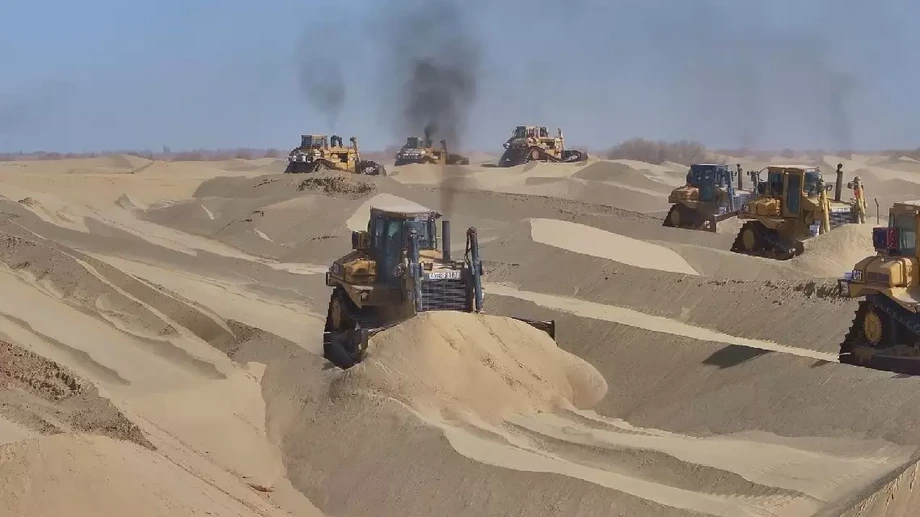
Some dunes cross administrative boundaries, so Pishan and Yecheng counties began coordinating their work and planting Russian olive and desert poplar across their shared sandy area. The Xinjiang Production and Construction Corps, which operates farms and settlements alongside the local county system, also joined the campaign. On projects including the road linking Tumxuk and Kunyu, workers installed straw checkerboards and protective forest networks. The checkerboards are grids of straw pressed into the sand. They slow wind near the ground and trap moving grains, giving vegetation a better chance to take root.
- 1978: China began the Three-North Shelter Forest Program, the national effort behind decades of shelterbelt planting.
- 28 November 2024: The final seedlings closed the 3,046 kilometre ring around the Taklamakan, 46 years after the wider programme began.
- 2025: Twenty one counties and cities expanded the desert edge vegetation by 9.3822 million mu.
- 2026: Rose products from Yutian entered the premium market in France, and a major cistanche processing project began operating in Shaya County.
- 2030: Xinjiang plans to complete its tasks under the sixth phase of the Three-North programme.
- Around 2050: The national shelter forest programme is scheduled for completion.
Makit County is building a second belt covering 20,000 mu behind the original ring. Ruoqiang County has arranged three forms of defence: fixing sand in place, expanding vegetation and blocking further movement. Its aim is to widen the green corridor between the Taklamakan and the Kuruktag Mountains, pushing control work eastward rather than defending only one fixed boundary.
Engineering adapted to salt, distance and moving dunes
Yutian has tested a method called terrace sand control, reshaping dunes in steps to reduce preparation costs and shorten construction periods. No county figure for those savings was released. The county has also established several standard demonstration areas combining planted forests, physical barriers and solar powered sand control, creating work for residents near their homes.
Shaya County addressed a different problem: how to irrigate plants in remote sand without first building an extensive power network. Distributed solar facilities pump shallow brackish water, which contains enough salt to make it unsuitable for ordinary drinking supplies, and use it to irrigate saxaul. Local officials say survival rates have steadily improved, although no precise rate was given for that site.
Minfeng County took an almost opposite approach in its Houheba desert control zone. Its model avoids building roads, installing conventional power lines or levelling all the land before work begins. Companies were brought in to treat sandy land at scale. Together, these methods show why the expansion is not simply a matter of planting the same tree everywhere. Water availability, distance from settlements, dune movement and the cost of maintaining plants all shape the design.
Roses created a market at the desert edge
Every May, the harvest changes the pace of life in Yetaikezile village in Yutian's Arele Township. At dawn, three wheeled vehicles arrive at the rose bazaar carrying buds and petals. The crop now supports thousands of households, while processing businesses and cooperatives turn it into flower tea, rose paste, essential oil, skin care products and foods. In 2026, Yutian's desert rose products entered the premium market in France.
The commercial chain matters because roses alone do not remove the need for continued planting and irrigation. Harvesting and processing create reasons for farmers to maintain the vegetation after the initial construction work ends. Yutian has also tested medicinal plants and selected varieties including skullcap, mint, astragalus and isatis, allowing some land between protective plantings to produce an additional crop.
Medicinal plants and processing factories broaden the desert economy
Cistanche, a fleshy medicinal plant that grows in association with the roots of host plants such as saxaul, has become another important source of income. Farmers inoculate saxaul roots with cistanche seed, allowing the same land to support a protective shrub layer and a harvestable crop. In Qiemo County, planting associated with saxaul forest has helped more than 2,000 people increase their earnings. Lop County has expanded cultivation and supported factories producing cistanche teas, extracts and solid drinks.
A processing project that began operating in Shaya in 2026 can handle more than 20,000 tonnes of cistanche a year, making it the largest project of its kind in Aksu Prefecture. Its capacity shifts more of the work from selling raw material towards making finished products. Pishan County has developed 50,000 mu of standardised gualou cultivation with processing facilities, while Hotan County has converted sandy wasteland for rice production. Yutian's herb trials add further variety.
Xinjiang now has more than 10 million mu of economic crops adapted to sandy conditions, an area of roughly 667,000 hectares. Their total output value is close to 30 billion yuan. Hundreds of local processing businesses support employment for 300,000 people near their homes. These figures cover desert crops across the region, rather than the Taklamakan belt alone, but they show the scale of the industry into which the new plantings are being connected.
Why residents now apply to treat the sand themselves
Hotan Prefecture has sought to make participation more secure by confirming rights over unused state owned sandy land at village level, contracting plots to households and directing the benefits to the people who work them. Land contract certificates give families a clearer claim on the returns from years of planting and maintenance. Since 2024, 1,929 households in Yutian have applied to join sand control work, covering 185,000 mu.
Rezi Bake, a farmer in Yutian's Oytograk Township, contracted 20 mu of sandy land in 2024 to test desert roses. After two years of care, he earned nearly 5,000 yuan from fresh flowers in 2026. He has also planted shegan, a medicinal plant known as blackberry lily, between the roses and expects another source of revenue the following year. He explained his change of attitude in simple terms.
I used to think roses could not survive in this yellow sand.
Qiemo County describes its approach as using forest to support forest. Cistanche has been inoculated across 83,200 mu, contributing to a green barrier about 23 kilometres long and covering 134,000 mu. The planting combines vegetation intended to hold sand with a crop that can finance continued care.
In Yuepuhu County, farmer Abdusalam Talip joined four other households in 2025 to contract sandy land and cultivate cistanche beneath saxaul. Their first harvest arrived in autumn 2026. Speaking about the change in how he viewed the desert, he said:
I used to look at this desert and see only raging sandstorms and a harsh environment. I never thought the sandy land could bring us an income.
Technical support is intended to reduce the risk of such experiments. Minfeng's sand control research station tests medicinal herbs in batches before recommending established varieties to farmers. Yutian has created a sand industry experimental base where an enterprise owned by the state tests cultivation first, rather than asking every household to bear the cost of an unsuccessful crop.
National gains come with lessons about survival and water
The Taklamakan barrier sits within a much older national campaign. The Three-North Shelter Forest Program is planned to run until around 2050, creating shelterbelts across northern, northeastern and northwestern China. Its proposed barrier extends about 4,828 kilometres and, in some regions, could reach 1,448 kilometres in width, encompassing about 88 million acres of forest. China's desert coverage declined from 27.2 percent a decade earlier to 26.8 percent in 2024, a reduction of 0.4 percentage points. National forest cover rose from about 10 percent of territory in 1949 to 25 percent in 2024.
Decades of planting have also produced warnings about choosing quantity over durability. Winter storms destroyed 10 percent of new forest stock in 2008, prompting the World Bank to advise greater attention to quality. The loss of one billion poplars in Ningxia in 2000 illustrated the vulnerability of extensive planting that relies heavily on one species. Researchers have also raised concerns about groundwater depletion, water loss through evaporation and plant transpiration exceeding local precipitation, and planting programmes that leave overgrazing or unsustainable farming untouched.
Survival research gives a more mixed picture than planting totals alone. A January 2023 study of the wider programme found that only one fifth of surviving forests had formed a stand within 10 years, while only one tenth survived for 40 years. Shrubland performed better. A 2026 study found that planted forests in the northern shelterbelt grew 46 to 66 percent faster than natural forests, but reached their growth peak at 30 to 40 years.
Those findings help explain the Taklamakan project's use of shrubs, grass grids, drip irrigation and several crop species alongside trees. Solar power is also being used in desert regions beyond Shaya's irrigation pumps. Panels can shade soil, reduce wind at ground level and create conditions in which grass or nitrogen fixing liquorice grows underneath. Sand accumulating on panels and the cost of carrying electricity from remote areas remain practical constraints.
The next target is 2030, but maintenance will decide the result
Xinjiang's plan calls for completing its sixth phase tasks under the Three-North programme by 2030 and achieving a decisive victory in the effort to contain the Taklamakan's edges. For oasis communities, success would mean more stable farmland and settlements, fewer severe dust episodes and employment that gives residents a financial reason to keep vegetation alive.
The anniversary figures do not provide a survival rate for all planted areas or a water budget for the complete belt. Those details will be essential as plantings mature and as processing businesses draw on harvests. For now, the most visible measure of the change is practical: along the original 3,046 kilometre ring, flower fields, medicinal crops, orchards and factories are appearing where the task two years ago was simply to close the remaining gaps in the sand.
What to Know
- A final rose planting on 28 November 2024 completed a 3,046 kilometre vegetation belt around the Taklamakan Desert.
- Expansion across 21 counties and cities added 9.3822 million mu in 2025, with the widest section reaching 7,500 metres.
- Hotan recorded 37 fewer average dusty days and 13 fewer severe dust days from January to September 2026 than a year earlier.
- Roses, cistanche, gualou, rice and medicinal herbs are linking sand control with processing businesses and farm income.
- Xinjiang has more than 10 million mu of economic crops suited to sandy land, producing nearly 30 billion yuan in output and supporting 300,000 local jobs.
- Land contracts and technical trials are encouraging households to join, while long term water use and plant survival remain central to the 2030 target.