A Direct Invitation at MIC's Assembly
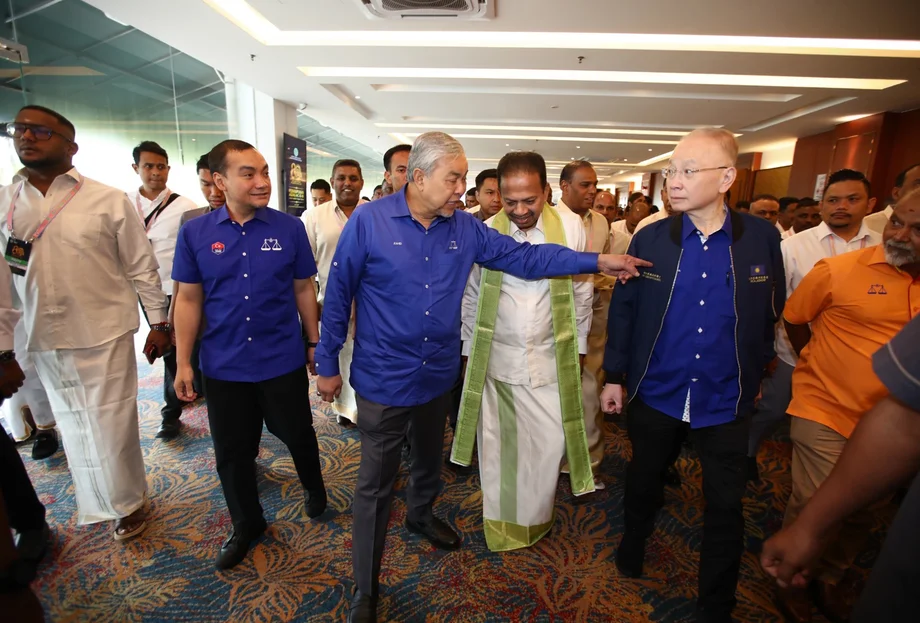
Barisan Nasional (BN) chairman Datuk Seri Dr Ahmad Zahid Hamidi used MIC's 80th Annual General Assembly in Johor Bahru on 28 November 2026 to make a direct pitch to Indian Malaysians: individuals, political leaders and NGO leaders outside the coalition can join BN as direct members. He said the coalition's constitution has a clause that allows people to become members of BN itself without first joining one of its component parties, such as UMNO, MCA or MIC.
Contents
The setting was the Austin International Convention Centre in Johor Bahru, with MIC president Tan Sri Dr SA Vigneswaran, MCA president Wee Ka Siong, PPP president Dr J. Loga Bala Mohan and Johor BN chairman and state chief minister Datuk Onn Hafiz Ghazi also present. Zahid, who is also UMNO president and deputy prime minister, framed the invitation as a homecoming for Indian Malaysians who had left or never joined the coalition.
Zahid spoke more plainly in his opening speech. He said it was time for former BN members from the Indian community and leaders from parties outside BN to return, using the phrase cukup-cukuplah in Malay.
I ask our Indian friends in political parties outside BN to return to us. Enough is enough.
The offer puts a constitutional mechanism at the centre of a political outreach campaign. It arrives as BN reviews a blueprint that is a decade old, nudges MIC toward a stronger election target and gives Indian parties outside the coalition, including one in the opposition camp, a decision to weigh.
How Direct Membership Works
Direct membership is a simple idea with political reach. BN is a coalition, meaning a group of parties that contest elections together. A component party is one of the parties inside that group. The BN constitution, Zahid said, includes a clause that lets the coalition accept individuals directly, so a person can be tied to BN without joining UMNO, MCA, MIC or another party in the coalition.
Zahid compared the plan with UMNO's Rumah Bangsa programme. He said that programme opened a route for former UMNO members and the wider Malay community to come back into UMNO's fold. BN was now opening a broader route for Indian Malaysians, including people who lead political parties or civil society groups but do not sit inside BN.
The practical effect is to give BN a way to reach Indian leaders who may not want to merge their own organisations into MIC or another existing party. For voters, BN is presenting a route into the coalition that does not require joining one of its existing parties.
Zahid said BN's doors were open through this route and argued that the coalition, rather than its rivals, would champion the interests of Malaysian Indians, especially younger people. He also said the other side had not promised anything to the Indian community, a line aimed at parties competing for the same voters.
A Short Timeline of the Political Opening
The invitation sits on top of earlier moves, a policy review and a forthcoming party decision. The dates show what has already happened and what is still open.
- 2017: The Malaysian Indian Blueprint was launched by then prime minister Najib Razak as a plan listing solutions on education, social inclusion and other issues affecting Indian Malaysians.
- April 2024: The Malaysian Indian People's Party, known as MIPP, joined the opposition coalition Perikatan Nasional (PN), a move viewed as strengthening PN's reach among Indian voters.
- June 2026: MIPP president P Punithan confirmed that MIPP had received an invitation to join BN, but said his party had made no decision.
- 28 November 2026: Zahid invited Indian individuals, political leaders and NGO leaders to take up BN direct membership at MIC's 80th annual assembly in Johor Bahru.
- Before the end of 2026: A Musyawarah Nasional, or national consultation, on Agenda Malaysia Biru is expected to be held, with MIC leading the discussion on Indian community interests.
- 6 December 2026: MIPP's central committee is scheduled to discuss BN's invitation.
- 2027: The Malaysian Indian Blueprint reaches its 10th anniversary.
The next formal checkpoint is MIPP's central committee meeting on 6 December.
The Blueprint at Ten Years
Zahid tied the membership invitation to a review of the Malaysian Indian Blueprint, launched in 2017. The blueprint will mark 10 years next year. He said MIC and BN component parties led by Indian leaders had been tasked with reviewing its framework so that it fits with Agenda Malaysia Biru, a policy agenda he announced at last year's UMNO general assembly.
Zahid said Agenda Malaysia Biru was not confined to UMNO. He called it a whole BN agenda intended to serve the country. That wording places the Indian community review inside a wider coalition policy drive rather than a single party project.
The blueprint is a policy document that lists solutions to problems facing Indian Malaysians, including education and social inclusion. Social inclusion means making it easier for people to take part in schools, jobs, public services and community life on fair terms. Zahid said he expects Indian community interests to be discussed before the end of this year through a Musyawarah Nasional on Agenda Malaysia Biru, with MIC leading.
The review gives the direct invitation a policy setting. BN is asking Indian leaders to come closer politically and promising a fresh look at a plan that has existed for a decade. Funding and delivery will decide whether the review changes daily life.
The Funding Numbers
Funding proposals gave the assembly its most concrete numbers. Zahid said the review should include doubling the value of the open unit trust investment portfolio for the Indian community from RM1.5 billion to RM3 billion. A unit trust is an investment fund that pools money from many investors and buys a basket of assets, making it easier for ordinary savers to invest.
He also proposed doubling the allocation for loans that carry no interest for the Indian community from RM500 million to RM1 billion. MIC president Tan Sri Dr SA Vigneswaran urged Zahid to seek the Prime Minister's approval for 1.5 billion Amanah Saham 1Malaysia units and RM500 million in loans that carry no interest.
The comparison is clear. The proposed unit trust portfolio would rise by RM1.5 billion. The proposed loan allocation would rise by RM500 million. Vigneswaran's request for 1.5 billion Amanah Saham 1Malaysia units refers to units in a government investment scheme; a unit is one share of ownership in such a fund.
Those figures were proposals at the assembly, not an approved budget. They are meant to be carried into the blueprint review and the Agenda Malaysia Biru consultation. The practical test for Indian families is whether any increase becomes available after the discussion ends.
MIPP's December 6 Choice
The party most directly tested by Zahid's invitation is the Malaysian Indian People's Party, or Parti Rakyat India Malaysia (MIPP), a component of Perikatan Nasional. MIPP president P Punithan said the invitation would be considered at the party's central committee meeting on 6 December. He said the party would weigh BN's approach against its principles, current commitments and the interests of Indian Malaysians over the long term.
Punithan confirmed in June that MIPP had already received an invitation to join BN. He said then that no decision had been made and that the party was open to reviewing its future as political developments unfolded. MIPP joined PN in April 2024, giving the opposition coalition a more direct channel to Indian voters.
Punithan's wording leaves room for either outcome. A party already inside PN must consider what its existing commitment means for its identity and its voters. Zahid's offer puts that choice on the table at a fixed date and gives MIPP time to discuss the matter internally before making any move.
Zahid said the other side had made no promises to the Indian community. He said BN was determined to champion Indian Malaysians, especially the younger generation. That message reaches beyond MIPP to Indian voters, NGO leaders, former BN members and leaders now in other parties.
MIC and the Seat Target
BN's invitation also comes with an election challenge for MIC. Zahid said he wants MIC to win at least five parliamentary seats in the 16th general election, known as GE16. He said MIC once held five seats and hoped it could win at least five again.
The target is set against a lean result in the 15th general election. MIC contested 10 parliamentary seats in GE15 and won only Tapah in Perak. Its deputy president M Saravanan retained Tapah with a majority of 5,064 votes.
Zahid acknowledged that the number of seats previously allocated to MIC had fallen short of the party's aspirations. He praised MIC's election machinery, the network of party workers and volunteers who campaign, visit voters and help on election day. He said cooperation among BN component parties in the Johor and Melaka state elections, which helped MIC win state seats, should continue.
MIC won one of the 10 parliamentary seats it contested in GE15. Zahid's target of at least five would mean four more wins than in GE15. Direct membership is one route BN is using to widen its political base before the next election; the seat target will depend on candidates, campaign machinery and voter support.
Johor Relations and the Segamat Question
Zahid linked MIC's revival to Johor, where the assembly was held. He advised MIC president Tan Sri Dr SA Vigneswaran to maintain good relations with Datuk Onn Hafiz Ghazi, the Johor menteri besar and BN state chairman. A menteri besar is the state chief minister in Johor.
Zahid hinted that Vigneswaran could contest a seat in Johor in GE16. He spoke about a constituency he described as safe, meaning a seat where a candidate is likely to win. His comments pointed toward Segamat, though he did not announce a candidate.
BN chairman Zahid addressed Vigneswaran directly from the assembly stage. He said the MIC president should keep close ties with the Johor state leader because that relationship would help him in a safe seat.
Tan Sri Vicky (Vigneswaran), maintain good relations with the Johor menteri besar. I know that constituency is safe, and if it is safe, Tan Sri Vicky will also be safe.
BN chairman Zahid was later asked whether Vigneswaran would contest the Segamat parliamentary seat in GE16. He did not confirm a plan, but he indicated that the formal candidate letter would follow in due course.
When the time comes, I will sign the 'watikah' (appointment letter of candidates).
Rayer Urges Immediate Action
The blueprint review drew a response from RSN Rayer, the DAP member of Parliament for Jelutong. He said Zahid, as deputy prime minister, should raise the matter with the Cabinet and work with Prime Minister Anwar Ibrahim instead of waiting for BN to return to power.
Rayer challenged Zahid's political timing in a statement. He asked whether the deputy prime minister needed BN to win back Putrajaya before acting on the aspirations of Indian Malaysians.
Does he need BN to return to power in Putrajaya before he can fulfil the aspirations of the Malaysian Indian community? As deputy prime minister, he is in a position to advocate for these initiatives.
Rayer said blueprint announcements at party assemblies were not enough for the community. He called for action through the Cabinet and the Prime Minister's Office and listed practical measures.
The Indian community must not be treated as an audience to be wooed with promises every time a political party holds its general assembly.
Rayer said the community needed concrete action, proper funding, clear implementation targets and measurable results. His challenge reframes Zahid's announcement as a test of government delivery and coalition politics. BN's answer at the assembly was a promise of discussion, with no implementation timetable beyond the planned consultation before the end of the year.
What Changes Now
For Indian Malaysians, the announcement creates three openings. The first is membership: people outside BN can now be invited into the coalition directly. The second is policy: the Malaysian Indian Blueprint will be reviewed and linked to Agenda Malaysia Biru. The third is money: proposals exist to raise investment and loan allocations.
For BN, the move is an attempt to rebuild bridges with a community that parties across the political divide now court. The direct membership route gives BN something to offer leaders who cannot or do not want to join MIC. It also gives MIC a chance to present itself as the anchor of Indian representation inside the coalition.
MIPP's decision on 6 December will be the first visible test. If MIPP stays with PN, BN's offer still exists for individuals, NGOs and other leaders. If MIPP moves closer to BN, the coalition gains an Indian party from the opposition camp, and the fit with MIC and other BN component parties becomes the next question.
Several details remain open. BN has not said how many direct members it expects. The only timing given for the blueprint review was that the consultation would be held before the end of the year. The funding proposals need approval and implementation details. GE16 candidate decisions remain unannounced, including Segamat. The 6 December meeting and the national consultation are the next checkpoints.
Key Points
- Zahid invited Indian individuals, political leaders and NGO leaders outside BN to join the coalition as direct members.
- He said the BN constitution allows direct membership and compared the route with UMNO's Rumah Bangsa programme.
- The offer was made at MIC's 80th Annual General Assembly at the Austin International Convention Centre in Johor Bahru on 28 November 2026.
- BN plans to review the Malaysian Indian Blueprint, launched in 2017, with MIC and component parties led by Indian leaders, ahead of its 10th anniversary in 2027.
- Proposals include raising the open unit trust investment portfolio from RM1.5 billion to RM3 billion and doubling allocations for loans that carry no interest from RM500 million to RM1 billion.
- MIPP, a PN component party, will discuss the invitation at its central committee meeting on 6 December.
- Zahid wants MIC to win at least five parliamentary seats in GE16, after it won only Tapah among 10 seats contested in GE15.
- RSN Rayer urged Zahid to act through the Cabinet and with Prime Minister Anwar Ibrahim rather than wait for BN to return to power.