Thailand puts a temporary brake on short selling
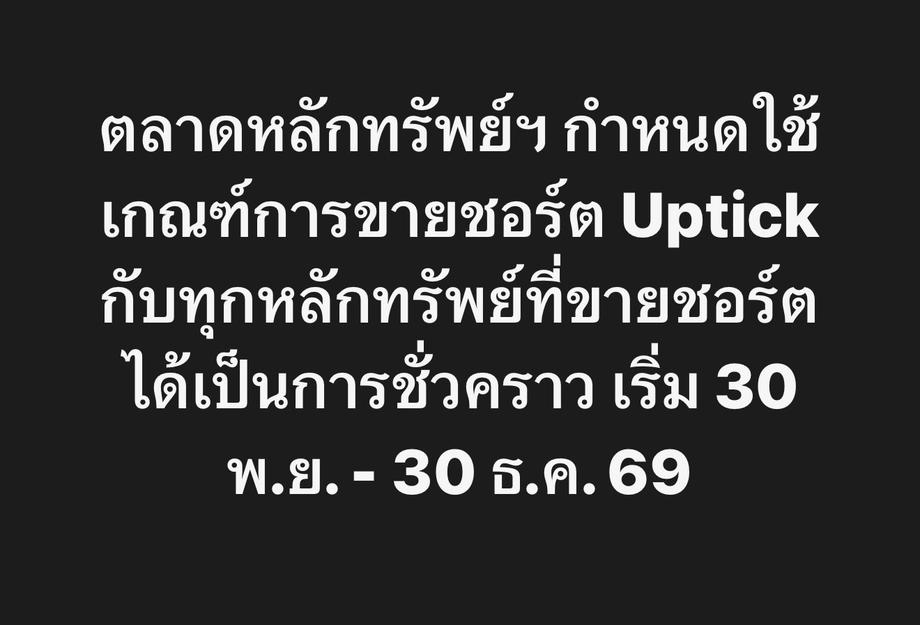
The Stock Exchange of Thailand (SET) will require short sellers to offer every eligible security above its last traded price from 30 November to 30 December 2026, restoring the Uptick Rule across the market for one month. The SET Board of Governors approved the temporary measure on 28 November after a global wave of selling in shares connected to artificial intelligence and other external uncertainties drove sharp swings in the SET Index and unusual trading conditions. Orders from market makers are exempt. The exchange can end the measure early if conditions improve; otherwise, its normal rules will return when the period expires.
Contents
- Thailand puts a temporary brake on short selling
- What changes for a trader selling borrowed shares?
- Why the normal rule remains in place
- The numbers behind concern about selling pressure
- Which stocks attracted the most short selling?
- Why a fund manager wants a different trigger
- Is short selling the cause or an accelerator?
- How the SEC wants the measure evaluated
- What investors should watch during the month
- Key Points
Paradorn Tiannarapramote, a fundamental analyst at Asia Plus Securities, calculated that the SET Index lost about 90 points during the nine trading sessions from 16 to 26 November. The combined market value of listed shares fell by roughly 1.2 trillion baht, while foreign investors were net sellers of about 13 billion baht. He put the index return since the start of the year at approximately 12% after the retreat and identified foreign selling and trade war concerns as continuing pressures. Research from CGS International Securities also noted that the index had fallen below 1,450 points.
What changes for a trader selling borrowed shares?
Short selling begins when a trader borrows shares and sells them, hoping to buy them back later at a lower price. The trader returns the shares and keeps the price difference if the plan succeeds. When many short sellers act during a decline, their orders can add to the selling pressure already weighing on a stock.
The Uptick Rule controls the price of those orders rather than banning the transactions. A short seller must offer the security above its last traded price. If a share last changed hands at 10 baht, for example, a covered short seller must offer it above 10 baht, using the price increments permitted by the exchange. Under the normal Zero-Plus Tick rule, an offer at 10 baht would be acceptable because orders can match the last traded price. The temporary rule therefore prevents short sellers from repeatedly posting the same price or chasing a decline with lower offers.
Market makers are outside the temporary restriction. These participants place buy and sell orders to help trading continue and provide liquidity, meaning investors can find someone willing to take the other side of a transaction. Other traders can still open short positions during the month, but they must meet the stricter price condition. The practical effect is to make short selling harder while a price is falling, without prohibiting it.
Why the normal rule remains in place
Eight new trading measures took effect on 16 November following consultation with market participants and approval from the Securities and Exchange Commission (SEC). One changed the usual short selling condition from the Uptick Rule to Zero-Plus Tick. Under that framework, the stricter requirement returns on the next business day only for a security whose closing price has fallen at least 10% from the previous close.
The temporary decision removes both the need to wait for a 10% decline and the limitation to individual securities. Every security eligible for short selling comes under the Uptick Rule regardless of how much its price has moved. SET nevertheless described Zero-Plus Tick and the 10% trigger as its main criteria for normal conditions. The exchange characterized the month of stricter control as a supplementary response to exceptional trading, not a permanent replacement for the package introduced on 16 November.
- 16 November 2026: Eight trading measures took effect, including Zero-Plus Tick and the individual stock trigger based on a 10% closing decline.
- 16 to 26 November: The SET Index lost about 90 points over nine sessions as short selling activity increased.
- 26 November: Trading figures provided the latest ranking of the stocks with the highest short selling values.
- 28 November: The SET Board of Governors approved the temporary market wide Uptick Rule, and the SEC publicly explained its oversight.
- 30 November: The stricter pricing condition is scheduled to begin.
- 30 December: The measure is scheduled to expire, although an improving market could bring an earlier return to the normal criteria.
SET said it would continue examining market and trading conditions and adjust its response as appropriate to preserve stable, orderly and efficient trading.
The numbers behind concern about selling pressure
Prakit Siriwatanaket, managing director of MFC Asset Management, said daily short selling had risen from about 1.7 billion baht, equivalent to 1% to 2% of total turnover, to between 7 billion and 8 billion baht, or about 12%. At 8 billion baht, the daily amount would be more than four times the earlier figure. He compared the situation with 2020 and 2021, when short selling reached 15% of turnover and computer programs trading at high speed were widely used.
The exchange had reduced tick sizes alongside the introduction of Zero-Plus Tick. A tick size is the smallest permitted movement between quoted prices, so a smaller increment allows orders to be priced in finer steps. Prakit said the intended benefits of the changes might not match the actual outcome. His comparison also places the recent activity in context: the reported 12% share of turnover was below the earlier 15% level, but far above the 1% to 2% share seen before the new rules.
Outstanding short positions stood at 13.2 billion baht. Prakit illustrated how that balance could keep growing: if traders short 8 billion baht of shares in a day but close only about 5 billion baht of positions, roughly 3 billion baht more remains open before other adjustments. Closing a position generally requires buying shares back. A growing balance can therefore represent both continued pressure while positions are being established and potential demand for shares when traders eventually close them.
Which stocks attracted the most short selling?
Figures compiled as of 26 November ranked KTB first by short selling value among ten heavily traded securities. Each percentage below compares the value of short sales with total trading in that particular stock, showing how large the activity was relative to its own turnover.
- KTB: 711.75 million baht, representing 23.38% of trading in the stock.
- DELTA: 590.56 million baht, or 15.23%.
- KBANK: 514.35 million baht, or 16.59%.
- GULF: 488.04 million baht, or 15.54%.
- KKP: 485.14 million baht, or 22.32%.
- ADVANC: 468.20 million baht, or 19.97%.
- AOT: 427.30 million baht, or 12.91%.
- TRUE: 385.92 million baht, or 20.16%.
- PTT: 344.86 million baht, or 15.76%.
- CPALL: 344.12 million baht, or 17.61%.
KTB led both the value ranking and the proportional ranking, with short sales accounting for nearly one quarter of its turnover. KKP was next by proportion at 22.32%, followed by TRUE at 20.16%. AOT had the smallest share among the ten at 12.91%, even though its short selling value exceeded that of TRUE, PTT and CPALL. CGSI said the concentration of activity in large companies and stocks with abundant liquidity had added pressure on the index.
Why a fund manager wants a different trigger
Prakit linked the increase in activity to risks for individual investors as well as the market. He drew on earlier episodes when short selling represented more than 10% of turnover and described the pattern he believed regulators should address.
From past experience, when the proportion of short selling exceeds 10% of total trading value, the Thai stock market tends to continue declining. This affects retail investors who buy shares when prices weaken, and it may affect market liquidity in the next period.
Prakit urged the exchange to alert investors when short selling becomes abnormal across the market or in an individual stock, especially where accumulated positions keep rising. He also proposed replacing the reliance on a 10% decline during one session. A stock can lose substantial ground over several days without ever crossing that threshold on a single day, leaving the automatic Uptick trigger unused. His alternatives included activating the rule when a price falls below an average or when a cumulative decline passes a specified level. He said these ideas had previously been presented to the exchange but could not be incorporated into the latest package in time.
Is short selling the cause or an accelerator?
Theeraseth Promphong, a macro strategist at Maybank Securities (Thailand), placed greater weight on international forces. He said Zero-Plus Tick gives short sellers more flexibility because, although they cannot directly keep offering lower prices, they can sell repeatedly at the same price when the market rebounds. That can increase pressure in the short term. His assessment of the broader decline focused on concerns about valuations for global technology shares and the scale of investment in artificial intelligence and data centres.
Theeraseth expected the Thai economy to improve after reaching a low point in the second quarter of 2026 and projected gross domestic product growth of 2.7% in 2027. He also used market valuation measures to argue that Thai shares were becoming more appealing.
Short selling is therefore only an accelerator of the adjustment in the Thai stock market, rather than the main cause. Market valuation is starting to become attractive again, with the P/E at 12.4 times and the earnings yield gap at 6.3%.
The price to earnings ratio, or P/E, compares share prices with company earnings. His figure of 12.4 times was part of that valuation assessment. The earnings yield gap is another comparison used to judge the return available from company earnings against a benchmark yield. His argument separates two issues that will run on different schedules: the temporary trading restriction ends in December 2026, while his economic projection concerns 2027.
How the SEC wants the measure evaluated
The SEC acknowledged the exchange's decision and said it was monitoring conditions closely. Secretary General Pornanong Budsaratragoon explained that SET was using powers under its own regulations, for which the SEC commission had already given approval, so that temporary measures could respond to threats to orderly securities trading. If SET ends the measure before 30 December, it must notify the SEC and other relevant parties in advance.
Pornanong said assessing trading measures must be continuous. Because recent market conditions have been influenced by several forces at once, she argued that temporarily restoring the Uptick Rule would make it easier to distinguish the effects of individual measures from other developments occurring during the same period.
She also described the regulator's continuing coordination with the exchange and its consultations with investors and other market participants.
The SEC has monitored and coordinated with the SET closely and continuously, and has listened to observations and opinions from investors and relevant parties, to assess the situation on the basis of data and facts. It is ready to consider establishing or reviewing measures, including the use of additional tools, as necessary and appropriate to the situation and market conditions.
That statement leaves open the possibility of further action if conditions require it. Neither institution announced a date for deciding whether the normal 10% trigger should be permanently redesigned.
What investors should watch during the month
CGSI's research team welcomed the temporary return of the Uptick Rule after selling in large, liquid stocks helped push the SET Index below 1,450 points. Its central test is whether the month produces less short selling and lower volatility. The team also cautioned that heavy short selling does not guarantee a later wave of buying. It advised investors to examine capital flows alongside the fundamentals of each company.
Theeraseth similarly warned against treating every short sale as a negative judgement on a business. Some transactions hedge, or reduce, risk elsewhere in a portfolio. Others are arbitrage, which seeks to benefit from a price difference between related assets. He identified large liquid stocks, expensive shares and companies sensitive to international conditions, including electronics and energy businesses, as likely candidates for short selling. His suggested approach was selective buying focused on strong fundamentals, reasonable valuations and positive factors specific to each company.
Stocks with large accumulated short positions could experience short covering if positive news encourages traders to buy shares and close their positions. For brokers and traders, the immediate obligation is simpler: from 30 November, systems and orders covered by the rule must respect a price above the last trade. For other investors, the scheduled milestones are the start on that date and the expiry on 30 December, with the possibility of an earlier change if SET decides that conditions have improved.
Key Points
- SET will apply the Uptick Rule to every security eligible for short selling from 30 November to 30 December 2026.
- Short offers must exceed the last traded price, while orders from market makers are exempt.
- The decision followed global selling in shares connected to AI, sharp SET Index movements and unusual trading conditions.
- Daily short selling rose from about 1.7 billion baht to between 7 billion and 8 billion baht, according to MFC Asset Management's managing director.
- KTB recorded the highest value among ten leading stocks as of 26 November, at 711.75 million baht or 23.38% of its turnover.
- SET retains Zero-Plus Tick and the 10% individual stock trigger as its normal framework.
- The exchange may end the temporary measure early, subject to advance notice to the SEC and relevant parties.