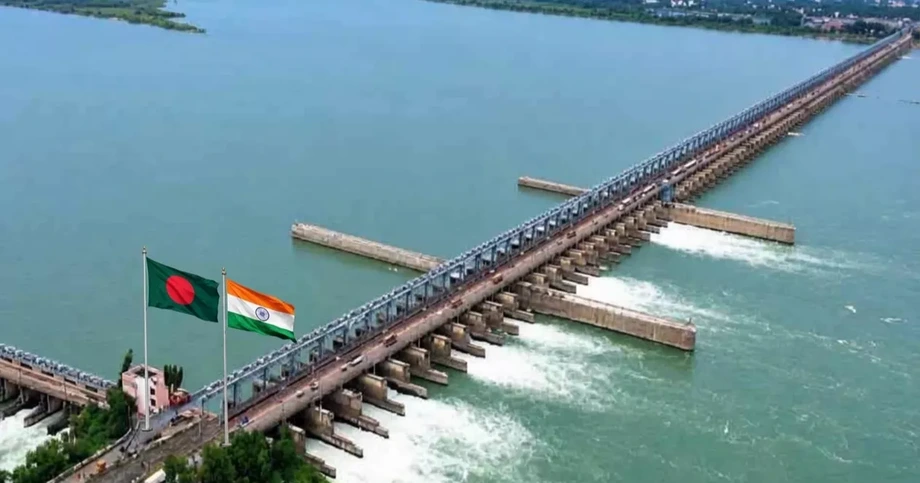
A Water Deal With 30 Years on the Clock
India and Bangladesh are days away from the expiry of the 1996 Ganges Water Sharing Treaty, with no agreed timetable for formal talks on what comes next. The agreement runs out on December 12, 2026. Its practical release season already ended on May 31, when the last scheduled quantum of Ganges water flowed from the Farakka Barrage in West Bengal to the Hardinge Bridge point in Bangladesh. The two governments still disagree about the route into negotiations: Dhaka has built a technical team and wants formal talks, while New Delhi says the Joint Rivers Commission is the established forum.
Contents
- A Water Deal With 30 Years on the Clock
- What the Treaty Says, Cusec by Cusec
- A Timeline With a Gap Before December
- How Farakka Became the Centre of the Dispute
- Why a Guarantee Clause Is the Central Fight
- Who Is Talking, and Through Which Door
- Water Moves Into Street Politics in Bangladesh
- Why Delhi Has Reasons to Care About the River Deal
- The Padma Barrage Makes the Arithmetic Harder
- What Could Bridge the Gap Before the Next Dry Season
- Key Points
For readers far from the river, the issue is straightforward. The Ganges is a lifeline. It forms a 129 kilometre boundary between India and Bangladesh and flows another 113 kilometres inside Bangladesh. India controls the flow at Farakka and uses diversion to keep the Hooghly and Kolkata port workable. Bangladesh sits downstream and depends on dry season flows for irrigation, fisheries, navigation, drinking water and delta ecosystems. A treaty lapse would leave both sides without the shared schedule that has measured releases every 10 days for three decades.
The deadline has arrived at a tense moment. Relations have been strained since Sheikh Hasina was removed from power in August 2024, and Bangladesh continues to seek her extradition from India. India has invited Prime Minister Tarique Rahman twice, and his perceived disinclination to engage India has added to uncertainty. A possible return by Hasina to Bangladesh on December 16 adds another political event just four days after expiry.
What the Treaty Says, Cusec by Cusec
The treaty was signed in New Delhi on December 12, 1996, by Indian Prime Minister H. D. Deve Gowda and Bangladeshi Prime Minister Sheikh Hasina Wajed. It set a 30 year arrangement for the dry season and recognised Bangladesh's rights as a lower riparian state, meaning a country downstream that relies on water entering from upstream. Its formula drew on average flow records from 1949 to 1988. It monitors flows from Farakka to Hardinge Bridge from January 1 to May 31 each year. It also permits barrages and irrigation projects in Kushtia and on the Gorai and Madhumati river system in Bangladesh.
A cusec is one cubic foot of water per second. The treaty uses a three tier schedule based on flow at Farakka. At 70,000 cusecs or less, India and Bangladesh split the water equally. Between 70,000 and 75,000 cusecs, Bangladesh receives 35,000 cusecs and India keeps the rest. At 75,000 cusecs or more, India receives 40,000 cusecs and Bangladesh gets the balance, which at the threshold is 35,000 cusecs.
There are exceptions inside the formula. Between March 11 and May 10, both countries are guaranteed 35,000 cusecs in alternating periods of 10 days. Article II(iii) says that if flow at Farakka falls below 50,000 cusecs in any period of 10 days, the two governments must hold immediate emergency consultations guided by equity, fair play and no harm to either party. Uttam Kumar Sinha, a senior fellow at the Manohar Parrikar Institute for Defence Studies and Analyses, said Article XI also requires India to release at least 90 percent of Bangladesh's calculated share in specified circumstances.
A Timeline With a Gap Before December
The 2026 monitoring season ended on May 31, but the calendar has kept moving. Bangladesh and India share 54 rivers, and the Ganges is the only one with a comprehensive bilateral water sharing treaty. The proposed Teesta agreement remains unsigned. Article 12 says the Ganges treaty lasts 30 years and can be renewed only by mutual consent, with no automatic extension. India has maintained the Farakka release schedule close to the treaty timetable, but the next legal base is now in doubt.
The most recent formal contact was technical rather than political. A four member Indian delegation led by Joint Rivers Commission chief Sharad Chandra and a six member Bangladeshi team led by Anwar Kadir met in Dhaka from November 21 to 23 for the 91st meeting of the Joint Committee. They finalised the annual report on treaty implementation for 2026. Renewal was not discussed there, because the decision sits with the two governments and their political leadership.
- June 22, 2024: The two sides welcomed a joint technical committee and agreed to prioritise data exchange and an interim sharing framework.
- January 1 to May 31, 2026: Scheduled Ganges releases were monitored at Farakka and Hardinge Bridge.
- May 31, 2026: The last scheduled quantum of water flowed to Bangladesh, closing the operational season.
- June 2026: Bangladesh formed a high level technical committee led by Prime Minister's Adviser on Finance and Planning Professor Rashed Al Mahmud Titumir.
- August 2026: Dhaka renewed its request that New Delhi name a committee and start talks.
- November 17, 2026: Bangladesh's water resources minister sent a letter seeking early negotiations.
- November 21 to 23, 2026: The 91st Joint Committee meeting finalised the 2026 implementation report in Dhaka.
- November 28, 2026: The National Citizen Party held a rally in Khulna demanding Bangladesh's fair share.
- December 12, 2026: The treaty expires.
- December 16, 2026: Hasina has said she plans to return to Bangladesh.
That leaves a narrow bridge between a completed monitoring report and a treaty expiry. Bangladesh has said it is ready; India has said it is committed to cooperation while protecting its own interests. Neither has announced a date for formal negotiations.
How Farakka Became the Centre of the Dispute
The argument began with a structure built for a port. The Ganga splits near Farakka in Murshidabad district, with the Padma flowing east into Bangladesh and the Bhagirathi feeding the Hooghly toward Kolkata. Sedimentation in the Hooghly had worried port planners since the 1800s. Work on the Farakka Barrage began in 1961 and was completed in 1975; a 1974 date is also used for the barrage in accounts of the dispute. It diverted dry season water into a feeder canal to flush silt and help ships reach Kolkata.
Bangladesh objected before and after independence. In 1976, Maulana Abdul Hamid Khan Bhashani led a Farakka Long March demanding demolition of the barrage. Bangladesh raised the issue at the Non Aligned Movement summit and the 31st session of the United Nations General Assembly. A treaty of friendship signed on March 19, 1972, by Indira Gandhi and Sheikh Mujibur Rahman created the Joint Rivers Commission to manage shared rivers, floods and cyclones.
A 41 day interim arrangement in 1975 preceded the first broad deal. In 1977, Morarji Desai and Ziaur Rahman signed a five year agreement. It gave Bangladesh about 59 percent of dry season water and India about 41 percent, and promised Bangladesh at least 80 percent of its scheduled share in each 10 day period. Memorandums in 1982 and 1985 kept much of the allocation but dropped that minimum guarantee. The Bangladesh Nationalist Party later criticised the treaty but did not abandon it after taking power in 2001. The 1996 treaty turned the arrangement into a 30 year legal framework.
Why a Guarantee Clause Is the Central Fight
Bangladesh's central demand is a promise that its share will not collapse when the river is low. Under the 1977 agreement, Bangladesh was entitled to at least 80 percent of its stipulated share in any 10 day period. The 1996 treaty removed that fixed minimum, though it kept formulas and emergency consultation. Dhaka now wants stronger protection in whatever document follows, along with better access to information on flows.
Bangladesh's water resources minister, Shahiduddin Chowdhury Anee, said the priority is a safeguard like the one Bangladesh had nearly five decades ago.
Restoring a guarantee clause, similar to the one in the 1977 agreement, is a priority for Bangladesh.
Anee also said Dhaka certainly wants a new agreement that protects national interests. Titumir, the prime minister's finance and planning adviser and head of Bangladesh's technical committee, said water sharing is tied to food, the environment and the economy.
We want an agreement that guarantees Bangladesh's fair share of water during the dry season and protects the country's interests in the long term.
India's objection is technical and political. Nilanjan Ghosh, vice president of Development Studies at the Observer Research Foundation in Kolkata and head of its Kolkata Centre, said a fixed guarantee would put risk on the upstream country when flows are low.
India therefore cannot commit to such an impracticable demand.
Sinha said India can offer a sharing mechanism but not an unconditional fixed volume guarantee. West Bengal needs water for the Bhagirathi and Hooghly system and Kolkata port. India also points to the National Thermal Power Corporation plant at Farakka. Bihar has raised concerns about sedimentation and flooding. Those state concerns matter because India's federal system gives states a strong voice in decisions over rivers. Shahab Enam Khan, executive director of the Bangladesh Centre for Indo Pacific Affairs, said renewal matters but the treaty must be revised because it was written almost three decades ago.
The numbers explain the gap in expectations. In 1977, Bangladesh received about 59 percent of dry season water. At the 75,000 cusec threshold in the 1996 formula, Bangladesh's 35,000 cusecs amount to about 47 percent of the flow. The two formulas work from different bases, but the change helps explain why Dhaka describes the older guarantee as protection.
Who Is Talking, and Through Which Door
Bangladesh moved first in institution building. It formed a high level technical committee in June 2026 and informed India. The committee is led by Titumir and includes ministries and river experts. Dhaka asked New Delhi to name its own committee and begin formal talks, then repeated the request in August. Anee said Bangladesh had sent two letters to India, including one personally, without a response so far. One letter seeking talks was dated November 17.
India has kept the conversation inside existing machinery. Randhir Jaiswal, official spokesperson at the Ministry of External Affairs, said the Joint Rivers Commission deals with water matters involving more than one country, including the Ganga.
there is an established mechanism for this purpose, for discussion between India and Bangladesh.
Jaiswal also said India remains committed to a constructive relationship with Bangladesh while safeguarding Indian interests. A four member Jal Shakti delegation attended the 91st Joint Committee session. Dhaka argues that the June 2024 understanding welcomed a joint technical committee for renewal; New Delhi's emphasis on the Joint Rivers Commission has left the process without an agreed roadmap. Officials in Dhaka describe the needed arrangement as equitable and able to withstand climate change.
Bangladesh's wording has shifted. Anee said Dhaka wants a new agreement, while Titumir after the Dhaka meeting said Bangladesh hoped India would take steps before December 12 so formal negotiations on renewal could begin. Both formulations carry the same demand: a stronger dry season guarantee.
Water Moves Into Street Politics in Bangladesh
The treaty is no longer only a subject for technical committees. Nahid Islam, convener of the opposition National Citizen Party, warned at a Dhaka rally on October 30 of renewed protests unless the water sharing agreement is renewed on terms that protect Bangladesh's share. The party held another rally near the Sonali Bank premises and Ferryghat intersection in Khulna on November 28.
Akhtar Hossain, a member of parliament and the National Citizen Party's member secretary, said the Khulna region depends on Padma distributaries and has suffered from water shortages and saline intrusion. He linked those problems to the Farakka Barrage and to harm for agriculture, fisheries, livelihoods and the environment. He said ties with India should rest on equality rather than hegemony.
The domestic debate in India has drawn in JD(U), Nitish Kumar and External Affairs Minister S. Jaishankar as Bihar's concerns meet the treaty's future. Silt deposition has been put at about 2 million tonnes annually, and Bangladesh has linked diversion to salinity, fisheries damage, navigation problems and water quality concerns.
The government in Dhaka is already managing other pressures. Hasina announced on November 24, through her spokesperson, that she plans to return on December 16, Victory Day. She has lived in India since the uprising that removed her in August 2024. Bangladesh's International Crimes Tribunal sentenced her to death in absentia in November 2025 for crimes linked to that uprising; she denies the allegations. The government rejected a passport request and has repeated its extradition demand.
Garment workers have also protested over wages. A wage board approved a 36 percent increase on November 25, raising the monthly minimum from 12,500 taka to 17,000 taka, but demonstrations continued in Gazipur. That political background makes any perception of weakness on water sharing difficult for Bangladesh's leaders, especially when opposition groups are already using the river issue in public meetings.
Why Delhi Has Reasons to Care About the River Deal
India often appears to hold the stronger cards because it controls the upstream flow. Ashok Swain, professor of peace and conflict research at Uppsala University, argued in a November 27 opinion piece that India has more to lose than Bangladesh if the treaty expires without a replacement. His reasoning goes beyond the immediate volume of water. Renewal may not give Bangladesh much more water if upstream demand and changing rainfall reduce flows at Farakka.
Swain and Sajid Karim estimated in a study for Oxfam that poor cooperation among countries in the Ganges Brahmaputra Meghna basin costs at least $14.2 billion a year. Better coordination could support hydropower, irrigation, flood management, navigation, environmental restoration and regional trade. Bangladesh's ports and waterways also matter for India's eastern and northeastern regions.
China adds another layer. Its existing and planned hydropower projects on the Yarlung Tsangpo, known as the Brahmaputra downstream, have raised concerns about water availability, sediment and transparency. Swain said India weakens its own position when it asks Beijing for responsible upstream behaviour while leaving Bangladesh's downstream concerns unresolved. Bangladesh has also expanded engagement with Pakistan and China, including Chinese work on Mongla Port and backing for the Teesta River Comprehensive Management and Restoration Project.
India's own record on treaty commitments is part of the diplomatic setting. New Delhi has held the Indus Waters Treaty with Pakistan in abeyance since April 2025 after the attack at Pahalgam. The Ganges and Indus agreements have different histories, but a Ganges lapse would add to questions about India's role in shared river cooperation. New Delhi is also moving away from fixed guarantees toward shorter terms and availability based formulas that put Indian demand first.
Bangladesh's foreign minister wants the settlement framed for decades, not months. Dr Khalilur Rahman spoke at the ninth Indian Ocean Conference in Mauritius about a durable arrangement. He noted 55 years of bilateral relations and called mutual climate resilience a key driver for the future.
These are common rivers, and we have common legacies here, common interests, and, as I said, there's no other alternative but to seek a solution that is durable and will win public trust. And this will also be very important to lay the basis for the relationship over the next 25 to 50 years.
The Padma Barrage Makes the Arithmetic Harder
Bangladesh's search for water security has its own engineering debate. The Padma Barrage project, approved in May by ECNEC, Bangladesh's economic approval body, carries a cost of Tk 34,497 crore. Its pond can hold about 2,900 million cubic metres. Released evenly from January to May, that volume would provide about 7,900 cusecs, roughly a quarter of the 35,000 cusecs that Bangladesh can receive in alternating periods under the current treaty.
Professor Md Ataur Rahman has argued that a barrage cannot create water and that sediment must be part of how any structure operates. Bangladesh Poribesh Andolon put 10 questions to the Bangladesh Water Development Board and its consultants at a Dhaka discussion on August 22. Professors Nazrul Islam and Md Khalequzzaman said the questions remained unanswered and the feasibility study was withheld despite a Right to Information request.
The treaty talks and the barrage are linked. A project that diverts part of the remaining dry season flow toward the southwest could give India an argument for releasing less at Farakka. The planned minimum release of about 9,000 cusecs in March and April is about one eighth of the roughly 70,000 cusecs that once passed Pangsha before Farakka. Bangladesh's stronger claim in negotiations rests on the need for lean season flow, so the design of its own barrage can affect that claim.
Professor Rahman's case also points to sediment. Farakka traps much Himalayan sediment, but what passes through is vital for delta land building. Trapping more at Pangsha could worsen sediment starvation along the coast. The 1996 treaty does not address sediment, biodiversity or ecosystem services in a basin wide way, an issue Ghosh has raised in discussing renewal.
What Could Bridge the Gap Before the Next Dry Season
The legal effect of expiry is precise. Article 70(1) of the 1969 Vienna Convention on the Law of Treaties says that expiration under a treaty's own terms ends the duty to perform it further, while preserving rights and legal situations created through its earlier execution. For the Ganges, the practical gap is a shared legal standard for measuring and dividing water in the 2027 dry season unless the two governments put a bridge in place.
Abhinav Mehrotra, an associate professor at Jindal Global Law School, and Amit Upadhyay wrote that an interim exchange of notes for 2027 could be concluded quickly while a permanent agreement takes longer. They proposed publicly accessible flow data, operating rules linked to observed inflows and neutral technical fact finding. Existing disputes move from the Joint Committee to the Joint Rivers Commission, with no independent technical determination. India has opposed binding third party adjudication, but independent verification of data is a narrower step.
Swain offered a similar bridge: temporarily extend the current treaty while negotiations continue, then add joint measurements, environmental safeguards, climate adaptation, sediment management and arrangements for extreme scarcity. Article IX of the 1996 treaty commits both sides to agreements on other common rivers, especially the Teesta. Linking Ganga renewal to a Teesta settlement would put both tracks at risk.
What remains undecided is plain. There is no agreed date for formal negotiations, no Indian timetable and no settled choice between extension, renewal and replacement. The next firm dates are December 12, when the current treaty expires, and December 16, when Hasina has said she plans to return. After that, the next operational test is the 2027 dry season, when any new standard would have to be in place before releases begin.
Key Points
- The 1996 Ganges Water Sharing Treaty expires on December 12, 2026, with no agreed roadmap for renewal or replacement.
- The 2026 release season ended on May 31, and the 91st Joint Committee meeting finalised the implementation report without discussing renewal.
- Bangladesh wants a stronger dry season guarantee, while India says the Joint Rivers Commission is the proper forum and resists a fixed volume promise.
- The current formula splits flows at 70,000 cusecs or less, gives Bangladesh 35,000 cusecs between 70,000 and 75,000, and gives India 40,000 cusecs at higher flows.
- Politics now surrounds the treaty, from protests in Khulna to Hasina's planned December 16 return and state level concerns in West Bengal and Bihar.
- An interim extension or exchange of notes for the 2027 dry season is one proposed way to keep joint monitoring alive while a new agreement is negotiated.