A preliminary approval with a hard stop
Binance has received approval in principle from the Gelephu Central Bank (GCB) to establish regulated digital asset operations in Gelephu Mindfulness City (GMC), giving the world's largest cryptocurrency exchange a possible base for its Asian operations in southern Bhutan. The company disclosed the decision in a statement dated November 27, 2026, and marked it the next day at Binance Blockchain Week 2026 in Bangkok, where it signed a cooperation agreement with the city.
Contents
- A preliminary approval with a hard stop
- What the Asia hub is meant to deliver
- Why Gelephu wants companies to stay and build
- The payment network already serving Bhutanese merchants
- The plan to enter five more Asian markets
- The October hack and Binance's recovery
- What else Binance disclosed in Bangkok
- Key dates in Binance's Bhutan push
- What happens next, and what remains undisclosed
- The Bottom Line
The Bangkok ceremony took place at the Queen Sirikit National Convention Centre. Binance wants GMC to become an Asia hub serving its users, while the cooperation agreement covers local hiring, workforce training and investment in Bhutan's digital asset sector. The regulatory decision and the business partnership are connected, but they have different immediate effects: the agreement sets out intentions, while GCB will decide when regulated activity can begin.
Approval in principle means that a regulator is prepared to consider the proposed operations, subject to conditions. It is an early stage in licensing, not permission to open for business. Binance must satisfy those conditions and complete the remaining regulatory requirements before receiving a full licence.
Binance's statement defined the restriction in direct terms.
The in-principle approval is a first step, not a full licence and Binance must satisfy the conditions specified by GCB... before the relevant regulated activities may commence.
For now, Binance and GMC can develop their plans and continue the licensing process. The first tangible test will be whether the exchange meets GCB's requirements. Announcing a regional address does not remove that obligation, and the preliminary decision carries no guarantee that a final licence will follow.
What the Asia hub is meant to deliver
The cooperation agreement promises a substantive operating presence rather than a company registered in Bhutan with little local activity. Binance plans to create employment and work with GMC on training, knowledge sharing and collaboration across digital assets, compliance and operations. Compliance means the systems and staff that check whether a business follows financial rules, including controls designed to protect customers and prevent illicit transactions.
The two sides also intend to explore a regional centre of excellence. In this partnership, that means a base of specialist expertise supporting Binance's wider Asian operations while developing skills and institutional knowledge inside Bhutan. The intended result is a workforce capable of handling technical, operational and regulatory work, rather than dependence on teams located entirely abroad.
Jigdrel Singay, a board director of Gelephu Mindfulness City, said the city's objective was to secure lasting economic activity. He described the type of investment Bhutan wants and acknowledged that the licensing process remains unfinished.
Binance choosing Gelephu Mindfulness City as a base for its Asia operations is an important milestone for what we are building in Bhutan. Our ambition is not simply to attract global companies to establish an entity here. We want them to build real operations, create meaningful jobs, develop talent and transfer capabilities that remain in the country over the long term.
The in-principle approval is an important first step, and we look forward to working closely with Binance and GCB as Binance completes the remaining regulatory requirements and builds its presence in GMC.
SB Seker, Binance's head of Asia Pacific operations, presented the decision as an endorsement of the city's regulatory approach rather than simply a choice of location.
Establishing an Asia hub in Gelephu Mindfulness City is a strategic decision that reflects Binance's commitment to operating within clear, progressive regulatory frameworks. The IPA from GCB is an important validation of GMC's approach to digital asset regulation, one that protects users while enabling innovation.
Seker also cited GMC's combination of traditional values, advanced technology and renewable energy as reasons for placing the proposed centre there. He said the partnership was intended to become a model for responsible growth in digital assets.
Why Gelephu wants companies to stay and build
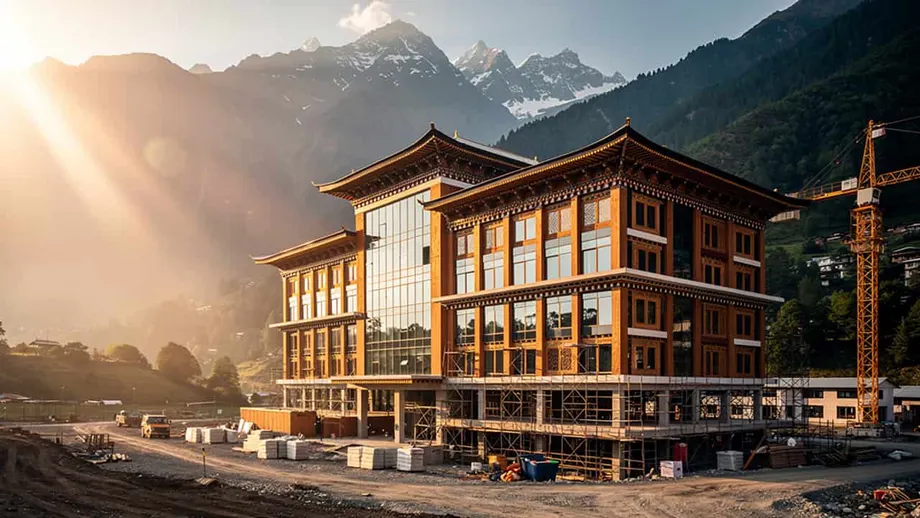
Gelephu Mindfulness City was established in 2024 as a special administrative region in southern Bhutan, along the border with India. Covering more than 4,046 square kilometres, it has an autonomous regulatory framework and counts finance and digital assets among its priority sectors. A special administrative region is an area given distinct administrative or legal arrangements, allowing GMC to develop rules suited to its economic goals while companies operating there remain subject to authorization and supervision.
The city is being presented around mindfulness, sustainability and innovation as well as finance. Its physical development has already included a corridor beside the Mau Chhu river, where Bhutan raised 108 chortens in 24 hours on November 1, 2026. Each Buddhist monument stands 15 metres tall. Project 108 brought together monastic preparation, public donations and volunteer labour, giving an early physical form to the effort to place spiritual values alongside economic development.
GMC has also used licensing as a way to attract financial and technology companies. In May, it offered an accelerated route for crypto and fintech firms already regulated in Singapore, Hong Kong and Abu Dhabi. Singay said at the time that this was not a passport for offshore licensing. Companies still needed authorization under GMC's own rules, so prior approval elsewhere could ease entry without replacing local scrutiny.
The European Securities and Markets Authority has warned about regulatory arbitrage in connection with the European Union's Markets in Crypto-Assets framework, known as MiCA. Regulatory arbitrage means choosing a jurisdiction mainly to avoid stricter obligations elsewhere. For Binance in Gelephu, the practical issue is therefore straightforward: experience in other regulated markets may help its application, but GCB's conditions will determine the scope and timing of any Bhutan operation.
The payment network already serving Bhutanese merchants
Binance's relationship with Bhutan began before this licensing step. Binance Pay and DK Bank launched a payment network in May 2025, when Bhutan introduced what the company describes as the first national system for tourism payments using cryptocurrency. Eligible visitors can pay participating businesses with supported digital assets, while merchants receive Bhutanese ngultrum, the national currency. A hotel or shop can therefore accept a crypto payment without having to keep its takings in a volatile token.
More than 3,700 merchants now accept payments through that network, according to Binance. They range from hotels and airlines to smaller vendors. This existing system gives the proposed hub a local foundation in payments, although the planned GCB licence concerns a separate set of regulated digital asset activities.
At the same Bangkok event, Binance Pay, DK Bank and Tether signed a memorandum of understanding to promote stablecoin payments among Bhutanese merchants, starting with USDT. A stablecoin is a digital token designed to track the value of an asset such as the US dollar. DK Bank is the official bank of Gelephu Mindfulness City, while Tether issues USDT.
Thomas Gregory, Binance's vice president of payments and fiat, said Bhutan had demonstrated that crypto payments could operate nationally. He said the next objective was to make stablecoins more useful for merchants. Ugyen Tenzin, DK Bank's chief executive, said merchant interest in digital payments had grown since 2025 and that the initiative would let businesses serve international customers while continuing to receive their funds entirely in local currency.
Eligible users could receive a 5 per cent rebate on qualifying transactions, capped at $5 per transaction, under the proposed promotion. The memorandum is not binding. Eligibility rules, final rebate terms and a launch date still require agreement among the three parties, so merchants do not yet have a confirmed start date for the new programme.
The plan to enter five more Asian markets
Binance enters the Bhutan process with operating licences in 15 markets, according to company figures. It intends to expand into as many as five Asian markets in 2027, with South Asia and Southeast Asia identified as priorities. Bhutan offers a prospective regulated base in the first of those regions.
Seker said in November that Binance was holding conversations with at least five or six markets and that three were at quite mature stages. He did not identify those markets. The Bhutan announcement therefore reveals one part of a wider expansion programme, rather than a complete list of destinations.
The exchange describes itself as serving more than 300 million users across more than 100 countries. According to Seker, it has no formally established global headquarters. Binance identifies the Financial Services Regulatory Authority of Abu Dhabi Global Market as its primary regulator, even as it seeks licences and permissions in individual markets.
For Bhutan, the partnership offers the prospect of capital, technical expertise and staff development beyond its existing tourism payment activity and small scale crypto mining. For Binance, GMC provides an opportunity to build operations within a regulatory framework that is still being put into practice. The value to either side will depend on the final licence, the size of the local team and the work actually performed in Gelephu.
The October hack and Binance's recovery
The expansion comes weeks after an October security breach in which about US$6.3 billion was stolen from Binance's platform. The FBI and Binance attributed the attack to North Korea, an allegation that Pyongyang denied. The breach stopped all users from making withdrawals for two days and made security a central part of the backdrop to the Bangkok announcements.
Binance said the attackers spent months gaining access through fake job interviews, a tampered developer tool and compromised internal tools that used artificial intelligence. A developer tool is software used to build or maintain other software; tampering with it can turn a routine technical download into an entry point. The described campaign relied on deceiving people as well as defeating computer defences.
Binance allocated $6.34 billion of its own funds to cover losses from the breach. The company said it had initially covered 95 per cent of the lost tokens by purchasing replacements with company money and working with industry partners to freeze $3 billion of stolen assets. It subsequently said coverage of the affected assets was complete. Binance has also maintained that it can absorb the financial losses without raising fresh capital.
On November 26, Binance said the withdrawal suspension had been lifted and recovery work was complete. A few networks remained temporarily closed for maintenance or planned upgrades. That update came two days before the Bhutan agreement was marked in Bangkok.
Richard Teng, Binance's co-chief executive, apologised to users at a media roundtable during the event.
The hack shouldn't have happened.
So we are extremely sorry to our users for the disruption.
Teng said user funds were never touched and that reserves had been fully replenished. He said customers could check this through proof of reserves, a method for presenting evidence that assets are available to support customer balances. Binance has also brought in three outside security firms to review its systems.
Teng warned that a successful attack on a company with Binance's security spending showed that other organisations could also be vulnerable. Binance said it contacted regulators in Japan, South Korea, Australia, Thailand and New Zealand within 36 to 48 hours of the breach. Those notifications, the external reviews and the restoration of withdrawals form the company's account of how it responded while continuing to pursue new markets.
What else Binance disclosed in Bangkok
Richard Teng also provided figures for bStocks, Binance's tokenised US stock products. These are digital tokens linked to US shares. Binance said bStocks had reached $1.5 billion in assets within four months, with 57 per cent of trading taking place outside US market hours. More than half of the activity therefore occurred while American exchanges were closed.
Teng described the broader market as a year of consolidation, meaning a period in which prices and activity settle after earlier movement rather than entering a clear boom. He identified that assessment as a personal opinion, not financial advice.
Major cryptocurrencies traded lower on November 28. Binance data showed bitcoin down 2.34 per cent to $60,057 over 24 hours, ether down 3.78 per cent to $1,666 and BNB down 1.4 per cent to $555.89. These figures provide a market snapshot for the announcement day, not a measure of the Bhutan project's value.
Key dates in Binance's Bhutan push
- 2024: Gelephu Mindfulness City was established as a special administrative region in southern Bhutan.
- May 2025: Binance Pay and DK Bank launched the tourism payment network that now serves more than 3,700 merchants.
- May 2026: GMC's accelerated licensing route for firms already regulated in selected financial centres was in place, with local authorization still required.
- October 2026: About $6.3 billion was stolen in the breach that US authorities linked to North Korea.
- November 26, 2026: Binance said withdrawals had been restored and recovery work completed.
- November 27 and 28, 2026: Binance disclosed the GCB decision, then signed the GMC cooperation agreement in Bangkok.
- 2027: Binance aims to enter as many as five Asian markets, although it has not named all of them.
What happens next, and what remains undisclosed
GCB's detailed licensing conditions have not been set out in the announcements, and no date has been given for a decision on a full licence. Binance has also not disclosed how much it plans to invest, how many people it expects to hire or when a Gelephu team would begin work. The specific activities to be permitted, the applicable custody and compliance expectations and the practical operation of the city's banking and licensing framework remain to be defined through the regulatory process.
For Bhutanese workers, the immediate prospect is a programme of hiring and training rather than a confirmed number of jobs. For merchants, the existing Binance Pay and DK Bank network continues, while the USDT promotion depends on a final agreement. For Binance users, the preliminary approval does not start new regulated services in GMC. Those services must wait until GCB is satisfied and a full licence is issued.
The next milestones are consequently concrete: Binance must meet GCB's conditions, GMC must turn its employment and skills commitments into operating plans, and the three payment partners must settle their outstanding terms. The full licence decision and the final payments agreement will show how much of the Bangkok announcement can move from planning into daily activity.
The Bottom Line
- GCB gave Binance approval in principle for regulated digital asset operations in GMC, but the exchange cannot begin those activities without a full licence.
- Binance and GMC signed their cooperation agreement in Bangkok on November 28, 2026, covering an Asia hub, local hiring, training and investment.
- No investment total, job count or full licence timetable has been disclosed.
- Bhutan's existing payment network reaches more than 3,700 merchants; a separate USDT initiative is still subject to final terms.
- Binance holds operating licences in 15 markets and aims to enter as many as five Asian markets in 2027.
- The expansion follows a $6.3 billion October hack attributed by the FBI and Binance to North Korea, which denied involvement. Binance says affected assets were covered and withdrawal recovery was completed.