A Door Opens After a Century
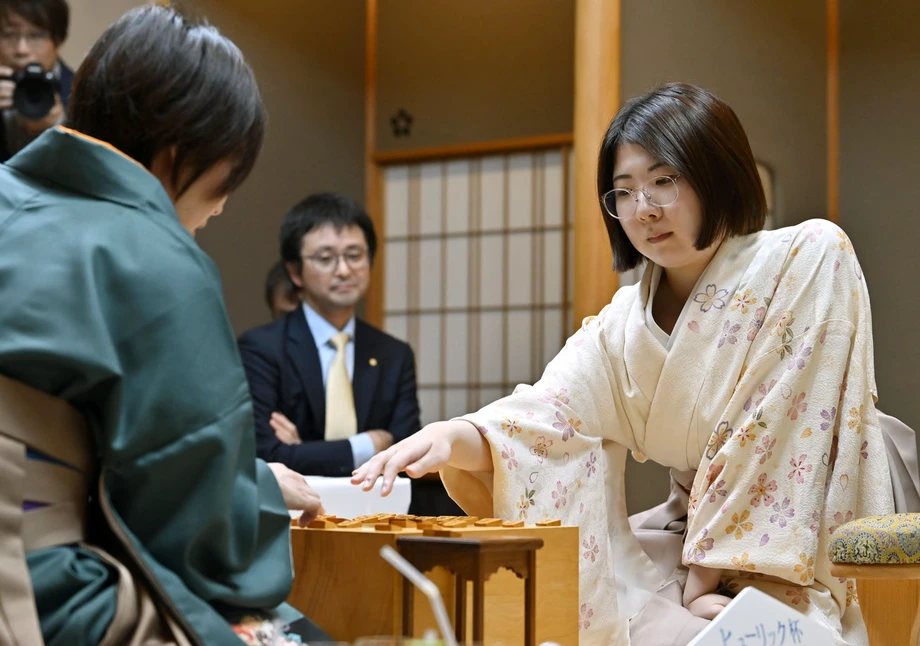
On April 1, 2027, Tomoka Nishiyama will become the first woman to enter shogi's kishi ranks, the professional category filled only by men since the Japan Shogi Association was formed in 1924. She will join as a fourth dan, the entry rank for a kishi, and start in the free class, which lets her play open professional tournaments without belonging to the ranking league that drives promotion through the A and B groups.
Contents
- A Door Opens After a Century
- How a Fifth Hakurei Title Opened the Door
- The Two Ladders Inside Professional Shogi
- Nishiyama's Long Route Through a Hard System
- Why the New Route Provoked Objections
- Pregnancy, Stamina and the Cost of Old Rules
- What Girls See, and What They Still Rarely See
- What Changes When She Plays Open Events
- A Women's Meijin Match at a Baseball Park
- Why Women Stopped Short of the Top in Chess Data
- Key Points
The change is concrete. At an October count, there were 174 active kishi, all men. Adding Nishiyama would make that snapshot 175, though the final number could change as players enter and retire. For decades, the answer to whether a woman could reach that category had been no. From next spring, the answer will be Nishiyama's name on the professional list.
She will not leave the women's game. Nishiyama, 31, holds four women's titles and plans to keep competing for them while taking on stronger opponents in open events. That double schedule is why her promotion is being treated as more than a symbolic first. It will test how a player raised in two systems can move between them.
How a Fifth Hakurei Title Opened the Door
The decisive game was played on October 10 in Kanazawa, Ishikawa Prefecture. Nishiyama, fifth dan in the women's system, defeated Kana Fukuma, 34, in game five of the best of seven Hakurei title series. The win gave Nishiyama her fifth Hakurei title and satisfied a rule introduced in June 2025: a Hakurei titleholder who wins the title five times can seek kishi status based on results in women's tournaments.
Nishiyama did not accept at once. Asked after the match about becoming a kishi, she described staying focused on the board and asked for time. She later filed the required form on October 23, and the association accepted it on October 26. Because the response deadline of two weeks fell on a Saturday, it was moved to Monday.
I tried not to think about it at all while competing. I'd like to calm down a little and consider it carefully.
Her road to that moment can be seen in a short sequence:
- March 2020: she finished 14 wins and 4 losses in the third dan league, one place short of the two promotion spots.
- April 2021: she left the apprentice school and became a women's professional.
- January 2025: she lost the fifth game of the kishi admission examination and ended at 2 wins and 3 losses.
- October 10, 2026: her fifth Hakurei title earned the transfer right.
- October 23 and 26, 2026: she filed the form and announced her decision.
- April 1, 2027: she is due to become a fourth dan kishi.
The Two Ladders Inside Professional Shogi
Shogi is often called Japanese chess, but it has its own pieces and rules. Players face each other across a board of 81 squares, move 20 pieces shaped like wedges and try to checkmate the opponent's king. Captured pieces can return to the board, which makes even simple positions branching and hard to read. A 2025 government white paper put the number of regular Japanese players at about 5 million, with women making up about 20 percent.
The professional game has long had two ladders. Kishi means a professional of fourth dan or higher belonging to the association, and the rank was open to women in wording while remaining male in practice. Joryu kishi is the separate women's professional category, created in 1974 to give women a structure of their own. Akiko Takojima was the first joryu kishi, and she was joined by five other pioneers. More than 80 women now hold professional status in that system, but they have not previously entered the list of 174 kishi.
The distinction matters for readers who hear that women have long been professional shogi players. They have, but mostly in a parallel circuit with its own titles, rankings and public attention. Nishiyama's move does not erase that circuit. It creates a bridge into the open category, where the opponents and title paths were formerly male.
Nishiyama's Long Route Through a Hard System
Born in Osakasayama, Osaka, on June 27, 1995, Nishiyama began playing shogi at 5 and went to a shogi school. Her father and older sister drew her into the game, and older sister Shizuka later became a professional go player. Nishiyama studied under Ito Hirobumi, a seventh dan, and joined the Kansai apprentice school in March 2010 at sixth kyu, the lower levels of the training system.
She reached third dan in December 2015, the last step before professional promotion in that route. In March 2020, she finished the third dan league with 14 wins and 4 losses. Only the top two players advanced, and tie breaks were decided by earlier results, leaving her as the next qualifier. In earlier eras, 11 wins and 7 losses had been enough for promotion, which is why the near miss still draws attention. Her final game in that league was against Sota Fujii, who won on the final day to become a professional.
Nishiyama left the apprentice school in April 2021 and joined the women's professional ranks. She later qualified for the kishi admission examination, a series of up to five games against young professionals in which three wins were required. She beat Takahashi Yujiro, lost to Yamakawa Taiki and Ueno Yuto, beat Miyajima Kenta, then lost to Sakuragi Kanta on January 22, 2025. The result was 2 wins and 3 losses, another narrow miss.
Why the New Route Provoked Objections
The association's decision to let women's title results count for kishi status drew objections from several male professionals and abuse on social media. Some dismissed Nishiyama's advancement as affirmative action, and the association intervened in her defence. The dispute centered on the route into the rank, not on the scale of her results in the women's game.
Yoshiharu Habu, the association president and one of the game's most decorated players, known for making moves that looked ordinary become decisive once the board unfolded, framed the change as an invitation.
We hope this initiative will inspire joryu kishi players to aim even higher.
The invitation lands in a game where older habits survive in small arrangements. Commentary teams almost always have male experts. The association withdrew a rule that would have barred pregnant players from title matches for 14 weeks around expected due dates. Those details show why some players see workplace culture as the harder change, alongside entry rules.
Pregnancy, Stamina and the Cost of Old Rules
An old assumption about women's bodies has already collided with title shogi. A pregnant player was forced to forfeit a match because of health issues. The association briefly prohibited pregnant players from playing title matches for 14 weeks around expected due dates, then withdrew the rule. In 2024, Kana Fukuma's pregnancy and health problems, together with Nishiyama's illness, reshaped several women's title series, producing forfeits because players did not appear and long gaps between games.
Karolina Fortin, the first foreign player to turn professional in Japan, said the milestone was welcome but also a source of worry. She called for changes that fit the actual lives of women players.
There need to be other big changes to how shogi is organised so that they reflect how women live their lives. Long overdue things, like maternity leave and childcare.
Long games add to the problem. Shogi title matches can take hours and finish late, so intellectual skill is joined by stamina. Fortin's point is practical: without maternity leave and childcare, a woman who reaches the top must still arrange her life around a calendar built without her in mind. No pregnancy or childbirth rules are in place for Nishiyama's new kishi schedule.
What Girls See, and What They Still Rarely See
Saori Shimai, a professional in the women's game and executive director of the Ladies Professional Shogi Players' Association of Japan, began learning shogi at 6 after watching her grandfather play. She described a youth scene where girls were thin on the ground.
Even today, there are far fewer girls playing than boys. When I was learning shogi there were hardly any girls playing at all.
Shimai, who turned professional at 15, said the number of women professionals has increased and the standard of play has improved sharply. She said attitudes are changing and the perception gap is narrowing, while adding that women still need an environment in which they can enjoy shogi.
Itsuko Hayashi, a shogi instructor and member of the women's association, said players are increasingly judged by strength. The association arranges events to promote shogi among women and girls.
I think the shogi world respects strength. Male players have no problem recognising shogi ability among women.
Akiko Takojima heard a harsher view when she set out in the 1960s. A male instructor told her women were too stupid to excel at shogi and suggested she find something else to do with her time. Takojima later recalled how boys she played as an apprentice reacted to defeat. Shaving the head has long been used in Japan as a sign of apology or contrition.
The boys I had played against as an apprentice had agreed that if they lost to me they would have to pay a fine or shave their heads.
The apprentice school, the main route into kishi, has about 210 current members, only 3 of them women. That figure sits beside the 5 million regular players and the 20 percent female share of the wider player base. The gap narrows sharply long before the professional top is reached.
What Changes When She Plays Open Events
Nishiyama's first kishi season will be measured by games. She already plays roughly 60 to 70 official games a year, including tournaments with male professionals. As a kishi, she can enter more open events, with results recorded in a different ranking structure.
Free class status means she starts outside the ranking league that leads to the top divisions. The later path runs through C class 2 and C class 1 if she earns promotion. She will start at fourth dan even though she is fifth dan among women, because the two systems rank players separately.
Her decision was not instant. Last October's decision followed two weeks of reflection and recorded her choice to add the open kishi career while continuing women's titles. At the news conference, she described both the encouragement she had received and her own competitive ambition.
I received warm words from many people. I also realized how strongly I wanted to compete against strong players and aim higher.
No date has been given for a second woman to follow her into the kishi ranks. For girls learning the game, the milestone gives a visible example of a route that had no recent destination.
A Women's Meijin Match at a Baseball Park
Before she becomes a kishi, Nishiyama will defend the Women's Meijin title in a series built around firsts. An [official event announcement](https://prtimes.jp/main/html/rd/p/000000423.000079562.html) says game one of the 53rd Women's Meijin five game match will start at 10 a.m. on January 17, 2027, at Es Con Field Hokkaido in Kitahiroshima. It will be the first shogi title match at a professional baseball home stadium.
Her challenger is Isogai Yui, women's second dan, who reached her first title match after an 8 win, 1 loss debut league season. Nishiyama is listed as holder of the Women's Meijin, Hakurei, Seirei and Women's Osho titles, and as the player due to become the first female kishi in April 2027.
- January 17: Es Con Field Hokkaido, Kitahiroshima.
- January 31: Izumo Cultural Heritage Hall, Izumo.
- February 7: Sekine Meijin Memorial Hall, Noda.
- February 22 and March 12: Shogi Hall in Shibuya, Tokyo.
The stadium programme includes an eve of match party on January 16, a viewing of the first move inside the special playing room on January 17 and commentary on a large board with guests including田中贤介, described as a special adviser. The announcement lists ticket prices of 25,000 yen for the party with 90 places, 50,000 yen for first move viewing with 20 places and 7,000 yen for the commentary session with 90 places. Tickets go on sale at noon on November 27, 2026, through F Ticket.
Why Women Stopped Short of the Top in Chess Data
Nishiyama's breakthrough renews an old question in board games: why have women so rarely reached the very top in shogi and chess? In chess, large datasets offer clues but no single answer. A 2009 study of about 120,000 German Chess Federation members counted about 113,000 men and 7,000 women, a ratio near 16 to 1. It reported that 96 percent of the gap between the top 100 men and women could be predicted from participation numbers.
Michael Knapp, an epidemiologist at the University of Bonn, challenged the statistical method in 2010 in the same journal. He said the normal curve used to estimate the top was not a good fit. His recalculation put the share explained by participation at about 67 percent on average. A normal curve is the familiar bell shape that assumes most results sit near the middle and extreme results thin out evenly at both ends.
Robert Howard's 2014 FIDE data compared countries. In Georgia, where women held about 32 percent of international ratings, the gap among players with enough games did not narrow. A 2025 study of about 680,000 US Chess Federation members over 28 years found that women left the game sooner overall, but once starting age and first rating were matched, dropout rates and later rating growth were nearly the same.
Greater male variability is one idea worth understanding. It means that even with similar averages, a slightly wider spread can create many more men at the extreme top. Long title matches are another practical factor: six hours of thinking can end late at night, and stamina matters. For shogi, the apprentice school numbers point to the same early pipeline problem of who starts and who stays.
A share of the gap remains unexplained by these figures. The useful answer for shogi stays close to what can be measured: participation, access to training, match format and the number of women who keep playing long enough to reach the top. Nishiyama's new rank changes the last part of that equation in Japan. It gives women's title results a route into the open professional ranks for the first time.
Key Points
- Tomoka Nishiyama will become the first female kishi on April 1, 2027, entering as a fourth dan in the free class.
- She earned the right on October 10 by winning the Hakurei title for a fifth time, beating Kana Fukuma in Kanazawa.
- The Japan Shogi Association accepted her application on October 26, after a deadline extension.
- She will continue in women's tournaments while playing open professional events against men.
- Her promotion has revived debate over entry rules, pregnancy policies, childcare and the small number of girls in shogi training.
- Her next major series begins January 17, 2027, at Es Con Field Hokkaido, the first shogi title match at a professional baseball home stadium.