A Head That Stopped the Sumo Broadcast
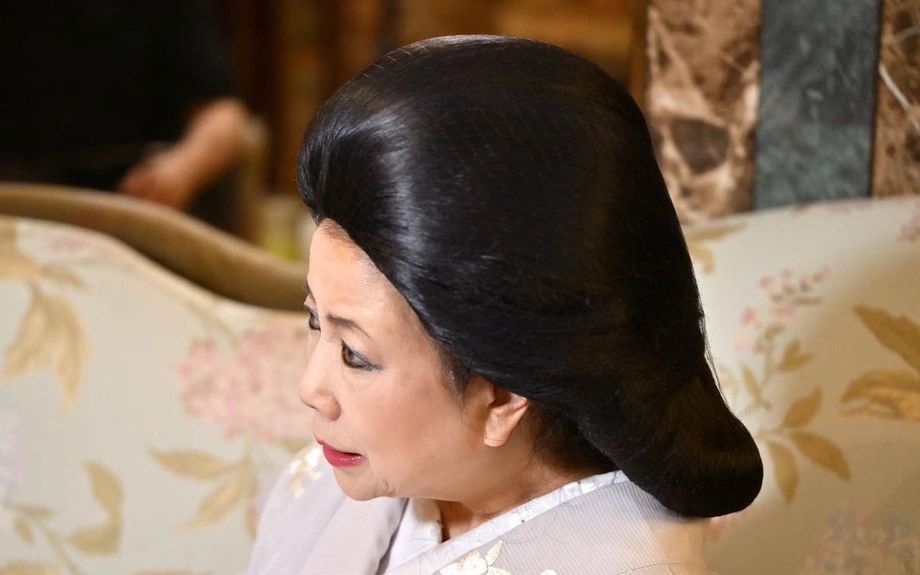
Rie Ueda spends about 2.4 million yen a year keeping a hairstyle that can fill a seat in the audience at a Grand Sumo Tournament. Monthly spending is about 200,000 yen, and annual figures range from 2.4 million to 2.6 million yen. The style takes about two hours to set, is rebuilt every morning and has kept the same basic shape for 38 years.
Contents
- A Head That Stopped the Sumo Broadcast
- What Is Actually Inside the Tower?
- Only One Stylist Can Build It
- The Calendar Built Around 10 a.m.
- Sleeping, Sitting and ID Photos With the Same Head
- From Odd Shape to Good Luck Charm
- From a Newspaper Route to Ginza
- A Club Owner's Rules for Staff and Guests
- The Husband She Supported
- Everyday Habits Behind the Public Image
- What Changes Now, and What Is Still Open
- Key Points
Ueda, 74, is better known as Rie Mama. Her own description names her as representative director of Rie Corporation and counts eight luxury clubs, five in Kanazawa and three in Ginza. A different description called her chairman and listed six Kanazawa venues plus three in Ginza. She is a central figure in Kanazawa nightlife, where a mama is the woman who runs a hostess club, a place where guests pay for drinks, conversation and carefully managed hospitality.
Her silhouette became a talking point after television cameras showed her watching a Grand Sumo Tournament in June. People on X said the hair was so noticeable that it interrupted their view of the bouts. Ueda said she did not know at first because she does not use the internet. When she learned that the attention came from footage of her in ordinary clothes, she was startled.
Ueda, the club owner at the centre of the attention, recalled her surprise in plain terms.
What was it that I appeared in?
The viral moment made a private routine public. Behind the height are bundles of hair, dozens of pins, one stylist, daily appointments and a business life that began with newspaper deliveries in a poor household.
What Is Actually Inside the Tower?
Ueda once said her hair held dreams and hope. Asked what was really inside, she gave a much more physical answer: bundles of hair added to her own hair, packed in layers. The clean curve depends on how the bundles are balanced, not simply on how much hair is used.
Ueda, the club owner who has built the look for decades, described the mechanics directly. She said the style is not a single solid mass and that the shape comes from the arrangement.
The inside of the hair is just hair bundles. I put a lot of hair clumps in there. Whether the shape comes out cleanly depends on the balance of how they are put in. That is the technique of Mr. Kanayama. Also, there are about 60 to 70 pins inside.
Sixty to 70 pins is far more than a usual formal hairstyle. Pins of that number work like a hidden frame. They hold the added hair in place, keep the crown high and stop the whole structure from sliding when she walks, eats or sits through a long sports match.
The scale explains why some viewers at the sumo broadcast looked past the wrestlers toward her seat. It also explains why her regulars can recognise her from the outline before they see her face.
Only One Stylist Can Build It
The man behind the structure is Kazuyoshi Kanayama, a stylist in his late seventies at a salon in Kanazawa. Ueda estimates that he is about six years older than her and under 80. She visits his salon because, in her words, no one else can make the same shape.
Ueda, the representative director who has trusted Kanayama with the style every day, said the look cannot simply be passed to another stylist.
This head is something only Kanayama can do.
Three stylists once knew how to build it. Two have died, leaving Kanayama as the only person still able to do the work. Other stylists have told Ueda that they cannot do it, and she has not set up a successor plan.
Ueda, the owner who adjusts her calendar to protect Kanayama's stamina, said she is not ready to imagine the end of the arrangement. No date was given for a handover, and no replacement has been named.
When that time comes, I'll think about it then.
She has said she does not intend to change the hairstyle, and she hopes Kanayama stays healthy. For now, the daily appointment continues.
The Calendar Built Around 10 a.m.
Ueda's first task each morning is going to the Kanazawa salon. The salon asked her to arrive just after the 10 a.m. opening, so she gets ready and leaves early. The styling takes about two hours. She once came at 9 a.m., but the time was changed so Kanayama could work without pressure.
Ueda, the club owner who has kept the same shape every day for 38 years, summed up the rule in a line about work and hair.
Work takes holidays, but the hair never does.
The New Year has its own timetable. Ueda has the hair finished on December 30 so it lasts through the holiday, then returns to Kanayama on January 3. She has her hair washed at the salon. At home, she uses a shower and does not soak in a bathtub.
Ueda, the owner who moved one weekly appointment to protect Kanayama's errands, explained why Monday's set happens on Sunday.
The teacher's free time disappears if he does my hair Monday morning. I want him to work without stress.
Those details turn a striking hairstyle into a daily system. The calendar is built around one stylist, one salon and a shape that is expected to survive work, travel, sleep and celebrations.
Sleeping, Sitting and ID Photos With the Same Head
The shape follows Ueda into ordinary life. She does not lean back on sofa backs, because pressure can push the structure out of place. She puts a cosmetic pouch around the top of her obi, the wide sash worn with traditional clothing, so the pouch works as a buffer.
Ueda, the club owner who uses the pouch as a sitting aid, described the habit precisely.
I don't lean back on the sofa. I put a makeup pouch at my waist so it acts like a buffer and stops me from leaning.
Sleep is another test. Ueda lies down in a normal posture on a regular pillow and does not take the hair apart before bed. She stays awake until her eyes can barely stay open, because once she falls asleep she no longer notices the weight. If her head tilts the wrong way, the bundles no longer sit correctly, so Kanayama tells her to stay awake while the structure is being built.
Her licence and other official ID photos also show the hair. For Ueda, the style is not an event look kept forstage or ceremony. It is part of how she appears at work, at rest and on documents.
From Odd Shape to Good Luck Charm
Ueda first adopted the current shape 38 years ago. Before that, she liked a high front section that she styled in a manner associated with actress Akiko Oyama. She says she has always liked a high crown and was drawn to the calm gaze of Guanyin, the Buddhist figure associated with compassion. One profile described the image behind the hairstyle as Guanyin.
Thirty and 40 years ago, strangers often told her that the hair was too big or asked why she did not make it smaller. Ueda kept it because she liked it. Over time, people around her changed their view. On days when the hair is smaller, regulars now tell her not to shrink it, because seeing the big shape gives them energy.
Ueda, the club owner whose hair has become a familiar signal in Kanazawa, said people sometimes react to the silhouette before they speak to her.
Customers say they spotted me somewhere but were too intimidated to say hello.
Sports related customers have also treated the hair as a charm. Ueda, the owner who hears these stories from guests, said some people connect touching her head with winning.
Everyone tells me that when they touched my head, they won.
Her public image is not limited to sumo. On the television programme Chidori no Aiseki Shokudo, she tried boat racing and won almost 1.4 million yen. The sumo attention added another chapter to a public persona built on height, discipline and an unwillingness to shrink.
From a Newspaper Route to Ginza
Ueda was the third of four siblings. Her mother delivered newspapers and washed dishes at an inn, while her father avoided newspaper work and her older sisters had left for jobs in Tokyo. Ueda saw the burden and volunteered to deliver papers herself.
Ueda, the third child who took over the route before anyone asked, said she made the choice cheerfully.
I'll deliver them.
She continued until she finished high school. Her interest in newspapers lasted. As an adult, she reads a local paper and a business paper every day. She has said she forgets most of what she reads, but knowing something is different from knowing nothing.
Her dream of Ginza began in the Showa 30s, when televisions were rare in rural areas. She watched from neighbours' verandas and saw programmes and songs about Tokyo nightlife, including Ishihara Yujiro and Makimura Junko's Ginza no Koi no Monogatari. She kept the dream private because she thought people would laugh if she said it aloud.
Ueda entered nightlife at 34 and later expanded to Tokyo about 25 years before the recent interviews. Club Rie opened in Ginza in 2002, growing out of a Kanazawa base.
- Showa 30s: Ueda watched television from neighbours' verandas and dreamed of Ginza.
- High school years: she delivered newspapers until graduation.
- Age 26: she began living with the man who later became her husband.
- Age 34: she entered nightlife.
- Age 40: she legally married her husband.
- 1998 or about then: the current hairstyle began taking shape, 38 years before the recent accounts.
- 2002: Club Rie opened in Ginza.
- 2021: her husband died at 82.
- June: her appearance at a Grand Sumo Tournament drew wide attention.
Kanazawa's Katamachi district has more than 1,000 food and drink businesses. Ueda has said a castle town like Kanazawa still needs a steady, dignified club alongside younger venues.
A Club Owner's Rules for Staff and Guests
Club Rie in Ginza uses a membership system, meaning guests join a list before visiting, and a dress code to shape the mood of the room. The interior has live piano, chandeliers and decoration inspired by medieval Europe. The club recruits women with no prior nightlife experience and reports low staff turnover in a district known for movement between venues.
Ueda treats the women in her clubs as company employees rather than casual workers. Tokyo hiring is delegated to staff who understand her preferences. She says long tenures are unusual in Ginza, and she wants to keep the content of the clubs polished rather than expand endlessly.
Ueda, the owner who explains her management style through the people she hires, said she values women who bring qualities she does not have.
I like girls who have something I do not have. I like pretty girls. I cannot live without being helped by pretty girls.
Staff welfare is part of the same approach. Women buy apartments or houses in the order they joined the company, and banks lend to them because of their work at Ueda's clubs. She replaced leather sofas with fabric ones because even small damage to leather looked poor. Regulars describe the club as a place where guests learn how to drink like gentlemen. Others praise her kimono and cultural knowledge.
Ueda, the club owner who says running the business keeps her active, linked work, appearance and happiness in one sentence.
I think there is no better health method than this.
She also takes the Shinkansen between Kanazawa and Ginza and treats the commute as exercise. A later part of her account turns to how hostesses are trained and to 200 million yen of her own money put into the business during the pandemic.
The Husband She Supported
Ueda's husband was 13 years older. They were together from her age 26 and legally married when she was 40. He died in 2021 at 82. He ran a construction company with dump trucks, but the business often faced dishonoured promissory notes, written promises to pay that failed when payment did not arrive, and difficult cash flow.
Ueda, the widow and business owner who supported his company, said she told him she could earn enough if the work became too hard.
It's okay because I'll earn the money.
He later used a wheelchair. Ueda hired helpers for hospital visits, travel and daily support. She put the cost at about 800,000 yen a month; a version of the interview lists 80,000 yen. Even with that expense, the couple ate good food and travelled together, and she said he was very pleased.
Her own account of money starts with a childhood in which reading a newspaper was a sign of wealth she admired. By running clubs, hiring carefully and keeping staff close, she built the life that later made the hair, the travel and the care possible.
Everyday Habits Behind the Public Image
Ueda wakes at 7 a.m. no matter how late the previous night ended. Her skin care routine uses a facial device she bought around age 35 or 36 and has used for about 40 years. She says she has no time for salon facials. She eats fruit every morning, even on busy days when phone calls interrupt breakfast. On one busy morning, she stood in the kitchen and ate melon because sitting down would waste time.
Newspapers remain part of the routine. She checks a local paper and a business paper daily. She also wears only one earring, because phones rang constantly and she kept losing the other one.
Her clothing adds another layer to the public image. She enjoys wearing Kaga Yuzen kimonos, a dyeing tradition associated with the Kanazawa region. She has said that being able to look presentable in front of others is part of staying young.
The hair itself remains the most visible habit. It is washed at the salon, shaped with bundles of hair and held by 60 to 70 pins. It travels with her to work, to sumo seats, to documents and to bed.
What Changes Now, and What Is Still Open
The broadcast made Ueda's hair a subject of public argument. Some viewers complained about the obstruction, while others saw the shape as a source of energy and recognition. Ueda's daily schedule has not changed because of the attention. She still goes at 10 a.m., spends about two hours in the chair and keeps the style every day.
The spotlight also falls on Kanayama. The future of the hairstyle depends on a stylist in his late seventies, and Ueda has said other stylists cannot reproduce it. She has no succession plan, no named replacement and no date for a handover. She has said only that she will consider it when the time comes.
The next fixed points in the routine are December 30 and January 3, when the New Year shape is prepared and renewed. Until then, Ueda continues to treat the hair as work, identity and daily discipline at once.
Key Points
- Rie Ueda, 74, is known as Rie Mama and runs clubs in Kanazawa and Ginza.
- Her hair draw at a Grand Sumo Tournament led to wide online comment.
- The hairstyle contains bundles of hair and about 60 to 70 pins.
- Kazuyoshi Kanayama is the only stylist who can build it now.
- Annual hair costs are about 2.4 million to 2.6 million yen.
- Ueda has kept the shape for 38 years, including New Year holidays.
- She avoids leaning back and uses a cosmetic pouch as a buffer.
- No successor, replacement or handover date has been announced.