A restaurant with 25 seats makes a swift impression in Paris
Maiya, a restaurant with just 25 seats in the 10th arrondissement of Paris, has been named Best Neo-Himalayan in the Le Fooding Guide 2027. Nepali cook Mohit Shrestha and his wife Shaheen opened it in June 2026. Roughly five months later, on 23 November, it became one of 13 establishments recognised at the guide's awards ceremony in Paris.
Contents
- A restaurant with 25 seats makes a swift impression in Paris
- A menu written fresh each morning
- From political science to a Paris kitchen
- How Le Fooding tests and selects restaurants
- Why the awards ceremony took place in a library
- Paris returns to the top of the guide
- What the winners reveal about restaurant ownership
- All 13 winners in the 2027 guide
- What the prize could change for Maiya
- Key Points
The French name of the prize is Meilleur néo-himalayen. At Maiya, it describes a personal approach that draws mainly on Himalayan and Indo-Gangetic traditions while also using French customs and kitchen techniques. Shrestha is not trying to produce a definitive version of Himalayan cuisine. His cooking begins with his own memories of Kathmandu and India, then changes with the people, ingredients and ideas around him.
Shrestha said the speed of the recognition was unexpected because the restaurant was still so new. He explained what the announcement meant to him and his team.
When I heard the news that we were being chosen for an award by Le Fooding, I was very, very surprised considering that we are such a new restaurant, but it also gave us the belief that we had definitely created something of value here.
The restaurant takes its name from Shrestha's paternal grandmother, Maiya Nani. He opened it with Shaheen, and Diamond Gurung joined as sous chef a few weeks before service began. The three run the dining room and kitchen with a small team, giving the project a family connection as well as a close professional core.
A menu written fresh each morning
Maiya's food does not follow a fixed catalogue of dishes presented as authentic for an entire region. Shrestha says the menu grows out of his cultural ties and his life across different parts of South Asia, rather than an attempt to draw firm borders around Himalayan cooking.
Shrestha, who developed the restaurant's cooking with his team, described where those references come from.
As far as our food is concerned, we take our references primarily from the Indian subcontinent, more often from my cultural ties to Kathmandu along with time spent growing up in various parts of India.
The kitchen also works with little formal research and development for individual dishes. Instead of spending months refining a permanent menu, the team decides what to cook on the day. Shrestha described that routine and the style he wants it to produce.
We come in the morning, write our menu for the day and cook it and serve it to our guests in the evening.
The idea really is to develop our own style to cook food that excites us.
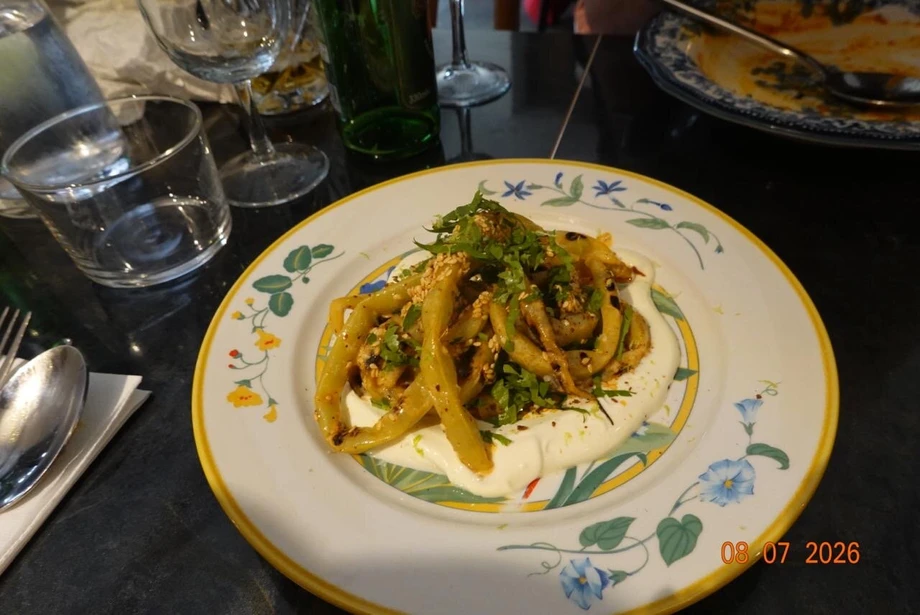
Dishes identified in restaurant photographs show how broad that vocabulary can be. They include butter chicken, kaalo daal with bone marrow, tripe with gundruk and golbheda achaa, jaulo with spinach and girolles mushrooms, and a plate combining saag, fresh paneer and trout eggs.
Several of those names may be unfamiliar to diners encountering Nepali food for the first time. Gundruk is made by fermenting leafy greens, while golbheda achaa is a tomato condiment. Jaulo is a soft rice preparation often associated with comfort and nourishment, saag refers to greens, and paneer is a fresh cheese. Girolles and trout eggs sit beside those references, showing how ingredients and techniques can cross borders without requiring Shrestha to settle on one definition of Himalayan cuisine.
From political science to a Paris kitchen
Cooking was not Shrestha's original profession. He studied political science, worked at OLE Nepal, an education organisation, and completed a short internship at UNRCPD, the United Nations regional disarmament centre then based in Kathmandu. He also spent several years in his family business. Although he enjoyed eating and occasionally cooked for friends, he has said that choosing cooking professionally was a major decision, particularly because he was almost 30 when he made it.
In Paris, he earned a Diplôme de Cuisine at Le Cordon Bleu Paris and spent seven years working at Le Dauphin. Le Fooding's description of Maiya also notes his experience in the kitchens of chef Iñaki Aizpitarte at Le Chateaubriand. There, Shrestha and Gurung developed food reflecting his youth in Nepal and the city he had adopted as his home.
The main dates in that progression show both the long preparation and the rapid recognition that followed.
- 2017: Shrestha moved to France to learn how to cook.
- Before June 2026: He completed his culinary diploma, spent seven years at Le Dauphin and also worked at Le Chateaubriand.
- June 2026: Shrestha and Shaheen opened Maiya, with Gurung joining the kitchen shortly before operations began.
- 23 November 2026: Maiya received the Best Neo-Himalayan award at the Le Fooding ceremony.
- 26 November 2026: The guide containing the awards went on national sale.
By the awards night, Shrestha had accumulated years of Paris kitchen experience, yet Maiya itself had been welcoming guests for only about five months. The award recognised a new restaurant built on a much longer apprenticeship.
How Le Fooding tests and selects restaurants
Le Fooding is an independent French food and restaurant guide. Its 2027 edition is its 27th and contains more than 300 new addresses across France. The selection covers restaurants and bars as well as wine cellars, food shops and rooms, but only 13 establishments received the special awards announced alongside Maiya's prize.
The guide says its inspectors have worked anonymously for 26 years. They decline invitations and pay their own bills, a method intended to keep a meal's treatment and cost similar to those of an ordinary customer. For this edition, the award selection was also examined by a committee of experts using Le Fooding's new ethical charter.
The written entries have changed as well. A new chronicle format concentrates on the feeling and individuality of each establishment, particularly what makes somebody want to return. The guide went on sale on Thursday 26 November 2026 at newsstands, bookshops and through Le Fooding, with a cover price of 25 euros.
Why the awards ceremony took place in a library
The ceremony on 23 November took place in the library of the École nationale supérieure d'architecture Paris-Val de Seine. Guests received a real library card as their entry credential. Tatiana Lenté, also known online as Banger Littéraire, presented the awards.
The setting suited the edition's theme, Online / Offline. Its magazine section contains 12 pieces by 12 journalists and commentators about eating in an age of constant food content. Their subjects include photographing a dessert before tasting it, saving restaurants on social media without ever visiting, placing a telephone on the table and the return of paper menus as QR codes become common. Another asks whether a cherished address can ever be kept to oneself once it has been recommended publicly.
For a small restaurant such as Maiya, that discussion has a practical side. Online attention can help people discover a dining room, while the guide's inspectors and writers still judge the physical experience of cooking, service and hospitality.
Paris returns to the top of the guide
Paris took six of the 13 awards. Five went to southern France and two to Brittany. The leading prize, Best Table, went to Bittikesu and chef Jules St-Cyr, making it the first Paris winner of that category since Rigmarole in 2019.
St-Cyr, a chef from Montreal, opened Bittikesu in April 2026 at 5 rue Crillon in the fourth arrondissement. About 10 guests sit around an oak counter facing the kitchen. His cooking uses wild ingredients, produce from his garden in Montreuil and Japanese binchotan charcoal, with influences that also extend toward Japan and Scandinavia. A menu of eight courses costs 70 euros at Friday and Saturday lunchtimes. The menu of 15 courses costs 105 euros in the evening and at Sunday lunchtime.
The two new Paris openings put the scale of the awards in perspective. Bittikesu has about 10 seats and Maiya has 25, and both reached the 2027 list within months of opening. Their cooking and service formats differ, but each gives a small team close control over the dining experience.
What the winners reveal about restaurant ownership
Lucie Caudrelier, director general of Le Fooding, said the presence of chefs who own and run their own establishments reflected a desire for independence, creative freedom, flexibility and control over the format. She cited St-Cyr, Anthony Orjollet, Sokunthear Vong and Mickaël Lecumberry among the examples.
Caudrelier also described a return to familiar, generous dishes rather than cooking designed primarily as a display of technique. Her examples included calf's head with ravigote sauce and veal sweetbreads at Ramones, sausage with mashed potatoes and boudin noir at Dents de Loup, and grilled lobster at Belle Maria.
Several winners have connections to earlier kitchens and awards. Belle Maria's Frédéric Péneau was a longtime associate of Aizpitarte at Le Chateaubriand and Le Dauphin, two names that also appear in Shrestha's career. Galaxy Bar's Léa and Louis-Marie Fleuriot previously ran the first Cadoret, which received the Fooding d'amour in 2019. In Toulouse, Lecumberry returned with Ramones after his former Rocher de la Vierge had been recognised in 2018.
All 13 winners in the 2027 guide
Le Fooding's categories mix conventional restaurant descriptions with its own vocabulary. The complete list, including the people behind the winning addresses, is:
- Best Table: Bittikesu, led by Jules St-Cyr, Paris.
- Fooding d'honneur: Anthony Orjollet of Ostavals, Ostabat-Asme.
- Fooding d'amour: Aronde, run by Lucie Péneau and Julien Vahl, Les Matelles.
- Best Sophistroquet: L'Espérance, led by Sokunthear Vong, Paris.
- Best Bistro: Ramones, run by Maïder and Mickaël Lecumberry, Toulouse.
- Best Mood Lifter: Belle Maria, run by Frédéric Péneau and Camille Tsvétoukhine, Douarnenez.
- Best Bar: Galaxy Bar, run by Léa Fleuriot, Louis-Marie Fleuriot and Léa Gonzalez, Paris.
- Best Neo-Himalayan: Maiya, run by Mohit and Shaheen Shrestha, Paris.
- Best Gastropub: Jozy, run by Lucy Rosedale and Noé Viviès, Rennes.
- Best Ramen: Toy, run by George Black and Solal Martin-Grondard, Paris.
- Best Bánh Mì: Cà Phê Dá, run by Anh Dao Nguyen and Émile Duchemin, Marseille.
- Best Nowhere Else: Café des Sports, run by Jules Butt and Andres Giraldo Flores, Padern.
- Best Butcher Boys: Dents de Loup, run by Paul Di Giandomenico, Édouard Haguet and Adrien Quennepoix, Paris.
A sophistroquet is a sophisticated version of a troquet, a casual neighbourhood bar or cafe. Categories such as Best Mood Lifter and Best Nowhere Else reflect the guide's interest in the feeling or singularity of an address. Maiya's category instead identifies a specialised culinary direction that had found a distinctive expression in Paris.
What the prize could change for Maiya
For Maiya, the immediate value of the award is visibility. Shrestha said he hopes attention from the guide will help the small restaurant build a dependable stream of reservations.
An award such as this helps a small restaurant like ours immensely to build our business, especially by shining the spotlight on us, which hopefully will turn into more regular reservations at the restaurant.
The economic observatory of Umih, a French hospitality industry body, recorded a 7 percent rise in restaurant bankruptcies over one year. Restaurant attendance has also been declining as inflation and reduced purchasing power lead diners to weigh each outing more carefully. For a dining room with 25 seats, regular reservations would provide a concrete sign that publicity is becoming a stable clientele.
No reservation figures have been released since the announcement, so the commercial effect is not yet known. The guide's publication and the attention surrounding its winners give Maiya a new audience, while the daily work of writing the menu, cooking and serving guests remains unchanged.
Shrestha resisted describing the restaurant as an entrepreneurship project or himself as a representative of a wider international movement for Himalayan cuisine. He said he did not spend much time considering that broader effect.
I do not really consider myself an entrepreneur, I will always be a cook and building a restaurant based on my vision is merely an extension of the work I've been pursuing for almost a decade now.
He called his work a personal expression of the craft he had spent time learning. His stated ambition for the restaurant was more immediate.
My hope for Maiya is to always be able to welcome people and offer them good food and hospitality.
Key Points
- Maiya opened in Paris in June 2026 and won Best Neo-Himalayan on 23 November, about five months later.
- The restaurant has 25 seats and is run by Mohit and Shaheen Shrestha with sous chef Diamond Gurung and a small team.
- Its cooking draws on Kathmandu, India and French techniques, with the menu written each morning.
- Le Fooding's 2027 guide lists more than 300 new addresses and gives 13 special awards; its anonymous inspectors pay for their meals.
- Paris won six prizes, including Best Table for Bittikesu, while five went to southern France and two to Brittany.
- The guide was released on 26 November 2026 with a cover price of 25 euros.
- Shrestha hopes the attention will produce regular reservations, but no booking figures have yet been released.