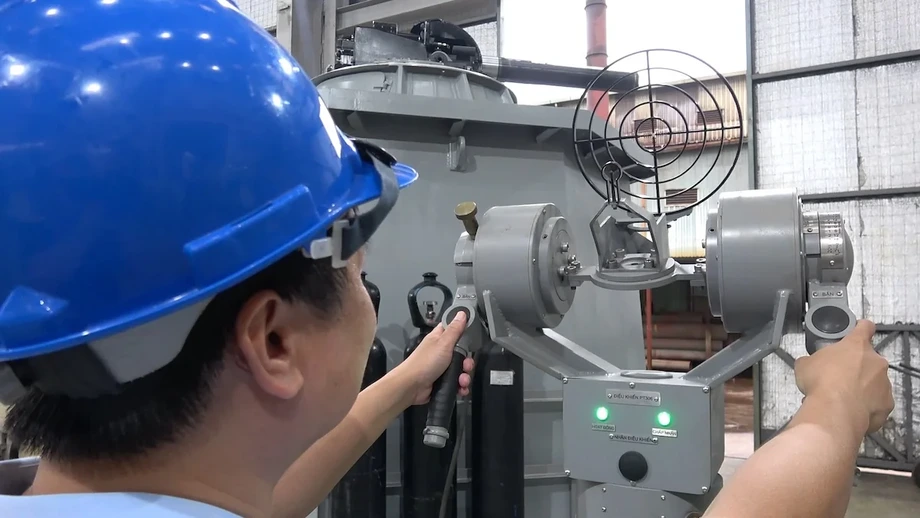
A fast firing naval gun designed for several kinds of threats
Vietnam's Hong Ha Shipbuilding Company, also known as Factory Z173, will introduce its PT-306 naval gun at the Vietnam International Defence Expo 2026 in Hanoi from December 10 to 13. The complete mount is built around an AO-18 automatic cannon with six 30 mm barrels. Its stated maximum rate is about 5,000 rounds a minute, equivalent to more than 80 rounds every second.
Contents
- A fast firing naval gun designed for several kinds of threats
- What the specifications say about ammunition and movement
- How the radar, computer and remote controls work together
- The Hai Phong shipbuilder behind the PT-306
- An exhibition covering more space and more countries
- What will happen during the four days at Gia Lam
- The dates leading to the debut
- What remains unannounced
- What to Know
The weapon is intended for combat ships and patrol vessels protecting territorial waters and airspace. Its listed aerial targets include aircraft, helicopters, drones and missiles attacking ships. At sea level, the intended targets include drifting mines, vessels and landing craft. The system is also described as suitable for firing against troops, firing positions on shore and military vehicles involved in a landing.
For a patrol ship, that means one mount is intended to cover several different situations rather than serve only as an aircraft defence weapon. The factory says its high firing rate can produce dense bursts of fragmentation ammunition over a short period against targets flying low at close range. Fragmentation rounds scatter metal pieces when they burst, spreading the effect across an area instead of relying on a single solid projectile.
Z173 sits under the General Department of Defence Industry, which is part of the Ministry of National Defence. The ministry is presenting the PT-306 among science and technology products intended to demonstrate Vietnamese mastery of modern weapons with military and civilian applications. The description credits the Hai Phong factory with successfully researching and improving the system, while its public debut will take place before an international audience at Gia Lam Airport.
What the specifications say about ammunition and movement
The technical description goes beyond the headline firing rate. The AO-18 uses continuous belt feed, allowing ammunition to be supplied without loading individual rounds by hand. Two thousand rounds are carried in the combat ammunition container, with another 1,000 in reserve. That gives the complete system a stated ammunition load of 3,000 rounds.
- The gun has a traverse arc of 180 degrees, meaning it can turn across half a circle rather than rotate through a full circle.
- Maximum traverse speed is 100 degrees a second, while the maximum speed of movement in elevation is 70 degrees a second.
- The turret weighs no more than 1,000 kilograms. The gun body itself accounts for no more than 216 kilograms.
- Recoil reaches 70,000 newtons, described as approximately 7.14 tonnes of force.
A simple calculation shows why bursts and ammunition management matter. At the maximum rate of 5,000 rounds a minute, the 2,000 rounds immediately available represent 24 seconds of firing. Using all 3,000 rounds at that rate would take 36 seconds. These are arithmetic illustrations, not an announced operating endurance. Actual use would depend on burst length, target engagements and reloading, none of which has been quantified.
Recoil is the backward push produced when a gun fires. The conversion to 7.14 tonnes of force describes that peak push; it does not mean the ship permanently carries an extra 7.14 tonnes. The mount's stated weight and recoil figures are nevertheless central to installation because a ship's structure must support the weapon and withstand firing.
The traverse and elevation speeds describe how quickly the weapon can change its aim. A gun engaging an aircraft, a small boat and then a coastal target may need substantial movement between shots. No minimum or maximum elevation angle was supplied, so the published 70-degree figure should be read as a speed, not as the vertical aiming limit.
How the radar, computer and remote controls work together
The PT-306 combines an electro-optical system with a fire control radar. Electro-optical equipment uses sensors concerned with visible light or other optical observation to help an operator see and aim. The radar adds measurements of a target's distance, azimuth, elevation angle, speed and acceleration in real time. Azimuth is the target's direction around the horizon, while elevation describes how high it appears above the horizon.
A fire control computer uses those measurements to predict where the target will be when the projectiles reach it. This is necessary because both the ship and the target may be moving. Aiming directly at an aircraft's present position could leave the rounds behind it; the computer instead calculates an intercept point for the gun to engage.
The listed radar targets include aircraft, drones, missiles and surface vessels. Operators can aim the weapon from a sighting column at the mount or work remotely from a gunner's console. Remote operation separates the operator from the gun itself, while the sensors and computer provide the information needed to track and engage a target.
No radar detection distance, optical sensor specification, reaction time or accuracy figure has been released. The description therefore gives a detailed account of the intended sequence, from measuring a target to calculating an intercept and firing, without providing performance results from an instrumented trial.
The Hai Phong shipbuilder behind the PT-306
Hong Ha Shipbuilding was founded in 1965 and is wholly owned by the state under the Ministry of National Defence. Its factory is in Hai Phong, Vietnam's major northern port city. The company was already established in military and commercial shipbuilding before adding the PT-306 to its exhibition portfolio.
Its listed products include TT-400TP gunboats, a 3,000 tonne oil tanker and a 3,100 tonne asphalt carrier, alongside patrol, rescue and firefighting vessels. In early 2020, Hong Ha announced a contract to build 10 patrol boats for the Nigerian Navy. In August 2026, it began construction of a 1,500 tonne multipurpose cargo ship that can also carry containers for export to the Netherlands.
Those projects show the range of work surrounding the gun programme. The Nigerian contract concerns patrol vessels for a foreign navy, while the Dutch project is commercial construction for export. The PT-306 gives the same organisation a naval weapons system to display alongside its experience with combat ships, auxiliary vessels, transport ships and specialised craft.
The company's 2024 revenue reached 1.457 trillion dong, up 74% from the previous year, with profit after tax of 14.3 billion dong. For Z173, estimated revenue for the whole of 2026 is 1.805 trillion dong, more than 10% above the 2025 figure. These figures cover different periods and are presented separately by the company and factory.
Revenue from economic activity combined with defence work is estimated at 578 billion dong in 2026, the highest level in five years. Dividing 578 billion by the factory's estimated total of 1.805 trillion shows that this activity represents about 32% of expected revenue. No PT-306 development cost, sales value or contribution to that revenue was disclosed.
An exhibition covering more space and more countries
The Ministry of National Defence announced at an October 20 press conference that 189 companies and organisations from 36 countries had registered for the expo. The 16 national pavilions announced are for the United Kingdom, Poland, Belarus, Brazil, Canada, the Czech Republic, Croatia, Iran, Italy, Myanmar, the United States, Russia, Japan, France, Türkiye and Slovakia. The event will run at Gia Lam Airport in Hanoi, with displays covering equipment for naval, ground, air defence and air force operations.
Major General Nguyen Duc Tang, deputy political commissar of the General Department of Defence Industry, said the exhibition would present weapons and military equipment from the Vietnam People's Army and the People's Public Security forces, including new products and technologies. Indoor displays organised by the ministry are expected to concentrate on products and services researched and developed by Vietnamese defence agencies, units and enterprises.
The expo's total area is approximately 123,800 square metres, an increase of 23,800 square metres from the 2024 edition. Subtraction gives a 2024 area of 100,000 square metres, making the 2026 footprint about 23.8% larger. Plans allocate around 23,500 square metres indoors and 24,700 square metres for outdoor displays. The government's official announcement of the press conference describes a site divided into seven main zones.
Registered exhibitors had booked 8,017 square metres of indoor space and 425 square metres outdoors by the October announcement. Sixteen national pavilions are planned, and negotiations were continuing for additional exhibition space. Separately, total floor space including exhibitors still in discussions was put at 8,161 square metres. Other exhibits will include combat vehicles, technological solutions, cyber warfare equipment, logistics systems and technical support products.
What will happen during the four days at Gia Lam
The opening ceremony is scheduled for 9:00 to 10:30 on December 10 and will be broadcast live on Vietnam Television's VTV1 channel. Plans include a special forces demonstration and a helicopter flypast by the Air Defence and Air Force Service. Party General Secretary and President To Lam is expected to attend and deliver a speech.
Members of the public can visit on December 12 and 13, the final two days. The exhibition is therefore not simply a static collection of weapons: its announced programme combines an opening ceremony, military demonstrations, national pavilions, indoor technology displays and outdoor equipment.
An 8,200 square metre zone will present economic and defence products together with cultural highlights from Vietnam's three regions. Organisers plan displays of signature products, interactive experiences, national brands and traditional village goods. This area will sit beside the defence exhibits and give local manufacturers and cultural presenters a place within the larger event. A separate defence experience and military games area will cover about 11,000 square metres, with military medical, special forces engineering, service dog and simulated shooting experiences.
The dates leading to the debut
The gun's debut follows several decades of shipbuilding and a series of recent commercial and defence announcements. The main dates also show which parts of the exhibition schedule remain ahead.
- 1965: Hong Ha Shipbuilding was founded.
- Early 2020: The company announced its contract for 10 patrol boats for the Nigerian Navy.
- August 2026: Construction began on the 1,500 tonne cargo and container vessel for the Netherlands.
- October 20, 2026: The Ministry of National Defence announced registration by 189 exhibitors from 36 countries.
- December 10, 2026: The expo is due to open at Gia Lam Airport, with the ceremony broadcast on VTV1.
- December 12 and 13, 2026: The exhibition is scheduled to admit public visitors.
The December display is the next fixed milestone for both the PT-306 and Z173. The announced programme does not include a live firing demonstration by the gun.
What remains unannounced
No effective firing range, production quantity, unit price, naval order, installation schedule or export customer has been announced for the PT-306. There is also no public account of accuracy trials, testing against missiles or drones, or the ship class that would receive the first operational mount.
The project description names the AO-18 cannon and credits Z173 with researching and improving the complete system. It does not identify the origin of every component or state what proportion was manufactured in Vietnam. Those details will be needed to assess production arrangements and any future supply requirements.
For now, the concrete change is at the exhibition and within the contractor's portfolio: a Hai Phong shipbuilder with recent naval and commercial export work is preparing to present a sensor-guided naval gun with stated multi-target capabilities. Procurement and deployment decisions have not been given dates.
What to Know
- Z173 will introduce the PT-306 at Gia Lam Airport in Hanoi from December 10 to 13, 2026.
- The mount uses an AO-18 automatic cannon with six 30 mm barrels and a stated maximum rate of about 5,000 rounds a minute.
- Ammunition comprises 2,000 rounds for combat and 1,000 in reserve; turret weight is listed as no more than 1,000 kilograms.
- Radar, an electro-optical system and a fire control computer support local or remote operation against aerial, surface and shore targets.
- Hong Ha Shipbuilding was founded in 1965 and has announced naval work for Nigeria and a commercial vessel export to the Netherlands.
- The expo has registrations from 189 companies and organisations across 36 countries, with public visiting days on December 12 and 13.
- Firing range, trial results, production numbers, prices and customer orders for the gun have not been announced.