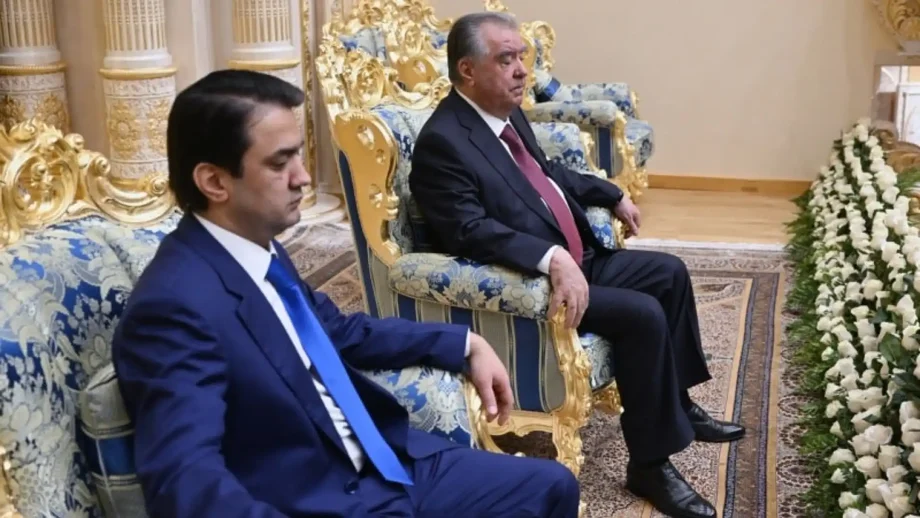
Father and son share a busier public stage
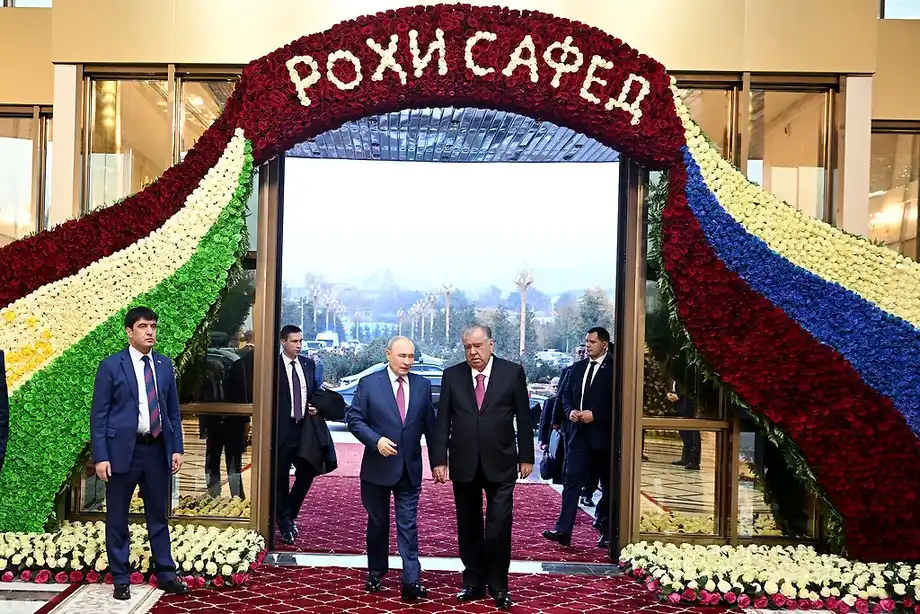
Rustam Emomali, aged 38, joined his father, President Emomali Rahmon, to open a college at the Interior Ministry academy in Dushanbe on November 10, 2026. They also remotely launched other ministry facilities in cities and districts across Tajikistan. Three days later, the pair attended the opening of an international hospital in the capital. On November 20, Rustam again appeared beside his father, this time to welcome and later see off Russian President Vladimir Putin.
Contents
- Father and son share a busier public stage
- The appearances, date by date
- Why the upper house carries constitutional weight
- A rapid rise through the state and City Hall
- Why analysts see a deliberate public introduction
- Moscow, Tashkent and Beijing enter the calculation
- Russian ties extend beyond airport protocol
- Rahmon retains the decisive choice before 2027
- What to Know
Those appearances placed the president's eldest son at ceremonies covering education, health, city development and relations with Tajikistan's most important security partner. Rustam already holds two substantial offices. He has been mayor of Dushanbe since January 2017 and chairman of the National Assembly, the upper chamber of parliament, since April 2020.
Rahmon, who turned 74 on October 5, has led Tajikistan since 1992 and has served as president since 1994. The next presidential election is due in 2027. Authorities have announced neither a transfer of power nor a presidential nomination for Rustam, but the frequency of his appearances with Rahmon has given new energy to discussion about whether he is being presented to the public as the next head of state.
The appearances, date by date
The recent activity extends beyond a single ceremony or one foreign visit. It combines domestic openings, an award from Uzbekistan and repeated contact with Russia's leadership.
- September 3: Rahmon and Rustam jointly laid the foundation stone for the Dushanbe International District, a construction project valued at $1.5 billion.
- Late October: They appeared at openings involving a hotel, enterprises and a medical centre. Exact dates for those events were not given.
- November 4: Uzbek President Shavkat Mirziyoyev received Rustam during his visit to Uzbekistan and awarded him the Fidokorona xizmatlari uchun order. Uzbekistan's presidential press service said the award recognised his contribution to strategic partnership and wider dialogue between the two parliaments.
- November 10: Father and son opened the college at the Interior Ministry academy and launched other ministry facilities remotely.
- November 12: Rahmon and Putin held Kremlin talks on November 12, a day after a summit of the Collective Security Treaty Organization, a military alliance led by Russia.
- November 13: Rahmon and Rustam attended the inauguration of an international hospital in Dushanbe.
- November 20: Rustam joined the official welcome and departure ceremonies surrounding Putin's November 20 working visit. It was the second meeting between Putin and Rahmon in eight days.
The Uzbek ceremony gave Rustam international recognition in his own right, while the Dushanbe openings displayed him beside Rahmon in areas that affect daily life. The Russian meetings added a diplomatic dimension. Tajikistan is due to assume the chairmanship of the Collective Security Treaty Organization in 2027, the same year as its presidential election.
Why the upper house carries constitutional weight
Tajikistan's parliament, the Supreme Assembly, has two chambers. Rustam leads the upper chamber, known as the National Assembly or Majlisi Milli. Fayzali Idizoda chairs the lower chamber, the Assembly of Representatives. Rustam was first elected to his parliamentary position on April 17, 2020, at the age of 32, and was elected again on April 11, 2025.
The constitution gives the chairman of the National Assembly a central role if the presidency suddenly becomes vacant. If the president dies, resigns or is found incapable of performing the duties of office, that chairman temporarily exercises presidential powers. A presidential election must then take place within three months. The arrangement provides an interim mechanism while the country organises a vote.
A constitutional referendum on May 22, 2016, also changed the longer term political arithmetic. It reduced the minimum age for presidential candidates from 35 to 30. Rustam, born on December 19, 1987, turned 30 in December 2017. The amendment therefore made him eligible to contest the presidency after 2017.
The same referendum removed Rahmon's presidential term limits and banned religious political parties, including the Islamic Renaissance Party. Rahmon can consequently seek another term, while his son meets the age requirement. The legal changes leave Rahmon with the decisive choice between continuing himself, supporting Rustam or pursuing another arrangement.
A rapid rise through the state and City Hall
Rustam Emomali was born in Danghara, then part of Kulob Oblast and now in Khatlon province. The Dushanbe administration biography lists a world economics degree from Tajik National University in 2006, a Russian public administration qualification in 2011 and a law degree from the academy of Tajikistan's Interior Ministry in 2014. He also took courses at the Diplomatic Academy of the Russian Foreign Ministry.
His government career began in 2006 in a department dealing with cooperation with the World Trade Organization. Work at the State Committee for Investments and State Property Management followed in 2009. In 2011, he entered the customs system as head of a department combating customs violations. He became deputy head of the service in 2012 and its head in November 2013, when he was 25. The appointment came with the rank of major general, which attracted attention because he had not served in the armed forces.
Rahmon appointed him in March 2015 to direct the State Agency for Financial Control and Measures Against Corruption. He remained there until 2017. On January 12 that year, at the age of 29, he became mayor of Dushanbe, replacing Mahmadsaid Ubaydulloyev, who had run the capital since 1996.
His municipal record supplies practical experience as well as controversy. New roads, parks, administrative buildings and public spaces have appeared under his administration, and the city adopted a new development plan. A programme to remove approximately 20,000 marshrutka minibuses and replace them with buses angered drivers. In 2018, one driver injured himself in front of the mayor's office during the dispute. Demolition of historic buildings and the removal of trees along boulevards also drew criticism.
Football provided another public platform. Rustam helped found Istiklol in 2007 and played as a striker and captain. He became president of the Tajikistan Football Federation in 2012 and served on FIFA's Development Committee from 2012 to 2014. His latest federation election, on December 14, 2024, keeps him in that football position until 2028.
Why analysts see a deliberate public introduction
A Tajik political expert who asked not to be named interpreted the increasing number of joint appearances as an effort to familiarise the public with a possible successor. He directed particular attention to the way official publicity presents father and son together.
I think the press service is deliberately showing Rustam Emomali alongside his father more often so that society gradually gets used to seeing him as the future head of state.
Bruce Pannier, an American journalist and researcher specialising in Central Asia, also regards the public appearances as part of Rustam's promotion. His assessment is that Rustam could become president while his father is still alive, possibly after the 2027 election. Pannier identifies support from the leaders of Russia and China, together with understanding among neighbouring states, as important requirements for such a transition.
Political analyst Khursand Khurramov framed the immediate issue as a choice that still rests with Rahmon.
The main issue is whether Rahmon will run for another term or whether he will nominate his son Rustam Emomali, who has been preparing for this position for the past 10 years.
The three assessments approach the subject from different directions. One focuses on domestic public images, another on a possible transfer after an election and the third on Rahmon's own decision. None amounts to an announced government programme.
Moscow, Tashkent and Beijing enter the calculation
Khurramov argues that a change at the top could not occur without Moscow's consent. In his assessment, the Kremlin's main question would be whether a future Tajik president honours agreements covering the Russian military base. The installation in question is Russia's 201st military base, one of Moscow's largest military facilities outside Russia. Putin and Rahmon reviewed its operations during their Dushanbe discussions.
Economic ties give those security arrangements additional weight. Putin said bilateral trade grew by more than 25% in 2025 and by nearly 19% during the first nine months of 2026. Prime Minister Kokhir Rasulzoda valued trade with Russia at a record $2.5 billion in 2025, representing more than 22% of Tajikistan's foreign trade. The World Bank estimated that remittances from abroad were equivalent to about 46% of Tajikistan's gross domestic product in 2025, illustrating the importance of migration and external economic relations to household incomes.
Rustam made his first visit to the Kremlin in May 2025. His more recent Uzbekistan visit supplied a regional counterpart to that Russian contact, while the award from Mirziyoyev explicitly connected his parliamentary work with the strategic relationship between Tashkent and Dushanbe.
China appears both in Pannier's assessment of the support Rustam would need and in major construction activity. The Chinese contractor Sino-Hunan International Engineering has started work on the Dushanbe International District. Any future president would inherit relationships with Moscow, Beijing and neighbouring capitals that are already tied to security, investment, trade and migration.
Russian ties extend beyond airport protocol
The Dushanbe International District shows how those relationships meet in a project overseen by Rustam's city administration. Plans describe a complex covering 29 hectares, with a 340 metre tower containing 77 floors as its centrepiece. The proposals also include 42 residential towers with 6,160 apartments, offices, a school and a concert hall. Completion is expected in five years.
Boris Rotenberg, a Russian businessman associated with Putin and subject to sanctions imposed by the United States, United Kingdom and European Union, appeared in Dushanbe as a backer of the project in November. He described himself as a small part of the undertaking. The size of his stake has not been disclosed, leaving the extent of any sanctions exposure unclear.
Tajikistan delivered another signal to Moscow on the day of Putin's November visit. It lodged notice with the United Nations that it would withdraw from the Rome Statute, the founding treaty of the International Criminal Court. The withdrawal is due to take effect on November 20, 2027.
The court has sought Putin's arrest since March 2023 over the alleged unlawful deportation and transfer of children from occupied areas of Ukraine. Its Pre-Trial Chamber II ruled in March that Tajikistan had failed to act on a request to arrest and surrender him during his state visit in October 2025. The European Union urged Dushanbe on November 22 to reconsider and reverse the withdrawal. The presidency of the court's Assembly of States Parties said withdrawal would not remove obligations assumed while Tajikistan was still a party.
Rahmon retains the decisive choice before 2027
Rahmon's own legal position gives him room to delay or reject a handover. He has won five presidential elections, in 1994, 1999, 2006, 2013 and 2020. Official results gave him 90.92% of the vote in 2020. The Organization for Security and Co-operation in Europe said the 2013 contest lacked genuine choice and meaningful pluralism.
A law passed in December 2015 granted him the title Founder of Peace and National Unity, Leader of the Nation. It also provided lifelong immunity from prosecution, veto power over major state decisions and extensive rights to address the country, attend government meetings and participate in parliamentary sessions. Those powers would remain relevant to any arrangement in which he continued to play a national role after leaving the presidency.
Family influence extends beyond Rustam. His sister Ozoda Rahmon has headed the presidential administration since January 2016 and previously served in the National Assembly. She has also been discussed in succession assessments as a possible rival to her brother. Rahmon replaced the head of the Central Election Commission in late October 2026, adding a significant administrative appointment ahead of the election year.
When legislator Saidjafar Usmonzoda addressed the succession question in 2023, he said that the People's Democratic Party, the president and the government had not at that time announced Rustam's nomination. His statement describes the position in 2023. The current public schedule supplies newer evidence of Rustam's visibility, while the presidency has still provided no public timetable for a transfer.
For Dushanbe residents, Rustam already directs decisions on transport, construction and public spaces. For the rest of Tajikistan, the 2027 election will determine who assumes responsibility for national economic policy, relations with Russia and China, labour migration and the agreements governing the Russian base. Tajikistan is also due to chair the Collective Security Treaty Organization that year. No exact polling date has been announced.
What to Know
- Rustam Emomali, aged 38, is both mayor of Dushanbe and chairman of parliament's upper chamber.
- He appeared with Rahmon at several domestic openings in November and joined ceremonies for Putin's November 20 visit.
- The constitution places the upper house chairman first in line to exercise presidential powers temporarily, with an election required within three months.
- A 2016 referendum lowered the candidacy age from 35 to 30 and removed Rahmon's term limits.
- Analysts interpret the appearances as public preparation, but no succession plan or nomination has been announced.
- Russia's military base, extensive trade ties and Tajikistan's dependence on remittances give Moscow a central place in the discussion.
- The presidential election and Tajikistan's chairmanship of the Collective Security Treaty Organization are both due in 2027.