From Dining Table to National Recognition
At the 13th National SME Product Fair in Dhaka, Farzana Islam Mouri received the National SME Entrepreneur Award 2026 in the Micro Entrepreneur of the Year (Female) category. Prime Minister Tarique Rahman handed over the award on Sunday morning, 22 November 2026, at the Bangladesh-China Friendship Conference Centre in Agargaon. Official figures from the SME Foundation, which organised the fair, put participation at 388 small and medium enterprises from across the country, with 60 percent of them owned by women entrepreneurs. That works out to about 233 businesses.
Contents
- From Dining Table to National Recognition
- What the Award Ceremony Showed
- Why a Bank Job Lasted Only Months
- How the First Products Found Buyers
- What Craftimation Makes Now
- Who Buys the Products and Why
- The Flood That Almost Stopped the Business
- Why the 2025 Fair Became a Turning Point
- Timeline of a Small Business Learning to Scale
- What Growth Means for Artisans and Exports
- Advice for New Entrepreneurs
- Key Points
Mouri's company, Craftimation, began in 2020 with Tk 3,000 on a dining table in her family home in Khilgaon. It now makes more than 500 kinds of handicraft products, from rickshaw art souvenirs and metal miniatures to three dimensional ceramic mugs and customised corporate gifts. Mouri has said monthly sales run between Tk 10 lakh and Tk 20 lakh, averaging Tk 15 lakh. She has also described current monthly sales as around Tk 10 lakh.
The workforce figures show the same growth. Mouri has described nine permanent staff and 50 to 60 artists and artisans brought in when orders rise. She has also described 19 salaried employees and about 70 project workers. Production takes place at units in Malibagh Chowdhurypara, Old Dhaka and Khilgaon, with a separate office in Malibagh.
Products range from Tk 50 to Tk 20,000, putting the brand within reach of students, office workers, gift buyers and companies planning large orders. An average month now brings in 500 times her original Tk 3,000 capital.
What the Award Ceremony Showed
The SME Foundation organised the fair, which opened on Sunday and runs until Nov 28, from 10am to 8pm each day. Entry is free. The fair's theme, Prosperity in SMEs, growth in the economy, placed the awards in a wider economic setting. SME means small and medium enterprise, a business much smaller than a large corporation.
Prime Minister Tarique Rahman formally opened the fair before the awards. Commerce Minister Khandaker Abdul Muktadir chaired the event. Finance Minister Amir Khosru Mahmud Chowdhury, Fazlul Haque, administrator of the Federation of Bangladesh Chambers of Commerce and Industry, City Bank Managing Director and Chief Executive Masrur Arefin, SME Foundation Chairperson and Industries Secretary Abdun Naser Khan and Mouri also spoke at the ceremony.
Eight entrepreneurs received awards in eight categories. The National SME Entrepreneur Award categories were Best Medium Entrepreneur of the Year (Male), Best Small Entrepreneur (Female), Best Small Entrepreneur (Male), Best Micro Entrepreneur (Female), Startup, Green SME Business, Technology-based Creative Entrepreneur and Special Entrepreneur. Alongside Mouri, the recipients included S M Faruk Hasan, Syed Aminul Kabir, Haniam Maria Chowdhury, Masrur Hossain Shahid, Hamid Hasan Alvi, Musnad-e-Ahmad and Siddique Bhuiyan Rizvi Cynthia. Firms recognised included Stylish Footwear and Leathergoods, Star Agro Processing Industries, Tahur Studio, Polyeco Recycling Industries and Skytech Solutions.
Mouri, the founder of Craftimation and the winner in the female micro entrepreneur category, said the award increased the responsibility she felt toward her business and its workers.
Receiving this award from Prime Minister Tarique Rahman is a major achievement for my business. It is a great honour and joy, and such recognition is a tremendous source of inspiration.
She said the recognition followed years of product experiments, a serious flood loss and repeated reinvestment of sales income.
Why a Bank Job Lasted Only Months
Farzana Islam completed a BBA in Accounting in 2018 and later earned an MBA in Finance. After her BBA, she took a job at a bank, but she left within a few months. She had already decided that her future lay in drawing, handwork and objects that carried a personal touch.
Her childhood habits pointed in that direction. When she needed to give a gift, she made it herself. She made cards with family photographs for a friend's wedding and decorated presents by hand. Those small projects gave her the idea of turning a personal hobby into a business.
In 2020, while pursuing her MBA, she opened a Facebook page named Craftimation. She started with handmade cards, small lamps and tree lamps, using Tk 3,000 in capital. After getting a trade licence, she formally launched Craftimation in 2021.
How the First Products Found Buyers
The first catalogue was modest. Mouri made cards by hand, small lamps and tree lamps, and she learned new craft techniques by watching YouTube videos. Learning from videos kept early costs low for a business running from a home dining table.
She later began shaping three dimensional designs on mugs with ceramic clay. A customer could ask for a name, a photograph or a company logo on a mug. Demand for those mugs was strong, and until the middle of 2023 her attention stayed mainly on mug making.
Orders grew, and about two years after the start she opened an office on the ground floor of her Khilgaon home. Young men and women from the area joined her. She put much of the business income back into materials and new designs. Daily sales rose, with a strong lift during Eid.
What Craftimation Makes Now
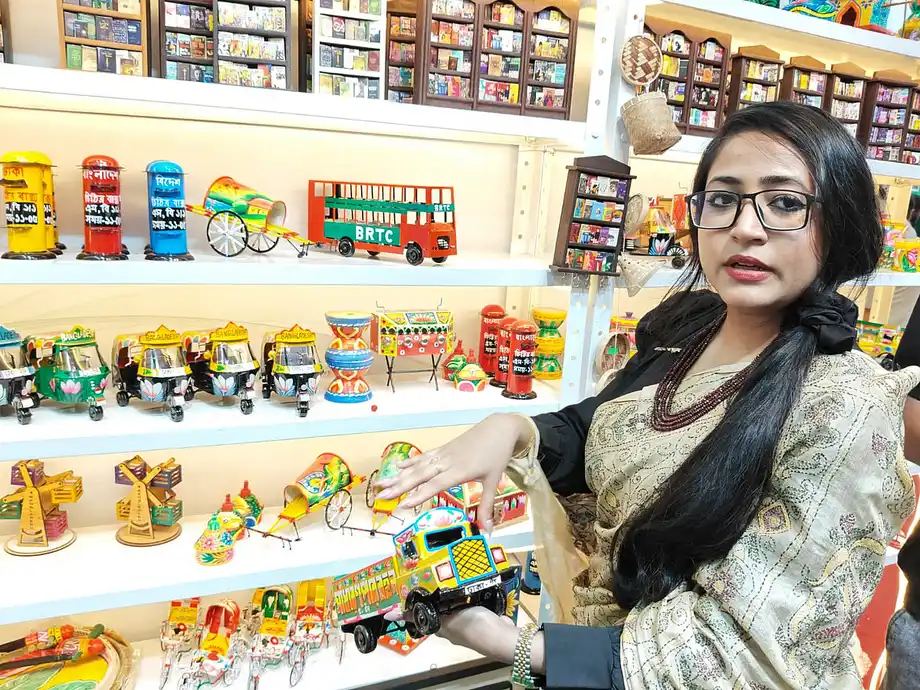
Craftimation's catalogue has passed 500 products. It includes rickshaw art items, metal miniatures, three dimensional mugs, bamboo and jute handicrafts, wood miniatures, resin art and sculptures, Jamdani diaries, home decor and hand painted sunglasses. Rickshaw art is the bright, detailed painting tradition used on Bangladesh's cycle rickshaws. Craftimation moves those patterns onto everyday objects so a phone cover or a lamp can carry a familiar local look.
Artists apply rickshaw art to mobile phone covers, pens, sunglasses, hurricane lamps, tiffin boxes and wooden trunks. They can also paint a customer's own photograph or portraits of family members in that style. Fifteen artists work on rickshaw art products.
Mouri invested in metal miniatures in 2023. These are small artistic copies of vehicles and objects made from metal sheets. Workers cut parts with hand press moulds and laser cutting machines, weld the frame and then ask artists to paint the finished piece.
- Small rickshaw replica: Tk 450
- CNG or tempo replica: Tk 630
- Bookshelf: Tk 799
- Sunglasses: Tk 400
- Hurricane lamp: Tk 1,200 to Tk 1,500
- Truck replica: Tk 1,500
- Customised painting: Tk 2,000 to Tk 5,000
- Large special design: up to Tk 20,000
The miniatures include rickshaws, vans, baby taxis, trucks, bioscopes, bullock carts and pushcarts. The range shows how the company turns street level transport into small collectable objects.
Who Buys the Products and Why
Corporate clients including bKash and Unilever order Craftimation products for staff recognition, gifts for business partners, souvenirs for foreign guests and annual gifts. These buyers want objects that feel personal and carry a company's identity, which is why mugs with logos and customised keepsakes fit the market.
Some small entrepreneurs buy from Craftimation at wholesale prices and sell the products under their own names. Retail buyers also approach the brand for personal gifts. When a customer asks for a new design after buying one item, Craftimation tries to make it. That habit has helped push the product count past 500.
Craftimation's products also reach buyers in Canada, Australia and the United Kingdom through third party arrangements. Mouri wants to begin direct exports from next year, meaning the company would handle its own overseas sales rather than relying on intermediaries. She did not give an exact date for direct exports, a planned factory or the one thousand jobs target. The company is also working on toys that introduce children to Bangladesh's culture and heritage.
The Flood That Almost Stopped the Business
In July 2024, heavy rain and waterlogging flooded the ground floor office and workshop. Finished products worth nearly Tk 20 lakh were destroyed. For a young company with most income going back into production, the loss threatened to stop work.
Mouri said her mother cashed savings certificates worth Tk 10 lakh to help cover the damage. She has also given the value as Tk 17 lakh. The money allowed Craftimation to restart operations and rebuild stock.
Mouri, the founder who credits her family with keeping the business alive, described her mother as her main source of strength and said her husband's support also mattered.
My mother is my powerhouse. Honestly, it is her encouragement that keeps me going. My husband's support has also played a significant role in taking the business forward.
Family backing links the award to a practical story. Craftimation survived because the founder had access to emergency savings and because she could return to a workforce that already knew how to make the products.
Why the 2025 Fair Became a Turning Point
In 2024, Mouri visited the National SME Product Fair to see how other entrepreneurs displayed goods, attracted customers and secured orders. She returned in 2025 with her own stall. Craftimation won the Best Stall award in the handicraft zone that year.
The stall brought meetings with corporate organisations and new business contacts. Mouri said the recognition introduced the brand to a wider audience and helped buyers trust the products.
Mouri, the founder explaining what changed after the stall, said the award did more than add a trophy.
It was more than just an award. It introduced Craftimation to a wider audience. Many organisations approached us afterwards and placed orders for corporate souvenirs and customised gifts. Our products also reached new retail customers.
Corporate orders changed the scale of the business. A single company order can require dozens or hundreds of personalised items, which gives artists more work than a single retail gift.
Timeline of a Small Business Learning to Scale
The sequence from a student's interest to a national award helps explain why the 2026 honour arrived after several distinct stages.
- 2018: Farzana Islam completed a BBA in Accounting.
- 2020: She opened the Craftimation Facebook page and began making handmade gifts from a dining table in Khilgaon with Tk 3,000 in capital.
- 2021: Craftimation was formally launched after a trade licence was obtained.
- Middle of 2023: Mug making remained the main focus, and investment in metal miniatures began.
- July 2024: Flooding destroyed finished products worth nearly Tk 20 lakh.
- 2024: Mouri visited the National SME Product Fair to learn how stalls worked.
- 2025: Craftimation won Best Stall in the handicraft zone at the fair, bringing corporate orders.
- 22 November 2026: Mouri received the National SME Entrepreneur Award 2026 at the 13th National SME Product Fair.
- Until 28 November 2026: The fair remains open to visitors in Agargaon.
The timeline shows a business that grew through repeated changes in product type, sales channel and production capacity.
What Growth Means for Artisans and Exports
The 2026 fair gave that growth a public stage. Its 388 participating businesses covered footwear, leather goods, jute, handicrafts, fashion, cosmetics, food processing, jewellery, light engineering, information and communication technology, and plastic and rubber products. Seven departments and agencies under the Ministry of Industries, around 17 public and private organisations, the government's One Village, One Product initiative and 78 enterprises from SME clusters also took part.
Craftimation's expansion is visible in its workplaces. Production runs from units in Malibagh Chowdhurypara, Old Dhaka and Khilgaon, while the company office is in Malibagh. The core team has been described as nine permanent staff with 50 to 60 artists and artisans on demand, and as 19 salaried employees with about 70 project workers. Both descriptions point to a business that uses a small fixed team and a larger flexible group.
Mouri wants a factory that can support employment for one thousand people. She also wants direct exports under the Made in Bangladesh identity. For local artisans, the practical change would be more orders for rickshaw art, miniature vehicles, resin pieces and other craft items. For buyers abroad, direct exports would shorten the distance between a Dhaka workshop and a foreign customer.
Advice for New Entrepreneurs
Mouri tells new entrepreneurs to plan two to five years before starting a business. Her advice is to study the market, competitors, production costs and likely buyers before spending money on stock or tools.
That advice comes from the way Craftimation grew. Mouri credits creativity, new product ideas and keeping pace with the market. The company began with items a young founder could make herself, moved into mugs after customers responded, added rickshaw art products when demand widened and invested in metal miniatures in 2023. Each step came with a new skill and a new kind of buyer.
Her story also shows why small orders matter. A customer asking for a customised mug or a new painted design can lead to a product line that reaches offices, retail buyers and overseas clients. For a craft business, that cycle of request, experiment and repeat order can be as important as a large single purchase.
Key Points
- Farzana Islam Mouri received the National SME Entrepreneur Award 2026 in the Micro Entrepreneur of the Year (Female) category at the 13th National SME Product Fair.
- Prime Minister Tarique Rahman handed over the award on 22 November 2026 at the Bangladesh-China Friendship Conference Centre in Agargaon.
- Craftimation began in 2020 with Tk 3,000 on a dining table in Khilgaon and now offers more than 500 products.
- Mouri has cited monthly sales between Tk 10 lakh and Tk 20 lakh, averaging Tk 15 lakh.
- A July 2024 flood destroyed finished products worth nearly Tk 20 lakh, and her mother cashed savings certificates to help recovery.
- Craftimation won Best Stall in the handicraft zone at the 2025 fair, which brought corporate orders and new buyers.
- Clients include bKash and Unilever, and products reach Canada, Australia and the United Kingdom through third party arrangements.
- Mouri aims to create jobs for one thousand people and to move into direct exports.