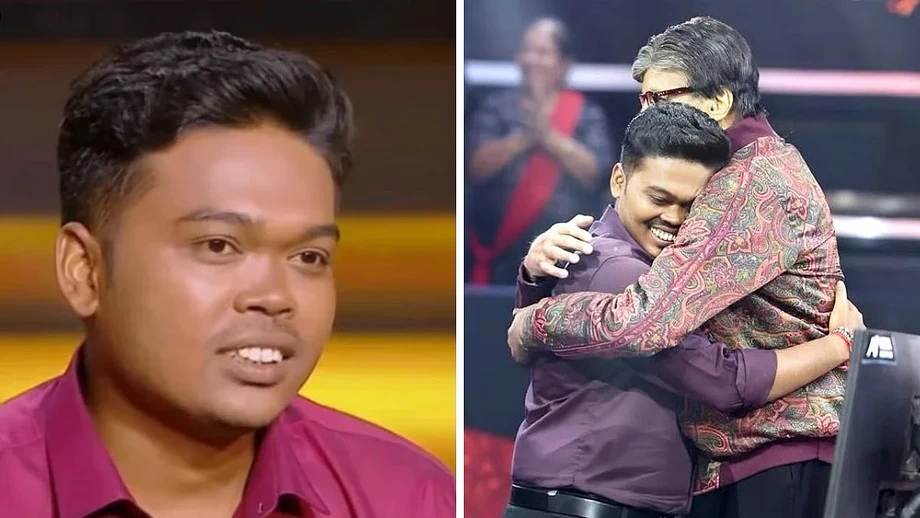
The Contestant Who Arrived in Mumbai With Rs 24
Bhushan Eshwar Thakare arrived in Mumbai to compete on Kaun Banega Crorepati with just Rs 24 and became the first contestant of the show's 18th season to win Rs 1 crore. Thakare, who is 28, comes from Balwadi village in Raver taluka, an administrative subdivision of Maharashtra's Jalgaon district. His prize is worth 10 million rupees, a sum that has given his family possibilities that years of manual labour could not.
Contents
- The Contestant Who Arrived in Mumbai With Rs 24
- Why He Walked Away From Rs 7 Crore
- A Decade of Registration, Auditions and Rejection
- The Parents Who Kept Him Studying
- How 20 to 25 Grams of Gold Paid for Education
- Eighteen Months Away From Home
- The Host Who Calmed His Nerves
- What the Prize Means in a Family Budget
- Jewellery, Monthly Income and the UPSC Dream
- Key Points
The victory was the culmination of attempts that began in 2016. Thakare answered the question worth Rs 1 crore, then faced a decision over the Rs 7 crore jackpot, worth 70 million rupees. He chose to stop playing. When host Amitabh Bachchan subsequently asked him to guess the answer, his selection proved correct, but he said he did not regret protecting the money he had already won.
Sony Entertainment Television's promo showed Bachchan embracing and congratulating him after the Rs 1 crore answer. The jackpot segment was initially promoted as a suspenseful continuation, with Monday, 23 November 2026, given as the date when viewers would see what happened next. The completed story is more unusual than a correct answer alone: Thakare walked away, guessed correctly and still described the smaller prize as sufficient to transform his life.
Thakare has described the Rs 24 as both his bank balance and the money in his pocket. His fullest description of the Mumbai trip explains why so little money did not prevent him from participating. The production team paid for his travel, accommodation and food and arranged his ticket home. He said he therefore left Mumbai with the same Rs 24, untouched, while his family's financial prospects had changed completely.
Why He Walked Away From Rs 7 Crore
The jackpot was the 16th question of his game. It concerned George A. Grierson, who completed a survey over three decades covering 179 languages and 544 dialects spoken by more than 200 million people in British India. The question asked from which place in England Grierson had conducted that work. The four options presented were Harris, Grossum, Oxford and Camberley.
Thakare still had his 50:50 lifeline, a form of assistance that normally removes two incorrect options. Lifelines could not be used on the Rs 7 crore question, however. An incorrect answer also carried the danger of sharply reducing his winnings. Faced with uncertainty, he decided that the Rs 1 crore already secured was more valuable to his family than the possibility of a much larger prize.
Bachchan asked him to make a guess after he had quit, and Thakare selected option D, Camberley. It was the correct answer. Had he chosen and locked that option while still playing, he would have won the jackpot. Instead, he left with Rs 1 crore and said the programme had already given him enough to alter the course of his life.
His decision also matched the purpose that had brought him to the show. He wanted to improve his family's finances, support his mother's treatment and relieve the pressure on his father. A gamble might have produced Rs 7 crore, but quitting guaranteed that those immediate plans remained within reach.
A Decade of Registration, Auditions and Rejection
Thakare's association with KBC began long before his preparation for the civil services. He registered in 2016, around the time he turned 18, and continued applying without receiving an audition call during the first four to five years. His first call came in 2021. Calls and interviews followed in later years, but selection continued to elude him.
He said he was invited to five auditions and eliminated in the first round each time. In his account of the period from 2021 to 2026, disappointment repeatedly interrupted the ambition, yet he kept registering. He rejected the idea that luck alone explained success and placed his faith in continuing to try.
- 2016: Thakare began registering for KBC at about 18 years of age.
- 2020: He began preparing for the Union Public Service Commission Civil Services Examination while still waiting for a KBC audition call.
- 2021: His first audition invitation arrived. Further attempts brought interviews and repeated elimination.
- 2026: Selection finally placed him opposite Amitabh Bachchan, almost ten years after his first registration.
- 21 November 2026: His emergence as the season's first crorepati was publicly revealed, followed by attention on the jackpot question.
Preparation for the two examinations fed into each other. While reading for the civil services, he would make a mental note of facts that might be useful on KBC. He also studied because he wanted to reach the quiz. He rejected the suggestion that civil services preparation alone had carried him to the hot seat, describing the two ambitions as connected.
The term crorepati, commonly used in India for someone possessing at least a crore of rupees, became his public label after those years of rejection. On KBC, it also marks a contestant who has crossed one of the programme's most celebrated prize levels.
The Parents Who Kept Him Studying
Thakare's household consists of his parents, his younger brother Kuldeep and himself. The family owned no land. His father supported them through labour paid by the day, including work under the rural employment system. Some days brought wages, while other days brought no work. Thakare said his father had begun working at only five years of age, never received an education and spent his life labouring for other people.
His father is now 55. Thakare described watching him work beside men aged about 20 to 22 and feeling that he had to exert himself even harder to remain acceptable to employers. He also said his father had probably bought no new clothes during the previous three to four years, continuing to wear old garments marked by work.
His mother worked through the Mahatma Gandhi National Rural Employment Guarantee Act, known as MGNREGA, a government programme providing wage employment on rural public works. Her tasks included planting and watering trees beside roads. She had little formal education and persistent health problems limited the heavy work she could perform.
Thakare said she had undergone seven to eight operations, including treatment for kidney stones and a hysterectomy, the surgical removal of the uterus. In another conversation about her medical history, he put the number of operations at eight to nine. Treatment, household expenses and the education of two sons all drew on the same limited income.
That income was approximately Rs 15,000 to Rs 20,000 a month for the entire family, according to Thakare. Even within that budget, his parents resisted making him abandon education for labour. Both watched KBC and encouraged him during the years when no selection call arrived.
How 20 to 25 Grams of Gold Paid for Education
His mother gradually converted small savings into gold, buying a gram, two grams or three grams when she could. Thakare said she accumulated about 20 to 25 grams, purchased when gold was cheaper, by setting aside portions of the family's earnings. The ornaments were not treated as possessions she could safely keep. They became an emergency education fund.
Whenever money for fees, study or hostel expenses ran short, some of that gold was sold. Thakare recalled returning home, explaining another educational need, taking ornaments and selling them to meet the cost. His schooling had begun in a government school in his village, where he studied through grade 12. He later attended a government institution in Jalgaon, completed postgraduate study in history and is pursuing further postgraduate study in political science.
His progress was repeatedly interrupted by financial pressure. He said studying without earning made him feel increasingly dependent on his parents. At times he could not contribute even when his mother's health deteriorated, deepening his sense that he was becoming a burden rather than a support.
The jewellery explains why his first planned purchase is so specific. He wants to give his mother twice as much jewellery as was sold for him. He has described it as returning her sacrifice with interest and said she had spent her life seeing ornaments on other women. He now wants her to wear gold of her own again.
Eighteen Months Away From Home
Thakare began preparing for the Union Public Service Commission Civil Services Examination in 2020. The examination recruits candidates for prestigious government services, including the Indian Administrative Service. He hopes to become an IAS officer, improve his family's circumstances and engage in social service.
For 18 months before his television victory, he lived away from his family at a government hostel in Bhusawal. Its full name is the Bharat Ratna Dr. Babasaheb Ambedkar Government Hostel. Accommodation and basic needs were covered there, allowing him to concentrate on study. He promised his parents that he would not return home until he had achieved something worthwhile.
Kundan Patil, the hostel warden, played an important part during that period. Patil recognised Thakare's potential, encouraged his education and provided continuing guidance. That support gave him a stable base while his own financial resources remained extremely limited.
Living away did not remove his anxiety. He admitted wondering whether he would ever accomplish enough to justify the promise. He had also used the figure of Rs 24 when describing the money with which he left home, making it a recurring symbol of both his departure for study and his later trip to Mumbai.
His father had earlier stopped him from taking a different route. While preparing at home after failing to secure admission for further study, Thakare began working near the village river to contribute financially. His father objected and told him to concentrate on education rather than manual labour. The parent who had spent his life doing physically exhausting work refused to let his son treat it as the only available answer.
The Host Who Calmed His Nerves
Amitabh Bachchan had been a familiar television presence in the Thakare household, but sitting opposite him was overwhelming. Thakare described a racing heartbeat, sweating and trembling legs. He had spent little time in large cities, considered himself reserved and initially struggled to speak.
Thakare, recalling how the show's host responded before beginning the questions, described Bachchan's effort to put him at ease.
Amit ji understood what I was going through," he said. "He didn't immediately start asking me questions. He spoke to me about my family and my personal life, and only when he felt I was comfortable did he move on to the questions.
That conversation lasted several minutes and allowed him to settle. Thakare said Bachchan spoke in a way that made contestants feel equally respected regardless of where they came from. He still experienced uncertainty around the 10th and 11th questions, but continued and eventually accepted the risk involved in attempting the question worth Rs 1 crore.
Bachchan's response after the win went beyond congratulations. He advised Thakare to accept responsibility for his family and ensure that his father would not have to return to labour paid by the day. The embrace shown in the programme's promo became the public image of a private family struggle reaching a national television audience.
What the Prize Means in a Family Budget
Thakare measured the prize against years of work rather than against luxury purchases. In one interview, he said Rs 1 crore resembled what his family might earn over the next 30 to 40 years. In another, he described it as equivalent to 30 to 35 years of family earnings. Both comparisons convey why he regarded quitting the jackpot question as a sensible decision rather than a missed opportunity.
The first changes he envisions are domestic. He wants his father to stop labouring and both parents to experience some rest after decades of physical work and financial anxiety. His mother's medical needs remain part of that responsibility, alongside his wish to replace her jewellery.
His social circumstances shifted quickly as well. He said relatives who had previously declined to help him financially were now telephoning to offer congratulations. The calls did not alter his stated priorities, which remained his parents, a dependable income and continued education.
The victory also gave practical meaning to his promise not to return home without an achievement. For 18 months, that promise had separated him from his family while offering no guarantee of success. Winning gave him something concrete to bring back to them, although his plans show that he sees the prize as the beginning of a longer period of work.
Jewellery, Monthly Income and the UPSC Dream
Thakare intends to seek advice from a senior before investing the winnings. His stated preference is an arrangement that produces regular monthly income, even if the amount is modest. Predictability matters to someone whose father could never be certain that work would be available on any given day.
His education will continue. He wants to join a better coaching institute, possibly in a city with more facilities, and find improved accommodation for his civil services preparation. No date for his next examination attempt was given, and he has not specified where the prize money will be invested.
He has also challenged claims that reaching KBC requires money, personal connections or an arrangement behind the scenes. His message to other aspirants is that knowledge and the ability to understand and answer questions matter. His own experience does not promise immediate selection: it includes five failed auditions, years without a telephone call and repeated interruptions to his studies.
The result is therefore more complicated than a sudden change of fortune. A father rejected labour for his son even when the household needed money. A mother turned small savings into gold and then surrendered it for education. A hostel warden supplied guidance, and a contestant kept studying through rejection. The Rs 1 crore prize connects all of those contributions to a plan for his parents' comfort and his own continued preparation.
Key Points
- Bhushan Eshwar Thakare, 28, from Balwadi village in Jalgaon district, became KBC 18's first crorepati by winning Rs 1 crore.
- He travelled to Mumbai with Rs 24; the production covered his travel, stay and food, and he said the same Rs 24 remained when he left.
- He began registering for KBC in 2016, received his first audition call in 2021 and endured repeated rejection before selection in 2026.
- He quit before answering the Rs 7 crore question, then correctly guessed Camberley after leaving the game.
- His father worked for daily wages, while his mother's rural employment included planting and watering roadside trees.
- About 20 to 25 grams of gold accumulated by his mother was sold to meet his education and hostel expenses.
- He spent 18 months away from home at a government hostel in Bhusawal, where warden Kundan Patil mentored him.
- His plans include buying his mother twice as much jewellery, arranging regular investment income, relieving his father from labour and continuing his UPSC preparation.