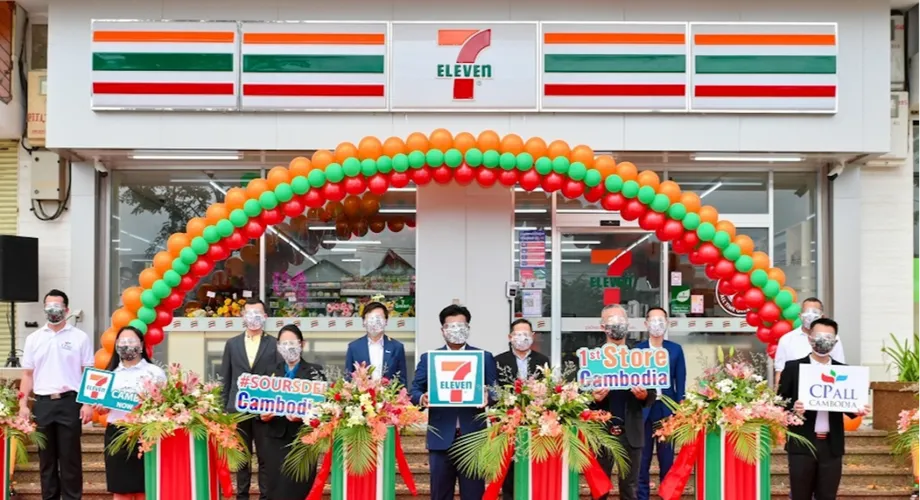
Thai Retailers and Food Makers Pull Back from Cambodia
Thailand's CP All will shut every 7-Eleven store in Cambodia on Dec 25 2026, ending a market entry that began with one shop in Phnom Penh in 2021. The company told the Stock Exchange of Thailand on Nov 24 that 23 outlets would remain until the closure date. The exit is the clearest sign yet of a wider retreat by Thai consumer brands after border clashes, a boycott of Thai products and closed trade gates disrupted supply and sales.
Contents
- Thai Retailers and Food Makers Pull Back from Cambodia
- What CP All Put in the Filing
- How Fast the Store Network Shrunk
- Why Thai Products Lost Their Pull
- Mama Closes a Factory That Once Led the Market
- The Money Behind Mama's Exit
- Why Mama Chose Waiting Over Reinvention
- Where Mama Will Look for Replacement Sales
- Other Consumer Companies Are Changing Routes
- Some Companies Change the Label on the Box
- OR Has Not Made Up Its Mind
- What Workers, Shoppers and Investors Face Next
- Key Points
Thai President Foods, maker of Mama instant noodles, is closing its Cambodian factory after more than 20 years. PTT Oil and Retail Business, known as OR, is weighing whether to leave or stay with a network that has fallen to fewer than 100 stations from 200. CP-Maji has stopped all exports and sales in Cambodia, a loss of about 500 million baht in sales. Other consumer companies are pausing expansion, shifting production to Malaysia or searching for buyers in China, India and Mexico.
The change reaches daily life. About 18 land checkpoints in seven Thai provinces, Trat, Chanthaburi, Sa Kaeo, Buriram, Surin, Sisaket and Ubon Ratchathani, have been closed indefinitely since the middle of 2025. Goods made in Thailand became harder to move, while Cambodian consumers increasingly chose local products and goods not made in Thailand. Thailand's trade with Cambodia fell 28% in the first 10 months of 2026 compared with the same period a year earlier.
What CP All Put in the Filing
CP All, the operator of more than 16,000 7-Eleven stores in Thailand, filed notice IDR 24/2569 with the Stock Exchange of Thailand on Nov 24 2026. Company secretary and authorised disclosure officer Supot Shitgasornpongse signed it. The notice set Dec 25 as the end date for the Cambodian business and said the decision followed terms agreed with the owner of the 7-Eleven trademark.
CP All's exact wording kept the reason narrow:
Such cessation is in accordance with the mutually agreed terms between the company and the owner of the 7-Eleven trademark rights.
That wording matters. The filing did not blame the boycott, the border closure or weak sales. It also gave no cost estimate, no successor for the franchise and no plan for employees, landlords or suppliers in Cambodia. CP All had entered through CP All (Cambodia) Co Ltd under a master franchise, a contract that gives a local operator the right to run a global brand in a country. The original term ran for 30 years, with two extensions of 20 years each available.
How Fast the Store Network Shrunk
CP All's quarterly figures show a fast reversal. Company filings list 123 stores at June 30 2025, 125 at September 30, 112 at December 31, then 63 at March 31 2026, 39 at June 30 and 23 at September 30. A shorter company timeline starts the decline at 112 stores at the end of the first half of 2025. By the final quarter before the exit announcement, the network had lost 100 stores from the June 2025 filing figure, a fall of 81.3% in 15 months.
- June 30 2025: 123 stores
- September 30 2025: 125 stores
- December 31 2025: 112 stores
- March 31 2026: 63 stores
- June 30 2026: 39 stores
- September 30 2026: 23 stores
The first Cambodian outlet opened on Aug 30 2021 in Phnom Penh's Chroy Changvar district. By the end of September 2026, CP All had 16,491 7-Eleven stores in Thailand, showing how small the Cambodian chain had become inside the group. Kampot's 7-Eleven branch was described as permanently closed in early November after customers fell and goods ran short.
CP All is not leaving Cambodia completely. It keeps a direct and indirect stake of about 60% in CP Axtra, which runs Makro wholesale and food service stores. Two Makro branches remain in Phnom Penh. The Siem Reap branch closed in July 2026 as the business shifted more sales online.
Why Thai Products Lost Their Pull
Border clashes in July 2025 changed the commercial climate. A boycott of Thai brands built through the second half of 2025. Shops seen as Thai, especially those selling products shipped from Thailand, faced weaker demand. 7-Eleven's Cambodian shelves relied heavily on Thai goods, so closed checkpoints created supply and inventory problems along with a political image problem.
Thai companies had already been navigating 18 closed checkpoints across Trat, Chanthaburi, Sa Kaeo, Buriram, Surin, Sisaket and Ubon Ratchathani. A checkpoint is an official crossing point where goods and people pass through border controls. When those gates stay shut, a seller cannot simply send a truck across the border and restock a shop.
A ceasefire and a peace agreement followed two clashes in 2025, but public pressure continued. The effect can be seen in trade. Thailand's commerce with Cambodia fell 28% in the first 10 months of 2026 from a year earlier. For retailers, that drop meant fewer deliveries of everyday goods and more empty space where Thai products once stood.
Mama Closes a Factory That Once Led the Market
Thai President Foods had operated in Cambodia for more than 20 years. Phan Phaniengvet, a director of the company, said the shutdown came from several forces at once: blocked crossings, resistance to Thai products, unpaid bills, stock stuck in warehouses and competitors taking space. The company had survived earlier tension, including the burning of the Thai embassy, but that episode was brief and trade later returned to normal.
Mama's position was once strong. Phan put its former share at 70% to 80% of Cambodia's instant noodle market. Consumers knew the brand, and the factory sold noodles made inside Cambodia. The latest disruption lasted long enough for shoppers to change habits.
The Money Behind Mama's Exit
Before the dispute, Mama exported about 100 million baht of cup noodles from Thailand to Cambodia each month, or about 1.2 billion baht a year. The Cambodian factory had a similar scale, generating about 1 billion baht in annual sales. Phan said receivables, money owed by customers after goods had been delivered, reached several tens of millions of baht. Some buyers kept stock and did not pay, saying Thai products could no longer be sold.
For the whole company, the hit is smaller than the headline sales loss suggests. Thai President Foods has annual revenue above 20 billion baht and profit above 3 billion baht. Phan estimated the Cambodia closure would reduce profit by about 30 million baht, no more than 1% to 2%, before any accounting charge for factory impairment or damage, meaning a reduction in the recorded value of the factory. A factory generating 1 billion baht in sales had produced less than 10 million baht in profit, he said.
Phan expects some unpaid invoices to be paid over five to seven years if conditions recover. He did not give a return date for the factory. Mama exports to 68 countries, had four factories last year and may operate three this year because of the Cambodia problem. The company says the immediate problem has been solved and it is finding replacement markets.
Why Mama Chose Waiting Over Reinvention
Mama considered launching a new brand, changing the company name and reducing visible Thai identity to soften resistance. Phan concluded those steps would not help enough. He said the company had no dispute with Cambodian consumers and would return if conditions improved, but would wait for the right moment instead of forcing sales in a difficult market. He compared the decision to cutting a loss in stocks and shifting attention to other opportunities.
Competitors filled the space. Local Cambodian brands grew, alongside noodles from China, Vietnam, Indonesia and South Korea. Phan argued that taste alone did not decide the contest. Once shoppers tried and grew used to another product, it became part of routine consumption, making a comeback harder.
Cambodia's market has also changed over 20 years. Two decades ago, fewer local choices meant greater dependence on goods made abroad. Today, Cambodian factories and regional suppliers can provide alternatives. South Korea's GS25 opened its first Cambodian store on Nov 24 2026 and aims for more than 500 outlets over 10 years. Emart24 entered in 2024, and Circle K also operates in the country.
Where Mama Will Look for Replacement Sales
Thailand's own instant noodle market is close to saturation at 56 or 57 packs per person a year, the third highest rate in the world after Vietnam and South Korea. Mama is running at 80% of production capacity. Phan said China is attractive but demanding because strong sales can exceed capacity and weak sales hurt results. India still has room to grow, while Mexico and Suriname are smaller markets where Mama has previously received a good response.
The company also plans to widen distribution in the United States, Australia and Europe. Instead of relying mainly on Asian grocery shops, it wants more shelf space in large department stores and modern retail channels. Thai flavours such as tom yum, basil and green curry are being used as selling points.
Partnerships matter in that push. Mama has been the market leader in Finland for 20 years without heavy company activity because a local agent bought the product and taught customers how to eat it. Phan wants similar local partners elsewhere, along with tasting events that help shoppers become familiar with the brand.
Other Consumer Companies Are Changing Routes
CP-Maji has stopped exporting and selling in Cambodia completely after scaling back from the middle of 2025. Managing director Apisit Theerapharungroj said the halt removed about 500 million baht in sales. The company is replacing that revenue through three routes: new markets in ASEAN and South Asia, including the Philippines this year; deeper sales in existing markets to ordinary consumers and business customers such as coffee shops and bakeries; and work with government agencies to reduce tariffs and trade barriers.
Neo Corp has stopped marketing in Cambodia as well. Commercial chief Patama Thokasri said the effect was limited because its brands, including Fine Line and De-nee, sit in the premium segment with smaller sales volumes. De-nee is now being pushed into mainland China through online channels, filling part of the gap.
Kanokkarn Matturaporn, management chairperson at Singha Food Industries Thailand, which manages April Bakery, said branches in Cambodia have closed but not permanently. The company is waiting for a clearer assessment. She pointed to After You, which closed branches in Hong Kong and Cambodia, as one example of the strain on food retailers.
Some Companies Change the Label on the Box
Payment problems have become as important as consumer sentiment. Kanokkarn described one seller whose Cambodian partner took delivery of goods, then refused to pay because the products could not be sold. The loss ran to about 100 million baht a month for that operator, who began considering a sale of the business. Another operator has already left the market.
Some suppliers are trying a different label. They work with partners in Malaysia, produce there and send goods into Cambodia as Made in Malaysia rather than Made in Thailand. That approach can reduce the visible Thai link while keeping access to Cambodian customers. It also shows how origin has become part of the sales pitch, not just a line on a package.
Mama looked at a softer version of the same idea by downplaying Thai identity, but decided against it. CP-Maji is taking another route, pushing consumption of Thai products into new markets instead of hiding origin. The two choices show how differently companies read the same shock to the market.
OR Has Not Made Up Its Mind
Nisit Pongwuthipanpan, deputy chief executive for corporate strategy at PTT Oil and Retail Business, said OR is still deciding whether to end or continue its Cambodian operations. The company must weigh the value of selling the business against the need for a clear route that avoids losses over time, he said.
OR's network has fallen to fewer than 100 service stations from 200 as local dealers changed brands. Sales of fuel at PTT Station have declined about 70%, and Cafe Amazon sales have fallen at a similar rate. OR operates fuel stations and retail shops, so a dealer switch removes both fuel volume and store traffic at once.
No final decision date was given. The company said any continued operation would need a plan that prevents losses over time.
What Workers, Shoppers and Investors Face Next
For shoppers in Phnom Penh, the most visible change will be the disappearance of 7-Eleven after Dec 25. For workers and suppliers, the picture is less clear because the notice did not describe job transfers, severance, store sales or future use of the sites.
Investors have treated the CP All exit as manageable because Cambodia is a small part of the group. Maybank Securities (Thailand) estimated Cambodian revenue at less than 1% of CP All's total sales and said operating losses were immaterial, meaning too small to have a meaningful effect on earnings. It kept a buy recommendation with a target price of 61 baht, compared with 50.50 baht at the time. CP All management expected no large special charge because the exit was mutual and provisions had been built up over time. Because the termination was agreed by both sides, there was no breach or penalty.
The same analysis said CP Axtra could close its two remaining Makro branches after closing one branch and recording a 95 million baht asset charge in the third quarter of 2026. An asset charge reduces the value of a company asset in the accounts. CP All reported third quarter net profit of 5.9 billion baht, down 20% from a year earlier, while quarterly revenue rose 4.5% to 262 billion baht.
CP All still plans to add 700 stores this year in Thailand and Laos. Laos has moved the other way, with 32 7-Eleven stores at the end of the second quarter of 2026 and 39 in a later group description. The group also has Cambodian interests in Makro, Indoguna, prepared food and distribution businesses, so the 7-Eleven closure is not a complete exit from Cambodia.
Mama's next test is cost. Phan said the larger task for 2027 is higher raw material prices. The company must find new sales and profit to cover higher input costs without raising prices. OR still has to decide whether Cambodia can be made profitable. Those choices will determine whether the current pullback becomes a pause or a permanent change.
Key Points
- CP All will close all 23 remaining 7-Eleven stores in Cambodia on Dec 25 2026.
- The company's notice cited agreed terms with the trademark owner and gave no staff, cost or successor details.
- The Cambodian network fell from 123 stores in June 2025 to 23 by September 2026, a decline of 81.3%.
- Mama is closing a factory it ran for more than 20 years after losing sales, facing unpaid bills and seeing rivals take market share.
- Thai President Foods estimated the Mama closure would cut profit by about 30 million baht, no more than 1% to 2%, before accounting charges linked to the factory.
- CP-Maji has stopped all Cambodia sales, a loss of about 500 million baht, while OR is still weighing whether to stay.
- Thailand's trade with Cambodia fell 28% in the first 10 months of 2026, as border closures and a boycott reshaped demand.