A returning mother highlights a vast protection gap
On 10 April 2026, researchers identified three humpback whales in the Babuyan Marine Corridor at the northern tip of the Philippines. One was Mary F Hill, catalogued as PH038 and seen by the monitoring team on two consecutive days. The others were Flappy, already known as PH022, and a newcomer named Nike. Their appearance drew attention to a striking mismatch between the importance of these waters and the protection available inside them.
Contents
- A returning mother highlights a vast protection gap
- What three whales told researchers this season
- Why this population needs special attention
- Sanctuaries with boundaries no one can see
- Traffic and ghost gear replace dynamite fishing
- How warming seas can reach a whale's calf
- An important label with no legal force
- Why connected protection matters to whales and fishers
- What expansion could look like on the water
- Why local action still needs a regional plan
- Key Points
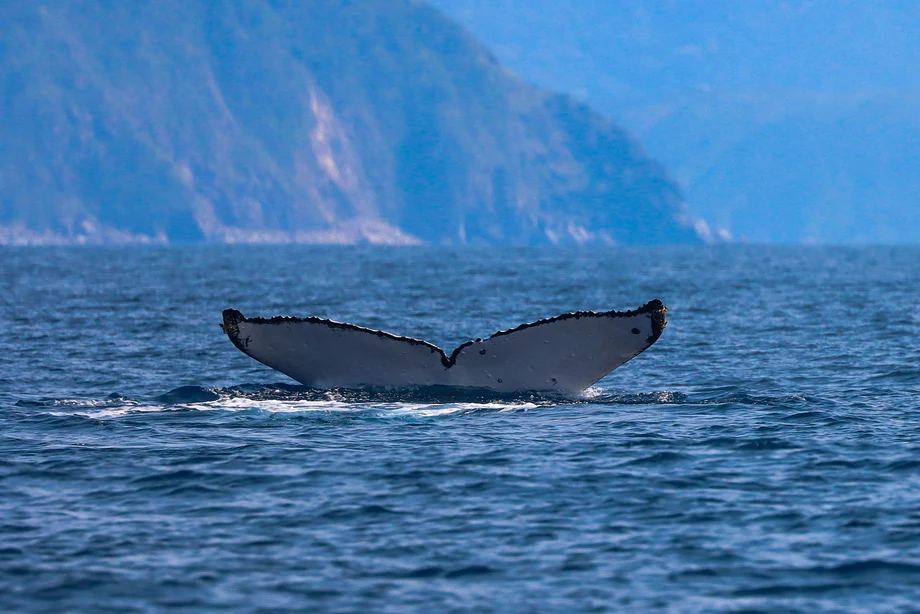
The corridor is the only known humpback whale breeding ground in the Philippines. Mothers with calves favour shallow water several kilometres from shore, where local residents can watch the whales surface, slap their flippers and raise their tails above the sea. Balyena.org, the cetacean research nonprofit that monitors them, says humpbacks migrate to the corridor between January and May to breed, give birth and nurse their young.
Only two marine protected areas, or MPAs, exist in the Babuyan Islands themselves. Both lie along the southern coast of Calayan and together cover 1,677 hectares. Set beside a marine corridor of nearly 1.7 million hectares, that is roughly 0.1%. Other MPAs exist elsewhere in the corridor, but the Babuyan Islands are a principal focus of research because whales are regularly documented near them during the breeding season.
Jo Marie Acebes, founder and principal investigator of Balyena.org, said too little data is collected inside the two island MPAs to determine whether they overlap with the waters the whales normally use. Without those observations, a boundary on a map cannot show whether a mother and her calf are actually inside it.
What three whales told researchers this season
Mary F Hill was first identified in 2003 and has now returned for 11 breeding seasons. Researchers recorded her with a calf in 2016 and again in 2023. During the 2023 observations, she was initially seen alone, then with another adult and, days later, with a calf. Balyena.org said that sequence strongly indicated that she had given birth in the area.
Her repeated appearances illustrate site fidelity, the tendency of a whale to return to the same breeding region. This season, the monitoring team again saw her alone and raised the possibility of another birth.
This season, we've seen her alone again... could it be a sign that another calf is on the way?
Researchers have not confirmed that she is pregnant or that another calf has been born. Flappy, meanwhile, was spotted several times and photographed lobtailing, which means lifting the tail and slapping it against the water. Nike received that name because a marking on the whale's tail resembles the Nike logo. The newcomer has not yet received an official Philippine identification number.
Photographs of tails and other distinguishing marks allow researchers to recognise individual whales without capturing them. Balyena.org said each identification improves knowledge of the population using the corridor, and it invites public participation through its Adopt-A-Whale Program.
- 2003: Mary F Hill was identified for the first time.
- 2011: A municipal ordinance established the two Calayan MPAs.
- 2016: Researchers documented Mary F Hill with a calf.
- 2023: She was again documented with a calf, days after being seen alone and then with another adult.
- 10 April 2026: Mary F Hill, Flappy and Nike were identified during the breeding season.
Those records turn an encounter with three animals into evidence about survival, reproduction and repeated use of the same nursery across more than two decades.
Why this population needs special attention
The International Union for Conservation of Nature lists humpback whales globally as a species of least concern. The whales visiting Babuyan belong to a much smaller group, the Western North Pacific Distinct Population Segment. A distinct population segment can be assessed separately because of its isolation and conservation status. This one is classified as endangered under United States law and vulnerable on the national red list of threatened species in the Philippines.
Estimates in 2016 put the Western North Pacific population at about 1,000 whales. Acebes, who has worked on cetacean conservation in the corridor for more than 20 years, said these animals face greater threats in their area than some other humpback populations.
Their annual journey adds another difficulty. Many feed in colder northern waters, including waters near Russia, during summer. As winter approaches, they travel to warmer breeding areas in Japan and the northern Philippines. A protected bay can shelter a calf at one stage of life, but it cannot safeguard the entire migration.
The Marine Protected Areas Support Network Secretariat, which works with Filipino organisations to improve MPA management, said breeding ground protection still has value. It can reduce disturbance to breeding and nursing whales and protect vulnerable calves, even though protection at other habitats and along migration routes remains necessary.
Sanctuaries with boundaries no one can see
The Calayan Municipal Environment and Natural Resources Office said the two MPAs were created through a 2011 municipal ordinance to manage coastal and fishery resources. They were not designed specifically around the full range of breeding humpbacks. One of them, the 1,049 hectare Mag-C MPA on Calayan's southern coast, contains a designated fish sanctuary and lacks proper demarcation.
Acebes said whales require large areas even while breeding. She argued that the location, size and management of a protected area all matter.
One of the ways you can protect them is by establishing marine protected areas, but it has to be in the right place, [of the] right size, and it has to be managed effectively.
She said the existing MPAs were neither fully monitored nor fully implemented and had not addressed the threats facing the area. Wilbert Gumarad, Calayan's municipal environment and natural resources officer, acknowledged both their fisheries value and their practical weaknesses.
The MPAs have helped regulate fishing and have become spawning grounds for fish."
"However, they have not been properly established. No proper demarcation; no buoys. You cannot see the actual boundaries.
Roel Vuerme, a 50 year old fisher, said people using boats without motors usually fish close to shore and avoid the protected areas. For other vessels, invisible boundaries make compliance harder. Gumarad said funding is needed for boundary markers, dedicated sea patrollers and public education about the benefits of protection.
Enforcement is also shaped by geography. Fish sanctuaries inside the MPAs, where fishing is prohibited, were designated by the municipal government and national environment and fisheries authorities. Gumarad said some lie along commonly used boat routes and directly in front of community landing areas, leaving them vulnerable to violations.
Traffic and ghost gear replace dynamite fishing
The dangers have changed during Acebes' two decades of work. Before the 2010s, dynamite fishing and heavy boat traffic threatened marine mammals. She said dynamite fishing has since disappeared from the area, while increasing boat traffic remains a concern.
Marine debris has emerged as another danger. Discarded fishing equipment, often called ghost gear, continues drifting after it is lost or abandoned. Whales can swallow debris or become entangled in ropes and nets, creating risks to feeding and movement.
These local pressures act on a population that already travels long distances and concentrates in particular breeding waters. They also coincide with a broader change in ocean temperature, which can affect both the whales and the food on which their migration depends.
How warming seas can reach a whale's calf
A 2022 study suggested that rising sea surface temperatures could threaten humpback whales. The animals largely breed in water between 21 and 28 degrees Celsius and often return to the same breeding grounds, as Mary F Hill's record shows. A whale accustomed to one nursery cannot simply be assumed to shift immediately to another as conditions change.
A 2025 study of Southeastern Pacific humpbacks found that they rely partly on environmental cues and their memory of conditions in feeding grounds to time their migration. The aim is to arrive when prey is seasonally abundant. Warming can disrupt that timing by changing when krill, small fish and other food become available. Krill are small crustaceans eaten by many marine animals.
Acebes explained the danger by describing how climate change affects that timing.
Climate change "alters ocean temperatures faster than a whale can adapt, causing a mismatch between when whales arrive at a site and when food, such as krill and small fish, are available".
She said food shortages can lead to starvation and make it harder for females to sustain a healthy pregnancy. The consequences can include reproductive failure, poorer health and a reduced ability to nurse calves. The risk therefore extends from feeding grounds thousands of kilometres away to the survival of young whales in Babuyan's shallow waters.
An important label with no legal force
The IUCN Marine Mammal Protected Area Task Force has designated the Babuyan Marine Corridor an Important Marine Mammal Area, or IMMA. Scientists use this label for a discrete habitat that matters to one or more marine mammal species and has potential for conservation.
An IMMA differs from an MPA established by government. The scientific designation identifies priority habitat but does not itself create fishing restrictions, patrol duties or other legal protection. That distinction matters in Babuyan, where the corridor carries international recognition while the island sanctuaries remain small and difficult to enforce.
Erich Hoyt, co-chair of the task force, said warming oceans will require IMMAs to be reconsidered and reassessed in each region roughly every 10 to 15 years. He created the programme partly because his research found that existing protected areas for whales were often too small, confined to coastlines and waters around islands, and disconnected from the places identified by scientific evidence.
Hoyt placed breeding areas at the centre of that work and linked them to recovery from the era of intensive commercial whaling.
Breeding habitats are of core concern.
He said humpbacks need those habitats, together with meaningful protection where they occur, if their populations are to continue recovering.
Why connected protection matters to whales and fishers
The MSN Secretariat calls the unimpeded movement between breeding, calving, resting and feeding areas connectivity. For a migrating whale, separate protected places offer the greatest benefit when the animal can travel safely among them.
If whales can freely and safely move among these habitats, their population's resilience and recovery are secured.
A 2023 study found that conservation and fisheries results improved with greater protection and connectivity. Networks of connected MPAs produced increases in fish stocks and harvests comparable to those from a single large MPA, provided both approaches were fully protected. In connected networks, positive conservation and fisheries outcomes emerged between protected areas after 10 years of full and strong protection.
Calayan gives that finding a local economic dimension. The Municipal Agriculture Office recorded more than 2,600 registered fishers and fish production exceeding 700 tonnes in 2025. Using the national average consumption of 34 kilograms per person each year, 700 tonnes equals 700,000 kilograms, or the annual fish consumption of about 20,580 people. The municipal figure was enough to supply Calayan's entire population for more than a year at that average.
Well placed sanctuaries can therefore serve two connected purposes: giving fish places to spawn and reducing disturbance in waters used by whales. The study's results also show why simply drawing additional boundaries, without enforcement or connections between sites, would deliver fewer benefits.
What expansion could look like on the water
Acebes said designating the entire Babuyan Marine Corridor as an MPA would be ideal, but establishing or expanding a protected area large enough for humpbacks is extremely difficult. A single protected plot would also fail to cover the range of such a highly migratory population.
Her more realistic starting point is a group of key sites, especially shallow bays used for calving. Balyena.org has discussed possible MPAs around Camiguin Island, another major island in the Babuyan archipelago where whales have been observed during the breeding season.
Communities have begun their own initiatives. Gumarad said several barangays, the smallest local government districts in the Philippines, on Calayan and Camiguin have declared sanctuaries. Those areas have not yet received accreditation. National authorities still need to identify and assess their geographical boundaries and designated activity zones.
No timetable has been given for accreditation or for new MPAs around Camiguin. Acebes said Balyena.org hopes to guide willing communities through the complete establishment process rather than beginning with an area too large to manage.
Start small... and eventually come up with a bigger area that is focusing mainly on humpbacks.
Calayan mayor Joseph Llopis said technical guidance would come from the national government, while operation and safeguarding should be the community's responsibility. That gives local residents a direct role in patrolling, managing and explaining protected areas, alongside the government support needed for assessment and enforcement.
Why local action still needs a regional plan
The MSN Secretariat has called for a regional approach that crosses national borders and connects effectively managed protected areas. Such a system would cover breeding, calving, resting and feeding grounds, as well as the routes between them. For Babuyan's whales, those routes extend towards feeding waters near Russia and other breeding areas around Japan.
Hoyt said governments were only beginning to use IMMA information to strengthen marine conservation. He encouraged communities to use the scientific evidence when advocating stronger measures. In Calayan, the immediate work is visible and practical: install buoys, finance patrols, collect information on whale use, assess community sanctuaries and connect new sites where evidence supports them.
Balyena.org's position is that protecting whale habitat also shelters the other marine life within it. In the Babuyan corridor, that links a returning mother and her calf to fish spawning grounds, community landing areas and the thousands of people whose livelihoods depend on the same sea.
Key Points
- Mary F Hill, Flappy and a newly identified whale named Nike were recorded in the Babuyan Marine Corridor on 10 April 2026.
- Mary F Hill has returned for 11 breeding seasons and was documented with calves in 2016 and 2023.
- Two MPAs on southern Calayan cover 1,677 hectares, roughly 0.1% of the nearly 1.7 million hectare corridor, although other MPAs exist elsewhere in the corridor.
- The Western North Pacific humpback population was estimated at about 1,000 whales in 2016 and carries endangered or vulnerable classifications in the United States and the Philippines respectively.
- Boat traffic, ghost gear, marine debris and warming seas remain threats, while weak boundaries, limited patrol funding and insufficient whale data hamper protection.
- Research supports connected, fully protected MPA networks, with fisheries and conservation benefits developing over years of strong management.
- Proposed expansion around Camiguin and community sanctuaries remains under discussion or assessment, with no timetable announced.