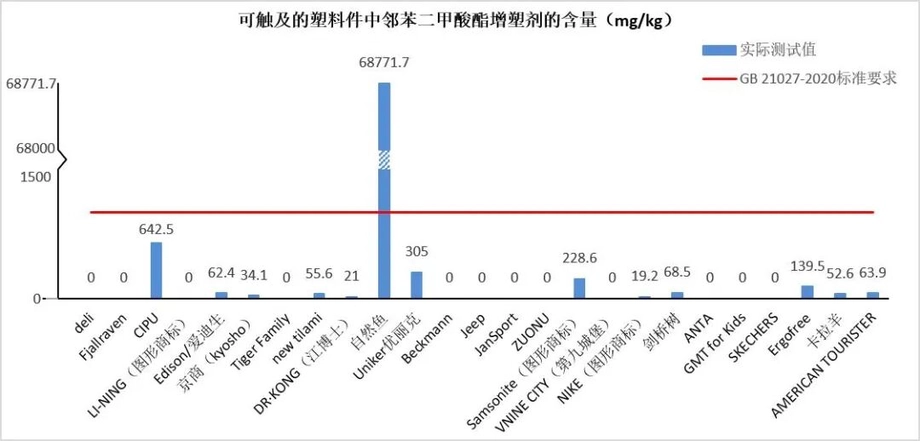
One sample stood out among 25 schoolbags
A zipper pull on a children's schoolbag labeled Ziranyu (自然鱼) contained 68,771.7 milligrams per kilogram of phthalate plasticizers, according to a comparison test released by the China Consumers Association. The national limit for plastic parts that users can touch is 1,000 milligrams per kilogram. The reading was therefore about 69 times the limit, or roughly 68 times above it.
Contents
- One sample stood out among 25 schoolbags
- Why phthalates in handles and wheels matter
- How the comparison was carried out
- What the brand's store said, and what remains unanswered
- Other bags failed seam, handle and labeling checks
- Fabric tests, trolley weight and visibility completed the picture
- How the association advises parents to choose a bag
- Daily carrying and inspection can reduce strain and damage
- At a Glance
The same sample also had a pink plastic wheel that registered 1,362.9 milligrams per kilogram. That was 362.9 milligrams per kilogram above the limit, an excess of about 36.29 percent. The two measurements made this the only sample identified in the findings as failing the phthalate requirement for accessible plastic components.
The schoolbag was one of 25 products examined in a wider exercise covering chemical content, stitching, resistance to repeated impacts, weight and reflective features. The bags were bought from a physical department store and five online platforms, with prices ranging from 104 yuan to 899.1 yuan.
Why phthalates in handles and wheels matter
Phthalates are chemicals commonly used as plasticizers, substances that make plastic softer and more flexible. The requirement applied in this test concerns plastic components that can be touched during ordinary use. That category can include a zipper pull held between a child's fingers and a wheel handled while a bag is being moved or repaired.
Public health information describes phthalate plasticizers as substances that can disrupt the endocrine system. This system is the body's network of glands and hormones, chemical messengers that help regulate growth, metabolism and reproduction. Prolonged exposure during childhood can interfere with that system and affect reproductive health.
The size of the zipper reading helps explain why it drew attention. Dividing 68,771.7 by the 1,000 milligram limit gives 68.7717. In practical terms, the measured concentration was nearly 69 times what was permitted, while the pink wheel exceeded the same limit by a much smaller but still measurable margin.
How the comparison was carried out
The China Consumers Association bought the samples from Beijing Hanguang Department Store, JD.com, Tmall, Douyin, Xiaohongshu and Vipshop. It commissioned Zhonglian Pinjian (Beijing) Inspection Technology Co., Ltd. to perform the testing. The exercise assessed decomposable carcinogenic aromatic amine dyes, formaldehyde content, phthalate plasticizers, seam strength, oscillation impact performance, reflective strips and each bag's own weight.
Several of those terms describe ordinary situations rather than obscure laboratory conditions. Seam strength measures whether stitching at fabric joins and attachments can resist breaking. Oscillation impact testing simulates repeated lifting, jolting and knocks, with the product expected to remain free from opened stitching and damage. A bag's own weight matters before books, lunch boxes and other school supplies are added.
The complete tables are available through the association's website and the Consumer Check WeChat mini program, in the module called The Consumers Association Helps You Choose. Those tables allow readers to look beyond the headline failure and examine the individual samples and test categories.
What the brand's store said, and what remains unanswered
After the findings were released, a reporter contacted the Ziranyu flagship store on Taobao while posing as a consumer. An unnamed customer service representative gave an account of destroyed stock and replacement production.
All goods from the batch involved have been destroyed. A new batch has now been produced using environmentally friendly zipper pulls.
The representative also claimed that earlier batches had all met quality requirements and that only a recent small batch had failed. No formal response had been obtained from the company that owns the brand by the time the report was published.
The store response did not provide a batch number, production date or quantity for the destroyed goods, nor did it give a date for the replacement stock reaching customers. Those details would help an owner determine whether a particular purchase belonged to the affected batch.
- Before the release: The association purchased 25 samples and commissioned the laboratory work. Exact purchase and testing dates were not given.
- 26 November 2026: The comparison results were made public, including the phthalate, seam strength and impact findings.
- 27 November 2026: The flagship store gave its destruction and replacement account. The brand's owner had not supplied a formal response by publication.
Other bags failed seam, handle and labeling checks
A sample labeled Uniker (优丽克) recorded a seam strength result of 145 newtons. A newton is a unit of force, and 145 newtons is approximately the weight of a 15 kilogram object on Earth. The stated minimums are 200 newtons for student schoolbags and 240 newtons for carry bags, leaving the Uniker result below either threshold.
Weak seams can open where fabric panels join or where straps and other components are attached. Parts may then come loose, shortening the useful life of the bag and creating practical problems when a child is carrying books between home and school.
Two other samples, labeled ZUONU and VNINE CITY (第九城堡, or Ninth Castle), developed opened stitching or damage around their handles during oscillation impact testing. The test repeatedly shakes and jolts a bag to imitate lifting and rough everyday movement. Damage at the handle matters because that area carries the load whenever the bag is picked up.
Four samples also had irregular product labels. The published examples included an Edison (爱迪生) sample with no contact telephone number and no main material listed on its product label. A Kyosho (京商) sample had no production date or batch number on the product or packaging, no specifications on its label and improper material labeling. Such information helps consumers identify what they bought and trace a particular production run.
Fabric tests, trolley weight and visibility completed the picture
All 25 samples met the requirements for decomposable carcinogenic aromatic amine dyes and formaldehyde content. The dye test concerns certain colorants that can break down into carcinogenic aromatic amines. Together with the formaldehyde result, the passes indicated comparatively good performance in the tested fabric safety categories, even though problems appeared elsewhere.
Five trolley schoolbags were relatively heavy because their pull rods, wheel assemblies and supporting structures added weight. The findings did not present those models as unsuitable for every child, but the added hardware makes it especially useful to check the empty bag before loading it.
Most samples included reflective strips. These can improve visibility and provide an auxiliary warning during journeys at dusk or after dark. The association's advice treats them as one practical feature alongside fit, weight, secure components and sound construction.
How the association advises parents to choose a bag
The China Consumers Association recommends starting with the child rather than the decoration or price. A bag should match the child's height and build, sit closely against the back and feel comfortable when tried on. A lighter model with simple decoration leaves more capacity for school supplies before the total load becomes uncomfortable.
- For a design intended to support the back, look for wide shoulder straps, a waist belt and a back pad, then judge whether the bag feels comfortable when worn.
- Check that there are no sharp corners or edges and that zippers, buckles and decorative fasteners are secure and difficult to detach.
- For a trolley bag, test whether the rod moves smoothly, whether its height suits the child and whether the wheels turn freely and appear durable. A wider base can improve stability and reduce tipping.
- Avoid products with an obvious pungent smell.
- For dark fabrics, fabrics using several colors and mesh materials, rub the surface with a pale tissue to check whether color transfers.
- Choose clear internal compartments and stable side pockets. For regular journeys to and from school, give preference to reflective strips for added visibility in low light.
The price spread in the test, from 104 yuan to 899.1 yuan, gives parents a reason to inspect the actual product rather than relying on price alone. The practical checks proposed by the association can be performed in a shop or soon after an online purchase arrives.
Daily carrying and inspection can reduce strain and damage
The association's usage advice addresses both posture and wear. Children should not carry a schoolbag over one shoulder. Chest and waist fasteners should be secured where fitted, and the shoulder straps, chest strap and waist belt should be adjusted as clothing thickness changes between summer and winter.
- Do not haul a trolley bag forcefully up or down stairs. Retract the rod and carry the bag by hand or wear it on both shoulders.
- Avoid pulling a trolley bag with the same hand in the same direction for long periods. Alternating hands reduces continued loading on one side of the body, which can shift the forces acting on the spine.
- Inspect the bag regularly for loose components, split stitching and aging or broken plastic parts. Repair or replace the bag when these problems appear.
For the Ziranyu sample, the immediate numerical findings remain the zipper pull at 68,771.7 milligrams per kilogram and the pink wheel at 1,362.9 milligrams per kilogram. For the wider group, the results show why a buying decision needs several checks: chemical content, durable stitching, secure handles, clear labels, manageable weight and a comfortable fit all address different everyday risks.
At a Glance
- A Ziranyu schoolbag zipper pull tested at 68,771.7 milligrams per kilogram of phthalates, nearly 69 times the 1,000 milligram limit.
- Its pink plastic wheel measured 1,362.9 milligrams per kilogram, about 36.29 percent above the limit.
- The China Consumers Association compared 25 schoolbags costing between 104 yuan and 899.1 yuan.
- A flagship store representative said affected stock had been destroyed and replacement bags made with different zipper pulls; the brand's owner had not given a formal response.
- Uniker recorded seam strength of 145 newtons, while ZUONU and VNINE CITY samples suffered handle stitching or damage during impact testing.
- All 25 samples passed the tested dye and formaldehyde requirements, four had labeling irregularities and five trolley models were relatively heavy.
- The association advises checking fit, weight, smell, fasteners, color transfer and reflective features, then inspecting seams and plastic parts regularly.