199 musicians and nearly 20,000 visitors
The 26th Rainforest World Music Festival brought 199 musicians from 12 countries to Sarawak Cultural Village near Kuching from 23 to 25 June 2023, and finished with 19,800 attendees. The Sarawak Tourism Board (STB), which organises the event, had set a target of more than 20,000 visitors. The final count was 200 below the 20,000 mark, but it exceeded the 12,000 people who attended physically in 2022 by 7,800, or 65%.
Contents
- 199 musicians and nearly 20,000 visitors
- Stars from abroad and momentum from Sarawak
- A stage at the foot of Mount Santubong
- Workshops, food and crafts fill the daylight hours
- How a sape journey led to the first festival
- The audience in numbers
- Sustainability becomes an operating promise
- Recognition and the record that followed
- What to Know
The 2023 theme, Reflections, invited performers and audiences to consider how far the event had come since about 300 spectators attended its first concert in 1998. The 2023 attendance figure was numerically 66 times that initial audience. STB described the festival as Sarawak's star event and as part of the state's ambition to become a regional hub for music tourism and performing arts.
Gipsy Kings featuring Tonino Baliardo supplied the best known international name, while the programme also placed Sarawakian performers beside artists from Asia, Africa, Europe and the Middle East. Across the weekend, afternoon workshops, cultural and craft displays, food stalls and evening concerts made the festival more than a sequence of headline performances.
When the edition was launched, ticket sales were scheduled to open on 15 April 2023. Passes covering one, two or three days were priced from RM190 to RM650, while a child's pass for one day cost RM80. Festival information was directed to rwmf.net.
Stars from abroad and momentum from Sarawak
Gipsy Kings performed on the first day, bringing songs such as Djobi Djoba and Bamboleo and a pop sound with roots in traditional flamenco and rumba. Big Mountain, the reggae band associated with Jamaica and the United States, was the main act on the final day. The festival usually presents between 18 and 20 bands across its weekend programme.
Other international performers included Safi Theatre from Tanzania, Rastak from Iran, Fasylive from the Maldives, Afriquoi from the United Kingdom, Chatusram from India, Rizal Hadi & Folk from Indonesia and Ethno Thai Fusions Sound Band from Thailand. Performers from Japan, Hong Kong, Singapore and Russia were also part of the wider roster described after the event. The English launch announcement said the musicians spanned more than four continents, while the Malay language version said three; both gave the same totals of 199 musicians and 12 countries.
Sarawak's Minister for Tourism, Creative Industry and Performing Arts, Dato Sri Abdul Karim Rahman Hamzah, told the launch that local musicians who had grown through the festival deserved recognition alongside the international stars. He credited music and culture with creating positive effects in their communities. The local roster he named comprised Zee Avi, Suk Binie, APU, Nadir, Steve Thornton Band, Sada Borneo, Tuku Kame, Nading Rhapsody, Geng Wak Long, Buloh Berkocak, At Adau, Meruked and Orang Orang Drum.
At Adau appeared for the third consecutive year. David Hogan Jr, who has attended the festival since 2010, said the Sarawakian band delivered an especially stirring performance and drew strong support from the crowd. He also reported that Jun Lin was no longer the artistic director for the 2023 edition and that the change had disturbed the usual scheduling and flow of music. The launch announcement did not name a successor.
Hogan considered opening with Gipsy Kings a risky scheduling decision, although he said the band gave an audience ready to celebrate what it wanted. His wider assessment was less generous: he felt some of the selection resembled a more commercial pub music festival rather than the world music programming he had valued in earlier years. That criticism coexisted with his praise for the setting, the workshops and the local performers.
A stage at the foot of Mount Santubong
Sarawak Cultural Village stands about 35 km north of Kuching, at the base of Mount Santubong. Its grounds cover 17 acres and function as a living cultural museum, with traditional houses and displays surrounding the performance spaces. For first time visitors, the music programme therefore unfolds within a broader introduction to Sarawak's communities and crafts.
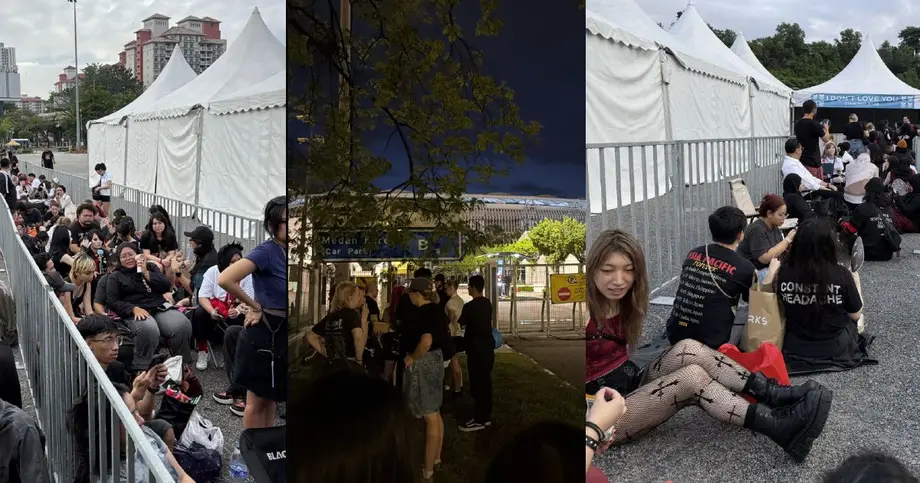
A grassy open area behind the village accommodates around 3,000 people at any one time. That capacity describes the audience space at a particular moment, while the attendance total covers participation across the festival. Visitors commonly arrive in the evening, spread out mats and settle on the grass before the concerts begin.
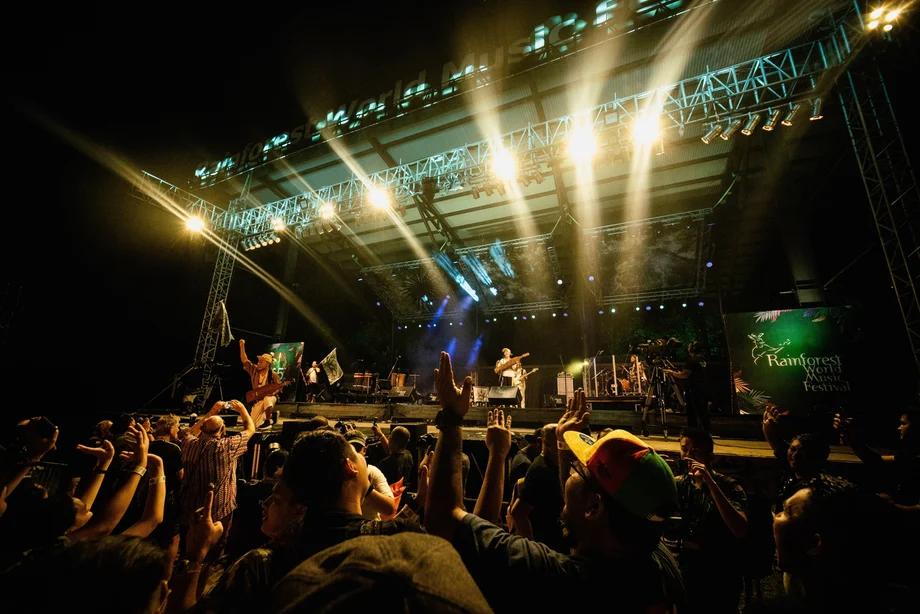
Two principal stages operate in rotation, allowing the next performers to prepare while music continues on the other stage and reducing gaps between acts. Headline performers generally use the Rainforest Stage. The arrangement keeps the evening programme moving while retaining the informal atmosphere of an outdoor village gathering.
Hogan estimated that the usual crowd consists of about 70% Malaysians and 30% visitors from other countries. He observed that many Sarawakians attend on Saturday, with some returning on Sunday depending on the performers, while people travelling from Kuching often choose passes covering all three days. His estimate describes the crowd mix rather than an official breakdown of the 19,800 attendees in 2023.
Workshops, food and crafts fill the daylight hours
Performers lead daytime workshops lasting about 30 minutes in venues scattered around the village. These sessions resemble small concerts, but they also invite visitors to dance, ask questions and examine traditional instruments at close range. Some take place inside traditional houses, where musicians and audience members can sit at the same level. Visitors may move between sessions, and artists are often visible around the grounds rather than remaining confined to backstage areas.
A large food tent offers more than 20 kinds of local and Western dishes, supplemented by smaller stalls around the grounds. Sarawakian ethnic food has a dedicated area near the Bidayuh House, while the village restaurant and the Damai Food Court provide additional choices. Hogan's account said designated stations sold beer and wine only to customers aged 18 and above who were not Muslims. Water refill stations allowed visitors carrying their own containers to replenish them around the village.
The Craft Bazaar occupies space beneath the Melanau Tall House and the Traditional Malay House. Its stalls sell Sarawakian and Bornean jewellery and handcrafted objects, including work associated with Iban, Bidayuh, Kelabit, Kayan and Kenyah communities. For those artisans, the festival audience provides a direct market; for visitors, the bazaar connects the music on stage with the material culture of the same region.
How a sape journey led to the first festival
The idea began in 1997, when Canadian musicologist Randy Raine-Reusch met Robert Basiuk, then deputy chief executive of STB. Raine-Reusch was researching ethnic music and had a particular interest in the sape, a stringed instrument played mainly by Kayan and Kenyah communities. Their discussions turned to whether Sarawak could establish an annual music festival and use international performances to introduce its musicians to a wider audience.
Jayl Langub of Majlis Adat Istiadat, the Native Customary Laws Authority, helped arrange a journey to the World Music Expo, known as WOMEX, in Marseilles. Sape players Asang Lawai and Tegit Usat travelled from the upper reaches of the Balui River in Belaga and were joined by Erang Lahang and Uchau Bilong. After rehearsing with Raine-Reusch for a week in Kuching, they performed in France. The festival history records that European agents, managers and festival directors were moved to tears by the beauty and purity of the performance.
Raine-Reusch, the Canadian musicologist whose research had prompted the discussions, explained how the French invitation became a proposal to Basiuk and the tourism board.
I had an invitation from WOMEX in Marseilles to bring some traditional musicians, so I suggested to Bob, and the Tourism Board, that we should send some musicians there to promote Sarawak.
STB approved funding in March 1998 on the condition that the board itself would organise the festival. Society Atelier Sarawak supplied musical and technical support, with Edric Ong assisting logistics and his brother Edgar Ong contributing writing and film production experience. The Sarawak Music Society had concluded that running the event was beyond its scope. Raine-Reusch became the main consultant, and the first festival went ahead with an audience of roughly 300.
The audience in numbers
Attendance records show repeated fluctuations rather than uninterrupted growth. The festival recorded 20,000 attendees in 2006 and 22,390 in 2013. It drew 18,000 in both 2015 and 2016, followed by 19,440 in 2017, 22,000 in 2018 and 23,650 in 2019.
- 1998: About 300 spectators attended the first concert.
- 2013: Attendance reached 22,390.
- 2019: The festival attracted 23,650 people before the pandemic disrupted live events.
- 2021: A virtual edition drew 402,865 viewers from 79 countries.
- 2022: A hybrid edition, staged physically and streamed online, recorded 12,000 physical attendees.
- 2023: The edition held from 23 to 25 June attracted 19,800 people.
- 2024: The following edition, held from 28 to 30 June, drew more than 26,000 attendees, its highest total.
The virtual and physical figures describe different forms of participation. The 2021 number counts online viewers, while the 2022 figure counts only people at the site. The 2023 total remained 3,850 below the 2019 figure, but the 2024 audience was more than 6,200 above that of 2023 and at least 2,350 above the 2019 total.
Sustainability becomes an operating promise
STB has linked the festival's future to responsible tourism, meaning tourism that tries to limit environmental damage while benefiting host communities. Measures used in earlier editions included banning plastic items designed for one use, encouraging the reuse and recycling of materials, testing new waste management methods and providing shuttle buses to reduce car journeys and carbon emissions. Energy conservation, environmental education and public participation in greening initiatives formed part of the same programme.
Water refill stations gave visitors a practical alternative to buying repeated containers of drinking water. The board's ambition was for the event to become one of the world's most sustainable festivals, but the launch did not set a dated target for that goal. No total for waste avoided or emissions reduced during the 2023 edition was given with the attendance figures.
Sharzede Datu Haji Salleh Askor, STB's chief executive, connected the festival's next quarter of a century with Sarawak's sustainability and ecotourism ambitions.
We look forward to reflecting on the next 25 years as we move towards making the RWMF a platform for Sarawak to push on sustainability and ecotourism for the next generation of music lovers.
Recognition and the record that followed
The festival's honours extend beyond its audience totals. It won the Heritage and Culture PATA Gold Award in 2006 and the ASEANTA Excellence Award in 2009 for the best ASEAN marketing and promotional campaign. Other recognition included HSMAI Silver Adrian Awards in 2012 and 2016, the BrandLaureate Country Branding Award for 2012 to 2013, and a Communications Director Asia Pacific Excellence Award in 2016 for event and experiential marketing.
Songlines recognition is listed in the festival history as six consecutive years among the Top 25 Best International Festivals, from 2010 through 2015. A tourism board background note instead counts five selections, from 2011 through 2015. The Transglobal World Music Chart placed the festival eighth in its Global Top 10 category in both 2018 and 2019, while the Malaysia Book of Records recognised it for the Most Percussionists In A Music Festival.
Its environmental and cultural work also received attention. The Rainforest World Music Festival and Borneo Jazz Festival Virtual Experiences were named Ones to Watch at the World Responsible Tourism Awards 2021. The 2021 virtual Rainforest World Music Festival subsequently won a PATA Gold Award in 2022 in the Sustainability and Social Responsibility category for culture.
The 2024 edition then supplied the clearest numerical continuation of the 2023 recovery. More than 26,000 people attended from 28 to 30 June, surpassing every earlier total listed for the festival. For Sarawakian musicians and craftspeople, that growth means a larger audience for performances and direct sales. For STB, it provides a bigger physical event around which to pursue its music tourism and ecotourism plans.
What to Know
- The 26th Rainforest World Music Festival took place at Sarawak Cultural Village from 23 to 25 June 2023.
- Its programme featured 199 musicians from 12 countries, including Gipsy Kings, Big Mountain and a large Sarawakian contingent.
- Attendance reached 19,800, just below the 20,000 mark used in STB's target but 65% above physical attendance in 2022.
- At Adau performed for the third consecutive year, while a change of artistic director prompted debate over scheduling and musical selection.
- The festival grew from discussions in 1997 and a first concert before about 300 spectators in 1998.
- Sustainability measures included restrictions on disposable plastics, recycling, waste management projects, shuttle buses and water refill stations.
- The edition held from 28 to 30 June 2024 attracted more than 26,000 people, setting a new attendance record.