Thousands still do not know they have HIV
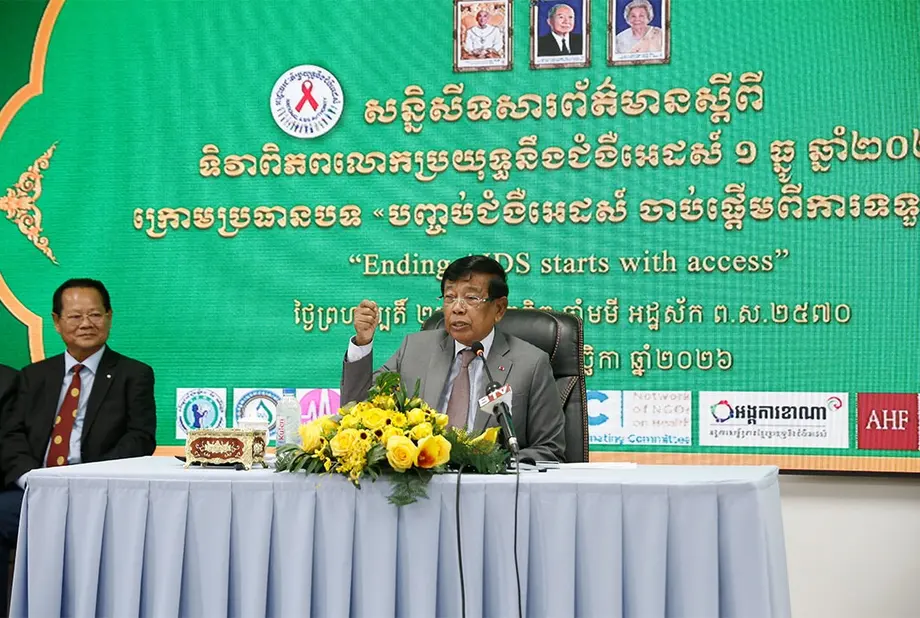
Cambodia has built an extensive HIV treatment system, but an estimated 3,000 to 4,000 people living with the virus still do not know their status. Senior Minister Eang Mouly, chairman of the National AIDS Authority (NAA), set out that concern on the morning of November 26, 2026, at a press conference held before World AIDS Day under the theme End AIDS, start from access. Finding those people is central to preventing illness, protecting their partners and keeping the national 2030 goal within reach.
Contents
- Thousands still do not know they have HIV
- Why early diagnosis changes lives
- Free testing kits arrive in discreet packaging
- Stigma can defeat strong medical services
- What the official estimates show
- Young men and children need closer attention
- A sin tax enters the funding debate
- Community networks feel the aid squeeze
- The dates that matter next
- Key Points
Mouly put Cambodia's total number of people living with HIV at about 76,000, with approximately 73,000 receiving antiretroviral treatment. He also cited about 960 new HIV infections and more than 1,000 deaths related to AIDS each year. Dr Chan Phanna, country programme manager of AIDS Healthcare Foundation (AHF) Cambodia, put the number unaware of their infection at about 4,000.
Mouly described the national aim as reducing annual new infections to around 300 by 2030. Phanna stated the target as fewer than 250. Reaching 300 from the current estimate of 960 would require about 660 fewer infections each year, a reduction of nearly 69%. Ending AIDS as a public health threat does not mean that HIV will disappear. It means controlling transmission, illness and deaths while people living with the virus continue to receive treatment and support.
Why early diagnosis changes lives
HIV damages the immune system over time, and AIDS is its advanced stage. Antiretroviral therapy, often called ART, controls the virus rather than removing it from the body. Effective treatment can reduce the amount of virus in the blood until standard tests cannot detect it. A person who maintains an undetectable viral load does not transmit HIV through sex. Phanna said some Cambodian patients still seek help only after their immune systems have been severely weakened, making early testing essential even where treatment is widely available.
Speakers at the press conference also recalled Cambodia's recognition as the first country in Asia and the Pacific to meet the UNAIDS 95-95-95 targets. Those targets describe a chain of care: 95% of people with HIV knowing their status, 95% of diagnosed people receiving treatment, and 95% of those treated achieving viral suppression. The remaining undiagnosed cases sit at the beginning of that chain, before medicine can help.
AHF Cambodia works with 44 treatment centres across the country on early diagnosis, consistent treatment and contact with patients who miss appointments. Phanna said more than 90% of patients who missed appointments eventually returned for treatment. He credited cooperation between health facilities and community organisations. AHF plans to continue its cooperation with the government through 2028, with priorities including prevention and testing among young people, prompt treatment and keeping patients in care.
Free testing kits arrive in discreet packaging
Mouly said confidential testing options now include free kits that use oral fluid, allowing people to carry out preliminary screening at home. The kits can be ordered through the Foodpanda delivery platform and arrive in discreet packaging. This arrangement allows someone to request a test without discussing the reason with delivery staff or other people nearby.
A reactive result means the kit has detected a possible sign of HIV. It is not a final diagnosis, so the person should go to a healthcare facility for confirmatory testing and, if HIV is confirmed, treatment. Chub Sokchamroeun, chairman of the board of the Health Action Coordinating Committee (HACC), separately appealed to about 3,000 people who suspect they may be infected but have not yet been tested. He said Cambodia has many testing locations that protect confidentiality.
Mouly also asked journalists to check claims about HIV outbreaks against official testing information rather than repeat unsupported assertions circulating on Facebook. He explained how reporters should question the origin of such claims.
If you see someone on Facebook claiming that there is an HIV outbreak, ask where that information came from. If it does not come from testing facilities, the information is unreliable.
Stigma can defeat strong medical services
Chub said healthcare providers must create welcoming surroundings, particularly for young people who fear having to explain their personal circumstances. Privacy at the testing stage is only part of the response. People also need confidence that health workers, relatives, employers and neighbours will not punish or reject them.
No matter how good our prevention services are, they will not reach the target population if people are afraid or worried that others will find out.
Mouly identified embarrassment and discrimination as reasons people avoid testing and treatment. He urged local authorities and media organisations to encourage people at risk to come forward and to explain that viral suppression prevents sexual transmission.
As long as discrimination persists, AIDS will not end.
Phanna said the response should enable people living with HIV to stay healthy, obtain services without discrimination, and continue their education and work. HACC has also encouraged families and communities to discuss HIV openly rather than remain silent.
What the official estimates show
A detailed official baseline was presented in Phnom Penh on April 5, 2023, when the NAA, the Ministry of Health National Center for HIV/AIDS, Dermatology and STDs (NCHADS), and UNAIDS jointly released the 2023 HIV estimates. The document estimated that 76,000 people, within a range of 63,000 to 85,000, were living with HIV at the end of 2022. About 74,000 were adults aged 15 or older, while approximately 2,000 were children aged 0 to 14.
The earlier estimate found that 86% of people living with HIV knew their status, leaving an estimated 11,000 unaware. That figure is considerably higher than the 3,000 to 4,000 cited at the November press conference and belongs to the earlier set of estimates. As of December 2022, 64,931 people were accessing ART. Among those who knew their status, 99% were receiving treatment, and 98% of people on treatment had achieved viral suppression. The roughly 73,000 people on treatment cited in November is about 8,000 higher than the December 2022 count.
The official document estimated 1,400 new infections in 2022, equivalent to about four each day. New infections had fallen by 91% since the epidemic's 1996 peak, but by only 33% compared with 2010, showing that the pace of decline had slowed. The roughly 960 annual infections cited in November are 440 below the 2022 estimate, a difference of about 31%.
Dr Ouk Vichea, director of NCHADS, said Cambodia's ability to connect diagnosed people to treatment was a strength, while testing had to reach those still outside the system.
Now we must work to reach those not accessing testing services by scaling up approaches such as community-based testing and self-testing.
Young men and children need closer attention
Males accounted for 79% of new HIV infections in 2022. Key populations and their sexual partners accounted for 83%. The term key populations refers here to female entertainment workers, gay men and other men who have sex with men, transgender women, and people who use or inject drugs. Patricia Ongpin, UNAIDS director for Cambodia, Lao PDR and Malaysia, said infections were increasing among men, particularly young gay men. More recent figures cited at the press conference show that young people made up 44% of new cases in 2025.
Ongpin called for prevention knowledge and services designed around the people still being missed.
To bend the curve of new HIV infections, we need focused interventions to increase HIV knowledge as well as access to prevention and testing services for young key populations.
Children presented a different weakness in the 2022 figures. Only 59% of children living with HIV had been diagnosed and were receiving treatment. The transmission rate from mothers to children was 9.9%, and one in ten pregnant women living with HIV had not accessed services intended to prevent transmission to babies. Ongpin said eliminating such transmission required urgent attention alongside efforts to ensure infected children received care.
A sin tax enters the funding debate
Cambodia spends about $20 million a year on its HIV response. Mouly listed an $8 million contribution from the national budget and $31 million in support from the Global Fund over three years. He separately put annual government spending on medication at $5 million. Falling resources have already reduced food assistance for patients, adding a practical difficulty for people trying to remain in treatment.
Mouly is considering a sin tax on tobacco, alcohol and sugary drinks as one way to finance the response. Such a tax would raise revenue from products whose consumption can also create other health costs. After discussions with the Ministry of Health, he intends to present financing proposals to the government or the Ministry of Economy and Finance.
We are the owners of the problem, so we must find ways to solve it. This is one possible strategy for ending AIDS.
The NAA also plans to seek bilateral assistance from partners including China and loans from institutions such as the World Bank and Asian Development Bank. The tax and loan proposals have not been presented as settled financing arrangements, and no date was given for a government decision.
Community networks feel the aid squeeze
HACC illustrates how declining support can narrow the response beyond clinic walls. Only 20 of its 78 member organisations now work on HIV and AIDS. Chub warned that volunteers, peer educators and community care providers lose their roles when programmes contract, weakening the networks that help people begin and continue treatment.
When investment in HIV programmes declines, networks of volunteers, peer educators and community-based care providers lose their jobs and opportunities to participate.
Phanna called for greater domestic financing to replace declining international assistance. He also wants HIV services integrated into the general public health system, alongside continued outreach led by communities to combat stigma. Such integration would make testing, treatment and patient support part of routine healthcare rather than services dependent entirely on separate projects.
Phanna said Cambodia's achievements should not hide the remaining difficulties and framed the response as a wider social obligation.
This is not simply a technical issue. It is a matter of public responsibility, social protection and human dignity.
The dates that matter next
Several dates explain how Cambodia reached this point and what happens next.
- 1996: The epidemic reached its peak; estimated new infections in 2022 were 91% below that level.
- December 2022: Cambodia recorded 64,931 people receiving antiretroviral therapy.
- April 5, 2023: The NAA, NCHADS and UNAIDS presented the national estimates in Phnom Penh.
- 2025: Young people accounted for 44% of new HIV cases.
- November 26, 2026: Officials and health organisations set out concerns about undiagnosed cases, stigma and financing.
- 2028 and 2030: AHF plans to continue government cooperation through 2028, while Cambodia's infection reduction goals fall due in 2030.
AHF Cambodia scheduled public awareness activities and free testing at Phnom Penh's riverside on November 28 and at Wat Phnom on December 1, World AIDS Day. Those events offer immediate opportunities for testing while decisions on domestic taxes, foreign assistance and loans remain pending.
Key Points
- An estimated 3,000 to 4,000 people in Cambodia are living with HIV without knowing their status.
- About 76,000 people are living with HIV, and approximately 73,000 are receiving antiretroviral treatment.
- Cambodia records about 960 new infections and more than 1,000 deaths related to AIDS annually.
- Mouly cited a 2030 target of around 300 new infections a year, while Phanna gave a target below 250.
- Free preliminary testing kits can be ordered through Foodpanda in discreet packaging, but reactive results require confirmation at a health facility.
- Young people represented 44% of new cases in 2025, while earlier estimates showed major gaps in care for children.
- A proposed tax on tobacco, alcohol and sugary drinks is among the financing ideas under discussion as foreign aid declines.