A sudden crisis after a Tube video
Sabrina Bahsoon, 26, known to more than 900,000 followers as Tube Girl, spent around two months in a psychiatric hospital being treated for psychosis before doctors identified inflammation in her brain. The eventual diagnosis was anti-NMDA receptor encephalitis, an autoimmune disease associated in her case with ovarian tumours called teratomas. Surgeons removed the tumours on June 18, 2026, preserved her ovaries and set her on a difficult course of recovery.
Contents
- A sudden crisis after a Tube video
- The test result her family says was missed
- How can an ovarian tumour affect the brain?
- Why can it look like psychosis?
- The tests that can change the diagnosis
- How rare is the teratoma connection?
- Treatment can reverse the attack, but recovery takes time
- Warning signs families can raise with doctors
- What Bahsoon wants hospitals to change
- Key Points
The creator, who was born in Malaysia, became famous in 2023 after posting a clip lasting 11 seconds of herself lip-syncing on the London Underground. Her confident Tube performances led to fashion and beauty work, magazine appearances and a music career. That public life stopped abruptly after she filmed a Tube video with the girl group Flo in March 2026.
On the evening of March 19, Bahsoon began screaming, crying and speaking erratically. She unexpectedly ended her relationship the next day, prompting her sisters to check on her. They found her posting incoherent videos, threatening to harm herself and becoming violent. Emergency doctors initially attributed her behaviour to stress, a breakup and lack of sleep, and sent her home with sleeping tablets. Bahsoon said the violence was entirely unlike her.
I'm normally a very relaxed person, maybe anxious at times, but the way I was speaking about harming myself and the way I was screaming and being violent was super out of character for me.
Back at home, she reported hallucinations, smashed belongings and tried to escape. Police eventually took her to hospital in handcuffs, and four people were needed to restrain her before she was sedated. After four days in accident and emergency, she was detained under the Mental Health Act and moved to a psychiatric ward. Antipsychotic medication did not restore her health. She lost weight, stopped eating and drinking, and struggled to speak. She described the change in her condition in stark terms.
I went from being a total firecracker to being completely catatonic. I stopped eating, drinking. I could not speak properly.
- March 19, 2026: Bahsoon's sudden crying, screaming and erratic speech began after her filming session with Flo.
- March 2026: An initial hospital discharge with sleeping tablets was followed by a police journey to hospital, detention under mental health legislation and treatment for psychosis.
- About two months later: Further investigations, pressed for by her family, identified anti-NMDA receptor encephalitis and ovarian teratomas.
- June 18: She underwent an operation lasting four hours at Charing Cross Hospital. The tumours were removed and her ovaries were saved.
- July: She was discharged after also receiving two rounds of immunotherapy.
- September and October: She returned to TikTok in September after six months away, then publicly explained her diagnosis on October 1.
Bahsoon has described spending roughly four months in hospital in total, including the psychiatric admission and the treatment that followed her correct diagnosis.
The test result her family says was missed
Bahsoon's parents travelled from Malaysia as her condition worsened. Her father consulted a neurologist friend and pushed for investigations into autoimmune encephalitis, including scans of her brain and pelvis. Bahsoon later said the family discovered, only a week before an interview in November, that an anti-NMDA receptor test had already returned "weakly positive" and that the result had been missed. The hospital trusts have not publicly addressed that specific test result in their statements.
Bahsoon said the delay left her feeling that insufficient urgency had gone into finding the cause of her illness. She also objected to being treated as though further physical investigation were unnecessary.
In a way I do feel let down by the care I received. I feel like the urgency to discover what was actually wrong with me wasn't there.
Imperial College Healthcare NHS Trust, which first treated her, said it was "very sorry" for her experience. Its internal review found that aspects of her initial assessment "were not followed up as they should have been", and an investigation into her care began. Central and North West London NHS Foundation Trust confirmed that it would take part. Dr Ed Beveridge, its divisional medical director, called anti-NMDA receptor encephalitis a "rare autoimmune condition" and said it is not "routinely screened for nationally". He added that he was pleased her condition had been identified and treated.
No completion date for the investigation has been made public. Bahsoon's father said the family did not intend to sue, adding that the hospital had called to apologise for getting matters wrong.
How can an ovarian tumour affect the brain?
NMDA receptors sit on brain cells and help transmit signals involved in memory, learning, perception and mood. Dr Neha Pandita, senior consultant neurologist at Fortis Hospital in Noida, compares them to switches that allow neurons to communicate.
Think of NMDA receptors as the brain's primary communication switches. They control everything from how we form memories and process reality to how we regulate mood.
A 2026 comprehensive review in Biomedicines, led by Hanna Miski and colleagues at the Medical University of Warsaw, explains how some teratomas can start the immune error. These germ cell tumours can contain several kinds of tissue. In some patients, nerve related tissue inside the tumour produces GluN1, the same receptor component targeted by the antibodies found in anti-NMDA receptor encephalitis.
Immune cells can gather around that tissue in organised clusters and produce antibodies locally. The resemblance between tumour proteins and proteins in the brain creates a case of mistaken identity known as molecular mimicry. Antibodies activated against the tumour can then react with the brain's receptors. Inflammation can also make the barrier between the bloodstream and brain more permeable, while antibody production may continue within the central nervous system.
Once attached, pairs of antibodies can link neighbouring receptors and draw them inside the neuron. Fewer receptors remain on the cell surface, so signalling falls. The tumour does not need to spread to the brain or press against it. The Warsaw review describes this receptor loss as reversible: receptor density and neuronal function can return when antibody levels fall after tumour removal or immunotherapy.
Why can it look like psychosis?
Psychosis is a collection of symptoms rather than one illness. Hallucinations involve sensing things that are not present, delusions are fixed false beliefs, and thought disorder can prevent someone from forming coherent speech. Dr Jonathan Rogers, clinical lecturer at University College London and a neuropsychiatrist at the National Hospital for Neurology and Neurosurgery, estimates that roughly 5% of psychosis cases are triggered by an identifiable neurological condition. Infections, seizures, dementia and autoimmune attacks are among the possibilities. Most people experiencing psychosis require assessment for a much wider range of psychiatric, physical and social causes.
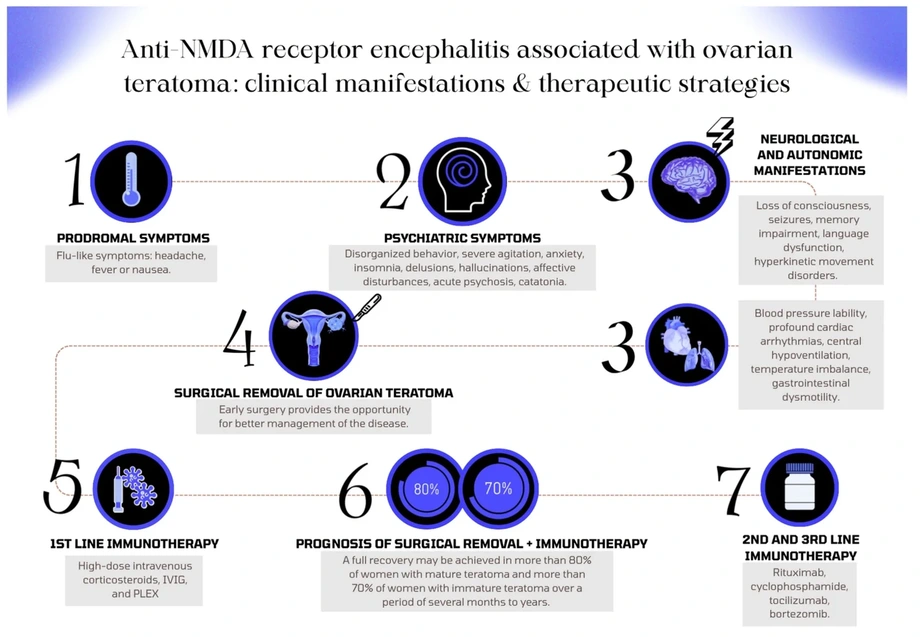
Anti-NMDA receptor encephalitis often moves through stages. It may begin with fever, headache, nausea or exhaustion resembling a stubborn viral infection. Psychiatric changes can follow within days or weeks, including agitation, insomnia, paranoia, hallucinations, aggression or profound withdrawal. Speech problems, memory loss, seizures and involuntary movements may then develop. Severe cases can involve catatonia, reduced consciousness, unstable blood pressure or heart rate, and breathing difficulties.
The Warsaw review puts psychiatric symptoms at presentation in 60 to 80% of adults. It also cites research finding that more than 95% of patients eventually develop neurological symptoms. Children may instead show seizures or movement disorders first, making their illness look different from an adult's sudden psychiatric crisis.
Demographic figures compiled from 633 patients give a mean age at onset of 22.6 years, with ages ranging from eight months to 84 years. Women and girls accounted for 492 patients, or 77.8%. Encephalitis International says about 40% of cases occur in people under 18. Ovarian teratomas and infection with herpes simplex virus type 1 are recognised triggers, but the review says most cases have no identified trigger.
UK estimates are not uniform. Encephalitis International has been cited with an estimate of about 6,000 people affected by encephalitis annually, while another public estimate put anti-NMDA receptor encephalitis at about 4,000 cases a year. The Warsaw review states that the true incidence of this subtype remains uncertain.
The tests that can change the diagnosis
A clinical case series published in Frontiers in Neurology examined 17 patients treated at Xuanwu Hospital, Capital Medical University, between August 2015 and August 2025. Heqin Yang, Chun Fang and Shijun Wang studied women aged 16 to 40, with a median age of 25. The median interval from symptom onset to diagnosis was 16 days, and the median from hospital admission to diagnosis was four days.
Twelve of the 17 patients, or 71%, initially presented with psychiatric or behavioural abnormalities. Sixteen, or 94%, experienced those manifestations during their illness. Involuntary movements affected 15 patients, while seizures and impaired consciousness each affected 13. None had abdominal pain or swelling from tumour compression when admitted, showing why a pelvic cause can remain hidden behind brain symptoms.
The decisive test is examination of cerebrospinal fluid for anti-GluN1 IgG antibodies. Doctors obtain the fluid through a lumbar puncture, which involves taking a sample from around the spinal cord. All 17 Beijing patients had positive antibodies and elevated white blood cell counts in their cerebrospinal fluid. The Warsaw review identifies this antibody testing as the definitive diagnostic criterion.
Other investigations supply different pieces of the picture. A brain MRI looks for inflammation or structural changes, while an EEG records electrical activity and can reveal slowing, seizures or patterns called delta brushes. Seven of the Beijing patients had normal MRI scans, and five had no reported EEG abnormality. Pelvic ultrasound identified teratomas in 11 patients; CT or MRI revealed them in four more. Another patient's imaging suggested a cyst, but examination after surgery confirmed a teratoma. These findings explain why doctors may combine spinal fluid testing, brain investigations and pelvic imaging rather than depend on one scan.
How rare is the teratoma connection?
The Beijing authors state that an underlying neoplasm is found in approximately 25 to 40% of anti-NMDA receptor encephalitis cases, and that around 90% of those associated tumours are ovarian teratomas. In the much larger group of 633 patients reviewed by Warren and colleagues, an ovarian teratoma was identified in 178 cases, or 28.1%.
The reverse risk is far smaller. The Warsaw review cites a series in which 3.07% of 163 patients with confirmed ovarian teratoma were diagnosed with the encephalitis, equivalent to about five patients. Mature cystic teratomas, often called dermoid cysts, have an estimated incidence of 8.9 per 100,000 women. Immature teratomas are estimated at 1.5 per 100,000 women.
Researchers are still trying to explain why only a small minority of tumours provoke autoimmunity. One pathological study cited in the review found nervous tissue in 26 of 27 teratomas associated with the disease, compared with about one third of control teratomas. Abnormal neurons, organised immune infiltrates and local antibody production appear more relevant than the simple presence of nerve tissue. Genetic susceptibility remains under investigation.
Dr Sumati Tadas, a gynaecologist at Apollo Spectra in Pune, said many small teratomas cause no symptoms and are discovered during examinations for unrelated concerns.
These tumours are sometimes discovered accidentally during a routine ultrasound or an examination done for an unrelated health concern.
Dr Tadas advises women diagnosed with a teratoma to follow their doctor's treatment and monitoring plan rather than assume that a brain illness will follow. A sudden psychiatric or neurological change requires its own urgent assessment, while an incidental teratoma requires gynaecological evaluation.
Treatment can reverse the attack, but recovery takes time
Treatment addresses the tumour and the immune response together. Surgeons remove a teratoma when one is found, reducing a continuing source of immune stimulation. Doctors can then use high doses of steroids, intravenous immunoglobulin or plasma exchange. Immunoglobulin supplies prepared antibodies that help modify immune activity, while plasma exchange filters a patient's blood plasma to remove harmful antibodies. Some patients require additional immune medicines, treatment for seizures, assistance with breathing and intensive care.
All 17 Beijing patients received immunotherapy and tumour removal. Fifteen required intensive care, and 14 needed mechanical ventilation. Every patient met the study's definition of clinical improvement, meaning that at least one major neurological symptom resolved or substantially decreased. Recovery of independence was slower. Three months after surgery, four patients, or 24%, had a modified Rankin Scale score of 2 or lower, indicating a favourable functional outcome. Eight, or 47%, remained at score 5, representing severe disability. A patient can therefore show clear neurological improvement while still needing extensive daily care.
Dr Pandita estimates that roughly 75 to 80% of patients make a full or almost complete recovery, often after months of rehabilitation for memory, concentration, speech and stamina. The Beijing authors cite a recovery figure above 80% across published patients and mortality of approximately 7%. Dr Ava Easton, chief executive of Encephalitis International, also warns that improvement can be slow and that some survivors are left with physical, cognitive, emotional or behavioural effects of brain injury.
Research continues into more targeted treatment. The Warsaw review describes ART5803, an experimental antibody with a single binding unit. It is designed to obstruct harmful antibodies without triggering the receptor removal caused by conventional antibodies with two binding units. It is an emerging approach rather than a treatment Bahsoon is known to have received.
Bahsoon said her behaviour changed "drastically" after surgery, from constant agitation to a better understanding of her surroundings. She nevertheless lost substantial weight, much of her hair and large portions of memory. She spent part of her recovery in Malaysia, where therapy helped her process the trauma. Later back in London, she described filming a Tube video with her sisters on Halloween but leaving it unpublished in her drafts. She plans to resume content creation with more limits on work and says her doctors expect her to recover fully.
Warning signs families can raise with doctors
Sudden psychiatric symptoms deserve particular attention when they arrive with physical or cognitive changes. Dr Pandita and Dr Claudia Aymerich, a consultant psychiatrist at Berkeley Psychiatrists, identify several patterns that should prompt discussion of a neurological cause. A 2025 review in the Journal of Clinical Investigation also highlighted abrupt onset, rapid swings between agitation and catatonia, and poor tolerance of antipsychotic medicines.
- Psychosis, aggression or severe withdrawal appearing suddenly in someone with no previous psychiatric history.
- Confusion, disorientation or memory loss developing alongside the behavioural change.
- Seizures, speech difficulty, involuntary movements such as lip-smacking, or rapid shifts between agitation and unresponsiveness.
- Fever, headache or exhaustion shortly before the psychiatric symptoms.
- Deterioration despite standard psychiatric treatment, or an unusually poor reaction to antipsychotic medication.
- Reduced consciousness, unstable heart rate or blood pressure, and breathing problems in more advanced illness.
Doctors use the whole pattern, the patient's history and examination findings to select tests. Anyone at immediate risk of harming themselves or someone else needs urgent emergency help. Hospital treatment may be necessary while clinicians investigate psychiatric, infectious, metabolic, medication related and autoimmune causes.
Dr Aymerich said relatives often recognise the earliest change because they know the person's usual behaviour.
Families often notice these changes first, so they should feel able to speak up and keep asking questions until they feel heard.
A useful question for the treating team is whether a physical cause has been considered, particularly when new seizures, movement problems, confusion or catatonia emerge.
What Bahsoon wants hospitals to change
Bahsoon wants a standard set of medical tests for patients who suddenly present with psychotic symptoms, alongside psychiatric assessment. Her family has discussed a safeguard called Sabrina's Protocol, while her campaign has also been described as Sabrina's Law. No bill, national protocol or start date for routine national screening has been announced.
She connects that proposal with her attempt to prevent another patient spending months without treatment for the underlying disease.
I do want reform in the way that hospitals deal with psychotic patients or patients that present with psychotic symptoms. I hope I'm sharing my story so that nobody else has to go through this.
Her account has also renewed discussion about whose descriptions of illness are believed. An international survey of 6,607 participants found that 43.3% of women said their symptoms had been mistaken for mental health issues, compared with 32.7% of men. Psychosomatic explanations were reported by 33.9% of women and 21.5% of men.
Asal Shirazi, chief executive and founder of the autoimmune support organisation ASA Foundation, cited an English government women's health survey in which 84% of respondents recalled at least one occasion when they, or the woman they were answering about, felt unheard by a healthcare professional. Shirazi said Bahsoon's experience raises legitimate questions about listening and reconsidering an initial diagnosis, while adding that whether bias played a part in her particular care remains an open question.
For Bahsoon, the immediate plans are more personal: continue therapy, rebuild memory and stamina, and return to the videos that made her famous. The formal investigation into her care and her request for standard testing remain separate processes, with no public decision dates yet.
Key Points
- Sabrina Bahsoon's sudden behavioural crisis began on March 19, 2026, and she spent about two months receiving psychiatric treatment before the underlying diagnosis.
- Doctors eventually identified anti-NMDA receptor encephalitis associated with ovarian teratomas.
- Surgeons removed the tumours on June 18 and preserved her ovaries; she received immunotherapy and was discharged in July.
- Bahsoon says her family later learned that a weakly positive antibody result had been missed.
- Imperial College Healthcare NHS Trust apologised and opened an investigation after finding shortcomings in follow up to her initial assessment.
- Spinal fluid antibody testing is definitive, while MRI, EEG and pelvic imaging help identify the illness and its trigger.
- Only 3.07% of patients in one series of 163 confirmed teratoma cases developed the encephalitis, so most women with these tumours will not experience it.
- Tumour removal and immunotherapy can reverse the immune attack, but rehabilitation may take months and recovery differs widely between patients.