Employers Push for Review as Procurement Wage Rules Bite
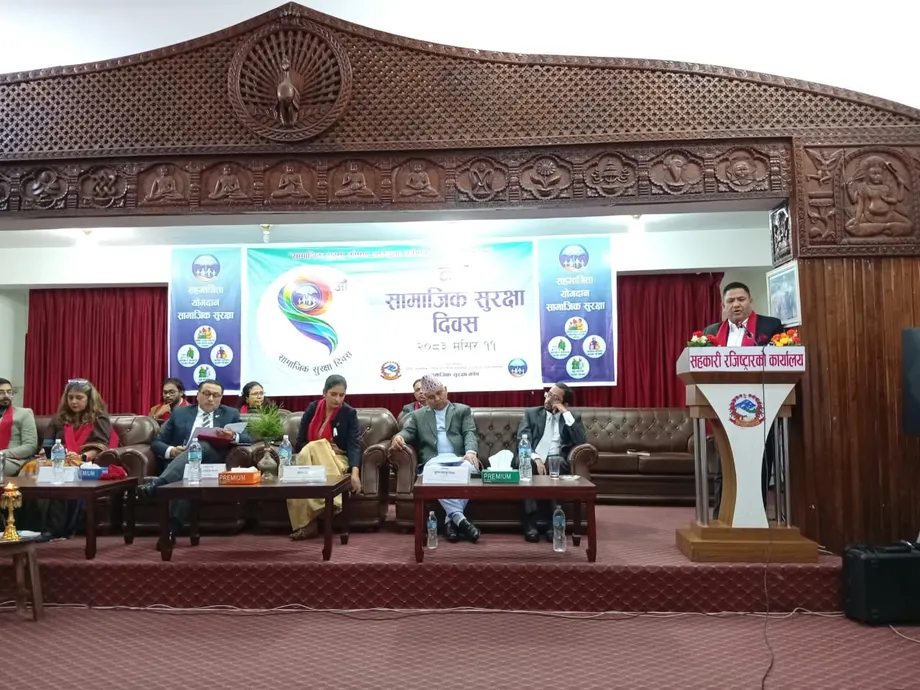
Kathmandu, Mangsir 11, 2083: Prabaljung Pandey, associate vice president of the Federation of Nepalese Chambers of Commerce and Industry and chair of the Employers' Council, asked the government to review the wage and social security rules for workers on public contracts. He framed the request as a way to remove disparity in employer and worker contributions to the Social Security Fund and make the system more practical and effective. Speaking at an event marking Ninth Social Security Day, he said some provisions were positive but that the package added costs for private businesses and construction companies, especially where old contracts were priced before the rules changed.
Contents
- Employers Push for Review as Procurement Wage Rules Bite
- What the Rules Cover in Plain Terms
- Where the Pay Gap Comes From
- Why Old Contracts Sit at the Centre
- The Cost for 100 Workers Over 26 Days
- Subcontractors, Bank Payments and Penalties
- What Pandey Wants Done With the Fund
- Why Practical Enrolment Matters
- What Would Make the System Work
- What Happens Next for the Rules
- Key Points
The rules at issue are the Procedure on Remuneration and Social Security of Workers Associated with Public Procurement, 2083, approved by the Council of Ministers on 17 Kartik 2083 under Section 74ka of the Public Procurement Act, 2063. The procedure, which has 31 sections, took effect immediately. It sets pay floors, social security contributions, bank payment requirements and penalties for employers working on government projects.
What the Rules Cover in Plain Terms
Public procurement means the goods, construction and services that government bodies buy. A road, school building, consultancy job or information technology contract can all fall into this world. Nepal's new procedure ties access to that work to how employers treat the people who do it: registered employment, wages paid through banks, regular contributions, safe workplaces and a way to complain when wages are withheld.
Law, Justice and Parliamentary Affairs Minister Sovita Gautam said the procedure was meant to protect wages, prevent exploitation by intermediaries and make employers responsible for workplace safety. Intermediaries, in this setting, are middlemen who can stand between a worker and the company or agency paying for the work.
The rules cover more than permanent staff. Daily wage workers, temporary workers, seasonal workers and people hired for a short period are inside the system, including workers brought in by subcontractors. When the rules were approved, Nepal set daily packages from NPR1,740 to NPR2,400 for construction and field workers under the approved pay floors. The lowest package was NPR1,450 paid to the worker plus NPR145 from the public body and NPR145 from the employer.
- 17 Kartik 2083: Council of Ministers approved the procedure with 31 sections under the Public Procurement Act, 2063.
- 5 Mangsir 2083: A cost example put the lowest daily labour package at NPR1,740 and set out concerns about clauses on cost estimates and payment.
- Mangsir 11, 2083: At the Ninth Social Security Day programme in Kathmandu, Pandey and Devendra Lamichhane urged a more practical system.
The earlier announcement also placed the public body's contribution inside project budgets. In simple terms, worker protection becomes part of the price of a government project, not a cost left outside the tender.
Where the Pay Gap Comes From
Pandey put the central comparison in numbers. The private sector minimum is NPR19,550 a month, or NPR754 a day. For unskilled workers on public procurement, he used a daily figure of NPR1,740. The procedure's own breakdown says NPR1,450 goes to the worker and NPR290 goes to social security, split equally between the employer and the public body.
Pandey, speaking as the federation's associate vice president and Employers' Council chair, warned that two pay systems in one labour market could draw workers away from private industry and raise costs for factories and construction firms. He said:
One labour market with two wage systems risks workers leaving the private sector, industry costs rising and competitiveness weakening.
The comparison is stark once the figures are placed side by side. NPR1,450 is NPR696 above the NPR754 private daily minimum, nearly double it. The NPR1,740 package is NPR986 above the private figure, more than twice as much. Those numbers explain why employers say fair pay for workers and the way the added cost is built into contracts must be handled together.
Why Old Contracts Sit at the Centre
Old contracts are the hardest part of the dispute. Pandey said many rate schedules, cost estimates and bids were prepared before the new wage floor and the 10 percent employer contribution were included. When a contractor has already agreed to a fixed price, a new cost added later has to come from somewhere, usually thinner margins or reduced work quality.
Section 17 says labour pay and social security costs must be included in the cost estimate. Section 28 says no extra amount will be paid beyond the quoted sum. The two provisions sit awkwardly together if the original estimate did not include real labour costs. Section 30 says contracts already being implemented should continue according to their agreements, yet Pandey and construction sector representatives say the practical treatment of tenders already under way still needs a clear answer. No date was announced for the review he requested, and no fresh deadline was given for consultations.
The Cost for 100 Workers Over 26 Days
Pramod Lamichhane, a central member of the Nepal Construction Business Association, put the cost into a simple example. If 100 workers labour for 26 days in a month, the base pay alone comes to NPR3.77 million. Adding the employer's 10 percent contribution brings the contractor's monthly labour cost to NPR4.147 million. The public body's 10 percent contribution is another NPR377,000.
That example leaves out other costs contractors commonly carry, including leave, overtime, accident insurance, safety equipment and other worker facilities. For one site, the figures are manageable to follow. Across many projects at once, they explain why construction businesses say the new duties change the economics of a tender. Nepal uses NPR as its currency, so NPR1,740 a day means 1,740 rupees for one worker for one day.
Subcontractors, Bank Payments and Penalties
Section 20 makes the main contractor jointly responsible for wages and social security when workers are hired through a subcontractor. In plain terms, a construction company cannot treat wage duties as someone else's problem once work is passed to another firm. That protection matters on building sites, where workers may move between crews and small contractors may have weak records.
Section 18 requires wages to be paid through bank accounts. Proof of wages and contributions must be submitted with running bills, which are interim payment requests for work completed. If nonpayment is proven, the public body can deduct money from the bill and pay the worker directly. Section 25 allows tough steps for breaches, including a red card, stopping running bills and blacklisting.
What Pandey Wants Done With the Fund
Pandey's second demand concerns the Social Security Fund itself, the pool that holds worker and employer contributions for future benefits. He said billions of rupees have already been collected in the fund. His view is that money sitting in a bank is less useful than money invested in projects that create more work and income.
Pandey, who also leads the Employers' Council, told the Ninth Social Security Day audience that the fund should support productive activity such as infrastructure, hydropower, industry and job creation. He added large projects to that list and said a fund that grows without investment leaves Nepal with a smaller practical benefit. He also said responsibility for workers does not become lighter if a ministry changes its name or structure. Social security is tied to workers' rights and employers' duties, he said, so institutional changes should not reduce protection.
Keeping the amount collected in the fund in a bank alone is not productive. It should be invested in infrastructure, hydropower, industry and areas that create employment.
The proposal links two problems. Workers gain protection when the fund has enough money to pay benefits, and employers argue that the wider economy gains when those savings help build projects and jobs. Pandey did not give an investment plan or name a specific fund body to manage such lending.
Why Practical Enrolment Matters
Devendra Lamichhane, director general of Nepal Chamber of Commerce, spoke at the same programme. He urged policymakers to bring informal workers into social security by looking at real income, the kind of work people do and what they can afford to contribute. A fixed rule can be hard to follow for a driver with irregular contracts, a farmer with seasonal earnings or a trader whose sales rise and fall.
The enrolment gap gives his point a hard number. Only 1,469 informal workers and people who work for themselves had joined Nepal's Social Security Fund, which is funded by contributions. The total was made up of 809 informal sector workers and 660 people who work for themselves. Against an estimated 4.411 million informal workers, that is about 0.033 percent, roughly one enrolment for every 3,000 people.
Labour Force Survey data put Nepal's internal labour market at 7.086 million workers, with 4.411 million in informal work, or 62.2 percent. That figure includes 1.434 million agricultural workers, 2.904 million people in informal jobs outside agriculture and 73,000 domestic workers. Construction accounted for 13.8 percent of employment in the survey. A national campaign used a broader measure, placing more than 86 percent of Nepal's workforce in informal employment and more than 90 percent of employed women in informal work.
Lamichhane argued that registration totals alone are a thin measure of success if people cannot keep paying or if their work stops after a short spell. He said protection and business capacity belong together:
Worker protection and employer capacity should not be treated as opposing goals. Moving forward by balancing both these aspects is the basis for sustainable social development and an effective social security system.
Nearly 2.7 million workers are registered with the fund across all categories, so the issue is not a lack of registration in every part of the economy. The gap sits in informal work and among people who work for themselves, where income can be irregular and contributions hard to sustain.
What Would Make the System Work
For the procedure to function on the ground, construction firms need systems that match the rules. That means registering workers, giving written employment terms, paying wages through banks, depositing contributions, arranging accident insurance, supplying safety equipment and recording skills. Pramod Lamichhane also called for digital attendance, updated worker records, written agreements with subcontractors and staff dedicated to labour management.
Pramod Lamichhane pointed to examples beyond Nepal. Japan and South Korea pair worker management tied to skills with social security and digital records backed by state support. India has a separate welfare structure for construction workers, while China uses bank payment and a mechanism to control wage arrears. Nepal's task is to combine worker protection with cost rules that employers can follow.
The government side has matching work. Construction norms and rate schedules need revision so real wage costs appear in cost estimates. The public contribution must reach projects on time, because contractors cannot pay workers regularly if their running bills stay unpaid for months. Clear treatment of old contracts would let companies price the new duties instead of absorbing them after the fact.
What Happens Next for the Rules
The procedure is already in force, so employers working on covered projects face its duties now. What Pandey wants is a review before the system settles into practice. He has asked for talks among employers, workers and other concerned groups before stricter application on older contracts and cost structures that were not designed for the new charges.
For workers, the rules promise wages paid through banks, a documented job, social security credits and stronger action when employers fail to pay. For contractors and public agencies, the next practical task is to align estimates, budgets and payment timelines with those promises. Unless that alignment happens, the same policy can protect workers on paper while putting pressure on the projects that employ them.
Key Points
- Prabaljung Pandey, associate vice president of the Federation of Nepalese Chambers of Commerce and Industry and chair of the Employers' Council, asked for a review of public procurement wage and social security rules.
- The procedure with 31 sections was approved on 17 Kartik 2083 under Section 74ka of the Public Procurement Act, 2063, and took effect immediately.
- Pandey compared the private daily minimum of NPR754 with NPR1,740 for unskilled public procurement work, a package made up of NPR1,450 pay and NPR290 in social security contributions.
- Old contracts, cost estimates and bids are central to the dispute because many were priced before the new wage and 10 percent employer contribution.
- An example with 100 workers over 26 days gives NPR3.77 million in base pay, NPR4.147 million in contractor cost and NPR377,000 from the public body.
- Pandey wants Social Security Fund money invested in infrastructure, hydropower, industry, large projects and jobs.
- Devendra Lamichhane says enrolment must reflect real income, work type, contribution capacity and continuing employment.