Kathmandu Forum Turns Old Ties Toward New Investment
Nepal and the United Kingdom used a one day business forum in Kathmandu on 27 November 2026 to push a practical agenda: more investment, clearer taxes, stronger skills and new links between companies. The UK Nepal Business Forum 2026 gathered more than 250 government officials, diplomats, investors, academics and business representatives at the Kathmandu Marriott Hotel in Naxal. The day was organised by the Nepal Britain Chamber of Commerce and Industry with the British Embassy in Kathmandu under the theme 'Driving Innovation, Investment and Sustainable Growth'.
Contents
- Kathmandu Forum Turns Old Ties Toward New Investment
- Why the Tax Treaty Became the Centerpiece
- Envoys Link 1816 Ties to Modern Investment
- Trade Looks Small Beside the UK Service Market
- Eight Sectors Named for Closer Cooperation
- Four Growth Paths for British Investors
- Regional Links With India and China Enter the Pitch
- Two Agreements Move Ideas Into Institutions
- Education, Skills and Digital Policy Share the Stage
- Ministers and Chamber Leaders Set a Practical Tone
- A Short Timeline of Dates to Watch
- What Changes for Nepal and Britain
- Key Points
The meeting produced two partnership agreements and a renewed call for a double taxation avoidance agreement between the two countries. The economic case was set out in numbers, sectors and examples, from Nepali software firms selling to British clients to British investors looking at hydropower, tourism and agriculture. It also turned an old relationship into a business checklist: which rules need fixing, which sectors have demand and which institutions can move first.
A double taxation avoidance agreement, often shortened to DTAA, is a treaty that decides which country has the right to tax a particular income. It can reduce cases where the same earnings are taxed in both Nepal and the United Kingdom, and it gives companies a clearer idea of costs before they sign contracts. For small firms, that certainty can matter as much as a tax cut, because it helps them price work and plan cash flow.
For readers new to trade policy, the gathering was less about ceremonial speeches than about the small rules that decide whether a company opens an office, hires a graduate or signs a contract. Those rules include tax treatment, recognised qualifications and the presence of local partners who can turn an introduction into a project.
Why the Tax Treaty Became the Centerpiece
Dr Roshan Rathi, president of the Nepal Britain Chamber of Commerce and Industry, urged both governments to give the long awaited DTAA the highest priority. He said the agreement would give investors greater tax certainty and encourage cross border trade and investment. His argument addressed a basic problem in international business: a company may earn money in one country and be based in another, so unclear tax rules can make a deal risky before it starts.
For example, a Nepali information technology company paid by a British client may face questions about where the service was performed, where the profit arose and whether tax is due in both places. A treaty sets clear rules for these cases. It does not create customers by itself, but it removes one reason companies hesitate when they choose where to invest or where to hire suppliers.
The call comes as both sides describe historic friendship as underused in commerce. The immediate effect is political and business pressure rather than a new legal rule. What changes for firms is the signal that tax certainty is now a shared priority at a high level.
Envoys Link 1816 Ties to Modern Investment
Rob Fenn, the British Ambassador to Nepal, pointed to ties between the two countries dating back to 1816. He said that history should be translated into stronger economic cooperation, not left as a ceremonial memory. He also highlighted the United Kingdom's Investment and Expertise Partnership with Nepal, which focuses on sustainable finance, digital transformation and local leadership.
Bipin Duwadi, also written Vipin Duwadi in Nepali, is Charge d'Affaires a.i. (Acting Ambassador) at the Embassy of Nepal in London. He said annual bilateral trade remains limited to roughly 300 million pounds, or 30 crore pounds in South Asian counting, while the United Kingdom has strengths in financial services, fintech, artificial intelligence, technology and international trade. He framed Nepal's task as expanding economic cooperation with a major economy that buys services on a huge scale.
Nepal Must Further Expand Economic Cooperation with the UK
Duwadi's message is aimed at business leaders as much as officials. In plain terms, he was saying that Nepal has strong cultural and historical links with Britain, but trade has not grown to match them. The forum gave that argument a public platform in Kathmandu, where investment decisions are often shaped by contacts, trust and clear rules.
Trade Looks Small Beside the UK Service Market
The most striking number shared at the forum concerned British imports. Duwadi cited 2024 figures showing that the United Kingdom imported 641 billion pounds of goods and services, including 424 billion pounds in services. Services made up about 66 percent of total imports. Services can mean banking advice, software work, tourism, accounting, design, education and many other activities that do not arrive in a shipping container.
The amounts were also presented in Nepali number units as 6 kharb 41 arab and 4 kharb 24 arab pounds. Kharb and arab are South Asian number units; 1 kharb equals 100 arab, and 1 arab equals 1 billion in international counting. That is why the numbers match the English figures.
The comparison is stark. Annual Nepal UK trade of roughly 300 million pounds is about 0.05 percent of the United Kingdom's 641 billion pound import bill, using the figures presented at the forum. Duwadi argued that tourism, information technology, professional services, creative industries and knowledge based enterprises could claim a larger share if Nepali firms build the right links and skills.
Eight Sectors Named for Closer Cooperation
Duwadi set out eight priority sectors for trade and investment. The list matters because it tells entrepreneurs where the forum sees a route into British demand, rather than speaking only about friendship or general potential.
- Information technology and digital services
- Hydropower and renewable energy
- Tourism and hospitality
- Agriculture and agro processing
- Service sector exports
- Infrastructure development
- Manufacturing industries
- International networking and connectivity
Together, those sectors cover both established Nepali strengths and newer opportunities. Hydropower and tourism are familiar pillars of the economy. Digital services and service exports point to a different kind of trade, where a worker in Kathmandu can provide a service to a client in London without sending a physical product across the world.
Four Growth Paths for British Investors
Duwadi singled out information technology and digital services as the area ready for early cooperation. He pointed to a growing pool of technically skilled, English proficient young people in Nepal. He named software development, Business Process Outsourcing, accounting and financial services, digital marketing and cybersecurity as fields where Nepali companies could serve the British market. Business Process Outsourcing means handling routine business tasks for another company, such as data entry, customer support or back office work.
Hydropower was the second major opening. He invited British companies into energy development, transmission infrastructure, energy storage, project financing and green investment. Transmission infrastructure means the lines and systems that carry electricity from power plants to users. Storage matters because hydropower output changes with water flow, and batteries or other storage systems can help keep supply steady.
Tourism and agriculture were presented as wider than their traditional image. Beyond Himalayan trekking and mountaineering, Duwadi pointed to wellness tourism, adventure tourism, heritage tourism and premium hospitality infrastructure. In agriculture, he highlighted organic farming, high value cash crops, food processing, cold storage and agricultural technology. Agricultural technology, often called AgriTech, uses tools such as sensors, data and improved machinery to help farmers produce and sell more efficiently.
Regional Links With India and China Enter the Pitch
Duwadi also argued that Nepal can gain from the United Kingdom's extensive commercial ties with India and China, Nepal's immediate neighbours. His idea was to use business to business links, knowledge exchange, wider international networks and commercial agreements so Nepali companies can join regional supply chains. A supply chain is the sequence of firms that supply parts, services or labour to make and deliver a product.
He also referred to trilateral trade, meaning trade involving three countries. In practical terms, a Nepali firm might work with a British partner and an Indian or Chinese supplier, instead of trying to enter the British market alone. The forum did not name specific projects under this plan, but the message was clear: Nepal's location between large markets can be an asset if companies build the right connections.
Two Agreements Move Ideas Into Institutions
The forum produced two memoranda of understanding, or MoUs, which are written expressions of intent rather than final investment contracts. The first linked National Law College with London based RADANKS Ltd for three years. The partners plan to introduce mediation training accredited by the United Kingdom Civil Mediation Council and to establish a Mediation and Alternative Dispute Resolution Centre at the college. The first workshop is planned for 2027.
Mediation is a way of settling disputes where a neutral person helps both sides reach an agreement without going through a full court case. Alternative Dispute Resolution covers methods such as mediation and arbitration. For Nepal, a training centre would give law students and professionals a practical route into a field used in commerce, employment and family disputes.
The second MoU linked the Nepal Britain Chamber of Commerce and Industry with Idea Studio Nepal for two years. The plan is to mentor and incubate young entrepreneurs and connect them with business networks in Nepal and the United Kingdom. Incubation means giving early stage businesses support such as advice, workspace, contacts and training so they can survive and grow.
Education, Skills and Digital Policy Share the Stage
Four panel discussions brought more than 20 experts to the forum. The topics were private sector growth and investment, transnational education, skills and research, energy innovation, and Nepal's digital economy and artificial intelligence. The education panel is connected to the mediation agreement, because both deal with skills that can be used across borders.
Transnational education means study or training that crosses national boundaries, such as a foreign accredited course taught in Nepal or a partnership between colleges in different countries. For students, the value is a qualification that may be recognised beyond Nepal. For employers, it can reduce the gap between what graduates learn and what businesses need.
The digital economy panel also fits the trade pitch. Nepal's pitch to British firms rests partly on services that can be delivered over the internet, from software to accounting support. Artificial intelligence raises the stakes because routine digital work can change quickly, and training becomes a way to keep workers useful as tools shift.
Ministers and Chamber Leaders Set a Practical Tone
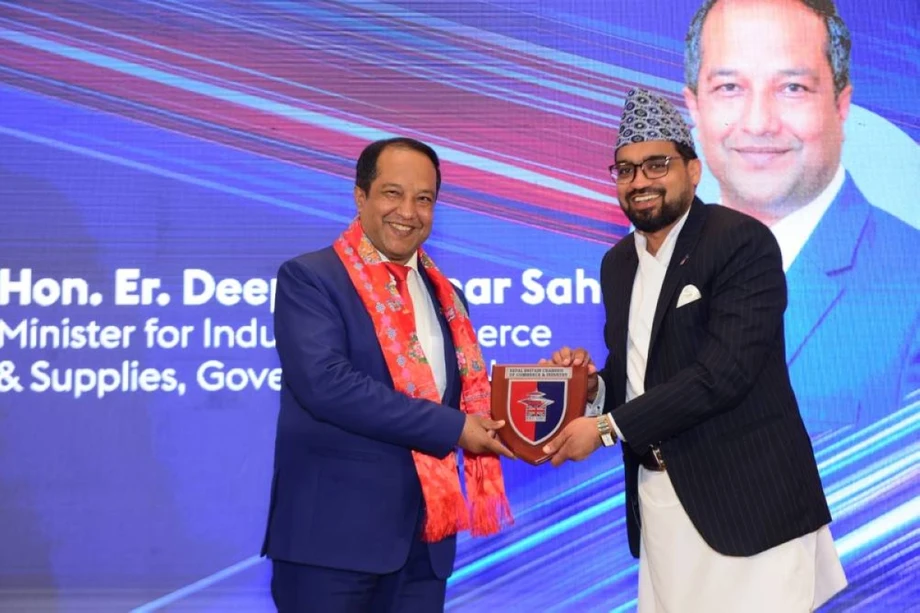
Deepak Kumar Sah, Minister for Industry, Commerce and Supplies, attended as chief guest. He said Nepal has significant potential in hydropower, tourism, agriculture, information technology, infrastructure and manufacturing. He welcomed British investment, innovation and technology transfer. Technology transfer means sharing knowledge, methods and equipment so local firms can use skills developed elsewhere.
The closing session broadened the list of voices. Bidhyabaridhi Sigdel, treasurer of the Nepal Britain Chamber of Commerce and Industry, presented a roadmap for continued bilateral cooperation. Manish Jha, coordinator of the Nepal UK Parliamentary Friendship Group, also addressed the session, alongside chamber president Rathi.
Rajendra K. Khetan, the chamber's immediate past president and president emeritus, described the forum in terms of practical results. He said the gathering was meant to create links that would continue after the event ended.
turning dialogue into results and building connections that last beyond today.
That framing explains why the two MoUs drew attention. They are small in scale compared with the tax treaty demand, but they give institutions something concrete to do in the near term.
A Short Timeline of Dates to Watch
The story stretches across more than two centuries, but only a few dates carry direct action. The timeline below separates the background from the decisions and plans that can be tracked.
- 1816: British Ambassador Rob Fenn cited ties between Nepal and the United Kingdom dating back to this year.
- 2024: The British import figures used at the forum cover this year.
- 27 November 2026, or 11 Mangsir: The UK Nepal Business Forum 2026 was held in Kathmandu, with more than 250 participants and two MoUs signed.
- 2027: National Law College and RADANKS Ltd plan the first mediation workshop.
The next concrete date on the public schedule is that 2027 workshop. No date was announced for a DTAA negotiation or signing, and no budget was given for the partnership programmes. Those details will determine how quickly the forum's language becomes visible to investors, students and entrepreneurs.
What Changes for Nepal and Britain
For Nepal, the forum offered a way to present the country as more than a destination for tourism and hydropower investment. Officials and business leaders described a wider menu: digital services, professional work, agriculture, manufacturing and regional trade links. That matters for young people looking for jobs that can serve foreign markets without leaving the country.
For Britain, the message was that Nepal can be a partner in services, clean energy and skills, not only a recipient of aid or charity. The proposed tax treaty would make it easier for British firms to calculate risks. The investment and expertise partnership points to a relationship built around finance, digital change and local leadership.
The scale of ambition is larger than the projects signed so far. A treaty is still a request, the MoUs are plans, and the trade figures show how much room there is to grow. The forum's achievement was to put those pieces in one room and agree on where to push next.
Key Points
- The UK Nepal Business Forum 2026 was held in Kathmandu on 27 November 2026 and drew more than 250 participants.
- The Nepal Britain Chamber of Commerce and Industry urged both governments to prioritise a double taxation avoidance agreement.
- British Ambassador Rob Fenn linked ties dating to 1816 with the UK's Investment and Expertise Partnership with Nepal.
- Bipin Duwadi said annual bilateral trade is roughly 300 million pounds and highlighted 424 billion pounds in British service imports in 2024.
- Eight priority sectors were named, including information technology, hydropower, tourism, agriculture and services.
- Two MoUs were signed on mediation training and entrepreneur incubation, with the first mediation workshop planned for 2027.