Rs 19.145 Billion in Profit, With Little Growth in Interest Earnings
Nepal's 20 commercial banks earned a combined Rs 19.145 billion in the first quarter of fiscal year 2083/84, corresponding to 2026/27, up 45.58% from Rs 13.15 billion a year earlier. Yet the income left from their main interest business increased by only about 1%.
Contents
- Rs 19.145 Billion in Profit, With Little Growth in Interest Earnings
- How Can Lower Interest Rates Help a Bank?
- Why Loan Loss Charges Matter So Much
- Prime and Rastriya Banijya Show Two Different Outcomes
- Nepal Investment Mega's Dramatic Jump
- Problem Loans Increased Despite Higher Earnings
- Which Banks Earned the Most?
- Why Profit and Dividends Can Look Very Different
- What Cheaper Credit Changes for the Economy
- Key Points
The biggest change came elsewhere in their accounts. Charges for possible loan losses fell from Rs 20.04 billion to Rs 10.99 billion, a reduction of Rs 9.05 billion, or about 45%. Banks also paid less for deposits and other funding as interest rates declined.
Those changes help explain how profits could rise by almost Rs 6 billion while net interest income increased by only about Rs 470 million, from Rs 49.10 billion to Rs 49.57 billion. Lower expenses allowed banks to keep more of their earnings.
Borrowers, savers and shareholders experienced different sides of the same development. Borrowing became cheaper on average, depositors received less interest, and many banks reported larger profits. Meanwhile, the average proportion of problem loans increased.
The figures come from unaudited quarterly financial statements. They describe an early part of the financial year, with the results still subject to audit and subsequent adjustments.
The comparison covers three relevant periods:
- First quarter of 2082/83: commercial banks earned Rs 13.15 billion and recorded Rs 20.04 billion in loan loss provisions.
- First two months of 2083/84: average deposit and lending rates were 3.11% and 6.38%, respectively, according to Nepal Rastra Bank figures.
- First quarter of 2083/84, covering Shrawan, Bhadra and Ashwin: combined profit reached Rs 19.145 billion and provisions fell to Rs 10.99 billion.
How Can Lower Interest Rates Help a Bank?
A bank receives interest from borrowers and pays interest to depositors and other providers of funds. Subtracting its interest expenses from its interest income gives net interest income, the amount available before paying staff, running branches, covering possible loan losses and meeting other costs.
Lower lending rates reduce what a bank earns on loans. Lower deposit rates reduce what it pays for funding. When funding expenses fall faster than interest receipts, the bank can retain more money from this business even while charging borrowers less.
Nepal Rastra Bank's figures for the first two months put the average commercial bank deposit rate at 3.11% and the lending rate at 6.38%. The difference is 3.27 percentage points. Actual interest earnings depend on how much money earns each rate, how much funding costs, and when those rates change.
Across the 20 banks, net interest income rose by roughly 0.96%. The much larger increase in final profit therefore came mainly from changes in expenses and other income. Service charges and commissions also contributed, although no combined amount for that contribution was given.
Why Loan Loss Charges Matter So Much
Banks record an expense when they expect that some lending may not be repaid. This is called a loan loss provision or an impairment charge. It brings an expected loss into the accounts instead of waiting until every effort to recover the money has ended.
Consider a simple example. A bank lends Rs 1 million to a business and later expects to lose Rs 200,000. Recording that expected loss reduces its profit. If repayments improve and the required accounting and regulatory conditions are met, the bank may reduce the allowance, which helps earnings.
Across Nepal's commercial banks, the Rs 9.05 billion reduction in provisioning expenses was about 1.5 times the nearly Rs 6 billion increase in net profit. Taxes, staff costs and other items also changed, so the final result reflects more than this single expense.
Improved recovery of some older loans helped reduce the amount banks needed to set aside. A lower charge can also reflect a change in the provisions required during the quarter. A reversal specifically means reducing an allowance recorded earlier. Both affect earnings, while cash collected from borrowers appears through repayment activity.
Prime and Rastriya Banijya Show Two Different Outcomes
Prime Commercial Bank illustrates how cheaper funding can support interest earnings. Its interest income fell from roughly Rs 5.90 billion to Rs 5.30 billion. Interest expenses, however, dropped more sharply, from around Rs 3.49 billion to Rs 2.70 billion.
Using those rounded figures, Prime's net interest income rose from about Rs 2.41 billion to Rs 2.60 billion, an increase of roughly 8%. The bank paid substantially less for its funding, more than offsetting the decline in interest receipts.
Prime's final net profit nevertheless fell by about 5.6%, to Rs 1.1876 billion. Charges relating to credit and other possible losses increased from around Rs 480 million to Rs 620 million, while personnel and other operating expenses also rose.
Rastriya Banijya Bank moved in the opposite direction. Its profit climbed from around Rs 600 million to Rs 1.6496 billion. Net interest income grew by about 37%, while charges for credit and other losses fell from roughly Rs 970 million to Rs 360 million.
Rastriya Banijya therefore benefited from both stronger interest earnings and lower loss expenses. Prime improved its interest earnings but faced higher costs elsewhere. Their results show why the final profit figure needs to be read alongside the income and expense lines that produced it.
Nepal Investment Mega's Dramatic Jump
Nepal Investment Mega Bank reported one of the sharpest changes: net profit rose from Rs 45.05 million to Rs 1.181 billion, an increase of 2,522.47%. The percentage is especially large because the earlier profit was small.
Its main interest business changed much less. Net interest income increased by 0.88%, from Rs 3.243 billion to Rs 3.272 billion. Impairment charges fell by 60.81%, from Rs 2.800 billion to Rs 1.097 billion, helping operating profit rise from Rs 150.29 million to Rs 1.691 billion.
The bank's cost of funds declined from 3.92% to 3.07%. Personnel expenses moved higher, rising 22.29% to about Rs 950 million. Lower credit loss expenses were therefore central to the improvement.
The detailed financial table puts deposits at approximately Rs 540.80 billion and loans and advances at Rs 322.41 billion. Against the comparison balances shown, deposits rose 2.69% and lending increased only 0.33%.
Nepal Investment Mega also reported a capital adequacy ratio of 12.17%, compared with 13.48%. This ratio measures a bank's capital cushion against assets adjusted for their risk. Its distributable balance after regulatory adjustments remained negative at about Rs 5.162 billion, leaving a different picture for shareholders than the quarterly profit alone.
Problem Loans Increased Despite Higher Earnings
Commercial banks' average nonperforming loan ratio rose from 4.858% to 5.641%, an increase of 0.783 percentage points. Twelve banks recorded an increase in their ratio, while eight recorded a decrease.
A nonperforming loan is lending placed in a problem category under regulatory rules because repayment has become overdue or otherwise impaired. A higher ratio means that a larger share of the loan book falls into that category.
Prabhu Bank recorded the highest cited ratio, at 14.80%, compared with 5.78% a year earlier. NIC Asia Bank stood at 9.81%. Nepal Investment Mega's ratio increased from 6.63% to 8.87%, even as its impairment expenses fell.
Everest Bank recorded a much lower ratio of 0.50%, followed by Standard Chartered at 1.83% and Sanima at 2.86%. Banks entered the quarter with very different levels of repayment pressure.
Recovering money from one group of overdue borrowers can improve current earnings while repayment problems develop among other customers. Provisioning expenses also depend on allowances already recorded and the treatment of individual loans. Readers therefore need both the profit figures and the condition of outstanding lending to understand a bank's position.
Which Banks Earned the Most?
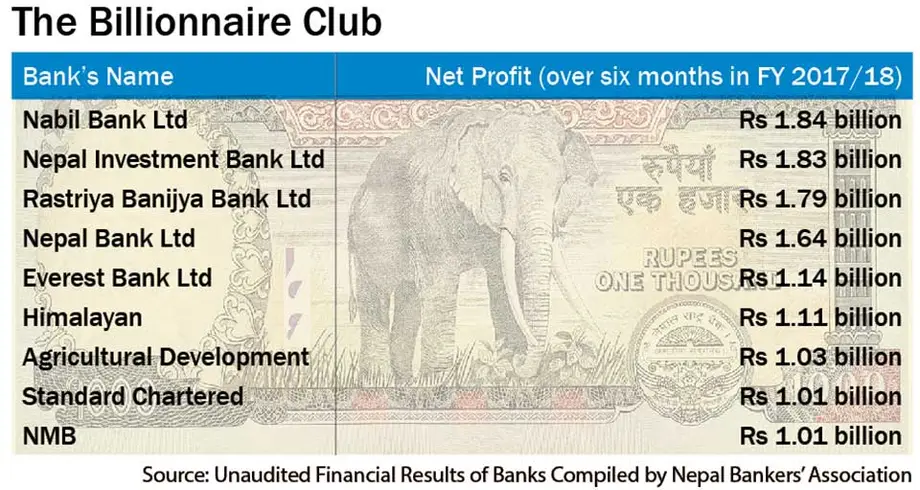
Nabil Bank led with Rs 2.5551 billion, followed by Global IME Bank with Rs 2.3138 billion and Rastriya Banijya Bank with Rs 1.6496 billion. Together, the three earned Rs 6.5185 billion, approximately 34% of the sector's total profit.
Nabil's profit increased by 45.43%. Across the sector, 17 banks recorded higher profits and three recorded declines: Prime, Standard Chartered and Himalayan. Standard Chartered's profit fell 2.99%, while Himalayan's declined 6.84%.
The quarterly profit figures, expressed in millions of rupees for a consistent comparison, were:
- Nabil Bank: Rs 2,555.1 million.
- Global IME Bank: Rs 2,313.8 million.
- Rastriya Banijya Bank: Rs 1,649.6 million.
- Everest Bank: Rs 1,252.7 million.
- Prime Commercial Bank: Rs 1,187.6 million.
- Nepal Investment Mega Bank: Rs 1,181.4 million.
- NMB Bank: Rs 1,164.2 million.
- Kumari Bank: Rs 1,074.5 million.
- Sanima Bank: Rs 1,051.4 million.
- Siddhartha Bank: Rs 851.5 million.
- Nepal Bank: Rs 832.1 million.
- Standard Chartered Bank: Rs 671.4 million.
- Himalayan Bank: Rs 654.8 million.
- Laxmi Sunrise Bank: Rs 653.3 million.
- Prabhu Bank: Rs 603.7 million.
- Nepal SBI Bank: Rs 552.2 million.
- Machhapuchchhre Bank: Rs 551.1 million.
- NIC Asia Bank: Rs 127.4 million.
- Agricultural Development Bank: Rs 109.2 million.
- Citizens Bank: Rs 107.7 million.
The size of a bank affects its total earnings. Measures calculated per share provide another perspective, while problem loans and regulatory adjustments help explain how much of those earnings may eventually reach shareholders.
Why Profit and Dividends Can Look Very Different
Nepal has 20 operating Class A commercial banks, of which 19 are listed on the Nepal Stock Exchange. State owned Rastriya Banijya Bank is unlisted. Shareholders in the listed banks face a wide range of earnings and distribution prospects.
Everest Bank led the cited annualized earnings per share figures at Rs 34.78, followed by Nabil at Rs 30.34 and Standard Chartered at Rs 26.74. Annualizing a quarterly result means expressing it at a yearly pace, usually by multiplying it by four. Actual earnings will depend on subsequent quarters.
Agricultural Development Bank reported positive net profit of Rs 109.2 million but negative earnings per share of Rs 1.51 in the calculation adjusted for preference share dividends. Preference shareholders have a prior claim to specified dividends, affecting the amount left for ordinary shareholders.
Everest's cited distributable profit per share was Rs 26.87, followed by Standard Chartered at Rs 22.19 and Siddhartha at Rs 21.96. Those figures were not annualized. NIC Asia's distributable figure was negative Rs 103.21 per share, Himalayan's negative Rs 43.39 and Prabhu's negative Rs 28.83.
A separate dividend capacity calculation put Everest at 40.77%, Rastriya Banijya at 35.11% and Standard Chartered at 34.61%. These are capacity measures; dividend payments depend on the applicable accounts, regulatory requirements and approval process.
Banks must make required allocations and adjustments before distributing earnings. Accumulated losses and interest recorded but not collected can reduce the balance available. Nepal Investment Mega's negative distributable balance makes that constraint particularly visible despite its large increase in quarterly profit.
What Cheaper Credit Changes for the Economy
Nepal Rastra Bank's figures showed annual growth in credit to the private sector of 7.2% through the first two months of the fiscal year. Lending was expanding, but banks still had ample liquidity, meaning funds available to meet payments and support lending.
Lower interest rates reduce the cost of a new investment. For a business borrowing Rs 5 million, annual interest would be Rs 400,000 at 8%, compared with Rs 300,000 at 6%, assuming the principal remains unchanged throughout the year.
The Rs 100,000 saving can matter to a small enterprise. Its owner still needs enough customers, expected revenue and confidence to repay the loan. A cheaper loan helps with financing costs, while demand for the business's goods determines whether expansion makes commercial sense.
Banks carrying substantial problem loans may also examine new applications more cautiously. Available funds, willing borrowers and acceptable credit risks all have to meet before money becomes a new factory, a larger shop or additional employment.
The quarter's results show stronger bank earnings driven largely by lower loss charges and funding costs, alongside modest growth in interest income. For the wider economy, the next results will help track whether credit demand, repayment performance and income from ordinary banking activity improve together.
Key Points
- Nepal's 20 commercial banks earned Rs 19.145 billion in the first quarter of 2083/84, up 45.58%.
- Net interest income rose only about 1%, while loan loss provisions fell from Rs 20.04 billion to Rs 10.99 billion.
- Lower deposit and funding costs helped banks retain earnings despite falling lending rates.
- Nabil, Global IME and Rastriya Banijya earned about 34% of total sector profit.
- The average nonperforming loan ratio increased to 5.641%, with substantial differences between banks.
- Distributable earnings remained negative at several banks, limiting their capacity to pay dividends.
- The quarterly results are unaudited, and private sector credit growth stood at 7.2% through the first two months.