A $22bn Bill After Ten Months of Rupture
Ten months after US forces captured Nicolás Maduro and took him to New York to face narcoterrorism charges, China and Russia are left with a large claim and much less control over the oil that once backed it. The finance ministry's Venezuela Renace plan lists $16.87bn owed to China and $5.08bn owed to Russia, about $21.95bn in total, inside public sector liabilities of $237.5bn. Caracas now sells oil under a system shaped by Washington, and the restructuring that will decide how creditors are paid is being coordinated by Centerview Partners, not the International Monetary Fund.
Contents
- A $22bn Bill After Ten Months of Rupture
- The Timeline From Miraflores to Venezuela Renace
- Who Runs the New Oil Fields
- How Beijing Lost Its Oil Foothold
- What Venezuela's Debt Papers Reveal
- Russia's Smaller Bet, Weaker Leverage
- Rodriguez Speaks to Moscow, Signs With Washington
- China's Wider Squeeze for Cheaper Crude
- Can the Oil Sector Really Expand
- What an Election Could Change
- Key Points
The US-China Economic and Security Review Commission, an advisory body to Congress, called the January capture an "unprecedented setback" for Beijing in the Latin America chapter of its 2026 annual report, released on November 18. US forces took Maduro a few hours after he met Qiu Xiaoqi, Beijing's special representative for Latin America, at Miraflores Palace on January 2. The commission said air defense radars made in China reportedly failed to help Venezuelan forces during the raid.
Beijing condemned the operation and demanded Maduro's release, but it did not intervene militarily or offer major new assistance. Chinese regulators began reviewing banks' exposure to Venezuela. Moscow also limited its response to diplomatic criticism. What remains for Beijing and Moscow is the role of creditors in a restructuring where Washington has the loudest voice and the United States controls the flow of new oil money.
The Timeline From Miraflores to Venezuela Renace
The sequence explains why the issue is bigger than a change of government. Venezuela's oil industry was the financial pipeline for Chinese loans and Russian projects. After January, that pipeline moved under a new set of rules.
- January 2: Maduro met Qiu Xiaoqi at Miraflores Palace.
- January 3: US forces captured Maduro in Caracas.
- January: Roszarubezhneft said its Venezuelan assets belonged to Russia and that it intended to keep operating them.
- February 28: US forces struck Iran, another oil producer central to Washington's energy push.
- August 24: Treasury Secretary Scott Bessent unveiled Operation Economic Outcast, a sanctions campaign aimed at cutting Iran's income.
- August 28 to 31: Trump announced the oil agreement, the White House published its fact sheet, and China protested the reassignment of oilfields.
- September 2: US Energy Secretary Chris Wright said in Caracas that China would have no claim on revenue from new Venezuelan oil production.
- September: Caracas paused the debt restructuring to focus on oil contracts.
- October 27: Putin addressed the Gas Exporting Countries Forum summit in Moscow.
- November 18: the congressional commission released its 2026 annual report.
- November 19: Trump spoke at the Asia-Pacific Economic Cooperation forum in Shenzhen and Betancourt put NABEP output at about 230,000 barrels per day.
- November 24: Venezuela Renace published the debt figures.
- Early December: the International Monetary Fund was expected to send a technical mission.
The pace matters because each step narrowed the practical room for Beijing and Moscow. China still has diplomats, banks and old contracts in Venezuela. Russia still has a state oil company with assets there. Neither can easily turn those positions into cash while US licenses, US refineries and US supervised sales decide how crude moves.
Who Runs the New Oil Fields
The White House fact sheet, dated August 31, says the interim authorities granted North American Blue Energy Partners concessions lasting 100 years for 17 fields with about 65 billion barrels of proven reserves. It compares that reserve base with roughly 46 billion barrels of current US territorial proven reserves. Venezuela Renace says the announcement came on August 29 and describes the duration as 26 years. Trump announced the agreement on August 28. The fact sheet names Secretary of State Marco Rubio and Secretary of War Pete Hegseth as signatories and refers to Operation Absolute Resolve.
NABEP is controlled by Venezuelan businessman Alejandro Betancourt. The fact sheet says the Department of War's Office of Strategic Capital holds a 35% equity stake in NABEP's corporate parent. The State Department can buy 20% of current and future output at production cost. Offtake means the share of production a buyer is allowed to take, and the department also has a right of first refusal on the remaining 80%, meaning it gets the first chance to buy that oil if NABEP offers it. The US government can veto board appointments, a majority of directors must be US citizens, and the agreement is governed by US law.
Betancourt told the Gas Exporting Countries Forum summit that NABEP was producing about 230,000 barrels per day and aimed to pass 250,000 by the end of the year. In a later account, he put output close to 240,000 barrels per day, with 170,000 coming from Lake Maracaibo and its surroundings. NABEP's 17 fields stretch from Lake Maracaibo in the west to the Orinoco belt in the east. Betancourt said a dredging contract worth more than $100 million would be signed in the week after November 24 with Deme Group and Great Lakes Dredge and Dock, raising tanker loading capacity to 470,000 barrels from 330,000 to 340,000 barrels.
The wider plan is larger than those current volumes. NABEP says it can invest up to $100 billion and reach one million barrels per day over a decade. Venezuela Renace projects more than $200 billion in state revenue between 2026 and 2051, equal to 84% of the public debt listed in the same document. Betancourt described the US purchase price as $30 a barrel, while Venezuela Renace uses $18.4 a barrel as the reference cost for existing upstream production. The new board will have seven members, four of them American, chosen by the Betancourt family and the US government. The names had not been announced.
How Beijing Lost Its Oil Foothold
In August, acting president Delcy Rodriguez's government reassigned five oilfields from Chinese companies to NABEP. The previous operators were Sinopec, China National Petroleum Corp and China Concord Resources, which Washington sanctioned in 2019 over alleged dealings with Iran. The package also included a project tied to a Russian operator, according to US officials. Beijing answered with legal and diplomatic objections.
Foreign ministry spokesman Guo Jiakun said Beijing wanted its existing rights protected.
China's legitimate rights and interests in Venezuela must be safeguarded
Mao Ning, another foreign ministry spokesman, said the cooperation between China and Venezuela was a bilateral matter.
China-Venezuela cooperation has no connection whatsoever to third parties
US Secretary of State Marco Rubio rejected that position, arguing that the fields had not been developed by their previous holders.
Chinese and Russian companies held these fields but never developed them into anything
The loss was not limited to oil. Treasury licenses that from August allowed American companies to supply Venezuela's telecoms sector excluded any entity in or controlled from China or Russia. That hit state operator CANTV, which runs on Huawei and ZTE equipment and owes Huawei about $600 million, according to local journalist William Pena. The congressional commission also flagged ZTE's role in the Carnet de la Patria, the biometric ID card used by the Chávez and Maduro governments to ration benefits. A biometric ID card uses physical features such as fingerprints or a face scan to confirm a person's identity.
Beijing's problems began before the field reassignment. The commission said Chinese anti aircraft defenses did not stop the raid, and that Chinese regulators started reviewing bank exposure to Venezuela immediately after Maduro's capture. China had supplied loans, military equipment, telecoms systems and political backing to a government that saw itself as an alternative to Washington in the region. Ten months later, that network still exists on paper, but the oil routes that paid for much of it are controlled from Washington.
What Venezuela's Debt Papers Reveal
The Ministry of Popular Power for Economy and Finance published Venezuela Renace on November 24 with liabilities to the end of 2025 and a framework for 2026 to 2036. The document says public debt is in prolonged default and unsustainable. It puts commercial debt at $116.549 billion, including $110.134 billion in eurobonds with $45.939 billion of past due interest. Nonfinancial debt concentrated at PDVSA totals $67.282 billion. Arbitration claims reach $26.288 billion, and multilateral debt is $4.163 billion.
Bilateral debt totals about $23 billion. China's China Development Bank is listed at $16.866 billion, Russia's Vnesheconombank at $5.080 billion and Brazil's BNDES at $1.128 billion. China holds more than 72% of that bilateral block. Past due eurobond interest alone is almost twice the bilateral debt owed to China, Russia and Brazil. Venezuela's bonds rose between 2.25 and 6.4 cents on the dollar after the figures were published.
Calixto Ortega, top economic adviser to acting President Delcy Rodriguez, said the government had restored contact with multilateral institutions and wanted a full restructuring.
We have normalized Venezuela's representation before multilateral and financial organizations, and we are in advanced discussions to resolve the existing arrears with some of them
An International Monetary Fund spokesperson said the fund was reviewing the new information before taking a position.
We are currently reviewing the information made available by the authorities and it would be premature to comment on specifics at this stage
The fund added that restoring fiscal and debt sustainability was central to Venezuela's recovery. Venezuela had sought $17 billion in multilateral financing and then said it planned up to $10 billion. It recovered about $4 billion in gold from the Bank of England after diplomatic normalization with the United Kingdom in September, within international reserves of $12.826 billion in July.
The Chinese number is higher than older outside estimates. The commission put outstanding Chinese loans at $10 billion or more in January, and other estimates ranged from $10 billion to $20 billion. China's loans were backed by oil, meaning Caracas repaid by shipping discounted crude to Chinese buyers. The commission said such loans gave Chinese lenders priority over important revenue streams. That route closed once Washington took charge of Venezuelan oil sales. Chinese authorities contacted Venezuelan and US officials soon after the capture to seek guarantees on those loans.
Rachel Lyngaas, a former chief sanctions economist at the US Treasury now at RAND, said in August that Centerview, rather than the IMF, was managing the restructuring and that talks could proceed even if China stayed away. She expected Beijing to seek longer maturities rather than large write downs, as it did in Zambia and Sri Lanka. The restructuring backed by Washington envisages Chinese claims being paid in full, with no funding source identified. Caracas halted the process in September to focus on oil contracts. Signum Global warned in November that verifying bilateral claims, particularly those owed to China, could push recognized liabilities past $200 billion and reduce recoveries for every creditor.
Some of the headline debt is owed inside the Venezuelan state. The plan includes PDVSA promissory notes to the Central Bank of Venezuela worth $23 billion, a cycle that began in late 2010. The document does not say how those claims would be treated. It also projects that GDP will reach $200.9 billion by 2031, but the current debt would still equal more than 118% of that future output. No debt sustainability analysis has been published, and the government has not given a date for one.
Russia's Smaller Bet, Weaker Leverage
Russia's claim is less than a third of China's, but Moscow's oil position is no stronger. State owned Roszarubezhneft took over Rosneft's Venezuelan assets in 2020 after US sanctions hit two Rosneft subsidiaries. In January, right after Maduro's removal, Roszarubezhneft said those assets belonged to Russia and that it intended to continue operating them. Deputy Foreign Minister Alexander Alimov sought guarantees in October that Venezuela's new hydrocarbons law would not dilute Russian projects. That law allows foreign companies to take majority stakes once reserved for PDVSA.
Roszarubezhneft remains under US restrictions, and the White House has threatened secondary sanctions against anyone trading Venezuelan oil with it. Secondary sanctions punish foreign companies or banks that do business with a sanctioned target, even if they are not American. US licenses now decide who can lift and sell Venezuelan crude, which leaves Moscow dependent on permission from the same government it is negotiating with over Ukraine.
Vladimir Putin, speaking to the Gas Exporting Countries Forum summit in Moscow on October 27, said Russian companies had invested billions of dollars in Venezuela and that Moscow was ready to work with the new authorities and with companies from other countries.
the official authorities of Venezuela
US government documents say Maduro asked Putin in October 2025 for missile units, repairs to Venezuela's Sukhoi Su-30 fighters and financing from Rostec. When the raid came three months later, fighting was left largely to Maduro's Cuban guards, who made up most of the 50 dead. The military relationship Moscow built over two decades did not protect Maduro or preserve Russian control of the oil fields.
Rodriguez Speaks to Moscow, Signs With Washington
Delcy Rodriguez, a former vice president who governs as acting president with US backing, has opened oil and mining to foreign investors and won praise from Trump, who called her a "terrific person" who is "doing a great job." After meeting Trump on the sidelines of the United Nations General Assembly in September, she returned to Caracas and welcomed Secretary of War Pete Hegseth for a military cooperation agreement covering joint training and intelligence sharing. That agreement marked a sharp change from the old alignment with Russia and China.
Rodriguez still sends occasional gestures toward Moscow. Speaking by video to the same gas summit, she said excluding Russia from international gas trade had been a mistake.
Attempting to exclude, for instance, Russia from the international gas framework has proven to be a grave error
Venezuela is a founding member of the forum, but Rodriguez did not travel to Moscow. Her gas plans run through Chevron, Shell, Eni and Repsol rather than Gazprom. No public objection from Washington was reported, even though the Trump administration has demanded that Caracas cut economic ties with China, Russia, Iran and Cuba. Rodriguez received Russia's Order of Friendship from Putin in 2024. Xi Jinping sent her a solidarity message after the June earthquakes, which killed at least 6,500 people and caused $19.6 billion in direct damage, according to the World Bank estimate cited in Venezuela Renace. The commission reads that message as Beijing adapting to the new government.
Trump said later that China and Russia had left Venezuela after he spoke to them. Rodriguez's words can still echo the old alliances, but the contracts and security ties now point elsewhere. For ordinary Venezuelans, that shift means reconstruction money, fuel supplies and jobs will depend heavily on investment decisions made under rules backed by Washington.
China's Wider Squeeze for Cheaper Crude
The Venezuela deal lands at a time when China is already losing access to discounted crude elsewhere. Operation Economic Outcast, unveiled by Treasury Secretary Scott Bessent on August 24, targeted tankers, brokers and banks that move Iranian oil. Chinese imports of Iranian crude fell to 534,000 barrels per day in August from 823,000 in July. Venezuelan crude accounts for less than 3% of China's total oil imports, so the direct fuel impact in China is limited, but refiners that relied on cheap heavy crude have fewer options.
Canadian heavy oil has been priced $8 to $9 a barrel above Venezuelan crude. Oil sands crude is similar enough that refiners need only minor changes to their process, and shorter shipping routes give more predictable deliveries. Beijing has another partial outlet in Russian crude. China buying more Russian oil became more visible after US tariffs pushed India to cut orders. Chinese refiners booked at least 15 cargoes for October and November, holding between 10.5 million and 15 million barrels. Russian Urals shipments to India fell to about 400,000 barrels per day from an average of 1.18 million earlier in the year, while China's Urals purchases reached about 75,000 barrels per day in August, nearly double the annual average.
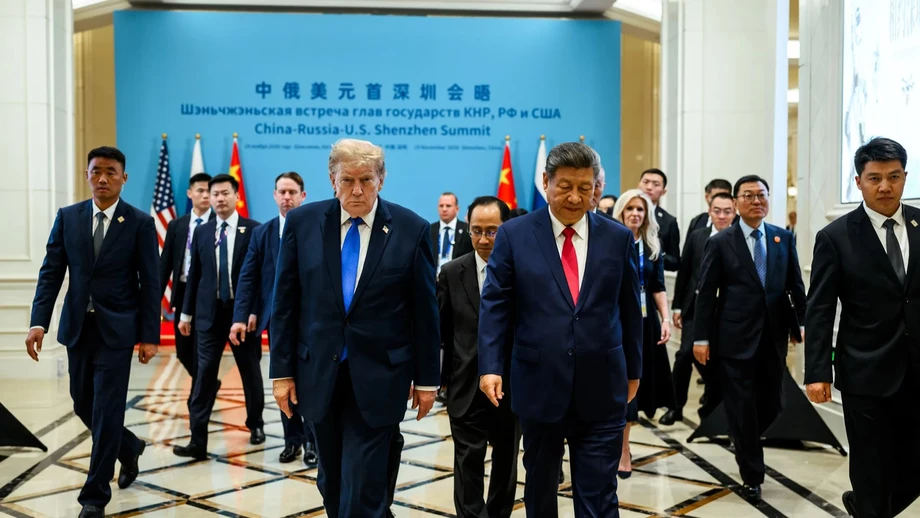
Washington's strategy was set out in the December 4, 2025 National Security Strategy, which asserted a Trump Corollary to the Monroe Doctrine. It called for developing strategic resources in the Americas, moving US forces toward hemispheric threats and treating energy dominance in oil, gas, coal and nuclear power as a priority. Some Chinese commentators first read the pivot as a US retreat from Asia. The Venezuela and Iran moves showed a resource strategy instead. Trump met Xi Jinping and Putin in Shenzhen and signed a three way declaration on energy supply and nuclear risk while the dispute over Venezuelan oil continued in the background.
Can the Oil Sector Really Expand
Venezuela's plan rests on a large production rebound. Output fell from 2.8 million barrels per day in 2012 to just over one million last year, and the country was pumping 1.16 million in August. Venezuela Renace forecasts annual growth of 9.1% to 2.9 million barrels per day by 2036. It assumes about $160 billion in oil investment through 2036, with $85 billion from operating partners and $75 billion from PDVSA, plus $15 billion for gas. The plan projects $30.1 billion in oil export revenue this year and net public hydrocarbon revenue of $12.8 billion in 2026, rising to $18.4 billion in 2031.
The legal changes are central. A hydrocarbons law approved in late January 2026 lets private companies conduct primary activities and take majority stakes, and it cuts the combined royalty and tax ceiling from 45% to 35%. Venezuela has also recorded deals with Chevron, Shell, Eni, Repsol, BP and Continental Resources, along with an ExxonMobil memorandum signed in November. The plan puts national proven reserves above 300 billion barrels, about 19% of the world total, with more than 85% in the Orinoco belt.
Asdrúbal Oliveros, director of Summa Consulting, told a forum at the Center for Political and Government Studies at Andrés Bello Catholic University in November that output could reach 1.25 million barrels per day at the end of 2026, 1.5 million in 2027 and 1.7 million in 2028. He said a return to 3 million barrels per day would require about $183 billion over ten years. He also said no logistics or financing move in the oil sector happens without US approval, and that the relationship may outlast Trump's presidency.
Andrés Rojas, editor in chief at Petroguía, put the 2026 to 2030 plan at a 65% rise from 1.2 million to 2 million barrels per day, requiring $45.7 billion, including $7 billion in 2027. Both speakers pointed to the same obstacles: storage, pipelines, upgrader capacity, electricity, skilled workers and the need to settle external debt before investment can grow at scale. The June earthquakes damaged the wider economy, though Venezuela Renace says oil and gas production and export terminals were not significantly affected. A technical annex notes temporary stops at El Palito and Morón because of electrical faults.
The document itself has gaps. It lacks a ministerial signature, leaves quake spending blank after 2030, and says $17.097 billion of PDVSA supplier debt remains under audit. Venezuela expects the economy to grow 5% this year and inflation to settle at an average of 24% in the medium term, while the public primary deficit is expected to last through 2030. Those projections give the government a case for a restructuring, but they also show how much must go right before creditors see money.
What an Election Could Change
María Corina Machado has returned home after nearly a year in exile and promised to review the oil deals struck since Maduro's removal, including NABEP's. The White House sidelined her after the raid in favor of Rodriguez, but she is seen as the frontrunner in an election expected next year. No date has been announced. Her programme leans even more openly toward the United States and private capital than Rodriguez's, so a change of government would not automatically reopen the door for Moscow. Beijing could eventually return through partnerships with Western oil majors, a route it has used across Latin America.
The NABEP agreement itself faces scrutiny. Venezuela's opposition has questioned its terms, and members of Congress are expected to examine it next year when Democrats take control. Betancourt has said the agreement needs to be understood and reviewed. Venezuela is also weighing an exit from the Organization of the Petroleum Exporting Countries, a move discussed with US officials but not decided. Leaving would free Caracas from production quotas as it tries to raise output.
For Beijing and Moscow, the practical position is unchanged. Their money is still in Venezuela, but the fields, oil sales and debt process now depend on decisions made in Washington and Caracas. China has the larger sum at risk and more ways back in through future partnerships. Russia has fewer routes, tighter sanctions and an oil company that cannot operate freely without US permission. Both are waiting on a restructuring whose terms have not been negotiated, under a government that needs oil revenue more than it needs old ideological allies.
Key Points
- Venezuela Renace lists $16.87bn owed to China and $5.08bn owed to Russia, about $21.95bn in total.
- The White House says NABEP holds concessions lasting 100 years for 17 fields with about 65 billion barrels of proven reserves, while Venezuela Renace describes a 26 year term.
- The United States holds a 35% stake in NABEP's parent, can buy 20% of output at production cost and has first refusal on the rest.
- Chinese companies lost five oilfields to NABEP in August, and US licenses excluded Chinese and Russian entities from telecoms supply work.
- Venezuela's total public debt is listed at $237.5bn, or 242% of GDP at the end of 2025.
- Russia's Roszarubezhneft remains sanctioned, and US threats of secondary sanctions limit its options.
- Rodriguez still speaks warmly of Russia and China, but her oil, gas and military agreements now run mainly toward Washington and Western companies.
- Machado has promised to review the oil deals, but the election expected next year has no announced date.