Banks Stay Steady Under a Harder Test
China's central bank said on November 27, 2026 that the financial system remains stable, even as banks were tested against harsher assumptions. The People's Bank of China said risks are shrinking in scope and remain controllable after a year in which GDP reached 140.19 trillion yuan, up 5%, and foreign exchange reserves exceeded $3.3 trillion. The central bank put 2,536 banks through its 2026 stress test. Those banks held 415.82 trillion yuan in assets at the end of 2025. The sample included six large state banks, 12 joint stock banks, 122 city banks, 1,168 rural commercial banks, 222 rural credit cooperatives, 12 rural cooperative banks, 933 village banks, 18 private banks, 41 foreign bank units, one housing savings bank and one direct bank.
Contents
- Banks Stay Steady Under a Harder Test
- What the Stress Test Actually Measures
- Bank Ratings Show Fewer Red Zone Institutions
- Small Banks Face the Hardest Cleanup
- Liquidity Was the Second Big Exam
- A Short Timeline of the Policy Shift
- Money, Credit and the Five Major Chapters
- Debt, Property and the Local Government Problem
- Capital Markets Get a Bigger Stability Toolkit
- Foreign Exchange, Payments and the RMB's Reach
- Shadow Banking and Funds Remain on the Watchlist
- What the Plan Says Comes Next
- Key Points
Stress tests are not forecasts. They are drills that ask what happens if loans go bad, large borrowers default or cash becomes hard to obtain. For ordinary savers and borrowers, the results matter because banks need a capital cushion to keep lending when losses rise.
What the Stress Test Actually Measures
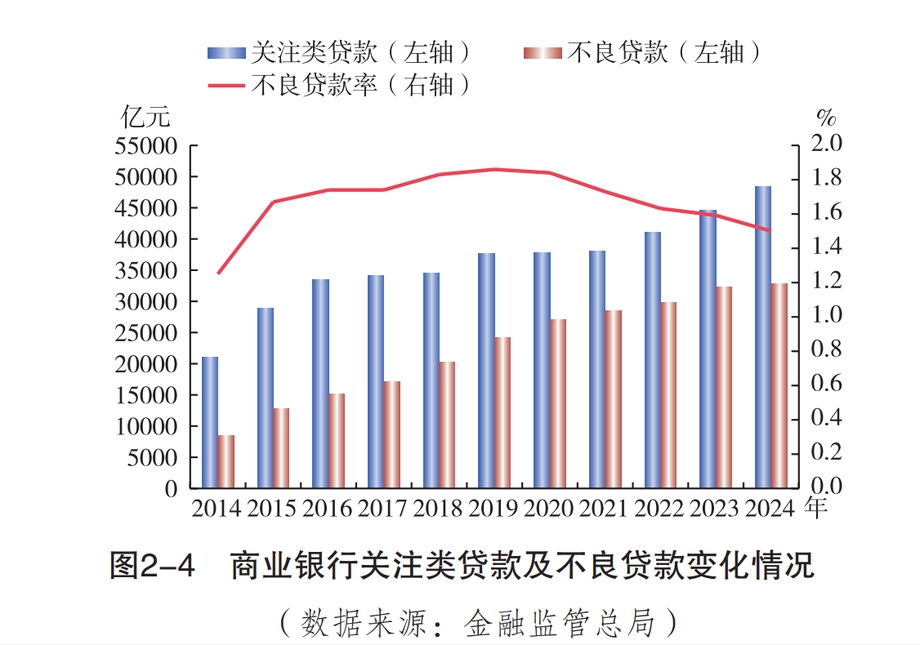
Capital is the money a bank can use to absorb losses before depositors are hurt. The capital adequacy ratio compares that cushion with assets adjusted for risk, meaning loans and investments adjusted for how risky they are. The 2,536 banks in the test had a combined capital adequacy ratio of 15.47% and a core tier 1 ratio of 10.95% at the end of 2025. Their nonperforming loan ratio, the share of loans not being repaid as agreed, was 1.51%. Commercial banks had 444.57 trillion yuan in assets at end September 2025. Their reported nonperforming loan ratio was 1.52% at end September, up from 1.49% at end June, while the stress test sample ended the year at 1.51%.
In the main asset quality test, bad assets were assumed to rise by 100%, 200% and 400%. The combined capital adequacy ratio fell to 14.41%, 12.91% and 9.79%, a drop of 1.06, 2.56 and 5.68 percentage points. The 21 D-SIBs, a group of large banks whose failure would damage the whole financial system, kept their lowest capital adequacy ratio at 11.8% in those scenarios.
Customer concentration caused the biggest capital hit. If the five largest groups of nonbank customers and connected borrowers defaulted, the ratio fell 3.8 points to 11.67%. If nonperforming loans among small and midsize firms and personal loans outside housing rose 400%, it fell 3.39 points to 12.08%. Defaults by the five largest bank counterparties cut it 2.65 points to 12.82%. Counting all extended loans as bad loans would cut it 0.75 points to 14.72%.
The People's Bank of China published the China Financial Stability Report 2025 with end 2024 results on 3,235 banks. Their loans totaled 219.73 trillion yuan, the bad asset ratio was 1% and the nonperforming loan ratio was 1.51%. In mild, medium and severe macro scenarios, 23 large banks were projected to have capital adequacy ratios of 12.50%, 12.42% and 11.95% by the end of 2027. Five of 20 D-SIBs did not pass the severe scenario.
Bank Ratings Show Fewer Red Zone Institutions
The central bank grades banks from 1 to 10 and D, with D used for institutions that have failed, been taken over or been closed. Grades 1 to 5 sit in the green zone, 6 to 7 in the yellow zone and 8 to D in the red zone. Red zone banks are the ones regulators watch most closely.
In the second half of 2025, 2,992 banks were rated. The central bank placed 1,454 in the green zone, with 424 trillion yuan in assets, or 92.9% of the total. Another 1,295 were in the yellow zone with 23.4 trillion yuan, or 5.1%. The red zone held 243 banks and 9 trillion yuan, or 2%. The 21 national banks, which hold 71% of the assets in the exercise, stayed in grades 1 to 5. Their grades were 1 for two banks, 2 for six, 3 for seven, 4 for five and 5 for one.
The first half had looked weaker. A review of 3,529 banks found 312 red zone banks with 9.4 trillion yuan in assets, or 2.1%. The midyear breakdown listed 14 city commercial banks, 191 rural financial institutions and 132 village banks, with village banks also included in the rural group. The number of red zone banks was 45 lower than at the end of 2023, while their share of assets was 0.32 percentage points higher. Named smaller lenders showed the pressure: Harbin Bank had a nonperforming loan ratio of 2.87%, Shengjing Bank 2.68%, Jiangxi Bank 2.17% and Jiujiang Bank 2.09%. Private banks stood at 1.83%, against 1.06% for foreign banks. More than half of 26 listed small lenders had ratios above 2%. Twelve provinces and regions had no red zone banks in the second half, up from nine in the first half.
Small Banks Face the Hardest Cleanup
Regulators are using three main tools for weak small banks: repairs while the bank keeps operating, mergers and market exit. The 2026 report said the number of small and midsize banks at high risk had fallen clearly from its peak. It did not give a new count.
Mergers have become the most visible tool. Zhejiang Chouzhou Bank absorbed two village banks in Zhoushan. Two village banks in Guangdong joined a local rural commercial bank through a deal arranged in the market. Liaoning Rural Commercial Bank brought more than 60 rural institutions together in just over a year, the largest such integration in the country. The National Financial Regulatory Administration has also issued the Implementation Plan for High Quality Development of Digital Finance in Banking and Insurance, setting five year goals for digital transformation. For small banks, digital tools can widen the reach of risk checks, while strong controls remain part of the same push to make lenders safer.
A policy known as Document 62 sets out three ways asset management companies can help. They can give valuation, pricing, plan design and advisory support to regulators and local governments, join mergers of weak institutions, or take part in resolution with little capital tied up. Those steps shift the work from single cash injections toward processes guided by markets and law.
Liquidity Was the Second Big Exam
Liquidity means having enough cash or assets that can be sold quickly to meet withdrawals. The bank test looked at cash gaps over 7, 30 and 90 days. In mild conditions, 98.34% of the tested banks passed. In severe conditions, 95.66% passed. Earlier testing of 3,235 banks, using end 2024 data, had a severe pass rate of 96.29%.
The 2026 report did not name the banks that failed. It said the whole sample still had enough liquidity to meet most stress conditions. For depositors, the practical point is simple. A bank can be solvent on paper and still face trouble if it cannot pay cash when many customers ask for it at once.
A Short Timeline of the Policy Shift
The numbers in the report come from several points in time. This sequence explains how the policy picture changed.
- Early 2025: The central bank merged its macroprudential and financial stability work into one committee and raised a parameter that governs how much money Chinese entities may borrow from abroad.
- May 7, 2025: The two capital market support tools were combined into a single 800 billion yuan quota.
- End of 2025: China completed the 14th Five-Year Plan period with 5% GDP growth, 140.19 trillion yuan in output and reserves above $3.3 trillion.
- March 2026: The central bank tested 17,286 mutual funds for their ability to meet heavy redemptions.
- November 27, 2026: The central bank published the 2026 report, with bank ratings, stress tests and policy plans for the 15th Five-Year Plan period.
The timeline shows a shift from building tools in 2025 to measuring how those tools and markets behave under pressure in 2026.
Money, Credit and the Five Major Chapters
The People's Bank of China, the central bank responsible for monetary policy and financial stability, said it would keep borrowing conditions easy and let the market play the main role in setting the yuan's value. It put the commitment this way:
flexibly and efficiently operate various monetary policy tools to maintain sufficient liquidity and keep social financing conditions relatively accommodative. uphold the market's decisive role in exchange rate formation and maintain exchange rate flexibility. manage market expectations to ensure the yuan exchange rate maintains basic stability at a reasonable and balanced level.
In 2025, the central bank cut the reserve requirement ratio by 0.5 percentage points, or 50 basis points. That released about 1 trillion yuan of liquidity intended to remain in the system. The reserve requirement ratio is the share of deposits banks must hold at the central bank. A lower ratio frees more money for lending. Policy rates and rates on special lending facilities were also lowered to reduce the cost of borrowing.
The report gave special weight to the five major chapters of finance, a policy label for technology finance, green finance, inclusive finance, pension finance and digital finance. Loans linked to those areas grew faster than the average for all loans. The report also called for a more proactive fiscal policy and a moderately loose monetary policy, with deficits and debt at necessary levels, more spending on consumption and public services, and larger transfers from the central government to local governments. It follows last month's growth support pledge, when the central bank described strong supply and weak demand in its quarterly policy report.
Social financing, the total flow of credit to the economy from banks and markets, was expected to grow in line with economic growth and price goals, while borrowing costs stay low.
Debt, Property and the Local Government Problem
Local government financing vehicles are companies set up by local authorities to borrow for public projects. The central bank told localities to apply strict exit conditions, limit new borrowing by these platforms and enforce debt resolution discipline. Compared with the start of 2023, both the number of platforms and their operational financial debt fell sharply. The report gave no new total.
Property policy focused on keeping the market stable rather than adding a broad stimulus. The central bank improved macroprudential management of real estate finance, adjusted mortgage rates under the housing provident fund, a savings scheme for housing, and refined pledged supplementary loans, funding backed by collateral for housing and infrastructure work.
Support was directed to affordable housing, urban village renovation and public facilities designed for everyday use and emergencies. Those projects can absorb investment while improving services in crowded urban areas.
Capital Markets Get a Bigger Stability Toolkit
The report gave more detail on how the central bank wants to support stock markets. On May 7, 2025, the two tools were merged into one 800 billion yuan quota to make them easier to use. By the end of April 2025, the swap facility had run twice, with 105 billion yuan deployed. More than 500 listed companies had announced loans totaling nearly 300 billion yuan to buy back or increase holdings of their shares.
Large insurers were pushed to put 30% of each year's new premiums into A shares from 2025. A pilot allowing insurance money to be invested in stocks for many years had approvals totaling 222 billion yuan by June 2025. The national social security fund was given a performance review system stretching beyond five years, which makes it easier to hold stocks through short swings.
For the next stage, the report calls for stronger monitoring of trading and disclosure, action against excessive speculation and market manipulation, and more products suited to patient money. It also says regulators will study a mechanism to provide liquidity to nonbank institutions under specific conditions. That idea matters because a fund or insurer can face a cash squeeze even when its assets pay off over many years.
The China Securities Regulatory Commission, the securities regulator, plans to expand floating management fee funds, which link manager pay to performance, and raise the share of equity funds and fund holdings of stocks. It will also speed registration of equity funds, improve index investing, introduce more products with moderate volatility for insurance money, pensions and bank wealth management, and adjust existing fund benchmarks in stages. Benchmarks are the yardsticks used to judge fund performance. New rules on fund company performance pay and a rating system for fund sales firms are also part of the plan.
Foreign Exchange, Payments and the RMB's Reach
The central bank said it would keep the yuan broadly stable at a reasonable and balanced level while allowing more flexibility. Its foreign exchange framework combines macroprudential tools, which limit risks across the market, with micro supervision, which looks at individual banks and firms. Early in 2025, it raised a parameter governing borrowing from abroad to help steady capital flows.
For companies with foreign currency costs, the report promises simpler RMB derivatives, contracts used to manage exchange rate risk. A preferential policy that waives trading and clearing fees for banks serving small firms with foreign exchange hedging will be extended for two years. Hedging means using financial contracts to reduce the risk that a currency move raises costs.
The central bank also backed better offshore RMB services in free trade zones through the China Foreign Exchange Trade System and wider clearing currencies at Shanghai Clearing House. A central counterparty is a clearinghouse that stands between buyer and seller, lowering the chance that one side's failure spreads to the other.
Payment infrastructure figures show the scale of the system. Payment systems handle more than 62 million transactions worth 38 trillion yuan each day. Stock settlement reaches 250 trillion yuan a year and bond settlement 2,700 trillion yuan. Gold trading is about 210,000 tonnes a year. The RMB payment system for international transactions, CIPS, connects more than 1,700 participants in 189 countries and regions. No major risk event has occurred in these systems. The report's infrastructure plan includes unified inspection and evaluation, first line monitoring and risk reporting, more international links for CIPS, greater use of data and AI, stress tests and domestic control of core systems.
Digital RMB is also changing. From 2026, digital RMB held by bank customers becomes a liability of commercial banks rather than the central bank, falls under reserve requirements and can earn interest in wallets whose holders are verified. A liability is money the bank owes its customer. By the end of 2025, pilot regions had recorded 19.5 trillion yuan in digital RMB transactions, opened 230 million personal wallets and expanded the network to 30 operating institutions. The mBridge project had handled about 500 billion yuan in international payments. 26 banks had signed with CBETS and 42 had applied. The report also cited a Financial Stability Board assessment that national rules for crypto assets remain inadequate, leaving room for regulatory arbitrage, meaning firms can move activity to softer rules.
Shadow Banking and Funds Remain on the Watchlist
Shadow banking means credit activity that resembles banking but sits outside parts of the normal bank regulatory system. The report said China's shadow banking scale is broadly stable, borrowing levels are controllable and the sector supports growth by channeling savings into credit. It also pointed to rising links inside shadow banking and between shadow products and banks.
The report named overseas episodes including the Archegos collapse, the British pension fund crisis and liquidity stress in private credit. In simple terms, these episodes showed what can happen when investors borrow heavily, concentrate exposures, disclose too little and struggle to value assets. Some Chinese asset management products still turn money that can be withdrawn quickly into loans that repay slowly, a mismatch that can bite when many investors exit at once.
A separate test looked at 17,286 mutual funds that existed at the end of 2025. The central bank simulated heavy redemptions, meaning clients asking for their money back. It sorted fund assets into 20 groups, gave each a liquidity weight and checked whether each fund could pay withdrawals. In mild conditions, every type passed except one pure bond fund holding medium and long duration bonds. In severe conditions, 40 funds failed, or 0.23% of the sample. Funds that combine stock positions with short selling had a higher failure share. The report did not identify them.
What the Plan Says Comes Next
The 15th Five-Year Plan period will bring more uncertainty, the report said. It said next work will be guided by Xi Jinping Thought on Socialism with Chinese Characteristics for a New Era and by the spirit of the 20th National Congress, its plenary sessions, the Central Economic Work Conference, the Central Financial Work Conference and the National Financial System Work Conference. The working line is to prevent risk, strengthen regulation and promote high quality development.
The report wants faster work on the Financial Stability Law and changes to the Law of the People's Republic of China on the People's Bank of China. It wants larger deposit insurance and financial stability guarantee funds, a fuller macroprudential system and better tools for monitoring risks that could spread across markets. No timetable was given for those laws or for the proposed liquidity mechanism for nonbank institutions.
For households and firms, the plan points to cheaper and steadier financing, more support for domestic demand, technology and small firms, and closer watching of shadow credit, funds and payment networks. The central bank's message is that the system has enough cushion now, while new risks will be met with tighter checks and faster repair.
Key Points
- The People's Bank of China said on November 27, 2026 that financial risks are shrinking in scope and remain controllable.
- China's 2025 GDP reached 140.19 trillion yuan, up 5%, and foreign exchange reserves exceeded $3.3 trillion.
- A stress test covered 2,536 banks with 415.82 trillion yuan in assets; severe liquidity tests had a 95.66% pass rate.
- Red zone banks fell from 312 in the first half of 2025 to 243 in the second half.
- The central bank cut the reserve requirement ratio by 0.5 percentage points in 2025 and released about 1 trillion yuan of liquidity.
- Capital market, foreign exchange, fund, shadow banking and payment infrastructure measures are set to expand in the 15th Five-Year Plan period.