Weak demand drives a broader policy push
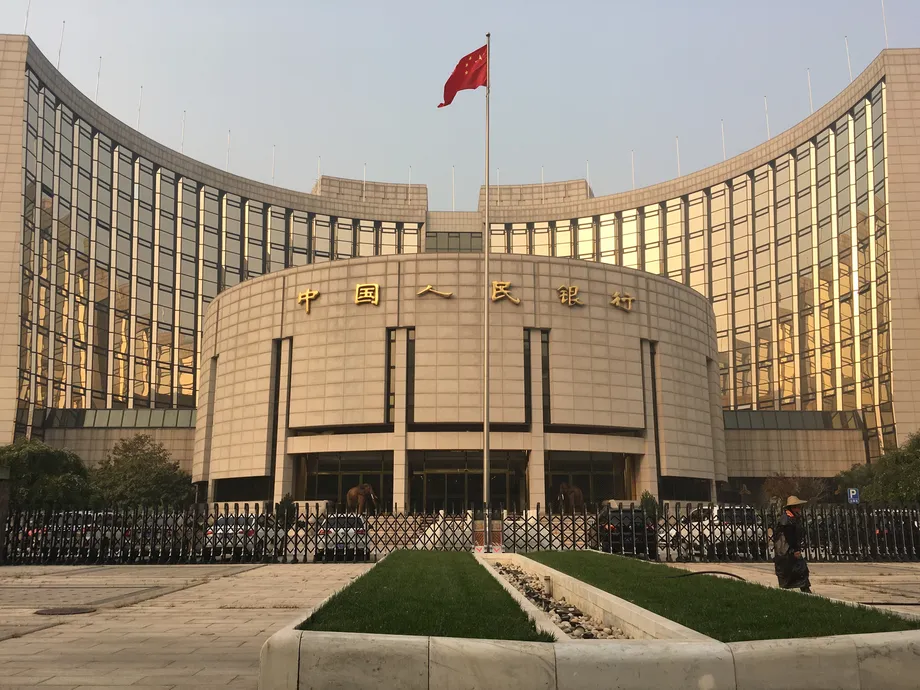
China's central bank pledged stronger support for economic growth in its third quarter monetary policy report released on November 11, 2026, combining easier financing with targeted lending, changes to loan pricing and stronger protection against disruption in financial markets.
Contents
- Weak demand drives a broader policy push
- Growth has steadied, but demand remains a concern
- The 2025 baseline shows how support has evolved
- Targeted funding takes priority
- Inflation changes the policy balance
- Some business loans could follow overnight rates
- Stock market support becomes more established
- A new facility targets forced bond sales
- Smaller banks and shifting deposits receive attention
- The yuan and the policy sequence
- Key Points
The People's Bank of China (PBOC) described an economy facing strong supply, weak demand, structural imbalances and external shocks. Gross domestic product grew 4.6% in the first nine months of 2026. Quarterly growth moved from 5.0% in the first quarter to 4.3% in the second and 4.5% in the third, showing a modest recovery after the slowdown earlier in the year.
The central bank said it would maintain an appropriately accommodative monetary policy, keep liquidity ample and make financing conditions relatively easy. Its practical priorities include technological innovation, smaller businesses, domestic demand and major infrastructure networks.
Countercyclical adjustment means using policy to lean against an economic slowdown. For the PBOC, that can involve making funding more available, reducing financing costs or directing cheaper funding toward areas where investment and spending need support.
The report gave no explicit commitment to a new broad interest rate cut or a reduction in the reserves banks must hold. Instead, it put greater weight on getting existing and additional measures to work together, while retaining flexibility over the strength, timing and pace of further action.
For households and businesses, the central issue is whether support reaches everyday economic activity: loans for smaller employers, financing for service businesses, investment in infrastructure and more manageable borrowing costs.
Growth has steadied, but demand remains a concern
China's growth of 4.6% in the first nine months was within the stated annual target range of 4.5% to 5%. The third quarter's 4.5% expansion was 0.2 percentage points faster than the second quarter, but 0.5 percentage points below the first.
The PBOC's focus on strong supply and weak demand describes an imbalance between the economy's capacity to produce goods and services and the willingness of households, businesses and other customers to buy them. More credit can help finance purchases and investment, while the effectiveness of that credit also depends on borrowers wanting to spend.
Liu Yu, chief economist at Industrial Securities, interpreted the stronger wording on this imbalance as evidence of increased concern about insufficient domestic demand. Zhu Qibing, chief macro analyst at BOC International China, pointed to uneven performance across industries, including support from electronics and the artificial intelligence supply chain.
The central bank also became more cautious about the international environment. Its discussion shifted toward weaker resilience in global growth, larger financial market swings and concerns about government finances. For Chinese exporters, softer overseas demand can affect sales, cash receipts and the money available to run their businesses.
The 2025 baseline shows how support has evolved
The PBOC's 2025 monetary policy report, published on November 11, 2025, provides a useful comparison. It recorded growth of 5.2% in the first nine months of that year, against 4.6% for the equivalent period in 2026, a slowdown of 0.6 percentage points.
The 2025 report also documented substantial financing support. At the end of September 2025, aggregate financing to the real economy grew 8.7% from a year earlier, broad money supply grew 8.4%, and outstanding yuan loans reached 270.4 trillion yuan. Aggregate financing includes bank lending and other funding channels, such as bonds.
The central bank described its intended financing stance in that report:
It will employ a mix of policy tools to maintain relatively accommodative social financing conditions, while continuing to improve the monetary policy framework and strengthening the implementation and transmission of monetary policy.
The PBOC Monetary Policy Analysis Group's Chinese language report put new aggregate financing in the first nine months of 2025 at 30.1 trillion yuan, 4.4 trillion yuan more than a year earlier. The 2026 emphasis on combining existing and new policies continues that support while placing greater attention on how funding reaches borrowers.
Targeted funding takes priority
The PBOC is placing structural monetary policy tools near the centre of its response. These tools channel central bank funding toward particular sectors, rather than changing borrowing conditions equally across the economy.
At the end of September 2026, the central bank reduced the rate on pledged supplementary lending, known as PSL, by 0.25 percentage points. It also extended the programme's support to construction of six major infrastructure networks and increased relending quotas for technological innovation, agriculture and smaller businesses.
Relending provides central bank funding to financial institutions to encourage qualifying loans. Its effect on the economy depends on banks extending credit and borrowers using it for activities such as investment, production or services.
The policy builds on programmes already operating in 2025. At the end of September that year, structural tools supporting technology, green development, inclusive finance, elderly care and digital finance had an outstanding balance of 3.9 trillion yuan. A separate facility made 500 billion yuan available for service consumption and elderly care.
The 2025 programme identified accommodation, catering, culture, sport, education, household services and tourism as areas for credit support. Those details show how a policy framed around domestic demand can reach businesses serving consumers, alongside manufacturers and infrastructure projects.
Inflation changes the policy balance
Consumer prices rose 0.9% in the first nine months of 2026, while core consumer inflation, which excludes food and energy, was 1.1%. The headline increase was 1 percentage point higher than in the same period of 2025, and the core increase was 0.5 percentage points higher.
The PBOC removed wording from its preceding quarterly report that had made stable growth and a reasonable recovery in prices an important consideration in monetary policy. It retained the commitment to adjust tools according to economic and financial conditions.
Ming Ming, chief economist at CITIC Securities, linked that wording change to improving price conditions and a somewhat lower weight for prices in the immediate policy calculation. The central bank continued to say that money supply and aggregate financing growth should match economic growth and the expected price level target.
For borrowers, lower financing costs remain a policy objective. Banks also need room to operate safely. The PBOC's 2025 report recorded annual declines of about 40 basis points in September rates on new corporate loans and 25 basis points on new housing loans. A basis point is one hundredth of a percentage point, so those reductions were about 0.40 and 0.25 percentage points.
Some business loans could follow overnight rates
The 2026 report set out a more specific route toward diversifying loan pricing: exploring floating rate loans linked to DR001, an overnight interest rate in the market where banks borrow against collateral. DR001 averaged 1.34% in the first nine months of 2026.
Most Chinese loan pricing has relied heavily on the loan prime rate, or LPR. DR001 reflects actual short term funding transactions more directly, potentially allowing changes in bank funding conditions to reach some business loans more quickly.
PBOC Governor Pan Gongsheng said at the Financial Street Forum that companies with strong financial management could negotiate with banks to choose DR001 or the LPR as the benchmark for floating rate loans. The LPR would continue to serve smaller businesses and personal borrowers.
Trials began in July. By October 20, more than 100 loans using DR benchmarks had been made across 24 provincial regions, according to an incomplete tally.
Dai Yun, deputy dean of Sun Yat-sen University's Lingnan College, explained that banks would still add a margin reflecting a company's creditworthiness, the loan term and other risks. A company's final borrowing rate would therefore combine the benchmark and an agreed margin. As market rates move, repayments could become cheaper or more expensive under the contract's adjustment rules.
Stock market support becomes more established
The PBOC called for stronger use of two capital market tools: the Securities, Funds and Insurance Companies Swap Facility, known as SFISF, and relending for share buybacks and shareholding increases. The first supports funding access for eligible financial institutions; the second supports bank financing for eligible share purchases.
On November 2, the central bank announced that institutions applying for the third round of the swap facility had increased from 20 to 31. An operation worth 100 billion yuan took place in early November.
The share purchase relending programme moved from a temporary arrangement to a standing institutional arrangement. Its central bank lending rate fell from 1.25% to 1%, while banks submitted programme amounts exceeding 200 billion yuan. Companies and major shareholders are the intended users of the bank financing supported by this tool.
A November 6 State Council executive meeting also called for better mechanisms to stabilise capital markets and strengthen the stock market's internal stability. Together, these measures give market support a more durable structure, with different tools serving financial institutions, listed companies and shareholders.
A new facility targets forced bond sales
On October 26, the PBOC established the Bond Market Nonbank Large Redemption Swap Facility, or BNSF. It addresses a specific problem: many investors asking for their money back at once, forcing funds or wealth management products to sell bonds quickly.
Heavy selling can push bond prices down. Falling product values can then prompt more withdrawals, creating another round of sales. The facility is designed to interrupt that cycle during exceptional pressure.
Eligible institutions can borrow central bank bills and use them as collateral to obtain funding in the market. They can then purchase qualifying bonds or product shares from public investment products under their own management, or that of an asset management subsidiary, facing redemptions. Eligible assets are pledged to the central bank under the arrangement.
Access comes with restrictions. Participating institutions must meet prudential requirements, have sufficient market importance and provide qualifying collateral. Institutions retain responsibility for repayment and for gains or losses. Purchases must use fair pricing, with safeguards against unfair transactions and transfers of benefits.
The facility is intended to exit once bond market liquidity recovers. Its discipline addresses moral hazard, the risk that institutions take excessive risks because they expect public support. The PBOC said imprudently managed institutions would be ineligible, keeping responsibility with the institutions using the tool.
Smaller banks and shifting deposits receive attention
The report also proposed a broader system for replenishing the capital of local small and medium financial institutions, including central government funding through legal procedures. Capital absorbs losses and supports a bank's ability to continue lending, while liquidity provides cash to meet immediate payments.
Zeng Gang, director of the Tianfu Liyan Financial Research Institute, interpreted the proposal as an expansion of funding channels, with intervention subject to clear procedures and responsibilities. Dong Ximiao, chief economist at Merchants Union Consumer Finance, described a structure involving retained earnings, market investors, local state capital, restructuring and public funding where necessary.
The report gave no total allocation or timetable for central funding. Its wording paired potential support with safeguards against moral hazard, leaving the responsibilities of institutions and shareholders central to any intervention.
Changes in deposits help explain why the central bank is also focusing on financial institutions outside traditional banking. Yuan deposits reached 349.45 trillion yuan at the end of the third quarter of 2026, up 7.5% from a year earlier, while M2 grew 7.2%.
The report said businesses and households were moving some deposits into stocks, bonds, wealth management and asset management products. Those products can return money to banks through deposits and certificates of deposit. Money therefore changes holders and channels as savers choose different investments, increasing the importance of monitoring funding pressures across markets.
The yuan and the policy sequence
The PBOC reiterated its managed floating exchange rate framework, based on market supply and demand with reference to a basket of currencies. It pledged to keep the yuan broadly stable at a reasonable level and guard against excessive movements.
At the end of September 2026, the yuan stood at 6.7053 per US dollar, an appreciation of 4.1% from the end of 2025. Exchange rate flexibility allows the currency to respond to economic conditions, while the central bank seeks to prevent disruptive swings.
The steps leading into the report show how the policy package developed:
- July 2026: Some institutions began testing loans linked to DR001.
- Late September: The PBOC reduced the PSL rate by 0.25 percentage points and expanded targeted support.
- October 20: Trials of DR benchmark loans had reached 24 provincial regions.
- October 26: The PBOC established BNSF for exceptional bond market redemption pressure.
- November 2: Authorities expanded participation in the stock market swap facility and made share purchase relending a standing arrangement.
- November 6: The State Council called for stronger capital market stabilisation mechanisms.
- November 11: The quarterly report brought growth support, pricing reform and financial stability measures into one policy programme.
The programme links three practical goals: getting credit into productive activity, making borrowing costs respond more effectively to funding conditions and preventing market stress from disrupting financing. Its immediate emphasis is on putting targeted measures to work while preserving room to adjust broader policy.
Key Points
- The PBOC pledged stronger growth support in its November 11, 2026 report, with weak domestic demand a central concern.
- GDP grew 4.6% in the first nine months of 2026, compared with 5.2% in the equivalent period of 2025.
- Targeted financing will support technology, smaller businesses, consumption and infrastructure.
- Some business loans could use DR001 alongside existing LPR pricing.
- Expanded stock market tools and a new bond market facility aim to contain funding stress.
- Potential central funding for smaller financial institutions will be subject to legal procedures and risk safeguards.