Keeping Taiwan connected when cables fail
Taiwan is expanding a NT$71 billion national space program through 2031 while Chunghwa Telecom builds a communications network combining undersea cables, terrestrial fiber, mobile base stations, microwave links and satellites. The aim is to keep essential services connected when disasters or damage interrupt the networks that carry everyday calls and internet traffic.
Contents
- Keeping Taiwan connected when cables fail
- Why undersea cables need backup
- Matsu shows how emergency capacity is shared
- Disaster response already uses satellites
- Why Chunghwa is using several satellite orbits
- A dedicated satellite has a later operating target
- Domestic production and launches take longer
- The budget also funds eyes above disaster zones
- Other telecom operators are joining the effort
- Space ambitions extend beyond emergency networks
- Key Points
President Lai Ching-te has reaffirmed support for the third phase of the National Space Technology Long-term Development Program. Its revised budget is nearly 2.83 times the original NT$25.1 billion allocation, and its end date has moved from 2028 to 2031. The extra NT$45.9 billion supports a broader effort covering satellite development, industry, research, launch infrastructure and training.
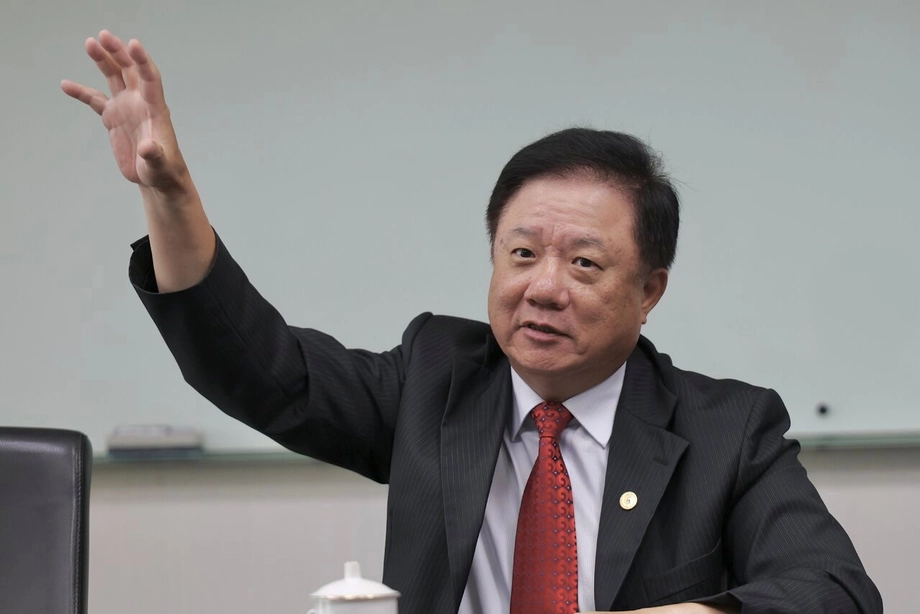
Chunghwa Telecom Chairman Chien Chih-cheng says the company's sea, land and space strategy brings different communications systems together so that another connection can take over when one fails. The company also plans investment in sovereign satellite resources focused on Taiwan and its outlying islands, giving it greater control over capacity for government command, disaster relief and other essential services.
The immediate challenge is practical: emergency workers need to exchange instructions, hospitals need connections, and isolated communities need ways to reach the outside world. Taiwan's plans combine services bought from international satellite operators with the slower work of developing domestic spacecraft and the ability to launch them.
Why undersea cables need backup
Taiwan depends heavily on cables laid across the seabed for its external communications. A November 2024 study published by the French Institute of International Relations, Taiwan's Rising Space Program, describes reliance on 14 submarine cables and records how an earthquake severed eight in 2006, disrupting internet service for weeks.
The same study documents the cutting of two cables connecting Taiwan's main island with Matsu in February 2023. Those incidents illustrate why having several cables is only part of the answer: an island also needs connections that travel by a different route and use different equipment.
A July 2025 assessment counted 14 international and 10 domestic undersea cables, with four cuts recorded that year by its publication date. Two were attributed to natural causes and two involved suspected sabotage by Chinese vessels. On June 12, 2025, a Chinese captain of the Togolese registered Hong Tai 58 was sentenced to prison for severing the Taiwan-Penghu No. 3 cable.
Chien's proposed response is a network in which cables, terrestrial infrastructure and wireless links support one another. A damaged cable could shift traffic onto microwave or satellite connections, while mobile equipment could help reach places where fixed infrastructure has also failed.
Matsu shows how emergency capacity is shared
Matsu is a concrete example of the approach. Chunghwa Telecom maintains undersea cable connections alongside microwave systems and satellite equipment. Chien says microwave links can take over after a cable failure, with satellites providing further support when needed.
Microwave links send information using radio signals between stations. They offer an alternative to a physical cable, but terrain, obstructions and interference can affect their performance. Satellite connections add another route by sending signals through spacecraft above Earth.
Emergency capacity is limited, so Chunghwa plans to allocate bandwidth according to the importance of the service. Bandwidth is the amount of information a connection can carry at once. If it falls sharply, operators must decide which traffic receives space first.
Chien says national security, police, fire services and government command would receive priority, while the network would also support medical care, finance and basic public communications. For residents, the practical aim is continued access to essential services and contact with others during an outage, even when the replacement network has less capacity than the damaged one.
Disaster response already uses satellites
Chunghwa Telecom has used satellite equipment to restore external communications after fiber was cut in mountainous parts of Taitung. Chien also described equipment being transported by helicopter during disasters in Hualien to maintain contact for residents and visitors.
Those deployments show that restoring a connection involves more than selecting a satellite provider. Equipment must reach the affected community and connect local users to the replacement service. Damaged roads can make that task difficult precisely when demand for communications is most urgent.
Chunghwa also deploys mobile communications vehicles that combine a base station with satellite equipment. The base station serves nearby users, while the satellite connection carries traffic beyond the damaged area. This gives emergency teams a way to establish service where fixed facilities are unavailable.
The company's broader investment therefore includes system integration and staff training. Engineers need to make terrestrial and satellite equipment work together, monitor traffic and move capacity toward the places and services that need it most.
Why Chunghwa is using several satellite orbits
Chunghwa's satellite network spans geostationary, medium and low Earth orbits. Its arrangements include the ST-2 geostationary satellite, Eutelsat OneWeb's constellation in low Earth orbit and SES's O3b mPOWER system in medium Earth orbit. The company says it obtained commercial permissions for the OneWeb and SES services during 2025.
Orbit describes the path a satellite follows around Earth. A geostationary satellite stays above roughly the same place, providing continuous coverage of a broad area. Satellites closer to Earth have shorter signal journeys, which can reduce communication delays, but move across the sky and require coordinated coverage.
Chunghwa is combining these systems to give customers several ways to stay connected. Its research institute has developed network management technology for automatic switching between satellite links, monitoring traffic in real time and allocating bandwidth according to demand.
The 2024 French Institute of International Relations study described OneWeb's constellation as having 630 satellites. It also recorded Taiwan's plan to deploy 700 terminals and obtain continuous service through ground stations in Japan, Thailand and Guam. These ground stations connect the satellite network with terrestrial communications networks.
Chien says the company is pursuing multiple partnerships to avoid depending too heavily on one system. The strategy combines diversity in suppliers with diversity in the physical routes that carry traffic.
A dedicated satellite has a later operating target
Chunghwa has partnered with US company Astranis for a MicroGEO satellite dedicated to Taiwan. MicroGEO refers to a compact spacecraft operating in geostationary orbit. The project would add satellite capacity focused specifically on Taiwan rather than relying entirely on shared coverage.
Chunghwa's earlier announcement envisaged launch by the end of 2025 and full bandwidth availability as early as 2026; its November 2026 description instead targeted operations in the second half of 2027. The company has not explained the reason for the later operating target or disclosed the investment terms and capacity of its broader sovereign satellite plans.
John Gedmark, chief executive of Astranis, described the purpose of the partnership when it was announced:
Our founding vision nearly a decade ago was to provide dedicated satellite capacity where it is most needed, ensuring secure and independent communications. We are honoured to partner with Chunghwa Telecom to enhance the resilience of Taiwan's critical communications infrastructure.
The Astranis partnership adds dedicated capacity through a foreign manufacturer. Taiwan's domestic satellite program takes on a wider industrial task: developing the spacecraft, communications equipment and production skills needed for a locally controlled constellation.
Domestic production and launches take longer
Taiwan's Beyond 5G LEO Satellite program, known as B5G, is intended to develop domestically owned, controlled and produced broadband satellites. The French institute's 2024 study described work on two experimental spacecraft, 1A and 1B, operating at an altitude of about 600 kilometers.
The study placed their expected launches in 2027 or 2028, following earlier hopes for 2025 or 2026, and described a longer ambition for several hundred satellites with initial launches around 2030. A July 2025 assessment gave a different projection of six domestic satellites by 2029, including two by 2026. These schedules represent different published planning snapshots as Taiwan develops its experimental and operational systems.
Launching those satellites independently requires another set of facilities. Taiwan currently uses foreign launch providers, including SpaceX, for orbital missions. Its existing Syuhai site launches sounding rockets, which carry experiments on flights that return to Earth rather than placing satellites into orbit.
Lai has backed domestic satellite and rocket production alongside new testing and launch infrastructure. A research, development, assembly and testing facility in Shalun, Tainan, is expected to start operating in 2030. A national launch facility at Jiupeng in Pingtung County is expected to become operational in 2032.
The main dates show how the work stretches across several stages:
- 2019: The original third phase began, with NT$25.1 billion and an end date of 2028.
- May 20, 2024: Lai called for the next generation of communications satellites in medium and low Earth orbits in his inaugural address.
- 2025: Chunghwa says it obtained commercial permissions for OneWeb and SES O3b mPOWER services.
- Second half of 2027: Chunghwa's latest stated target for its first satellite dedicated to Taiwan to enter operation.
- 2030: Expected start of operations at the Shalun rocket development and testing facility.
- 2031: Revised end date of the NT$71 billion national space program.
- 2032: Expected start of operations at the Jiupeng national launch facility.
The budget also funds eyes above disaster zones
Taiwan's space spending covers observation as well as communications. Lai says satellite data can help monitor environmental conditions, climate change and disaster areas, while satellite communications can maintain essential contact when networks on the ground are damaged.
The National Science and Technology Council describes FORMOSAT-8 as an eight satellite optical observation constellation. Six spacecraft are planned to provide images with a resolution of one meter and two with resolution finer than one meter, from an orbit about 561 kilometers above Earth. Resolution describes the scale of detail an image can show.
FORMOSAT-9 is planned to add radar observation. Optical satellites collect images using light, while synthetic aperture radar uses radio signals to observe the ground through cloud and in darkness. Together, the systems are intended to provide more frequent and dependable views for disaster response, land management and security.
In a legislative briefing, the council said the first FORMOSAT-8 spacecraft, named Chi Po-lin, had reached an 84 percent domestic production rate for key components. The revised space program targets more than 95 percent. The council also reported training 3,457 people in space related fields and securing 18 memorandums for cooperation with international space startups.
The revised program brings together B5G satellites, orbital rockets, the national launch site and support for emerging space companies. The council links the revision to the growth of satellite communications and implementation of Taiwan's Space Development Act.
Other telecom operators are joining the effort
Taiwan Mobile and Far EasTone are pursuing satellite services alongside Chunghwa. Their projects extend the industry effort beyond conventional satellite terminals toward connections between spacecraft and ordinary mobile phones.
Taiwan Mobile has signed a strategic cooperation memorandum with AST SpaceMobile to advance direct connections to standard phones. It is also working with Elveo Mobile to test backup through ground stations across national borders, and has introduced a maritime service combining several satellite orbits with 4G and 5G networks.
Far EasTone has announced cooperation with Elveo Mobile on direct satellite connections to phones. It is also working with Amazon Leo and planning services that combine satellites in low and geostationary orbits.
These projects are at different stages of cooperation, testing and service planning. For users, the practical change would be another way to connect beyond terrestrial mobile coverage, while Chunghwa's mobile disaster equipment already brings together local cellular access and a satellite route to the outside world.
Space ambitions extend beyond emergency networks
Lai outlined the broader program at TASTI 2026 in Tainan, an international gathering bringing together representatives from 32 countries and more than 80 exhibitors. Vice President Hsiao Bi-khim also visited the exhibition to view Taiwan's research and industrial supply chain.
National Science and Technology Council head Wu Cheng-wen said Taiwan would participate in NASA's efforts to return astronauts to the Moon. Taiwan had been invited to propose solutions to 32 technology gaps identified under the Artemis program, with industry consultations and information sessions planned to help shape its contribution.
Wu's industrial goal is to help Taiwanese companies move beyond making components into developing technology and designing complete systems. The communications strategy follows a similar progression: obtain working services now, integrate them with existing networks, and build more domestic capability over time.
For communities in Matsu, Taitung and Hualien, the most immediate measure of progress is whether a usable connection survives a broken cable or a damaged road. Taiwan's expanded space program ties that everyday need to a longer investment in satellites, manufacturing skills and independent access to orbit.
Key Points
- Taiwan's revised national space program totals NT$71 billion and runs through 2031, up from NT$25.1 billion through 2028.
- Chunghwa Telecom is combining cables, terrestrial networks, microwave links and several satellite orbits to maintain essential communications.
- Emergency bandwidth would prioritize national security, police, fire services and government command while supporting other basic services.
- Chunghwa's latest target for its first satellite dedicated to Taiwan is the second half of 2027, later than its earlier schedule.
- Domestic satellite development is proceeding alongside foreign service partnerships and investment in observation spacecraft.
- Rocket testing facilities at Shalun are expected in 2030, followed by the Jiupeng orbital launch facility in 2032.