A Billion Views and 500 Million Yuan in Orders
On the morning of November 26, Liang Jian, co-founder of Guanghe Dongli, an AI drama company in Guangzhou, left a roadshow stage and was quickly surrounded by dozens of potential investors. More than 200 investors and providers of overseas services had just heard him describe a business with more than 500 million yuan in orders. The company expects its overseas AI short drama business for the full year to reach about 50 times the level of the previous year.
Contents
- A Billion Views and 500 Million Yuan in Orders
- Why Guangzhou Has Become a Production Base
- The Computing Company Whose New Orders Overtook Three Years of Sales
- Two Production Models for Reaching Global Audiences
- Why the Overseas Economics Attract Investors
- A Flood of Output Is Driving Down Prices
- Copyright and Platform Rules Decide Who Gets Paid
- What the Investment Conference Has Already Delivered
- What the Boom Changes for Guangzhou
- Key Points
The audience response rested on more than a forecast. Liang said one of the company's recent productions had topped TikTok's drama chart in Japan, while its works had accumulated more than 1 billion views across the internet. He also said its productions regularly ranked first on TikTok. The pitch at the 2026 Greater Bay Area Cultural Industry Investment Conference turned Guangzhou's ambition to become an export center for AI drama into a story about identifiable viewers, orders and technology.
Liang told the roadshow that audience data, rather than instinct alone, would increasingly guide what studios make.
Future AI films and short dramas will no longer be created behind closed doors. Themes will be chosen through large model analysis and real data from different markets.
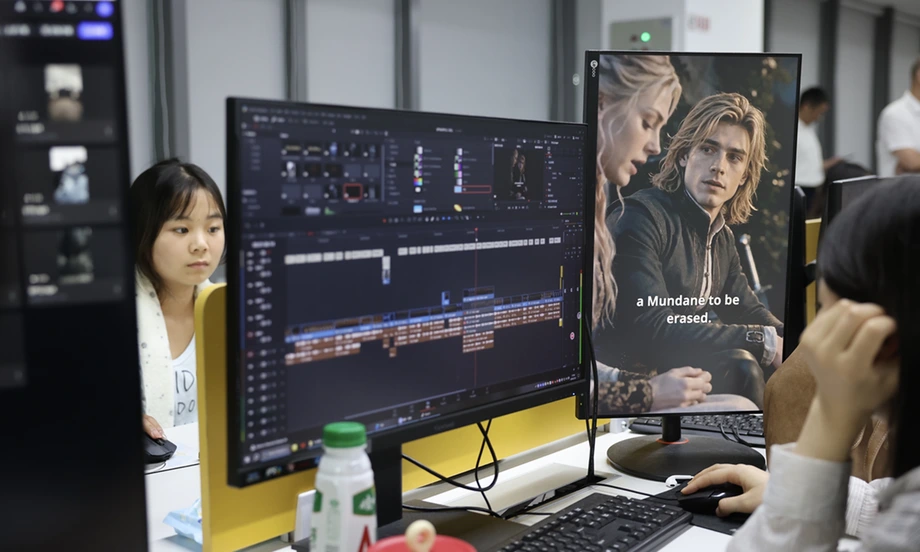
Guanghe's Ranmenggu platform covers script generation, production, editing and distribution in one workflow. More than 10,000 creators around the world use it, according to the company. Large models are AI systems trained on extensive collections of material that can generate text, images or video. In this business, they are being connected to audience information so that a producer can test which stories may appeal in Japan, Southeast Asia, Europe or the Americas before committing to a full series.
Why Guangzhou Has Become a Production Base
Guangzhou's cultural industries recorded revenue of 521.753 billion yuan in the first three quarters of 2026, an increase of 8.9 percent from the same period a year earlier. New forms of cultural business generated 278.203 billion yuan, up 14.4 percent. That amounts to about 53 percent of the total, calculated from the two revenue figures. Digital content services grew faster still, with revenue rising 31.2 percent.
The city already has more than 10,000 companies connected to film and television, while institutions with film and television licenses account for more than 15 percent of the national total. Haizhu district, one center of the activity, has 51 film and microdrama companies large enough to be included in the official statistical count. Their combined revenue approached 2 billion yuan in 2025.
DataEye placed Beijing, Shenzhen, Hangzhou and Guangzhou at the front of its city rankings for AI animated drama in the first half of 2026. Guangzhou faces intense competition, with cities including Shanghai, Foshan, Xi'an, Zhengzhou, Hefei, Wuhu, Huangshan and Changsha also introducing support for microdramas. Its advantage lies in the combination of content companies, game distribution experience, computing infrastructure and manufacturing connections across the Greater Bay Area.
The Computing Company Whose New Orders Overtook Three Years of Sales
Peng Yitian, general manager of Guangzhou Jubian Fangcheng Technology, brought a different set of figures to the conference. His company received 96 million yuan in new orders during the most recent three months, more than its combined orders over the preceding three years. The business supplies computing power and production tools to film companies, placing it behind the scenes of the same boom.
Peng graduated in information management and information systems from Sun Yat-sen University in 2012 and later worked on distributed computing and cloud computing. Those fields involve linking computers and remote data centers so that demanding digital tasks can be completed faster. He and friends founded the company in 2021. Its customers have included Enlight Media, Winsing Animation and Warner.
His video production platform, launched in October 2025, uses AI to produce material at a level intended for cinema release. Peng said it could deliver an improvement of roughly 20 times compared with traditional video production platforms, although the presentation did not break down how that multiple was calculated. He said the platform had already served 30 leading Chinese film companies.
Peng estimated that Guangdong has more than 18,000 companies related to microdramas. For him, their concentration in Guangzhou is as valuable as the technology.
Guangzhou has very fertile soil for cultural industries. Clients, suppliers and partners are all in the same city, and we can meet them at almost any time.
The company is now expanding into Malaysia, Vietnam, France and Morocco and registering business entities in places including Britain. Peng also plans to move into animated dramas during the second half of the year, although no launch dates were given.
Two Production Models for Reaching Global Audiences
Xinghuo Shenzhi, another company in Haizhu, represents one route abroad. Its own AI tools handle the complete production process for animated dramas, and its Journey to the West series has accumulated 230 million views. Its ToonBox distribution platform reaches more than 200 countries and territories. AI translation and adaptation allow the same script to be converted rapidly into English, Japanese, Korean and other language versions.
Guanghe has chosen a second route that combines AI production with filming in overseas locations. Ranmenggu connects to generative models available internationally, while the company has established a production base in Los Angeles where foreign actors take part in filming. Distribution then runs through TikTok and other global channels.
The two approaches show that AI does not remove every need for human performers or local knowledge. It gives producers a choice between generating an entire animated work digitally and using software alongside actors and physical sets. Both companies apply the technology across production, adaptation for different cultures and distribution, rather than confining it to writing a first draft.
Guanghe has two main sources of income. It produces AI short dramas for platforms including TikTok, ReelShort and Hongguo, and it supplies platforms with stories based on its own intellectual property. Liang compares its ambition as an overseas production organization with established film companies such as Alibaba Pictures, Sony and Metro Goldwyn Mayer. He argued that technology would not remove the need for a compelling script.
If we spend more time polishing the script and building empathy, good content planning will still have great reach. I believe all audiences will pay for content.
Why the Overseas Economics Attract Investors
DataEye expects the overseas market for dramas and animated dramas produced with AI to grow from about 100 million US dollars in 2025 to 650 million dollars in 2026. That would be an increase of 550 percent. The projection helps explain why investors remained around Liang after his presentation and continued discussions over lunch.
The Persian Revenge provides one striking example of the possible returns. The production reportedly cost 3,000 yuan, or 443 US dollars, to make. Within 72 hours of its release on the international platform YourChannel, it had generated more than 500,000 dollars in paid revenue. Another title, Revenge of XXL Wife, has passed 200 million cumulative views across related clips.
Cost savings are transforming localization, the process of adapting language, voices and cultural details for another market. Producers previously had to film abroad or build sets in China, hire foreign actors and spend heavily on translation and dubbing. Translating one microdrama could cost tens of thousands of yuan. Industry estimates now put the reduction from AI translation and dubbing at more than 90 percent, with accuracy above 95 percent.
Ni Kaomeng, initiator of the China AIGC Industrial Alliance, said some teams were already using AI to make microdramas for overseas audiences by the end of 2024. AIGC means content generated with AI. Production has since moved beyond basic translation and face replacement toward reusable libraries of digital actors and settings, allowing studios to produce series on a much larger scale.
Audience preferences still vary considerably. An industry white paper found that romance accounts for more than 70 percent of global microdrama viewing. Stories about powerful chief executives and marriages of convenience are especially popular among women aged 45 to 64 in Europe and the United States. Crime and revenge stories perform well in Latin America and Germany, while younger viewers in Southeast Asia show a stronger preference for fantasy. Those patterns also shape the subjects selected for AI productions.
A Flood of Output Is Driving Down Prices
About 128,000 microdramas were launched in the first quarter of 2026, and roughly 122,000 of them were generated with AI. That is more than 95 percent of the total. Ni estimated that high quality productions account for less than 10 percent of the market, creating a wide gap between the enormous number of releases and the smaller group capable of attracting substantial paying audiences.
Ni said the strongest international productions were being made to a much higher standard.
The highest-quality productions are directly benchmarked against the standards of US television, and some have even been sold to Netflix.
Competition is also cutting the price paid to creators. Song Donghuan, founder of the StoryStorm community, said overseas platform prices had fallen from between 4,000 and 5,000 yuan per minute last year to as little as 500 yuan per minute this year. At 500 yuan, the lowest quoted rate is only 10 to 12.5 percent of last year's range. Song separately estimated that about 2 million people now work in jobs related to AI microdramas.
Falling rates put pressure on studios even while order volumes rise. Guanghe's emphasis on original stories and polished scripts is one response. Computing providers and reusable production platforms offer another by reducing the time and expense required for each episode.
Copyright and Platform Rules Decide Who Gets Paid
Vobile Group, a digital copyright protection company, is building services around a less visible part of the export business. AI material can be copied, clipped and misused easily, while a successful video does not automatically produce income on every platform. YouTube channels must meet subscriber and viewing time requirements before they can apply for the Partner Program and begin earning advertising revenue.
The team behind Ma: The Word We're Born With encountered that barrier after the drama went viral and won awards. Vobile used digital fingerprinting and watermarking to make the work identifiable and traceable, then helped open a route to overseas distribution. A digital fingerprint identifies a piece of media through its technical characteristics, while a watermark embeds information that can help establish ownership. Other providers register works in databases and assist creators in pursuing infringement cases across borders.
Shanghai issued support policies for AI microdramas in May that called for stronger copyright protection. Larger studios are also entering the field. Bona Film Group has established an AIGMS center and produced Sanxingdui: Future Revelation, an AI animated microdrama consisting of 12 episodes. These developments give creators more production and protection services, but they also bring more competitors into an already crowded market.
What the Investment Conference Has Already Delivered
The conference has a financing record that extends beyond the latest speeches. Figures from its earlier editions show how many presented projects obtained investment and how the amounts changed.
- 2023: Nine of 18 projects received a combined 1.51 billion yuan after the inaugural conference.
- 2024: Eighteen of 40 projects secured nearly 8 billion yuan, more than five times the previous year's funding total.
- May 2025: Guangdong introduced 87 policy measures covering support that included funding for content creation and training for creative workers.
- November 26, 2025: The third conference opened in Guangzhou with 60 curated projects focused on AI and other new technologies.
- 2026: Tao Feng's latest investment trends report placed large model applications driving a surge in cultural content at the top of six major trends.
The 60 projects at the 2025 edition included tools for generating content with AI, filmmaking applications and robots with embodied intelligence, meaning machines designed to perceive and act in physical settings. Eight investment roadshows connected capital with film and television, live performance, animation, online gaming, e-sports and streaming services.
Tao Feng, head of the Institute of Industrial Economics at Jinan University, identified four investment priorities at the 2025 gathering: integration of culture and technology, digital content production, smart cultural manufacturing and new forms of cultural consumption. His 2026 report gave greater prominence to large models, reflecting their movement from a general investment theme into a practical content production tool.
Liu Feng, chief analyst at the Policy and Industry Research Institute of Guotai Haitong Securities, described a cultural sector being transformed by technology. He noted that Shenzhen and Guangzhou both ranked among the world's top 50 cities for AI innovation, giving the two Greater Bay Area centers a technical base alongside their entertainment businesses.
What the Boom Changes for Guangzhou
For young creators in Guangzhou, the immediate change is a route to overseas contract work without assembling a full traditional film crew. Small studios and teams can use AI tools to accept customized orders, while computing suppliers, copyright services and distribution platforms gain customers around them. Liang's stated goal is a Hollywood for short dramas in the Greater Bay Area that can help Chinese brands sell globally and carry Chinese cultural stories abroad.
Han Qiang, deputy general manager of Wuhan 2:10 Culture Communication, said the opportunity extended beyond exporting individual titles. He pointed to Guangzhou's Lingnan cultural traditions, the region's international trade connections and its resources in games, audiovisual production, manufacturing and supplies.
Guangzhou has enormous room for imagination. This is about more than selling one short drama overseas.
The wider cultural sector has already produced an international film success. Actress Xin Zhilei won Best Actress at Venice for The Sun Rises on Us All, a film backed by a company based in Guangzhou and shot in Guangdong. The award gives the city a second kind of example alongside the high volume drama business, one built around cinema and international critical recognition.
Several important figures remain projections or incomplete disclosures. Guanghe has not published a final result for its expected 50 times annual growth or a delivery schedule for its order book. DataEye's 650 million dollar market figure is a forecast for 2026, and Peng has not provided dates for his planned animated drama expansion. The measurable tests for Guangzhou are converting orders into revenue, maintaining income as prices per minute fall and building a larger share of productions that audiences will pay to watch.
Key Points
- Guanghe Dongli says it holds more than 500 million yuan in orders and expects overseas AI short drama business to reach about 50 times last year's level.
- The company reports more than 1 billion cumulative views, while its Ranmenggu platform is used by over 10,000 creators worldwide.
- Guangzhou's cultural industries generated 521.753 billion yuan in the first three quarters of 2026, with digital content services growing 31.2 percent.
- Jubian Fangcheng received 96 million yuan in new orders in three months, exceeding its total for the preceding three years.
- DataEye forecasts overseas growth from 100 million US dollars in 2025 to 650 million dollars in 2026 for dramas and animated dramas produced with AI.
- More than 95 percent of microdramas launched in the first quarter of 2026 were generated with AI, while high quality works were estimated at under 10 percent of the market.
- Guangdong's 87 policy measures, conference investment records and Guangzhou's computing and distribution networks are supporting the city's export ambitions.