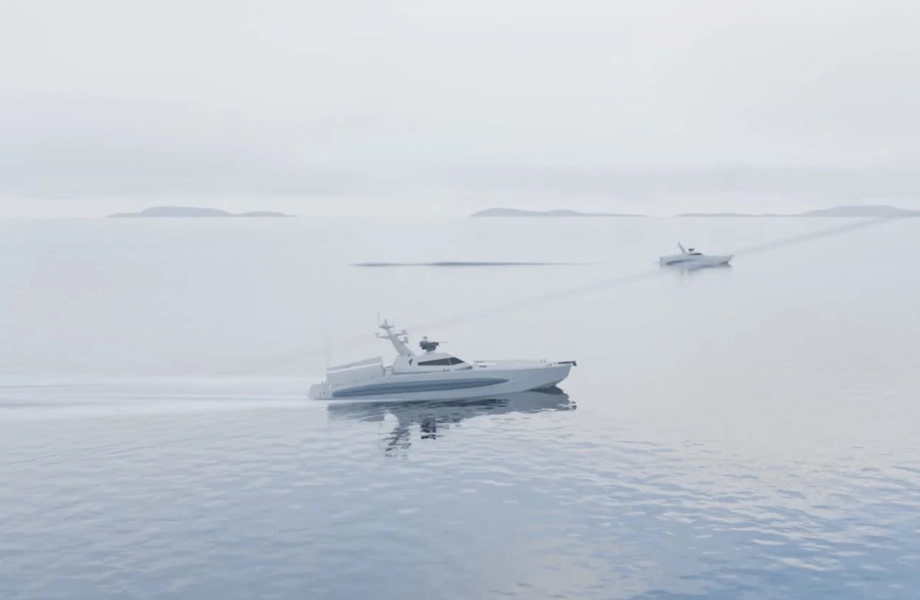
A Fast Boat With a New Status
On 25 November 2026, at Marina Boom in Banyuwangi, East Java, PT Lundin Industry Invest, trading as North Sea Boats, handed the Indonesian Navy its first KSR X33. The boat is 20 meters long and owned by the Defense Ministry. It entered service as Patkamla Geledek (II-5-46). It can carry six people or sail with nobody on board. It reached 58 knots in sea trials and has been prepared for two missiles designed to attack ships at ranges up to 300 kilometers.
Contents
- A Fast Boat With a New Status
- Why Java and Bali Get the First Hull
- Inside a Hull Built for Speed
- How the Boat Sails Without People Aboard
- The Missile Question Still Shapes the Story
- Three Later Boats Will Carry More
- A Short Timeline of the Programme
- What Changes for Patrols at Sea
- Domestic Industry Meets Foreign Systems
- What to Watch Before the Next Boats Arrive
- Key Points
The handover gives the navy a craft with an unusual legal and technical status. North Sea Boats said Geledek is the first craft capable of uncrewed operations to be formally classified as a naval vessel by the Indonesian Navy. The classification came through Chief of Naval Staff Decision No. Kep/2334/XI/2026, dated 18 November 2026. The boat will serve under a naval base within Kodaeral V Surabaya, the 5th Naval Regional Command responsible for central and eastern Java and Bali.
KSR means Kapal Serang Ringan, or light attack craft. Patkamla stands for Patroli Keamanan Laut, maritime security patrol. Geledek means thunder in Indonesian, a suitable name for a boat designed around speed.
Why Java and Bali Get the First Hull
Kodaeral V covers ports, islands and sea lanes around central and eastern Java and Bali. Placing the first hull there gives commanders a vessel that can be used for patrols with people aboard or for missions where sending people onto the boat is not needed.
Rear Admiral Tunggul, head of the Navy Information Service, said the service plans to combine crewed and uncrewed vessels rather than replace one with the other. He said the mix depends on the character of the mission and what is needed.
Pola operasi mengombinasikan antara kapal berawak dan nirawak sesuai karakteristik serta kebutuhan tugas
In everyday terms, a crewed boat can carry people who make decisions on board, while an uncrewed boat can be sent where a navy wants a vessel without exposing sailors. The Navy has not said how it will divide patrols between the two types in practice.
Inside a Hull Built for Speed
Geledek measures 20 meters long, with a beam of 4.6 meters, a draught of 1.2 meters and a displacement of 33 tonnes. It carries 5,000 liters of fuel and 600 liters of fresh water. A draught of 1.2 meters means it needs little water under the hull, useful near coasts and shallow approaches. The fresh water matters most when a crew is aboard.
The hull is made from carbon fiber composite using vacuum infusion, a process that draws resin through the fiber in a mould. The resin resists fire. The builder says the light, nonmagnetic structure reduces radar, infrared and magnetic traces and cuts fuel use and maintenance. The handover details did not include measured signature figures or the conditions of any test.
Two MAN V12-2000 engines drive twin Kongsberg Kamewa S 43/CA waterjets, which push the boat by jets of water rather than exposed propellers. The boat reached 58 knots, about 107 kilometers an hour, against a contract requirement of 50 knots, a margin of eight knots, or 16 percent. One knot is one nautical mile an hour, and a nautical mile is about 1.85 kilometers.
At a cruising speed of about 30 knots, the stated range is 330 nautical miles. At nine knots, it is 600 nautical miles. Dividing range by speed gives a simple comparison: about 11 hours underway at 30 knots and about 67 hours at nine knots. Those figures exclude fuel reserves, weather and time alongside another vessel, so they show the scale of endurance, not a guaranteed patrol length.
How the Boat Sails Without People Aboard
Geledek is described as optionally crewed. It can take up to six personnel for assignments that need them, and it can operate without a crew using a navigation system based on AI from Scandinavia. AI here means software that can help the boat steer and react to its surroundings. The system is designed to follow COLREG, the international rules that work like traffic rules at sea, including steps to avoid collisions.
Remote operation uses encrypted communications, including satellite links. The boat also has an optronic surveillance system, a tethered quadcopter that can lift a camera above the vessel, soft kill countermeasures against drone aircraft and drone boats, and a combat management system linked by data link. A data link lets different platforms share information. Soft kill means measures such as decoys or jamming meant to confuse an incoming threat rather than destroy it directly.
John Lundin, founder and director of North Sea Boats, said crewed and uncrewed vessels are changing maritime patrol work.
Kapal tanpa awak dan kapal berawak opsional sedang mengubah cara angkatan laut menjaga wilayah perairannya
The published descriptions explain autonomous handling of the vessel, but they do not say who would authorize weapons release in an uncrewed mission. That detail matters because navigation software and firing authority are separate questions.
The Missile Question Still Shapes the Story
Geledek has a 12.7 millimeter remote weapon station for closer range use. It was handed over as a platform prepared for two missiles designed to attack ships with ranges up to 300 kilometers. The handover did not name the missile or say whether the missiles were installed, and no final missile choice has been announced for the later boats.
The original plan was to use Kongsberg's Naval Strike Missile. The first vessel's canisters resemble that missile, but information from the shipbuilding programme now points toward Roketsan's Çakır for any larger production batch. Strict export limits on the Naval Strike Missile for countries outside NATO and close allied circles were cited as a reason the plan changed.
Roketsan quotes the version launched from the surface at more than 150 kilometers, while some programme descriptions of the planned fit for four missiles put the range at 300 kilometers. The missile is 3.3 meters long, or 4.1 meters with a booster, has a diameter of 275 millimeters and weighs 275 kilograms at launch, or 330 kilograms with a booster. It uses a Kale Arge KTJ-1750 turbojet, flies at Mach 0.75 to 0.85 and carries a warhead weighing 70 kilograms.
Çakır is designed to fly low over the sea and use several forms of guidance, including satellite navigation, inertial navigation, terrain contour matching, data link updates in both directions and seekers that work at the final stage. In simple terms, that means it can be updated during flight and find a target near the end of its journey. A common missile across Indonesian drone boats would make supply, maintenance and training easier.
In late September 2026, PT Tesco Indomaritim's USV was photographed with four Çakır canisters and sensors integrated by Aselsan Indonesia. That example helps explain why the Turkish missile is being discussed for the larger Geledek boats. The first hull remains the vessel whose real performance and weapon fit will be studied before the navy takes more of them.
Three Later Boats Will Carry More
North Sea Boats has three slightly larger vessels on order, with delivery targeted for 2027. Each is designed to carry four missiles designed to attack ships, twice the number associated with Geledek. Across the three boats, that gives 12 positions for missiles if the design is completed as described.
The larger boats are expected to keep performance broadly similar to the KSR X33 while carrying more equipment. Their systems are expected to come from Türkiye's Aselsan rather than Norway's Kongsberg, which supplied the autonomous navigation equipment on the first boat. That change would place Turkish sensors, weapons and integration work at the centre of the next batch.
Lundin said the company's production facilities are operating at full capacity for the next two years because of the KSR programme and other projects. He also noted interest from potential customers in the Middle East. North Sea Boats is preparing to test a drone boat designed to strike once and detonate on a target, often called a kamikaze USV, but the handover details gave no test date.
A Short Timeline of the Programme
The dated steps show how a procurement programme moved from budget planning to a vessel in naval service.
- 2020 to 2024: Indonesia's Defense Ministry funded the procurement through its budget years.
- Indo Defence 2025: The KSR X33 on display was associated with Kongsberg's Naval Strike Missile.
- 18 November 2026: The Chief of Naval Staff issued Decision No. Kep/2334/XI/2026, classifying the vessel as a naval vessel and confirming its commander.
- 25 November 2026: PT Lundin Industry Invest handed Patkamla Geledek (II-5-46) to the Navy at Marina Boom in Banyuwangi.
- 27 November 2026: The Navy described the operating approach as a mix of crewed and uncrewed vessels.
- 2027: Three slightly larger boats with positions for four missiles each are due to be delivered.
Together, those dates put one operational hull in service before the heavier later boats arrive.
What Changes for Patrols at Sea
For Kodaeral V, Geledek adds a shallow draught, high speed vessel that can be used in coastal and littoral waters. Littoral means the area near a coast. Its waterjets support sharp turns and a crash stop in less than twice the boat's length, useful when a remote operator or crew needs to avoid another vessel in crowded water.
The endurance figures give commanders choices. At about 30 knots, the boat can cover 330 nautical miles before refueling. At nine knots, it can cover 600 nautical miles. Slower travel saves fuel and lengthens time on station, but it also reduces how quickly the boat can reach a reported incident.
Taking people off the boat does not remove the need for people. Operators, communications staff, maintenance teams and analysts still have to support the vessel from shore. Geledek's ability to carry six personnel gives the Navy a way to compare both methods under one regional command before deciding how widely to use the model.
Domestic Industry Meets Foreign Systems
The Defense Ministry bought the boat through its 2020 to 2024 budget programme. PT Lundin Industry Invest built it at a yard covering 50,000 square meters in Banyuwangi. Air Vice Marshal Marsda TNI Ir. Wajariman, a defense industry expert at the Defense Ministry, said the vessel showed the government using domestic industry to protect sovereignty.
Kementerian Pertahanan ingin menjaga kedaulatan negara Republik Indonesia menggunakan aset-aset dalam negeri
Wajariman also said he hoped the domestic defense industry contribution would help build Indonesia's strength. He spoke at the handover in Banyuwangi.
Mudah-mudahan kontribusi yang dilakukan oleh industri pertahanan dalam negeri ini bisa membangun kekuatan pertahanan negara Republik Indonesia
John Lundin, the shipbuilder's founder and director, said the boat was a source of pride because it was designed and built in Indonesia and now sails for the Navy.
Kami bangga kapal yang dirancang dan dibangun oleh tangan-tangan Indonesia di Banyuwangi kini berlayar sebagai kapal TNI Angkatan Laut
The vessel brings local industrial goals together with foreign technology. Kongsberg equipment supports autonomous navigation and waterjets on the first boat, while Aselsan and Roketsan are linked to the later boats. For Indonesia, the practical test is whether local construction, foreign systems and naval operations can be combined without delays in training, maintenance or supply.
What to Watch Before the Next Boats Arrive
The 2027 delivery target is the clearest date in the programme. Before then, the Navy and builder will need to show how positions for four missiles change the larger hull's speed, range and handling. The result of 58 knots in trials belongs to the single hull of 33 tonnes; the later boats will carry more weapons and different systems.
The missile decision is the other point to watch. A move to Çakır would connect the Geledek boats with Turkish systems and with other Indonesian USV work. A choice to keep a different missile would change the logistics picture. No date was given for service firing, meaning a missile launch from the vessel during Navy trials, and no date was given for the planned test of a drone boat designed to strike once and detonate on a target.
For communities around Java and Bali, the change is practical rather than abstract. A fast vessel that can patrol with or without people may spend more time watching sea lanes, but it also requires new skills on shore. For North Sea Boats, the first accepted hull is now a reference point for export conversations in the Middle East.
Key Points
- Indonesia took delivery of its first KSR X33 on 25 November 2026 in Banyuwangi.
- The boat serves as Patkamla Geledek (II-5-46) under the 5th Naval Regional Command.
- It is 20 meters long, displaces 33 tonnes and can carry six people or operate without a crew.
- Sea trials reached 58 knots against a requirement of 50 knots.
- The boat has a 12.7 millimeter remote weapon station and was handed over as a platform prepared for two missiles with ranges up to 300 kilometers.
- Three larger boats are due in 2027 with positions for four missiles each and expected Turkish systems.
- The missile type for Geledek and the final choice for later boats were not announced at the handover.