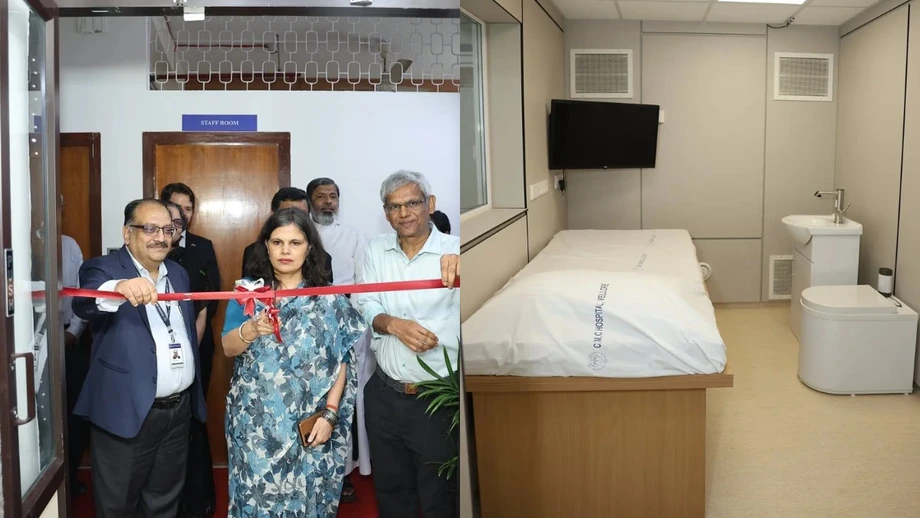
A Room Built to Measure Every Calorie
On 23 November 2026, Union Health Secretary Punya Salila Srivastava inaugurated a room sized laboratory at Christian Medical College (CMC) in Vellore where volunteers can eat, sleep, rest and exercise while sensors follow their metabolism for 24 to 72 hours. The Ministry of Health and Family Welfare said the Human Metabolic Chamber (HMC) has a bed, a desk, a portable toilet, a tap and an airlock for meals. It was set up jointly by CMC and the Tata Institute of Fundamental Research's (TIFR) Advanced Research Unit on Metabolism, Development and Aging (ARUMDA) at TIFR Hyderabad.
Contents
- A Room Built to Measure Every Calorie
- What the Chamber Actually Measures
- Why a Full Day Beats a Brief Mask Test
- Why Does India Need Its Own Calorie Data?
- Who Will Be Studied First?
- A Short Timeline of the Evidence
- What Earlier Work Suggested About Diabetes
- How the Chamber Connects to Other Labs
- What Could Change for Patients and Diets
- How the Lab Fits National Prevention
- What Happens Next
- Key Points
Officials described it as India's first dedicated advanced human metabolic chamber. Dr Nihal Thomas, senior professor in CMC Vellore's Department of Endocrinology, Diabetes and Metabolism and head of the Centre for Stem Cell Research, said an earlier metabolic facility was established at St John's Medical College in Bengaluru in the late 1980s. The Vellore facility is different because it can observe a person across a full daily cycle under tightly controlled conditions.
The project is built around a practical national question: how much energy do Indian bodies actually burn while living normal lives? The facility will support studies on nutrition, diabetes, obesity, ageing, malnutrition and cancer care, with an emphasis on evidence drawn from Indian diets, body types and lifestyles.
What the Chamber Actually Measures
Scientists call the chamber a whole room indirect calorimeter. Calorimetry means measuring heat or energy produced by biological processes. Indirect calorimetry does this by measuring oxygen consumed and carbon dioxide produced, because the body uses oxygen to burn food fuel and releases carbon dioxide when it does so.
Dr Felix JebaSingh, senior endocrinologist at CMC Vellore and one of the investigators, described the chamber's core task in plain terms.
Basically, this chamber will provide an estimation of the energy expenditure
Sensors track oxygen and carbon dioxide continuously. From those readings, researchers can calculate total energy expenditure, the calories a body burns across sleep, meals, rest and activity. The same measurements show whether the body is using carbohydrate or fat as fuel at different points in the day, a switch that happens during feeding, fasting and sleep.
Why a Full Day Beats a Brief Mask Test
A conventional metabolism test often uses a face mask that captures inhaled oxygen and exhaled carbon dioxide for 20 to 30 minutes. That gives a short snapshot, usually of resting energy use. The Vellore chamber follows a person through work, meals, rest, sleep and exercise, allowing researchers to see patterns that appear only across a daily cycle. One of those patterns is the circadian rhythm, the body's internal day and night schedule.
Dr Nihal Thomas said the longer observation period is the central change. He explained that small differences between people can be missed when scientists measure metabolism for only a few minutes.
This lets it detect small but important differences between individuals that shorter tests miss
The chamber also measures the energy spent digesting, absorbing and processing food, a process called diet induced thermogenesis. A meal can raise energy use by different amounts in different people. Researchers can record exact food intake and collect urine and stool samples, then compare the body's energy use with what entered and left it.
Some sensors measure gases beyond carbon dioxide, including hydrogen, which can offer clues about the activity of gut bacteria, the microbes living in the intestines. Staff can monitor readings from outside the room and adjust study conditions while a volunteer remains inside. Temperature can be held within approximately 0.3 degrees Celsius, far tighter than ordinary air conditioning. That precision lets researchers keep the room three degrees cooler for a sustained period and watch how the body responds. Exercise equipment can be used inside the chamber, and meals pass through an airlock so conditions stay controlled. Dr Thomas said longer stays will require real cooperation from participants.
Why Does India Need Its Own Calorie Data?
India carries one of the world's heaviest burdens of metabolic disease, but it has limited direct data on how Indian bodies use energy. A national ICMR and INDIAB study published in The Lancet Diabetes & Endocrinology in 2023 estimated that India had 101 million people with diabetes in 2021, 136 million with prediabetes and 254 million with generalised obesity. The survey was conducted between 2008 and 2020 and covered 113,043 adults aged 20 and above. Prediabetes means blood glucose is above the normal range but below the threshold for diabetes.
A 2023 study published in The Lancet estimated 212 million diabetes cases in India in 2023, and the reason for the gap between that figure and the ICMR and INDIAB estimate was not given. The scale is already visible in other parts of health care. A 2026 analysis linked 47,240 diabetes deaths to tobacco use in 2023. diet and treatment questions remain just as urgent: small trials found that mangoes replaced bread at breakfast without worse blood sugar responses in adults with type 2 diabetes, showing why measured responses to Indian foods matter.
Dr Thomas said around nine equations are commonly used to estimate calorie needs from age, height, weight and activity, but many were built largely on Western populations. He said Indian diets are highly varied and their effects on the body have not been studied enough. Two people of the same weight can carry very different amounts of muscle and fat. Body mass index, or BMI, is a weight to height measure, but it cannot show that difference, which matters for diabetes risk and nutritional needs.
Who Will Be Studied First?
The first research programme is expected to recruit adults above 18 across age groups and BMI categories. Researchers will record dietary histories, previous exercise patterns and occupations, because desk work, manual labour and regular exercise can change energy needs. The chamber can then compare what people say they eat and do with what their bodies actually burn.
The plan is to build a dataset that reflects different Indian realities, including people who are thin, people with obesity and people whose body weight hides higher risk. Ullas Kolthur-Seetharam, coordinator and principal investigator of ARUMDA, said Indian populations remain underrepresented in global metabolic research and that locally relevant measurements can guide nutrition advice.
A Short Timeline of the Evidence
The chamber sits on top of work that has been building in India for decades. The key dates show how older cohorts, newer surveys and the new facility fit together.
- 2008 to 2020: The ICMR and INDIAB survey covered 113,043 adults aged 20 and above across India.
- Late 1980s: St John's Medical College in Bengaluru established an earlier metabolic chamber.
- 2010 to 2012: CMC began following a birth cohort in Vellore.
- 2023: The ICMR and INDIAB study estimated 101 million people with diabetes, 136 million with prediabetes and 254 million with generalised obesity.
- 2025: ARUMDA established its National Analytical Facility for Nutrition and Metabolism Research.
- 2026: A joint ARUMDA and CMC study of the Vellore birth cohort, published in The Lancet Regional Health - Southeast Asia, found overweight and obesity nearly tripled between ages seven and nine, while about one in five children remained thin.
- 23 November 2026: The Human Metabolic Chamber at CMC Vellore was inaugurated.
The Vellore birth cohort is especially useful because researchers already know the participants' life histories. Ullas Kolthur-Seetharam said the chamber can attach precise metabolic measurements to those histories, helping explain why some children became overweight while others stayed thin.
What Earlier Work Suggested About Diabetes
Dr Thomas said diabetes has many causes. It is linked not only to insulin production, but also to insulin resistance in muscle and fat, excess glucose production by the liver and differences in how efficiently the body uses energy. Insulin is the hormone that helps glucose move from blood into cells. Insulin resistance means the body responds less well to that signal, leaving more sugar in the blood.
CMC researchers have previously used insulin clamp techniques, calorimetry and nuclear magnetic resonance spectroscopy to study these differences. An insulin clamp test measures how well insulin helps the body take up glucose. Nuclear magnetic resonance spectroscopy uses magnetic fields and radio waves to study molecules. Earlier work suggested that people born with low birth weight can carry more fat around internal organs, known as visceral fat, even when they look lean. That can raise metabolic risk as they gain weight.
Dr Thomas described some people as fuel efficient, meaning their bodies burn less energy. That can change how fat and glucose are used and may contribute to raised blood sugar among people who are not overweight. The new chamber gives researchers a way to study such patterns through long periods of controlled living rather than short tests alone.
How the Chamber Connects to Other Labs
The chamber will work alongside ARUMDA's National Analytical Facility for Nutrition and Metabolism Research, established in 2025. That facility offers metabolomics, which measures small molecules in blood and tissue, body composition methods, which show fat and muscle proportions, and stable isotope methods, which use harmless forms of elements as tracers to follow nutrients through the body.
Ullas Kolthur-Seetharam said combining those chemical measurements with whole body energy readings is uncommon.
It is a combination few centres anywhere can offer
The Department of Atomic Energy funded the chamber. Hindustan Unilever Limited provided corporate social responsibility support. NUTRIM at Maastricht University in the Netherlands gave technical advice, and the Embassy of the Kingdom of the Netherlands in India provided network support. The project brings together TIFR's research base and CMC's clinical experience in diabetes, endocrine disorders and metabolic disease.
What Could Change for Patients and Diets
For patients, the immediate value is better explanation. Doctors often see people of similar weight with very different risks of diabetes and heart disease. Better measurements can help explain why one person gains weight easily while another does not, and why some people develop diabetes while still appearing lean.
Ullas Kolthur-Seetharam said the chamber can address questions that matter across India's many populations, diets and lifestyles.
The chamber will help address questions about how the body uses energy, and how it varies across India's diverse populations, diets and lifestyle
Results could support diet and lifestyle advice built around Indian foods and daily routines. The team said better energy data could strengthen the evidence behind national programmes such as POSHAN Abhiyaan and Anaemia Mukt Bharat, which focus on nutrition and anaemia. The facility may also help research how metabolism changes with ageing, how muscle mass shifts, how deficiencies affect the body and how patients cope with cancer.
How the Lab Fits National Prevention
Punya Salila Srivastava called for research that reflects India's population diversity and specific metabolic risk profiles. She urged TIFR, ARUMDA and CMC Vellore to work with the Ministry of Health and Family Welfare and other national institutions on a focused research agenda. She also pointed to the Pan-AIIMS Research Consortium, a network of major medical institutes, as a possible partner in building robust national datasets based on evidence.
At the inauguration, she described a wider preventive health system. India has 1.87 lakh Ayushman Arogya Mandirs, or 187,000 primary health centres, providing screening for noncommunicable diseases and three cancers, including community assessment of everyone above 30. The country also has more than 781 district noncommunicable disease clinics and 6,489 such clinics at Community Health Centres for follow up care.
She highlighted Rashtriya Bal Swasthya Karyakram 2.0, a child health screening programme, and the expansion of the National Programme for Noncommunicable Diseases to five more conditions, including chronic obstructive pulmonary disease, stroke and chronic kidney disease. Chronic obstructive pulmonary disease is a long term lung condition that makes breathing hard. Stroke happens when blood flow to part of the brain is interrupted. Chronic kidney disease means the kidneys gradually lose function.
She also noted more than 7.8 crore cumulative yoga sessions, or 78 million sessions, and Prime Minister Narendra Modi's call for a 10 per cent reduction in oil consumption. The Aaj Se Thoda Kam campaign, Sugar and Oil Boards, school programmes and outreach through social media, radio and videos are part of that push. The Indian Council of Medical Research and the National Institute of Nutrition are also developing an artificial intelligence tool to help consumers understand packaged food labels.
What Happens Next
The first studies depend on equipment standardisation and ethics clearance. The number of participants has not been finalised, the building cost was not disclosed, and no start date was given. Those details will shape how quickly the chamber can produce results that are useful beyond research papers.
The next practical step is to enroll adults across different ages and BMI groups, record their diets and daily work, then measure what their bodies do across a controlled daily cycle. For families, clinicians and health planners, the value will come from clear data on how Indian bodies use food energy in real conditions.
Key Points
- The Human Metabolic Chamber at CMC Vellore was inaugurated on 23 November 2026 by Union Health Secretary Punya Salila Srivastava.
- CMC and TIFR's ARUMDA established the facility jointly at TIFR Hyderabad and CMC Vellore.
- Volunteers can live inside for 24 to 72 hours while sensors measure oxygen use and carbon dioxide output.
- The chamber can calculate energy expenditure and show whether the body uses carbohydrate or fat as fuel.
- An earlier metabolic chamber existed in Bengaluru from the late 1980s, but the Vellore facility is described as India's first dedicated advanced one.
- The research programme will first study adults above 18 across age groups and BMI categories.
- Equipment standardisation and ethics approvals are under way, and the participant number and building cost were not disclosed.
- The project received funding from the Department of Atomic Energy and support from Hindustan Unilever Limited, NUTRIM and the Netherlands Embassy in India.