A delayed briefing at Sheetal Niwas
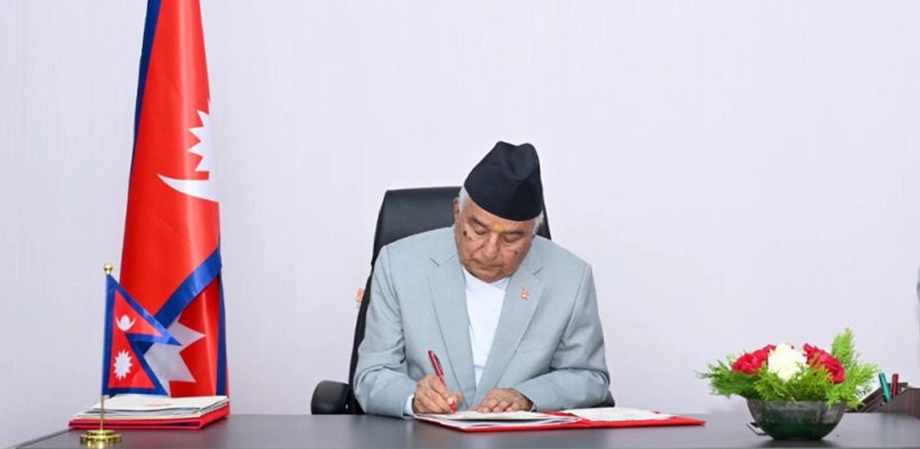
Prime Minister Balendra Shah spent 20 minutes with President Ramchandra Paudel at Sheetal Niwas on Friday, November 27, four days after returning from India. He described India's NPR 240 billion financial package and an understanding on the Bhairahawa air route as major achievements, then asked the President to issue three ordinances that have been waiting at his office.
Contents
- A delayed briefing at Sheetal Niwas
- The consultations that came before the meeting
- What the Indian financial package contains
- What changed on air routes, ports and connectivity
- The three ordinances on the President's table
- Why journalists are urging Paudel to pause
- Thirteen ordinances, 155 laws and a record under scrutiny
- What happens to the measures and agreements now
- Key Points
Kiran Pokharel, the President's press adviser, said the discussion covered the India visit and contemporary national issues. His office did not disclose details of the domestic matters. People familiar with the meeting said Shah argued that the ordinances were essential because the government was preparing several laws while Parliament was not in session.
The meeting also addressed an unusual political rupture. Shah left for New Delhi without briefing Paudel or consulting opposition parties, departing from the practice followed by previous prime ministers. He had also not personally informed the President when Parliament was convened or suspended. Paudel responded that democracy becomes stronger when institutions are respected, a remark directed at both the missed courtesies and the use of ordinances to legislate outside Parliament.
For Paudel, the immediate question is whether measures touching press freedom and other fundamental rights should receive parliamentary scrutiny before becoming law. For Shah, approval would allow his government, which took office eight months ago, to keep its legislative programme moving before the next session.
The consultations that came before the meeting
Shah's preparation for Friday began on Thursday at Rastriya Swatantra Party chair Rabi Lamichhane's residence in Budhanilkantha. The prime minister travelled there for talks lasting about five hours. Lamichhane's personal secretary, Abinash Acharya, said they discussed the India visit and its achievements, the coming parliamentary session, ordinances, the work of ministers, elections and a party training campaign.
Lamichhane then met Paudel on Friday for about 45 minutes, shortly before Shah arrived. His secretariat said their discussion covered the political situation, government activity, parliamentary affairs and ordinances. Lamichhane also explained why the government believed the three pending measures were necessary. The sequence reinforced a pattern in which Shah briefs his party chair, who then communicates with the President.
Shah had met Lamichhane before leaving for India as well. Previous prime ministers generally used the period before a foreign visit to consult both the head of state and opposition parties, making Shah's choice of political intermediary part of the criticism.
- October 2: Parliament's monsoon session ended after sitting for more than five months.
- November 3: The Cabinet recommended ordinances amending the Press Council Nepal Act, 2048, and several laws concerning culture, tourism and civil aviation.
- November 20: The Cabinet recommended an ordinance to create a commission investigating incidents during the Gen Z movement and addressing compensation and reparation.
- November 22 and 23: Shah made his state visit to India at Narendra Modi's invitation, spending about 25 hours on Indian soil.
- November 26: Shah and Lamichhane held their five-hour discussion in Budhanilkantha.
- November 27: Lamichhane met Paudel first, followed by Shah's meeting lasting 20 minutes.
What the Indian financial package contains
Indian Prime Minister Narendra Modi announced the package after talks with Shah at Hyderabad House. It is worth NPR 240 billion, or 24,000 crore, about $1.6 billion. Indian Foreign Secretary Vikram Misri called it the "largest ever package of financial assistance from India to Nepal". The commitment closed Shah's first bilateral visit abroad since taking office in March and became India's largest financial commitment to its northern neighbour.
The money divides into two very different forms of assistance. NPR 56 billion, equivalent to 35 billion Indian rupees, is grant assistance for reconstruction and new infrastructure. The remaining NPR 184 billion, equivalent to 115 billion Indian rupees, is a concessional credit line for energy projects. Concessional credit is borrowed money offered on easier terms than commercial loans, generally with lower interest or longer repayment periods.
Nepal had requested NPR 100 billion in grants and another NPR 100 billion in loans, according to Foreign Minister Shishir Khanal. The final grant is therefore NPR 44 billion below the request, while the credit component is NPR 84 billion above the requested loan amount. Grants make up about 23 percent of the announced package and credit about 77 percent.
Modi presented the announcement as support for reconstruction after the August 26 disaster, when an avalanche of ice and rock near the Lhende river in Tibet sent water and debris surging through the Bhote Koshi and Trishuli river systems. He told the joint press appearance:
Today, to provide fresh impetus to Nepal's reconstruction and long-term development, we are announcing a Development Cooperation Package worth 24,000 crore Nepali rupees.
Misri said the energy credit would be India's first credit line to Nepal denominated in Indian rupees. He distinguished it from a $750 million facility announced after the 2015 earthquake, of which about $550 million had been used. Much of the new credit could support electricity transmission. Nepal currently exports around 1,200 MW of electricity to India, against an ambition eventually to export 10,000 MW.
Nepali Congress General Secretary Pradeep Poudel has demanded a public, itemised account of Shah's meetings, agreements and financial understandings. He argued that Shah travelled on behalf of the country and must place its achievements and obligations before the public. The division between grants and credit answers part of that demand, but detailed borrowing terms and implementation schedules have not been made public.
What changed on air routes, ports and connectivity
The joint statement issued after the visit says the existing B345 route linking Kathmandu, Bhairahawa and Lucknow, which currently operates in one direction, "will be made bidirectional". Nepal first sought the change 17 years ago. Aircraft approaching Bhairahawa from the west can currently be required to detour about 300 kilometres through Simara, adding flying time and fuel costs for airlines using Gautam Buddha International Airport.
Technical consultations must still settle how the route will operate, and no date for those talks was announced. The statement says other civil aviation proposals from both sides remain under discussion. Nepal did not obtain the additional western entry point at high altitude near Mahendranagar that it has sought for Bhairahawa and Pokhara. The practical value of B345 will also depend on flight levels and operating procedures, including concern that a 21,000-foot restriction could require some aircraft to circle before landing.
Eight memorandums of understanding covered forensic science, police training, civil service capacity, satellite communications, health, sustainable urban development, Ayurveda and traditional medicine, and livestock and fisheries. Shah and Modi also inaugurated the Sarayu-Kamala Express between Ayodhya and Janakpur, opened a motorable bridge across the Mahakali at Darchula and virtually laid the foundation stone for the 669 MW Lower Arun hydropower project. Regular train service was scheduled to begin on November 28.
India announced completion of the field location survey for the proposed Raxaul-Kathmandu electric railway. Foundation work also covered a petroleum pipeline from Siliguri to Jhapa, while the visit advanced plans for a petroleum storage terminal in Jhapa and an integrated check post at Banbasa.
Deendayal port in Gujarat, formerly known as Kandla, will provide Nepal with a new sea access route, with access to Paradip in Odisha to follow once the necessary infrastructure is ready. Nepal had sought Dhamra and Mundra instead. Traders in Birgunj say the value of the alternative ports will depend on regular freight trains to the Sirsiya dry port, competitive charges and simpler transit procedures.
Boundary disputes received no mention in the leaders' public remarks. Before the visit, former diplomats had urged Shah to restart border negotiations, pointing to 182 jointly prepared boundary maps awaiting endorsement and a political negotiating mechanism agreed in 2014 that had never met. The joint statement instead instructed foreign secretaries to work on boundary matters, language also used in 2014. A separate vision document says existing agreements, including the 1950 Treaty of Peace and Friendship, may be reviewed by mutual consent.
The three ordinances on the President's table
Three separate Cabinet recommendations are now awaiting Paudel's decision. All were sent after Parliament stopped sitting, and the government has not publicly released detailed explanations of their contents or why each needed to be introduced immediately.
- The Press Council Nepal Act, 2048 amendment ordinance was recommended on November 3. It has been under study at the President's Office for three weeks.
- A second ordinance recommended the same day would amend several Nepal laws, including legislation concerning culture, tourism and civil aviation.
- The third, recommended on November 20, would establish a commission to investigate cases arising from incidents during the Gen Z movement and arrange compensation and reparation.
Article 114 of the Constitution allows the President to issue an ordinance on the Cabinet's recommendation when Parliament is not in session and immediate legislation is needed. An ordinance has the force of law, but it is temporary. It must be presented to both houses after a parliamentary session begins and converted into law through replacement legislation within 60 days. Otherwise, it lapses and the legal changes it introduced become inactive.
Paudel's office is examining whether legislation connected to constitutionally guaranteed fundamental rights should have come through Parliament instead. His concern extends beyond the wording of individual clauses to the practice of using temporary executive legislation when elected representatives could debate a measure publicly.
Why journalists are urging Paudel to pause
A Federation of Nepali Journalists delegation including its president, office bearers, advisers and central members met Paudel for about 15 minutes and submitted a written appeal against issuing the Press Council ordinance. The federation asked for time to study and revise the proposal, saying people and institutions working in the media had not been consulted.
Umid Prasad Bagchand, the federation's vice president, said its central objection was that the Press Council could lose its independence and be placed within government or under a ministry. He explained the delegation's position after meeting the President:
This bill for the media and journalism sector has come without consulting us and without consulting stakeholders. Many of its provisions will make journalism difficult, and there has been an attempt to place the Press Council, which exists as an independent body, within government or under a ministry.
Accounts of the draft say it would also bring social media pages within the journalists' code of conduct. That could widen the council's reach beyond conventional news organisations, making the definitions of journalism, responsibility and enforcement especially important. The detailed text and the government's formal rationale have yet to be published.
Bagchand said Paudel responded that he would consult legal advisers and lawyers. The federation wants any eventual law to protect press freedom and freedom of expression while giving journalists and media institutions a sense of ownership. No presidential decision was announced after the meetings.
Thirteen ordinances, 155 laws and a record under scrutiny
Parliamentary records show that the government has issued 13 ordinances during its eight months in office, amending 155 existing laws and introducing some new provisions. During the same period, Parliament passed 12 laws. Six were bills replacing ordinances, including measures on public procurement, money laundering, cooperatives and health science academies. Three were the Appropriation Act, Public Debt Act and Finance Act associated with the annual budget.
Of the three remaining policy laws, the National Forensic Science Laboratory Establishment and Operation Act and the Alternative Development Finance Mobilisation Act began as bills introduced under earlier governments. The third restored provisions of the Nepal Special Service Act, 1985, returning the National Investigation Department to the Office of the Prime Minister after an earlier ordinance had transferred it to the Home Ministry. That law was authenticated on September 16.
Eight ordinances were issued before the monsoon session. One amending several Nepal laws revised 19 statutes. Another changed 15 laws relating to universities, while the health science academies ordinance amended six. The broadest measure, concerning the removal of public officeholders, amended 24 laws and repealed provisions in 77 others, affecting 101 laws through a single instrument. More than 1,500 public officeholders were removed. Four of these eight ordinances later became law through replacement bills, while four did not.
Shah registered another bill on September 21 to restore legal provisions rendered inactive by the public officeholders ordinance. Parliament has not approved it. After the monsoon session ended, the government recommended eight more ordinances. Five have been issued, together amending 10 laws and introducing one new law, while the remaining three are those now before Paudel.
Two of the five issued measures were forest and land ordinances promulgated on October 13. Law Minister Sobita Gautam said they opened a route to land ownership for eligible landless families, with charges of 7 percent of the minimum valuation for agricultural land and 12 percent for residential land, subject to eligibility checks and conservation safeguards.
The RSP's parliamentary strength has sharpened the political argument. The party holds almost two thirds of the seats, yet its government has repeatedly used ordinances. On March 5, 2025, while in opposition, current Finance Minister Swarnim Wagle led seven lawmakers submitting notices against an ordinance concerning the Financial Procedures and Fiscal Responsibility Act, 2019. A related bill was already undergoing detailed discussion in the House Finance Committee.
Constitutional expert Bhimarjun Acharya has called the RSP's change of position a double standard. RSP parliamentary whip Prakash Chandra Pariyar defends the government's approach, arguing that ordinances are constitutional when Parliament is out of session. Paudel's review now gives that argument a practical test: constitutional permission establishes a power, while the frequency and subject matter of its use determine how much lawmaking remains with Parliament.
What happens to the measures and agreements now
No decision on the three ordinances was announced after Friday's meetings. Until Paudel acts, the existing Press Council law remains in place, the proposed amendments to tourism and aviation legislation remain waiting, and the Gen Z commission cannot be created through the pending ordinance. Approval would start the countdown toward parliamentary scrutiny; continued study would leave all three measures without legal effect.
The nearest fixed date arising from the India visit is November 28, when regular Sarayu-Kamala Express services were scheduled to start. Dates have not been announced for technical consultations on B345, the next parliamentary session or Paudel's decisions. Nepal therefore has headline figures and project announcements from New Delhi, while the borrowing terms, aviation procedures and legislative timetable that will determine their practical effects remain unfinished.
Key Points
- Balendra Shah briefed Ramchandra Paudel for 20 minutes on November 27, four days after returning from India.
- India announced NPR 240 billion in assistance: NPR 56 billion in grants and NPR 184 billion in concessional energy credit.
- The B345 Kathmandu, Bhairahawa and Lucknow route is to operate in both directions, but Nepal's request for a new Mahendranagar entry point remains unresolved.
- Three ordinances await Paudel's approval, covering the Press Council, culture, tourism and aviation laws, and a Gen Z investigation and reparation commission.
- The Federation of Nepali Journalists has asked Paudel to pause the Press Council measure for study and revision.
- The government has issued 13 ordinances amending 155 laws in eight months, while Parliament has passed 12 laws.
- No dates have been announced for the next parliamentary session, presidential decisions or technical talks on the air route.