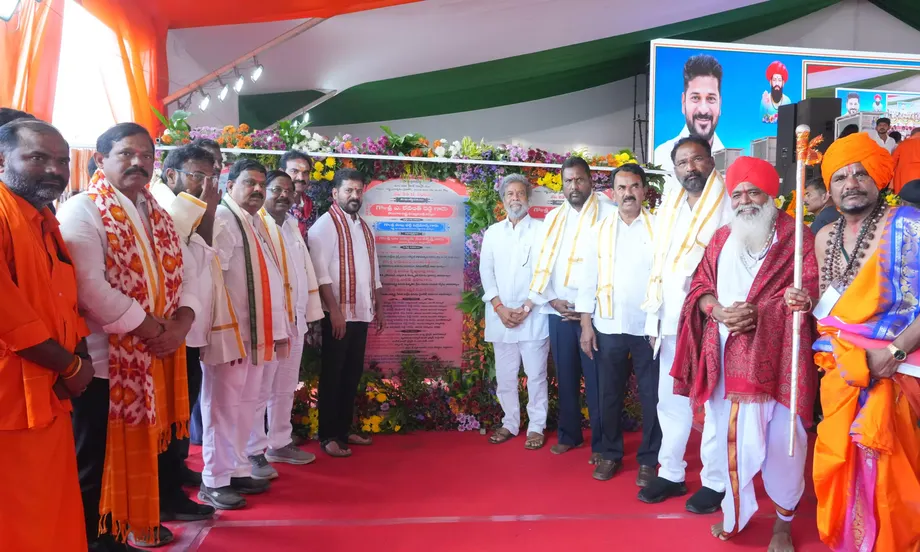
A Homecoming With a Price Tag
Telangana Chief Minister A Revanth Reddy returned to his birthplace in Achampet on Thursday, November 26, 2026, and turned a local public meeting into a statewide policy stage. He laid foundation stones for development works worth about ₹450 crore, launched the distribution of Indiramma sarees to one crore women and introduced new pensions. He promised that Achampet, in Nagarkurnool district, would be developed as a model constituency for Telangana.
Contents
- A Homecoming With a Price Tag
- How the ₹450 Crore Adds Up
- Sant Sevalal, Lambada Pride and a Commission Promise
- Sarees, Pensions and the Welfare Message
- Jobs, Caste Counts and the 2034 Claim
- Water Projects Take Centre Stage
- History Gives the Visit Its Setting
- What Changes on the Ground
- What Remains Open
- Key Points
The visit followed a tight schedule. About 1,400 buses brought people from across the region, and workers arrived from the united Mahabubnagar, Nalgonda and Rangareddy districts. The meeting was part of Praja Palana and Pragathi Bata and the one crore women Indiramma saree gift programme, timed around Constitution Day.
- Afternoon at Maddimadugu in Padara mandal: the chief minister laid the foundation stone for the Sant Sevalal Maharaj statue and related works.
- 3:40 pm: he reached the Achampet meeting venue by helicopter, drawing cheers from the crowd.
- After the statue ceremony: he walked about 3 km from the helipad near the RTC bus stand to the stage in a padayatra, greeting people on the way.
- At the main meeting: he spoke from a podium set up on the stage pathway, with women and young people crowding to shake his hand.
Banjara artists performed traditional dances and songs before the speech. Reddy told the gathering that he was a child of the soil and would work to make Achampet a development example for the state. Assembly member Dr. Vamsi Krishna had asked him to adopt the constituency, and Reddy responded with a promise to push development in as many ways as he could.
How the ₹450 Crore Adds Up
The headline figure was built from two sets of projects. At Maddimadugu, the Sant Sevalal Maharaj temple and statue were estimated at ₹38 crore, a Haritha hotel near Sri Pabbathi Anjaneya Swamy Temple at ₹15 crore and temple development at ₹18 crore. Those three added to ₹71 crore.
At the Achampet meeting venue, the biggest item was ₹274.32 crore for BT roads across Nagarkurnool district. BT refers to the bituminous surface used on many roads. The rest covered school buildings, local streets, drinking water, tribal infrastructure and extra classrooms.
- ₹274.32 crore for BT roads in Nagarkurnool district
- ₹29.65 crore for Telangana Public Schools in Nagarkurnool, Pedda Kothapalli and Veldanda
- ₹25 crore for concrete roads and drains in Achampet municipality
- ₹18.105 crore for 130 additional classrooms in government schools
- ₹16 crore for drinking water infrastructure in Achampet municipality
- ₹14 crore for an Integrated Tribal Development Agency building at Mannanur in Amrabad mandal
- ₹2 crore for an Adivasi Bhavan in Achampet town
The listed works at the meeting venue came to ₹379.07 crore. Added to the ₹71 crore at Maddimadugu, the total was ₹450.07 crore before rounding. The detailed list put the extra classrooms at ₹18.105 crore, while the speech rounded that figure to ₹18 crore.
Sant Sevalal, Lambada Pride and a Commission Promise
Maddimadugu gave the visit its cultural weight. Sant Sevalal Maharaj is revered by Lambada and Banjara communities, and Reddy described the spiritual leader as a guide whose teachings called for peace, service to the poor and avoidance of meat and alcohol. The government already had 16 acres at the site and acquired four more, taking the temple complex to 20 acres.
Reddy announced that a dedicated chairman for the State Scheduled Tribes Commission would be nominated from the Lambada community. The commission is a state body focused on the welfare and representation of Scheduled Tribes, often shortened to ST. He said the Congress government had replaced a joint commission with separate commissions for Scheduled Castes and Scheduled Tribes, and that he would press the Congress leadership in New Delhi for greater Lambada political representation.
Chief Minister A Revanth Reddy, speaking after the foundation stone ceremony at Maddimadugu, described Sant Sevalal as a moral guide for the Lambada community and set out the conduct he said the leader taught.
Sant Sevalal Maharaj, the revered deity of the Lambadis, is a great role model. We should live peacefully, away from violence. We should stay away from meat and alcohol. We should serve the poor. Sant Sevalal became a divine role model for the Lambadis by teaching them to set an example for society.
Reddy said some political parties had treated Lambadas as voting machines, while his government was focused on jobs, livelihood and representation. He recalled that Lambadas had resisted British rule and the Nizam regime, and that their tandas, or settlements, had sheltered people fighting the Nizam. He credited former Prime Minister Indira Gandhi and former Union minister S. Jaipal Reddy with securing ST status for Lambadas in 1976.
Sarees, Pensions and the Welfare Message
The Achampet meeting put women at the centre of the event. Reddy launched the distribution of one crore Indiramma sarees, named after Indira Gandhi, and new Cheyutha pensions. About 1,400 women were included in the saree distribution at the venue. He rejected criticism over the colour of the sarees and said the gift was about women's dignity and financial strength, not caste or religion.
Reddy said the state had provided ₹72,000 crore in loans under bank linkage across Telangana. Bank linkage means connecting welfare groups or borrowers to formal bank credit. He also said 25 buses had been given to the district, and he pointed to free bus travel and free electricity up to 200 units as measures helping tribal and poor families.
Housing and food support were central to his pitch. Reddy said nearly four lakh of the eight lakh sanctioned Indiramma houses had been allocated to Scheduled Caste and Scheduled Tribes families, and he also put the share at nearly 45 percent. On Sanna Biyyam, the fine rice scheme, he put coverage at 3.40 crore people in one statement and 3.48 crore in another at the same event. He said Lambadas formed the largest beneficiary group, with Adivasis also among the major beneficiaries. He said ₹1.78 lakh crore had been spent on farmer welfare in three years and crop loans up to ₹2 lakh had been waived for 25.35 lakh farmers.
Chief Minister A Revanth Reddy, speaking as the face of the Congress welfare programme, framed his scheme list as a political challenge and invoked the two great epics to describe its scale.
The list of all the welfare measures would be an epic equal to the Ramayana or the Mahabharata. I am throwing a challenge to both the BJP and the BRS to come together to the Assembly to settle the score. We are also providing welfare to the families associated with both the BJP and the BRS, and it is the legacy left to us by Indiramma (Indira Gandhi). We only know how to cherish the poor and hold them close to our hearts.
Jobs, Caste Counts and the 2034 Claim
Employment was the sharpest announcement for young people. Reddy said his government had already filled more than 75,000 government posts and would fill another 25,000 soon, taking the total to one lakh. He also mentioned 2,000 home guard posts. The remaining 25,000 posts would be one quarter of the one lakh target he described.
Reddy predicted that Congress would remain in power in Telangana until 2034 and linked that confidence to a goal of one crore votes and 90 seats in the next election. He said the Constitution written by B. R. Ambedkar gave ordinary people the vote. He also said his government had completed a caste census after decades without one, noting that a caste count had last been done under the British in 1930. A caste census counts people by caste and is used to shape reservation policy.
He used part of the speech to attack the BJP and the BRS. He said BJP leaders Bandi Sanjay, Ramachander Rao and Kishan Reddy were talking about a return to power without the numbers to support it. Chief Minister A Revanth Reddy also aimed a personal jab at BRS leader KTR.
Not every fool who grows a beard can become a Revanth Reddy
Water Projects Take Centre Stage
Reddy's most detailed promise concerned irrigation in the less developed Palamuru region. He said the government would complete the Palamuru, Achampet, Dindi, ESLBC, Bhima and Jurala projects and carry water to the final ayacut. Ayacut means the area that a project is meant to irrigate. He said Srisailam water was reaching 1.50 lakh acres through the KLI lift system, and that a government order, a formal official decision, would be issued to enable that supply.
MLA Dr. Vamsi Krishna said 0.1 TMC of water had been allocated to the Umamaheshwaram project and ₹55 crore had been set aside to expand the road from Padara to Maddimadugu. TMC means thousand million cubic feet, a unit used to measure large volumes of water. Nagarkurnool MP Dr. Mallu Ravi said the visit would be a turning point for the region and highlighted the Umamaheshwaram and Chennakeshva projects, which are intended to irrigate six mandals. A mandal is a local administrative block.
Reddy said lift irrigation, which uses pumps to move water from a lower level to higher land, was central to Achampet's future. He said that if the Achampet lift scheme had been completed earlier, lakhs of acres would have received water. He also promised that the government would take responsibility for supplying water from the Dindi project.
The chief minister revisited a long running political dispute over Krishna River water. He said Telangana had 811 TMC of Krishna water available and accused the previous BRS leadership of accepting a 299 TMC share for the state while allowing Andhra Pradesh to take 66 percent. He alleged that K Chandrashekhar Rao did not spend ₹10,000 crore on Palamuru projects during 10 years in power. Reddy gave the state debt as ₹8.11 lakh crore and also used ₹8.50 lakh crore in remarks at the same meeting.
History Gives the Visit Its Setting
Achampet is not just a constituency on a map. It sits near Umamaheshwaram, described as the northern gateway to the Srisailam shrine, one of the twelve Jyotirlinga sites. Maddimadugu is associated with Sri Pabbathi Anjaneya Swamy, and the wider Nallamala forest region is home to the Chenchu tribal community's traditional way of life. Reddy also recalled his own roots in Kondareddypalli.
The area's political history is long. Dynasties and rulers linked to it include the Satavahanas, Vishnukundinas, Chalukyas, Kanduru Cholas, Kakatiyas, Recherla Nayakas, Bahmani rulers, Qutb Shahi Sultans and the Nizams. Reddy invoked Achamamba, a woman from Telangana who, in the 14th century, resisted Malik Kafur, the commander of Alauddin Khilji's army. He called her the Jhansi Lakshmi Bai of South India.
The Sant Sevalal story added another layer. Reddy said Indira Gandhi's decision to include Lambadis in the Scheduled Tribes category in 1976 opened paths to civil service, elected office and leadership posts. He also recalled the distribution of assignment pattas and podu land pattas to landless tribal people. Pattas are land titles, while podu refers to cultivation on forest or hill plots.
What Changes on the Ground
A foundation stone marks the ceremonial start of a project. The practical effect will come later, when roads are laid, classrooms are built, water lines are laid and schools are staffed. For a student in Nagarkurnool, the school and classroom announcements matter because they address crowded classrooms. For a farmer, the water projects matter because irrigation can decide whether land produces one crop or more.
For households in Achampet municipality, the ₹25 crore for concrete roads and drains and the ₹16 crore for drinking water touch daily life more directly than a large project number. The hotel near the temple and the temple works aim at pilgrims and visitors, while the Integrated Tribal Development Agency building at Mannanur is meant to strengthen services for tribal areas.
For Lambada families, the promises link welfare with identity. A 20 acre temple complex, a community member as ST Commission chairman, housing allocations and rice support were presented together as a package of recognition and material aid. For women, the saree and pension programmes were the most visible part of the event. The coming test is whether these announcements become steady benefits that people can use.
What Remains Open
Completion dates, a job notification date, the ST Commission nominee and the date for the water government order were not announced. The timing word used for the recruitment drive was soon. No project by project payment schedule was given, and no date was set for when the final ayacut would receive water.
The next steps are administrative. The government must issue the job notification, name the commission chairman, release the water order and move each foundation stone project from ceremony to construction. Until then, the Achampet visit stands as a large promise built on roads, schools, water, welfare and political representation.
Key Points
The main developments were:
- A Revanth Reddy laid foundation stones for works worth about ₹450 crore in Achampet and Maddimadugu on November 26, 2026.
- The detailed package was ₹71 crore at Maddimadugu and ₹379.07 crore at the Achampet venue, with ₹274.32 crore for BT roads as the largest item.
- The chief minister launched one crore Indiramma sarees, new pensions and a 20 acre Sant Sevalal Maharaj temple complex.
- He promised an ST Commission chairman from the Lambada community and said 75,000 government jobs had been filled, with 25,000 more planned soon.
- Water promises covered Palamuru, Achampet, Dindi, Umamaheshwaram and Chennakeshva projects, including 0.1 TMC allocated to Umamaheshwaram.
- No completion dates were announced for the projects, job notification, commission appointment or water order.