Buyers turn cautious as the memory boom enters a new phase
DRAM buyers are starting to act more carefully. TrendForce published memory industry findings on Nov. 27, 2026, saying that supply chain participants have been reassessing 2027 and 2028 production and sales plans since early in the fourth quarter of 2026. The result is a slight slowdown in DRAM purchasing, with 2028 contract prices now facing a clearer risk of decline.
Contents
- Buyers turn cautious as the memory boom enters a new phase
- What the base case and bear case actually say
- A short timeline of the demand shift
- Why Chinese cloud cuts have limits
- Nvidia financing turns neoclouds into a swing factor
- US rules and elections add another brake on demand
- Cheap memory is not arriving yet for phone and PC buyers
- New capacity grows, but shortages take time to fade
- Why DRAM and NAND are separating
- What the scenarios mean for chipmakers and investors
- What is still undecided
- Key Points
DRAM is the working memory in phones, PCs and servers. It holds information a device needs right away, like a desk holding papers for a task in progress. Contract prices are the bulk rates agreed between memory makers and large buyers, so they move less quickly than spot prices, which are closer to immediate delivery prices.
The shift matters because DRAM has been one of the tightest parts of the artificial intelligence hardware boom. Asia Daily examined last month's memory crunch forecast that Samsung Electronics and SK hynix could see average DRAM selling prices rise 40% in 2027. KB Securities estimated global DRAM demand would grow 25% next year against supply growth of 18%, leaving major customers able to secure only about 70% of the DRAM they needed. Another industry model put 2027 contract price gains at 5% to 15% per quarter in the first half and 0% to 8% in the second half.
Asia Daily also examined the 3D DRAM proposal that Taiwan Semiconductor Manufacturing Co. was weighing at Nvidia's request. That plan showed how serious the supply pressure had become. The world's largest contract chipmaker was considering a move into memory manufacturing, either by building a factory or converting an existing one. Apple had also cited rising memory costs among the reasons for raising some product prices earlier in 2026.
What the base case and bear case actually say
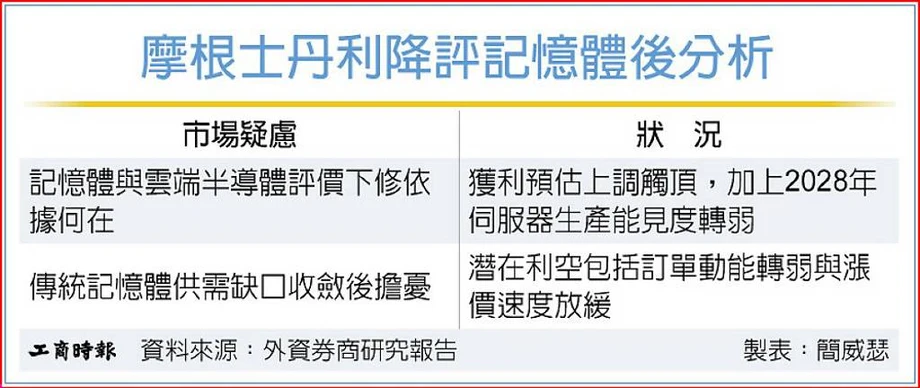
TrendForce set out two paths because the size of the demand hit is still being assessed. In the base case, conventional DRAM contract price increases narrow quarter by quarter through 2027, could level off in the second half and turn lower in 2028. If server shipment growth slows next year as expected, TrendForce expects DRAM supply to loosen and contract prices to decline across all product categories starting in the first quarter of 2028.
The bear case is harsher. It assumes server makers, also called OEMs, cut orders further after demand revisions, setting off inventory reductions through the chain. It also assumes neocloud companies cut investment or consolidate, and that the United States introduces tighter and broader controls. Under that path, server shipment growth could slow as early as 2027, conventional DRAM prices could reverse in the fourth quarter of 2027, and declines could widen during 2028.
GF Securities analyst Jeff Pu put numbers on the slowdown. He cut his 2027 DRAM contract price forecasts to quarter on quarter growth of +6%, +3%, 0% and 0% from +10%, +7%, +5% and +3%. In plain terms, prices still rise in the first half of 2027, then stop rising in the second half. A 0% quarter means the contract price stays flat compared with the previous three months.
GF's 2028 cases are starker. Conventional DRAM is put at $4, $8 or $12 per GB under bear, base and bull cases, compared with $16 per GB in 2027. That equals declines of 75%, 50% and 25%. High bandwidth memory (HBM), the stacked DRAM used beside AI processors, is put at $20.7, $23.7 or $29.6 per GB against $29.6 in 2027, meaning declines of 30%, 20% or no change.
A short timeline of the demand shift
Several dated changes sit behind the new outlook. The sequence helps explain why memory buyers moved from chasing supply to guarding orders.
- Early in the fourth quarter of 2026: Some Chinese cloud service providers began reducing 2027 server DRAM demand outside LTAs, contracts that run for several years. North American cloud providers largely took the available supply.
- Nov. 17, 2026: GF Securities cut its 2027 NAND price outlook to flat in the first quarter and declining through the rest of the year.
- Nov. 25, 2026: TrendForce released a revenue update putting 2027 DRAM revenue at $1.153 trillion and NAND revenue at $419.3 billion.
- Nov. 27, 2026: TrendForce published the base and bear cases for DRAM contract prices over 2027 and 2028.
- 2027: The base case has DRAM increases slowing, with possible flat prices in the second half.
- Fourth quarter of 2027 to first quarter of 2028: The bear case pulls the price turn forward to late 2027, while the base case has broad declines beginning in early 2028.
The calendar matters for buyers. A server company signing contracts now is planning for a market that may feel tight in 2027 but much looser if data center orders slow in 2028.
Why Chinese cloud cuts have limits
Cloud service providers, or CSPs, are companies that run large computing networks. Some Chinese CSPs began trimming 2027 server DRAM orders early in the fourth quarter of 2026 because graphics processing units (GPUs), the chips that perform much of the AI work, were scarce. GF Securities estimated the cut equalled about 1% of total DRAM demand and could be absorbed by North American CSPs.
The same support did not fully appear in NAND. Chinese CSPs reduced 2027 enterprise solid state drive orders from the middle of the fourth quarter of 2026, citing GPU shortages, inventory burdens and competition over AI service prices. Additional orders from North American companies were smaller than the Chinese reduction, leaving more NAND available than buyers wanted.
Consumer demand adds pressure. Phone and PC makers face higher component costs and weaker sales, so some buyers are limiting purchases and working through stock. That is why the DRAM market can still be short overall while older DDR4 and DDR3 products show softer spot prices.
Nvidia financing turns neoclouds into a swing factor
A neocloud is a newer cloud company that rents computing power for AI work. Nvidia has provided financing support to some of these companies, helping them buy servers and the memory inside them. If Nvidia narrows that support, some neoclouds may order fewer servers, and each server carries DRAM.
The concern sits beside Nvidia's rapid product pace. Asia Daily covered Vera Rubin production, where Nvidia said a server node could be assembled in less than five minutes, down from two hours for its Grace Blackwell predecessor. Faster assembly raises the value of reliable chip deliveries. It also increases demand for HBM4, the fourth generation of high bandwidth memory, from Samsung, SK hynix and Micron.
In the bear case, weaker neocloud investment would matter beyond one company's budget. It could reduce server orders across suppliers, slow DRAM purchases and encourage consolidation among smaller computing rental firms. That is why financing policy has become a memory price issue, not just a technology funding story.
US rules and elections add another brake on demand
The United States Department of Commerce's Bureau of Industry and Security (BIS) recently introduced rules limiting access to advanced AI chips for data centers that provide substantial computing resources to Chinese companies. Foundries, factories that make chips designed by others, must also obtain BIS approval before making advanced chips for Chinese integrated circuit design houses. Both rules can slow the flow of computing power and the DRAM orders attached to it.
The outcome of the United States midterm elections is another variable. Market participants expect a more cautious stance toward domestic data center development, and power supply limits could reshape construction plans for 2028. A data center needs electricity, cooling and network connections before it can install servers, so delays in those pieces can delay memory purchases.
Asia feels the effect because its memory makers and server suppliers sell into global AI projects. A policy change in Washington can alter orders in Taiwan, South Korea, China and the United States within a few quarters.
Cheap memory is not arriving yet for phone and PC buyers
Consumer electronics companies are under sales pressure and have limited room to absorb higher memory prices. TrendForce expects 2027 consumer DRAM demand to be lower than previously thought as device prices stay high and distributors reduce inventory. Some DDR4 and DDR3 spot prices have already fallen, an early cooling signal in the part of the market where orders are smaller and faster to change.
Samsung, SK hynix and Micron have shifted some capacity toward HBM and server DRAM used in high performance AI systems. Winbond Electronics and Nanya Technology have been filling part of the consumer DRAM gap. That helps balance supply for older products, even while the overall DRAM market remains tight.
NAND is closer to relief. Consumer NAND prices have fallen about 20%, with another 5% to 10% decline expected early in 2027. As inventory bought at lower prices runs out, device makers may raise finished product prices or reduce the storage capacity in each phone or PC to control bill of materials costs. Shoppers may see smaller storage specifications before they see much cheaper DRAM.
New capacity grows, but shortages take time to fade
On the supply side, TrendForce expects DRAM bit supply to grow strongly from 2026 through 2028 as makers add capacity and move to more advanced processes. A bit is the smallest unit of digital information, so bit supply measures total memory capacity rather than the number of chips. More bits can be produced from the same wafer, a round silicon disk used to make chips, when manufacturing improves.
GF Securities still sees DRAM supply below demand, with adequacy gaps of -5% in 2026, -5% in 2027 and -4% in 2028. A negative gap means buyers want more memory than the market can provide. HBM keeps taking wafer space, and SK hynix has expected shortages to persist through 2030 despite expansion, with about half of its capacity tied to LTAs in 2027 and 2028.
Asia Daily examined Micron's wafer bonding plan, which keeps the company on its 6F² cell design while it develops wafer bonding and future 3D DRAM. Micron has set volume production of 1 delta DRAM in Boise, Idaho, for the second half of 2027, aiming for a mid 20% increase in bit density over 1 gamma. Scott DeBoer, Micron's president and chief technology and products officer, said the limits of a smaller cell design called 4F² are fundamental. He was explaining why moving from one cell layout to another cannot instantly create more supply. He said:
There's fundamental problems with 4F² scaling, that ultimately will lead to 3D DRAM coming in instead of 4F².
That manufacturing reality is why prices can slow without a sudden flood of memory. New fabs, process changes and HBM capacity all take time, and a price decline in 2028 depends on supply finally outrunning demand.
Why DRAM and NAND are separating
DRAM and NAND do different jobs. DRAM is the desk where a device keeps active information. NAND is the storage shelf that keeps data when power is off. TrendForce projected 2027 DRAM revenue of $1.153 trillion, up 69% year on year, and NAND revenue of $419.3 billion, up 29%. Both forecasts were lower than earlier ones. Revenue growth is expected to slow from 345% for DRAM and 356% for NAND in 2026.
NAND prices are under more pressure. TrendForce cut its fourth quarter 2026 NAND contract price growth forecast to 8% to 13% from 15% to 20%, and expects the first quarter of 2027 to be flat to down 5%, followed by declines across all categories from the second quarter. NAND spot prices have fallen more than 20% recently. Industry capital spending is estimated at $29.9 billion next year, up 26.7%, while NAND bit supply is expected to rise 25% to 30%, helped by process changes and quad level cell (QLC) memory that stores four bits per cell.
Counterpoint Research put global NAND revenue growth at 70% in the second quarter of 2026 from the previous quarter and price growth at 55%. Samsung held a 28% revenue share and SK hynix 19%, together about half the market. Strong recent earnings make a price reversal more painful for those producers, while buyers of solid state drives may benefit first.
What the scenarios mean for chipmakers and investors
GF Securities kept a constructive view on Micron, SK hynix and Samsung Electronics despite the forecast cuts, describing the revision as moderate. The firm did not give individual stock ratings or price targets. It listed four risks: slowing AI demand, infrastructure deployment, supply constraints and competition. Gross margin, the share of revenue left after direct production costs, is put at 60%, 80% and 87% for conventional DRAM under bear, base and bull cases. HBM gross margin is put at 67%, 73% and 78%.
Earnings per share scenarios show how wide the range is. Micron is put at $54, $124 or $194 in 2028, while SK hynix is put at $15, $30 or $42, depending on the case. GF also expects possible production cuts if weakness persists, because cutting output can defend floor prices in LTAs. A floor price is the lowest agreed level in a supply contract.
For memory buyers, the practical message is simpler. DRAM prices may keep rising in 2027, just more slowly, and a drop to $8 per GB in 2028 would still be half the 2027 level. Large cloud companies may get relief before ordinary shoppers do. Phone and PC buyers are more likely to see slower price increases, lower NAND prices and smaller storage upgrades next year.
What is still undecided
The size of the demand hit is still unknown, as is the exact timing of any Nvidia financing change, the final shape of United States data center policy after the midterm elections and how strict BIS controls become. No exact date was given for those decisions. The dated markers that are known are the four quarters of 2027, the fourth quarter of 2027 in the bear case, the first quarter of 2028 in the base case and the wider 2028 declines in the downside path.
Three signals will shape the outcome. First, whether North American cloud providers keep absorbing supply released by Chinese order cuts. Second, whether server makers hold orders once inventory starts building. Third, whether power limits and export rules slow data center projects enough to reduce DRAM purchases before new supply arrives.
Key Points
- TrendForce says supply chain participants have been reviewing 2027 and 2028 plans since early in the fourth quarter of 2026, slowing DRAM procurement.
- The base case has conventional DRAM price gains narrowing in 2027, flattening in the second half and falling in 2028.
- The bear case pulls the price turn forward to the fourth quarter of 2027 and expects wider declines in 2028.
- GF Securities cut its 2027 quarterly DRAM forecast to +6%, +3%, 0% and 0% and put 2028 conventional DRAM at $4, $8 or $12 per GB against $16 in 2027.
- Chinese cloud order cuts affect about 1% of global DRAM demand and have largely been absorbed by North American providers, while NAND has weaker support.
- BIS rules, United States midterm policy, power limits and Nvidia financing for neoclouds are the main demand variables.
- DRAM remains tight in 2027, while NAND is nearer a price decline cycle, with spot prices already down more than 20%.