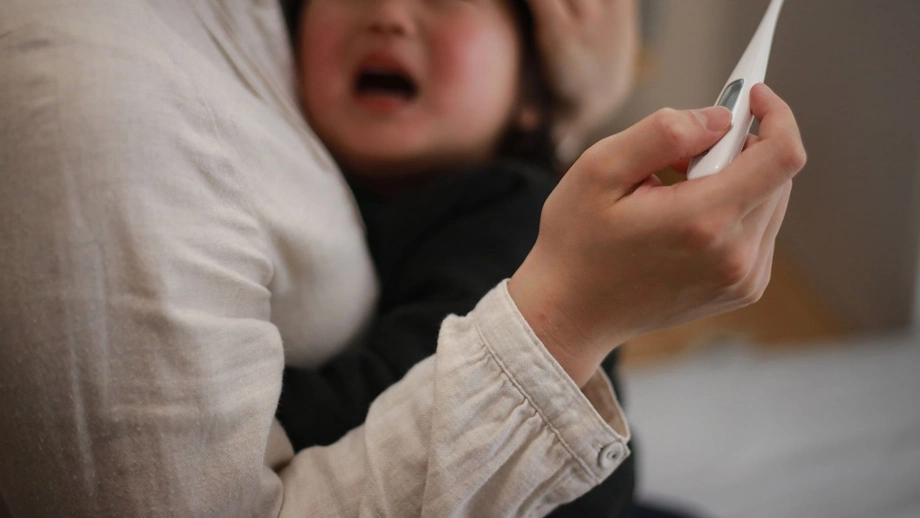
Why the number of days matters more than the number of degrees
A temperature of 39°C can frighten any parent, but pediatric specialist Shinnosuke Hirahara says the more useful question is how many days a fever of roughly 38°C or higher has lasted. Most childhood fevers are caused by viruses, and those accompanying an ordinary cold often settle naturally within three to four days. A child on day one or two who remains alert, reasonably active and able to drink can often be watched calmly at home.
Contents
- Why the number of days matters more than the number of degrees
- Which children should be seen without delay?
- What makes Kawasaki disease dangerous?
- Should families wait for five days of fever?
- What did the unusual case in Syria show?
- How do doctors distinguish it from other illnesses?
- What does treatment in hospital involve?
- What happens when the first infusion does not work?
- Why does care continue after the fever disappears?
- The Bottom Line
The pattern changes when fever reaches day four or five, energy keeps falling or urination becomes scarce. Hirahara advises medical assessment when fever lasts four days or more, when a child is markedly listless, or when there is very little urine. He also stresses that a clearly listless child should be seen on day one, without waiting for a calendar threshold. A thermometer reading describes one moment; the duration and the child's behavior show how the illness is developing.
One disease behind that caution is Kawasaki disease, an uncommon inflammation of blood vessels that can injure the arteries supplying the heart. Current Japanese diagnostic guidance does not require five days of fever before doctors can diagnose it. That makes the combination of symptoms, and their appearance over several days, especially important.
Parents can help by writing down the date the fever began, daily temperatures, fluid intake, urination and any changes in the eyes, lips, skin, hands or feet. Photographs can preserve a rash or redness that fades before an appointment. That simple record gives a clinician a sequence to examine rather than a single temperature.
Which children should be seen without delay?
Babies younger than three months sit outside the usual waiting advice. A temperature of 38°C or more at that age requires prompt medical assessment even if the baby appears well. For older children, difficulty drinking, passing little urine or becoming increasingly limp and unresponsive demands attention whatever the thermometer says.
Persistent fever accompanied by several of the following changes warrants contact with a pediatric service that day, even before day five:
- Both eyes become red, usually without pus or sticky discharge.
- The lips become very red, dry or cracked, or the tongue looks red with prominent bumps.
- A rash appears on the trunk, limbs or groin.
- The hands or feet become red or swollen, or the child resists holding objects or putting weight on them.
- A lymph node in the neck becomes enlarged.
- The site of a BCG vaccination becomes red or swollen during the fever.
New symptoms after an earlier medical visit are also a reason to return. Doctors may initially see too few features to name the illness, while the pattern becomes clearer a day later. Babies under six months and older children can have fewer typical signs, so continuing unexplained fever in those age groups deserves careful review.
In Japan, families unsure where to seek advice at night or on a holiday can use the #8000 pediatric telephone service, although its hours vary by prefecture. Emergency treatment through 119 takes priority when a child responds poorly, has an altered level of consciousness, struggles to breathe, develops blue lips or an obviously abnormal color, has a seizure lasting five minutes, or shows cold sweat, fainting or profound collapse.
What makes Kawasaki disease dangerous?
Kawasaki disease is a vasculitis, meaning inflammation of blood vessels. It mainly involves vessels of medium caliber and can affect the coronary arteries, which carry blood and oxygen to the heart muscle. Most patients are under five, although older children and, rarely, adults can be affected. Boys are affected somewhat more often. The illness carries the name of Japanese pediatrician Tomisaku Kawasaki, who first described it in 1967.
The exact cause remains unknown. The leading explanation is an excessive immune response to an infectious or environmental trigger in a child with a genetic susceptibility. It does not spread between people, and it is not caused by poor hygiene or something a parent did. Reported rates range from 8 to 67 cases per 100,000 children under five in many countries, compared with 124 per 100,000 in Japan. Rates are also relatively high in Korea and Taiwan and among children of East Asian ancestry elsewhere.
The central danger is a coronary artery aneurysm, a weakened and ballooned area in an artery wall. A large aneurysm can later narrow or develop a clot, reducing blood flow to the heart and creating a risk of heart attack. Without treatment, aneurysms occur in as many as 25 percent of cases and about 1 percent of affected children die. With treatment, reported mortality falls to 0.17 percent.
Those heart complications explain why Kawasaki disease has become a leading cause of acquired heart disease in children in wealthier countries. Acquired means that the condition develops after birth rather than being present from birth. The fever and rash may eventually disappear by themselves, while arterial damage continues, so treatment aims to protect the heart rather than simply make the child comfortable.
Should families wait for five days of fever?
The number five describes different things in different guidance. Hirahara's four-day point is advice to seek assessment. The sixth revised diagnostic guide issued by the Japanese Kawasaki Disease Society in 2019 sets no minimum duration for fever. The American Heart Association's classic definition uses fever for at least five days plus four of five physical features, while also recognizing incomplete disease and diagnosis before day five when the clinical pattern is clear.
The Japanese guide lists six principal signs, assessed across the whole illness rather than on one day:
- Fever, without a required number of days or a required peak temperature.
- Redness in the white part of both eyes, generally without pus.
- Red or cracked lips, a strawberry tongue, or widespread redness inside the mouth and throat.
- A rash, which can take different forms. Reddening at a BCG vaccination scar is included in this category.
- Firm swelling of the hands or feet and redness of the palms or soles during the acute illness, followed later by sheets of skin peeling around the fingers or toes.
- Swelling of lymph nodes in the neck without pus. A diagnostic description commonly uses at least one node measuring 15 millimeters or more.
Five or more of the six signs during the illness support a diagnosis of Kawasaki disease. A child with four signs can also be diagnosed when other illnesses have been excluded and an echocardiogram shows coronary artery changes meeting the criteria. Children with three or four signs, or even fewer, may be diagnosed with incomplete Kawasaki disease after doctors assess blood and urine tests, heart imaging and other possible causes.
Incomplete does not mean mild. The risk of coronary artery lesions is considered comparable to that in classic cases, and a Japanese nationwide survey has reported an even higher risk in some incomplete cases. Redness at a BCG scar is a useful clue in infants, but doctors still need the wider clinical picture. Since individual signs can fade, dated photographs and a fever diary can be especially valuable.
What did the unusual case in Syria show?
On November 25, 2026, the Journal of Medical Case Reports published a published case report describing a boy aged two from Syria who arrived at an emergency department after five days of unexplained fever and a rash. An echocardiogram revealed coronary artery aneurysms and a mild pericardial effusion, meaning a small amount of fluid around the heart. The findings led to a diagnosis of incomplete Kawasaki disease.
Coronary aneurysms associated with the illness usually develop two to four weeks after fever begins. Clear detection on the fifth day was therefore exceptionally early. The authors identified it as only the third documented instance in the medical literature. Their report was received on January 12, 2026, accepted on November 5 and published later that month.
William Borghol of the Faculty of Medicine at Hama University and his coauthors, including Saleh Takkem of the Department of Cardiology at Hama National Hospital, summarized the clinical warning in their conclusion.
Clinicians should remain vigilant that coronary artery aneurysms secondary to Kawasaki disease can develop much earlier than classically expected. Consequently, prompt diagnosis is essential to mitigate the risk of severe cardiac complications.
The published summary does not describe the boy's treatment or later condition. Its practical lesson concerns timing: when fever, rash and other compatible signs accumulate, doctors may need to examine the heart early rather than assume that aneurysms belong only to the later weeks of the illness.
How do doctors distinguish it from other illnesses?
No single blood test confirms Kawasaki disease. Clinicians begin with the date the fever started, the order in which signs appeared and a physical examination of the eyes, mouth, skin, hands, feet, neck, hydration and circulation. Repeated examinations matter because a child can have fewer visible signs at one visit than over the full course of the illness.
Blood tests commonly include CRP and ESR, two measures of inflammation, and a complete blood count. White blood cells may be raised early, while platelets often increase later. Doctors may also check liver function, albumin, electrolytes and urine, with other tests selected according to the child's condition. A chest X-ray can help when a prolonged fever raises the possibility of another infection.
An echocardiogram uses ultrasound to examine heart movement, the valves, fluid around the heart and the dimensions of the coronary arteries. An electrocardiogram records the heart's electrical activity. Coronary arteries can widen after an early normal echocardiogram, so repeat scans remain part of care.
Scarlet fever, measles, adenovirus infection, toxic shock syndrome and systemic juvenile idiopathic arthritis can produce overlapping fever, rash or inflammation. Multisystem inflammatory syndrome in children associated with COVID-19 can also resemble Kawasaki disease, although it has distinct features. Diagnosis therefore combines symptom patterns, laboratory evidence, heart imaging and the careful exclusion of alternatives.
What does treatment in hospital involve?
Children diagnosed with Kawasaki disease are generally admitted to hospital. Japanese standard treatment for a child who still has fever is intravenous immunoglobulin, known as IVIG, at a total dose of two grams for each kilogram of body weight, together with aspirin supervised by specialists. IVIG contains purified antibodies pooled from donated plasma. It has broad effects that calm inflammation, although researchers do not fully understand every part of its action in this disease.
A hospital infusion guide from Acibadem International describes a standard IVIG dose running slowly for about 10 to 12 hours. Staff begin at a low rate, increase it in stages and repeat measurements of temperature, heart rate, breathing, blood pressure and oxygen levels. Headache, chills, flushing, nausea or aches can prompt staff to slow or pause the infusion; allergic reactions and other rarer complications require immediate treatment.
Timing determines how much heart protection IVIG can provide. American Heart Association figures cited in the hospital guidance put coronary artery damage at about 25 percent without treatment and roughly 4 percent when IVIG is given within the first ten days of fever. Japanese cardiovascular guidance aims to give IVIG by illness day seven where possible and, when the first treatment is insufficient, to achieve a response by day nine. Doctors begin once the diagnosis is made rather than waiting for either deadline.
Japan's 25th nationwide survey offers another view of treated patients. In a group where 94.6 percent received IVIG as initial treatment, 7.6 percent had coronary artery aneurysms or dilation during the acute stage, falling to 2.2 percent from one month after onset. Those figures include dilation as well as aneurysms and use particular assessment times, while the American Heart Association figure concerns coronary damage after early treatment. Both sets of numbers show why heart monitoring continues after the fever settles.
What happens when the first infusion does not work?
Most children's fever falls substantially after IVIG, but a minority need more treatment. Japanese guidance describes an inadequate response to the first infusion in about 15 to 20 percent of patients. Guidance drawing on the American Heart Association definition reports persistent or returning fever at least 36 hours after the infusion in roughly 10 to 20 percent.
Doctors assess temperature alongside blood results, physical signs and echocardiogram findings. Options include a second IVIG infusion, corticosteroids, infliximab, cyclosporine or, in selected situations, plasma exchange. Children judged to have a high risk of resistance may receive steroids or cyclosporine from the beginning. The choice depends on the child's condition and the treating center's assessment.
A renewed fever after discharge calls for prompt contact with the hospital that directed treatment. It should not be managed by waiting at home for another calendar milestone. Resistance to the first infusion identifies a group needing closer cardiac assessment and additional inflammation control.
Why does care continue after the fever disappears?
Aspirin is a recognized exception to the usual rule against giving aspirin to children with fevers. That rule exists because aspirin used during certain viral illnesses is associated with Reye syndrome, a rare but serious condition affecting the brain and liver. In Kawasaki disease, specialists deliberately balance that risk against the benefits. Aspirin initially helps control inflammation; after the fever resolves, a smaller dose reduces the tendency of platelets to form clots inside an affected artery.
Families should never start aspirin for an ordinary childhood fever or change, stop or substitute a prescribed course themselves. Repeated nosebleeds, vomiting blood or black stools require urgent contact with the treating team. Suspected influenza or chickenpox, or clear exposure to either infection, also requires prompt specialist advice. Japanese practice often continues the smaller dose until two to three months after onset when no coronary lesion is present, while the Acibadem guide describes about six to eight weeks when scans remain normal.
IVIG also changes vaccine planning because donor antibodies can prevent some injected live vaccines from producing adequate immunity. The Japan Pediatric Society advises delaying live vaccines such as the measles and rubella combination, chickenpox and mumps vaccines for at least six months after a large IVIG dose, with a longer interval sometimes required for measles vaccine. BCG and rotavirus vaccines require separate advice. Acibadem's guidance, reflecting recommendations used in another setting, gives an 11 month delay for MMR and varicella vaccines. The treating team should therefore provide an exact date for each child rather than leaving families to choose an interval.
Heart checks follow a similar individualized schedule. An echocardiogram measures coronary artery diameter using a Z score, which adjusts the measurement for body size and compares it with reference values. Japan's 2020 guideline lists assessments at one, two and six months, then at one year and five years after onset, even when there was no coronary dilation in the acute stage. The hospital guidance based on American practice describes scans at diagnosis, after one to two weeks and again after four to six weeks. Actual timing varies with the institution, earlier findings and current risk.
Peeling skin around the fingertips and toes during weeks two to four is an expected part of recovery. Children with temporary dilation or aneurysms need testing and treatment adjusted to their largest and current Z scores. Those who have had coronary aneurysms may require lifelong cardiology monitoring, while moderate or giant aneurysms can require specialist management into adulthood.
The Bottom Line
- For most viral colds, fever often settles within three to four days; duration, energy, drinking and urination matter more than the peak reading.
- Fever lasting four days or more, increasing listlessness or very little urine warrants medical assessment. A baby under three months with a temperature of 38°C needs prompt care.
- Japan's 2019 diagnostic guide has no minimum fever duration for Kawasaki disease, so families should not automatically wait until day five.
- Red eyes, mouth changes, rash, red or swollen hands and feet, neck node swelling and redness at a BCG scar are important clues when they accompany fever.
- Incomplete Kawasaki disease can still damage coronary arteries. A Syrian case published in November 2026 documented aneurysms by the fifth day of fever.
- Hospital treatment centers on IVIG and specialist supervised aspirin. Early IVIG reduces coronary damage from about 25 percent without treatment to roughly 4 percent in American Heart Association figures.
- Heart scans continue after recovery, and aspirin and vaccine schedules must come from the treating team.