The FSC Picks Banks for the First Round
South Korea's Financial Services Commission has proposed that the first stablecoins tied to the won be issued only by consortiums in which banks collectively hold more than 50% of the issuer. A fintech or technology company could still be the largest individual shareholder. Issuers would need at least KRW 5 billion (USD 3.4 million) in capital, full reserves for tokens in circulation, monthly reserve audits, redemption on request and a ban on interest payments to holders.
Contents
- The FSC Picks Banks for the First Round
- What Issuers Would Have to Do
- Why the Central Bank Wanted Banks in Charge
- Where Fintech Companies Still Fit
- A Short Timeline of the Bill
- How Foreign Tokens Would Be Handled
- Exchange Ownership Faces a Harder Cut
- The Company Race Is Already Running
- What Changes for Users and Businesses
- What Is Still Open
- Key Points
The FSC set out the proposal at a virtual assets committee meeting on Nov. 24, 2026, chaired by FSC Chairman Lee Eog-weon. It is part of the Digital Asset Industry Innovation and User Protection Act, also referred to as the Digital Asset Basic Act. The plan would also cap stakes in cryptocurrency exchanges at 20%, or 34% with regulatory approval. The measures need legislation before they can take effect.
A stablecoin is a digital token designed to hold a steady value, usually by being tied to a currency such as the dollar or the won. Reserves are assets set aside so holders can swap tokens back for money. South Korea's draft would give won stablecoins the legal name digital payment tokens, a category for tokens used mainly as a means of payment.
The proposal ends a long argument over who should control the market. The Bank of Korea wanted banks in charge because of risks to monetary policy and capital movement. The FSC had argued that nonbank companies should also be able to build payment products. The draft keeps banks in the lead during an early phase while leaving room for technology firms as shareholders and distribution partners.
What Issuers Would Have to Do
Any domestic issuer would need FSC authorization and requirements similar to financial institutions: at least KRW 5 billion in equity capital, qualifying major shareholders, qualified staff and adequate physical facilities. It would have to file an issuance plan stating the planned volume, an issuance limit, reserve management and redemption procedures.
Reserves would need to cover at least 100% of outstanding tokens. They would be deposited with a custodian such as a bank or placed in trust, and held in highly liquid assets such as deposits and government bonds in the currency the token tracks. Issuers would have to disclose reserve status on an ongoing basis and have reserves audited every month. If an issuer fails during a hack or another disruption, users would have priority in the distribution of reserve assets.
Holders would have the right to redeem tokens for money of equivalent value without delay, and issuers could not pay interest to holders. That makes a won stablecoin closer to a payment tool than a savings product. Earlier versions set different numbers. A June 2025 Digital Asset Basic Act sponsored by Rep. Byung-deok Min required KRW 500 million in capital, licensing, refund reserves, a business plan, a repayment plan and a registration statement. The Value-Stabilised Assets Act sponsored by Do-geol Ahn in July 2025 set KRW 5 billion, banned remuneration to holders and required monthly disclosure of reserve balances. The Payment Innovation Act introduced by Eun-hye Kim in July 2025 set KRW 5 billion and gave holders redemption rights within 10 days.
Why the Central Bank Wanted Banks in Charge
Bank of Korea concerns sit at the center of the draft. The central bank warned that stablecoins could be used to bypass foreign exchange rules and capital controls, which are government limits on money entering or leaving the country. A won stablecoin that moves quickly across borders could make it harder for the Bank of Korea to guide interest rates and manage the value of the won.
Governor Rhee Chang Yong pushed for bank ownership above 50% of issuers. He wanted banks to carry out anti money laundering and know your customer checks and enforce capital flow management policies. Those checks are used to identify customers and stop criminal money from entering the financial system.
Central bankers also worried about seigniorage, the revenue a currency issuer can earn by creating money, and about large technology groups taking a role similar to narrow banks. South Korea has long kept a separation between commerce and finance. The FSC's position was that a bank only model could shut out fintech and blockchain companies that already understand digital payments.
Where Fintech Companies Still Fit
The draft is a compromise. Banks must collectively own more than 50%, while any single technology company can own more. In one example, four banks could each hold 15% for a combined 60%, a technology company could hold 30% and other participants 10%. Under the Banking Act, a bank's voting stake in a nonfinancial company is generally capped at 15%, so at least four banks would be needed to reach a majority.
The bank majority requirement would be written into a presidential decree rather than the law itself. That makes it easier to change once the market settles. Yoo Young-jun, digital finance policy director at the FSC, said the early stage has no fixed end date. He said issuance would be reviewed after the first tokens are issued and after issuance, distribution and redemption work steadily.
Fintech firms may still control the customer facing parts. Tiger Research, a research company focused on Asia, said distribution partnerships could matter more than the sheer size of issuance. It said:
Those relationships are likely to matter more to the business than the volume of stablecoins issued.
A Short Timeline of the Bill
The path to the draft stretched across more than a year of bills, election pledges and regulatory talks.
- Jan. 15, 2025: The FSC Virtual Asset Committee put stablecoins at the center of the second phase of its legislative agenda.
- June 2025: Won stablecoins became a campaign pledge during the presidential election. Rep. Byung-deok Min introduced a Digital Asset Basic Act with a KRW 500 million capital requirement, licensing, refund reserves, a business plan, a repayment plan and a registration statement.
- July 2025: Do-geol Ahn sponsored the Value-Stabilised Assets Act, and Eun-hye Kim introduced the Payment Innovation Act, setting out rival approaches to capital, redemption and foreign issuers.
- Sept. 5, 2025: Three bills were under review in the National Assembly. South Korea had no dedicated stablecoin law, so stablecoins sat inside the broad virtual asset category.
- April 8, 2026: The ruling Democratic Party proposed a Digital Asset Basic Act covering issuance, trading, custody, disclosure, internal controls and market conduct, and calling for a digital asset committee and national plans.
- Nov. 24, 2026: The FSC unveiled the government draft with bank majority issuance, exchange ownership limits and a path for foreign issuers.
Regulators had initially expected to finish the legislation in 2025. Disagreement over issuer eligibility and exchange ownership slowed the process.
How Foreign Tokens Would Be Handled
Foreign issuers would not be shut out. They could operate by opening a local branch and obtaining regulatory approval. Tokens without approval or reporting could not be listed or traded on domestic exchanges.
The three bills considered in 2025 took different routes. The Digital Asset Basic Act required a local branch or subsidiary and an FSC licence. The Value-Stabilised Assets Act required an eligibility check of the home licence, reserves, anti money laundering safeguards and dispute resolution. The Payment Innovation Act allowed distribution after simple FSC registration if basic prudential and operational rules were met.
Under any route, foreign tokens such as USDT and USDC would face a Korean gate. The gate is meant to give regulators a way to protect users and keep track of payment flows. Exchanges would have to check that a foreign token has passed the required step before listing it.
Exchange Ownership Faces a Harder Cut
Crypto exchanges would face one of the biggest changes in the draft. A shareholder would generally be capped at 20%. The FSC could approve a holding of up to 34%. Shares above the limit would lose voting rights.
The cap draws from rules for alternative trading systems, which are venues that match buyers and sellers outside a main stock exchange. The aim is to keep platforms that handle many users as neutral infrastructure.
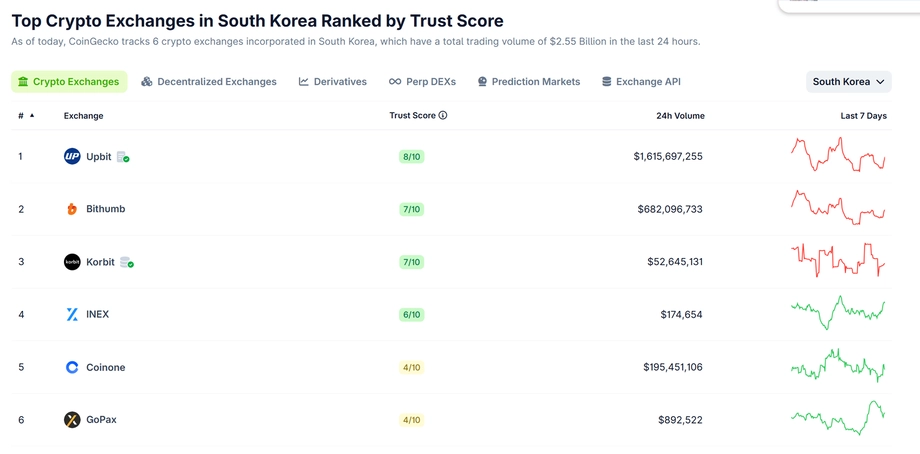
Existing platforms would get three years after designation as digital asset platform operators. Smaller exchanges could get an extra three years, up to six years in all. The current ownership map makes that important. Dunamu, operator of Upbit, is pursuing a merger with Naver Financial under a 100% ownership plan. Digital X has Mirae Asset Consulting holding 97.15%. Bithumb Holdings holds 73.56% of Bithumb. Coinone shareholder Cha Myung-hun holds 30.36%. Some stakes sit above the 34% exception level.
Industry representatives have argued that a blanket cap could weaken competition with global firms. The FSC had floated a 15% to 20% cap in January and faced opposition. The new draft also splits digital asset businesses into trading, brokerage, custody and management, each with licensing or registration rules, disclosure, internal controls and bans on unfair trading such as market manipulation and use of nonpublic information.
On the same day, the FSC and Financial Supervisory Service ordered domestic exchanges to adopt a uniform system for delaying withdrawals. The aim is to stop voice phishing scams, in which callers trick victims into moving money quickly.
The Company Race Is Already Running
Companies have already started preparing for a market in which bank consortiums get first access. Hana Financial Group signed a January memorandum of understanding with BNK Financial, iM Financial, Standard Chartered Bank Korea and OK Savings Bank. It planned a consortium meeting for the following month and later talks with nonfinancial companies on distribution and payments. Hyundai Card is in talks with Hana after completing a July proof of concept for dollar stablecoin remittances between Hyundai Motor's U.S. and Mexican units.
KB Kookmin Bank and Kakao hosted Next Finance Korea in September to discuss issuance, distribution, payments and remittances. Kakao's task force includes KakaoBank and Kakao Pay. Kakao Pay and KakaoBank worked with Fireblocks in September on digital asset infrastructure and stablecoin distribution. Toss, operated by Viva Republica, tested stablecoin payments with Optimism and Sunnyside Labs in July and has been scouting partners.
Shinhan has partnered with Visa to test stablecoin issuance and payments. It is also building a group around Shinhan Bank with Woori Bank and NH NongHyup Bank, while coordinating with Naver Financial and Samsung Card. The Open Blockchain and DID Association, chaired by Shinhan Bank, may discuss cooperation by year end and takes part in Pangaea, a project involving banks in Korea and Europe.
Vincent Chok, founder and CEO of First Digital, whose subsidiary issues FDUSD, said bank majority groups could give a won stablecoin credibility at launch while fintech participation could keep innovation in the system. The alliances now matter because four banks may be needed for a majority and because payment networks decide whether a token is useful after issuance.
What Changes for Users and Businesses
For ordinary users, the rules would be visible in daily use. A holder could ask for money back at equivalent value, and the issuer could not pay interest. Monthly reserve checks and ongoing disclosure are meant to show whether the tokens still have assets behind them.
Merchants and remittance customers could see more tests. KB Financial Group completed a won stablecoin pilot for merchant payments and cross border remittances in May. Hyundai Card tested dollar stablecoin remittances in July. Viva Republica tested stablecoin payments for financial institutions in July.
Banks could earn fees from reserve custody and management, while securities and card firms could seek roles if custodians are not limited to banks. The draft would also lift South Korea's 2017 ban on domestic initial coin offerings. A company conducting a token sale would need to file and publish a white paper covering token supply, use of proceeds and investment risks. Crypto operators would face liability for customer losses from hacking or system failures even when users cannot show negligence.
What Is Still Open
The bill has not passed. The government planned to introduce it in the National Assembly by Nov. 25 under Rep. Yoo Dong-su, chair of the Political Affairs Committee. Lawmakers have not set a final vote date, and the exact bank ownership percentage will be set in enforcement decrees.
FSC Chairman Lee Eog-weon chaired the Nov. 24 meeting and said the commission would seek action after parliamentary review. He said:
will do its utmost to ensure the bill is legislated as swiftly as possible
Tiger Research said the law is expected to take effect one year after promulgation. Some expect passage in early 2027, with implementation likely in 2028.
The draft gives the Bank of Korea a role without a direct veto over supply. Tokens with at least KRW 1 trillion outstanding may be named significant digital payment tokens, giving the central bank data request and joint inspection rights. A committee of the FSC, Ministry of Economy and Finance and Bank of Korea would discuss aggregate issuance and reserve composition. The draft leaves total issuance to approvals and committee talks rather than a fixed statutory ceiling.
Key Points
- The FSC proposes bank majority ownership for the first won stablecoin issuers, with a collective threshold above 50%.
- Issuers would need KRW 5 billion in capital, reserves covering all tokens, monthly audits, on demand redemption and no interest payments.
- A fintech or technology company could be the largest individual shareholder if banks together hold a majority.
- Foreign issuers would need a local branch and approval, and unapproved tokens could not trade on domestic exchanges.
- Exchange shareholders would face a 20% cap, rising to 34% with approval, with phased compliance periods.
- Hana, KB, Kakao, Shinhan, Toss, Hyundai Card and others are already testing or building stablecoin partnerships.
- The bill still needs passage, and key ownership details will be set by decree.