Four drafts, one medical destination
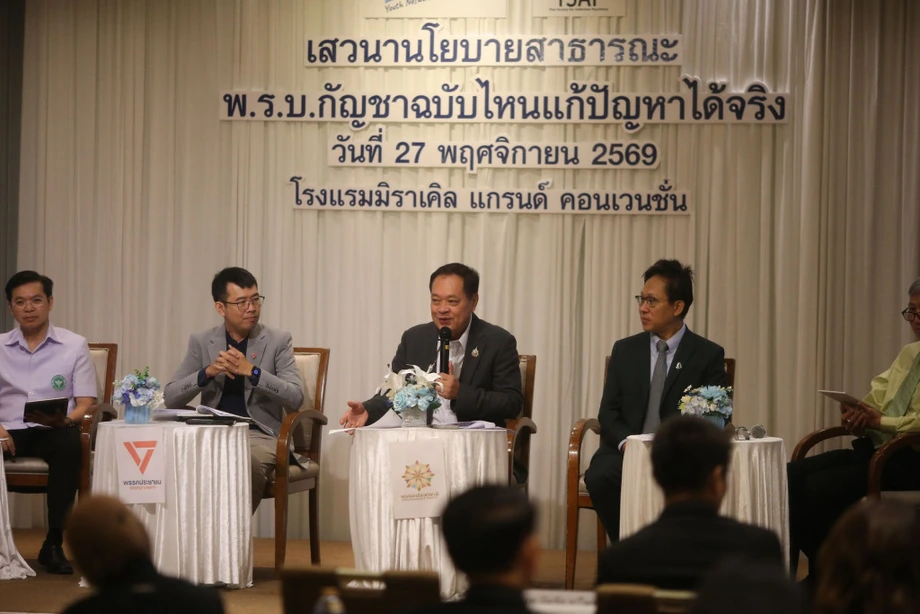
Four competing cannabis bills presented in Bangkok on 27 November 2026 share the same central destination: restricting cannabis to medical treatment, scientific study and research. Their sharp differences lie in how Thailand should follow each crop, punish illegal sales, protect patients and deal with businesses built after decriminalisation.
Contents
- Four drafts, one medical destination
- What the ministry bill would change
- The difficult transition for shops and patients
- How Thailand arrived at four competing drafts
- Why health data and smuggling are driving the crackdown
- People's Party: follow every lot and hear public complaints
- Democrat Party: heavier penalties and less ministerial discretion
- Prachachat Party: treat abuse as narcotics crime and seize assets
- Can small businesses afford the new system?
- What happens while the law is pending
- Key Points
Representatives of the Ministry of Public Health, the People's Party, Prachachat Party and Democrat Party presented their proposals at the Venus Room of the Miracle Grand Convention Hotel. The Centre for Addiction Studies, Youth Network Against Cannabis and Thai Society for Addiction Psychiatry organised the forum. Bhumjaithai Party's representative did not attend because of another engagement.
The ministry draft has the strongest procedural position. The cabinet approved it on 22 September, marking Thailand's third attempt to enact a definitive cannabis law after the regulatory gaps that followed decriminalisation in 2022. Participants expected the ministry text to become the principal draft during committee consideration, with the party proposals offering alternative provisions.
Dr Peeracha Khukasemkit, director of the Medical Cannabis Division, said the ministry had spent four to five years developing its proposal and gathering views from different sectors. He said licensing would cover possession, processing, production, exports and finished products, with records allowing officials to follow cannabis from its origin to its final destination.
The ministry draft sets penalties according to the nature of the offence and the size of the cultivation area. Unlicensed operations face criminal punishment, fines, or both imprisonment and a fine. Penalties are more severe for sales to people under 20, pregnant women or breastfeeding mothers.
Dr Peeracha said clinics would need permission to diagnose and treat patients, while exports would be checked against customs records to establish whether declared shipments actually left the country legally.
What the ministry bill would change
Details presented in October described a draft containing 77 sections, seven licence categories and quarterly digital reporting. The permits would cover cultivation, production, import, export, sale, occasional import and occasional export. Licences for the principal commercial activities would last three years.
Farmers would have to register each cultivation site by size and location. The government's digital platform already tracks about 95 per cent of legal cultivation sites, providing a base for connecting crops, processors, sellers and prescriptions. Unlicensed production or sale would attract heavier fines and possible imprisonment.
A national cannabis policy committee, chaired by the public health minister, would set policy. The draft would also ban sales to anyone under 20, pregnant women and breastfeeding mothers. Sales would be prohibited near schools, temples, public parks and amusement parks, while advertising cannabis flowers and smoking equipment would be banned.
Public Health Minister Pattana Promphat said the cabinet draft would restrict cannabis and its extracts to treatment by medical professionals and research. He explained its purpose when the cabinet approved the proposal.
This is to protect the health of people, especially children and youth, and prevent cannabis abuse.
The proposal does not simply restore cannabis to the narcotics list. It creates a separate statute for cultivation, supply chains, dispensing, advertising and consumption, giving the government a legal basis for separating legitimate medical activity from recreational or inappropriate use.
The difficult transition for shops and patients
More than 10,000 cannabis outlets operate nationwide, according to the health ministry's recent estimate. Existing retail licences are scheduled to expire progressively between 2026 and 2028. Recreational dispensaries wishing to continue would have to become licensed medical facilities by 2028, with an authorised health practitioner present at all times and cannabis dispensed only against valid prescriptions. Businesses unable to meet those conditions would have to close.
The market has already contracted sharply. Thailand recorded 18,433 cannabis outlets by late December 2025. In January 2026, the government said 7,000 shops had not renewed their licences at the end of 2025, nearly two in five of roughly 18,000 businesses. The more recent estimate of over 10,000 operating outlets reflects a market already adjusting to prescription requirements and closer inspections.
Patients currently need a PT33 prescription form from a licensed practitioner, valid for no more than 30 days of supply. Existing rules limit medical cannabis use to insomnia, chronic pain, migraines, Parkinson's disease and loss of appetite. Online sales and vending machine purchases are prohibited.
The proposed system would connect each production batch, identified by a Lot ID, to records of its movement and eventual medical use. Cannabis flowers would be available through authorised medical facilities, modern pharmacies, herbal product shops and recognised workplaces of traditional folk healers. The government's description of shop conversion places particular weight on medical facilities and doctors, so the precise renewal route for every kind of establishment still requires clarification in the final rules.
How Thailand arrived at four competing drafts
Bangkok Global Law's briefing describes a gradual tightening of rules rather than a single sudden reversal. Removing cannabis from the Category 5 narcotics list in June 2022 expanded commercial activity, but no dedicated cannabis statute governed the entire market. Different activities consequently fell under traditional medicine, herbal product, drug and narcotics laws.
Cannabis flower became a controlled herb under the Protection and Promotion of Thai Traditional Medicine Knowledge Act B.E. 2542 in June 2025. Ministerial Regulation (No. 2) B.E. 2569, published in April 2026, then added requirements for premises, dedicated storage, qualifying business or professional status, trained personnel and effective odour and smoke elimination for businesses selling, processing or exporting cannabis flower.
Existing licences remain valid until they expire, but renewal must satisfy the stronger requirements. The proposed Cannabis Control Act would consolidate these scattered controls into one dedicated law.
- 2018: Thailand legalised medical cannabis.
- 9 June 2022: Cannabis was removed from the Category 5 narcotics list, followed by rapid commercial expansion.
- June 2025: Cannabis flower became a controlled herb, and prescription requirements were introduced.
- April 2026: Stronger premises, storage, staffing and odour control rules were published.
- 22 September 2026: The cabinet approved the draft cannabis and hemp legislation.
- 27 November 2026: The ministry and three parties publicly compared their competing proposals.
Why health data and smuggling are driving the crackdown
Dr Bandit Sraiphisal, an adviser to the Youth Network Against Cannabis, told the forum that weekly patient numbers involving allergic reactions and psychiatric symptoms related to cannabis among people ages 10 to 19 rose after decriminalisation. He described cases involving hallucinations and subsequent family problems, and said medical personnel were concerned that cannabis could become a gateway to other drugs. He did not give a national patient total.
A Thailand Development Research Institute study illustrates the scale of the policy's unexpected direction. It estimated recreational use at 1.2 million people in 2020 and 11.1 million in 2022, an increase of more than nine times. Estimated medical use grew much more modestly, from 430,000 to 540,000 people.
Export controls are also being driven by the surge in cannabis smuggling. The United Kingdom's National Crime Agency said authorities intercepted 142 couriers carrying five tonnes of cannabis in 2023, followed by 800 couriers and 26 tonnes in 2024. Thai customs officers separately caught more than 800 smugglers and seized over nine tonnes at airports between October 2024 and March 2025.
Those figures explain why the ministry wants customs data connected to cultivation and export records, and why some politicians believe licensing penalties alone will not deter organised trafficking.
People's Party: follow every lot and hear public complaints
Ekkapop Sittiwanthana, a party list MP presenting the People's Party proposal, said his draft was still undergoing internal review. Its central mechanism is an electronic Track & Trace system covering cultivation, production, sale, exports and manufactured products. Lot numbers would allow officials to check whether a particular batch was actually used for medical purposes.
The strength of the People's Party draft is a control system that protects public health, especially children, young people and communities, alongside appropriate access to treatment. Its central proposal is a Track & Trace system throughout the chain.
Product labels would clearly state that an item contains cannabis, giving consumers information about its origin and risks. Licence applications and renewals would use digital registration with defined consideration periods, reducing official discretion and making decisions easier to scrutinise.
The draft would also specify the symptoms for which doctors could prescribe cannabis. Members of the public could complain about factories or retailers, follow the outcome and receive protection against retaliation when supplying information in good faith.
Political accountability forms another part of the proposal. The responsible minister would issue regulations and answer for the control system. Existing operators harmed by the policy reversal would also receive remedies, although the forum did not provide a compensation amount or mechanism.
Democrat Party: heavier penalties and less ministerial discretion
Captain Dr Pichayasak Boonmas, a Democrat Party public health subcommittee member, presented six main elements: Medical First, broader legal definitions, an electronic supervision platform, stronger public protection, penalties matched to the seriousness of offences and oversight involving several sectors.
The definitions would cover leaves, stems, roots and flowers. Direct and indirect advertising would be controlled, as would food containing cannabis. The party also wants protection for children and pregnant women and clearer rules governing legitimate use.
A person whose licence was revoked would be barred from applying again for three years, rather than one year. The minister would lose the power to let an operator whose licence had been suspended or revoked continue operating during an appeal.
The numerical penalties are among the most detailed proposals. Exporting without a licence would no longer attract only a 50,000 baht fine. The maximum punishment would become five years in prison, or a fine of up to 30,000 baht per kilogram. Driving after using cannabis and causing injury could bring up to three years in prison or a fine of up to 100,000 baht. Causing a death could bring up to 10 years in prison and a fine of up to 100,000 baht.
The cannabis control committee would have to report its performance to parliament every two years. Dr Pichayasak said these measures were intended to prevent repeat offences and stop licensing from becoming a substitute for continuing supervision.
The Democrat Party does not deny the benefits of cannabis and does not want to block patients from treatment. We disagree with allowing recreational cannabis use without suitable boundaries and control mechanisms.
Prachachat Party: treat abuse as narcotics crime and seize assets
Police Colonel Twee Sodsong, an MP and leader of the Prachachat Party, began with tetrahydrocannabinol (THC), the main intoxicating substance in cannabis. His draft cites the 1961 Single Convention on Narcotic Drugs and states that cannabis should serve medical and scientific purposes.
Cannabis used outside government, patient treatment, research or scientific purposes would be treated as a narcotic under the Narcotics Code. The party also wants to extend Section 44 so that such activity becomes a serious narcotics offence, aimed at major domestic and international trafficking networks.
Illegal cannabis imports and exports would become predicate offences for money laundering. That designation would allow investigators to pursue profits and assets connected with a shipment, rather than relying only on punishment for the shipment itself. Officials would receive powers to inspect and seize assets.
Medical treatment must be accessible, recreation must be controlled, and illegal businesses must have their assets seized.
Twee argued that asset seizure attacks the financial motive of organised dealers. He also warned against building an export industry around recreational cannabis when other countries continued to treat it as a narcotic.
Can small businesses afford the new system?
Laboratory testing illustrates the financial pressure behind the technical language of licensing. Farmers and small businesses have warned that testing alone could cost 10,000 to 20,000 baht per test. Licence holders would also face digital reporting every three months, traceable batch records and stronger premises and staffing requirements.
These costs follow substantial investment made during the opening of the market. The industry generated an estimated 28 billion baht in revenue during its first year after decriminalisation. The People's Party proposal for remedies acknowledges that some operators invested legally under one policy and now face a fundamentally different market.
Enforcement is already tightening under existing powers. The Department of Thai Traditional and Alternative Medicine announced on 21 November that it had revoked 24 cannabis business licences and suspended another 105 during the 2026 fiscal year. Phuket has also seen dozens of licences revoked during recent enforcement.
Bangkok had 1,710 licensed establishments, of which officials had inspected 1,437, or 84.04 per cent. Dr Peeracha reported 95 enforcement actions, with 10,584.9 kilograms of evidence seized or impounded. Officials valued the economic impact at 223.5 million baht (about US$6.9 million), and 70 people were arrested or placed in legal proceedings.
The department plans more proactive inspections during the 2027 fiscal year, particularly around schools, alongside faster responses to public complaints. These licence revocations and seizures show that businesses face immediate compliance pressures even before parliament settles the new law.
What happens while the law is pending
Twee urged the ministry to revive an announcement revoked on 8 February 2022 and to add transitional provisions controlling businesses already operating. He argued that relying on the future Act alone would leave controls uncertain if the legislation failed again.
Ekkapop supported an interim solution. He said committee members had asked whether cannabis could simply be returned to the narcotics list while the legislation was pending and were told that it could not. His conclusion was that the dedicated law needed to proceed quickly.
The cabinet draft must still complete parliamentary consideration, and the licensing and reporting system would require more than 15 supporting regulations before it could operate fully. No date was given for a final House of Representatives vote, enactment or the commencement of the proposed tougher penalties.
For patients, the immediate rules remain prescription-based access and limited supplies. For farmers and retailers, the practical work is registering sites, satisfying current licence conditions and preparing for closer inspection. The forum revealed broad political agreement on medical use, but parliament must still decide whether tracking, imprisonment, asset seizure or a combination of all three will form the core of enforcement.
Key Points
- The ministry, People's Party, Democrat Party and Prachachat Party all presented proposals centred on medical treatment and research.
- The cabinet approved the ministry-backed draft on 22 September 2026, but parliamentary approval and supporting regulations are still required.
- Existing retail licences expire between 2026 and 2028, and recreational shops seeking to continue must meet medical facility standards.
- The People's Party wants electronic lot tracking, clear labels, public complaints and remedies for existing operators.
- The Democrat Party proposes longer licence bans, prison terms of up to 10 years for fatal cannabis-related driving cases and reports to parliament every two years.
- Prachachat Party would treat non-medical use as a narcotics offence and make illegal imports and exports grounds for money laundering action and asset seizure.
- More than 10,000 outlets remain, while current enforcement has already produced 24 licence revocations and 105 suspensions in the 2026 fiscal year.
- No date has been given for a final parliamentary vote or for the new penalties to take effect.