A steady glow in Jupiter's restless neighborhood
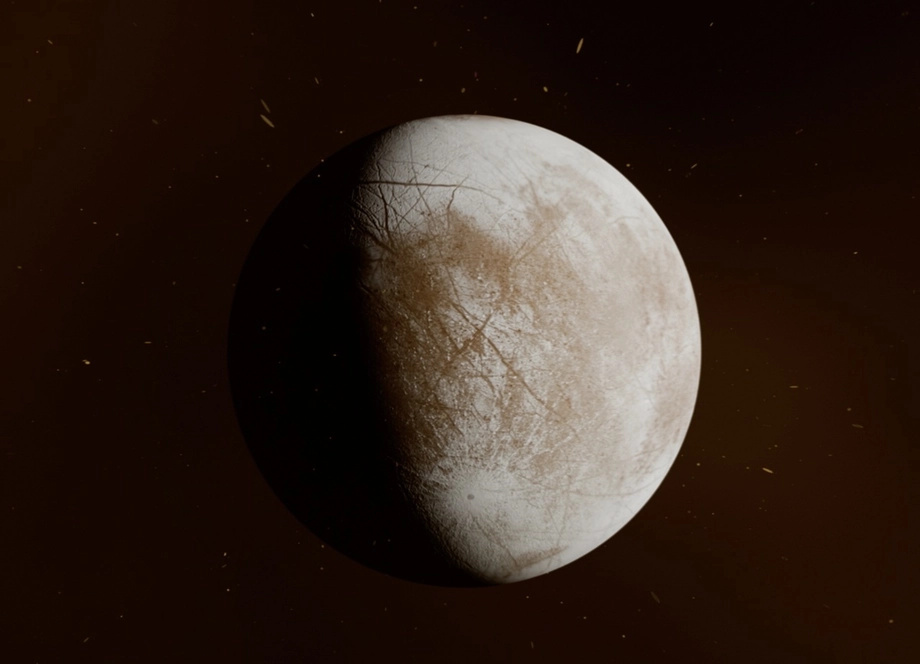
A faint cloud of sodium gas around Europa has changed surprisingly little over more than two decades of observations, even as volcanoes erupted on neighboring Io and Jupiter's magnetic environment shifted around it. Researchers led by Boston University say that stability points toward a source controlled by Europa itself, most likely salty material associated with the ocean beneath its ice. Their study appeared in the Journal of Geophysical Research: Space Physics.
Contents
- A steady glow in Jupiter's restless neighborhood
- Why the volcanic moon next door lost its leading role
- How researchers found faint gas beside a giant snowball
- The long record behind one steady picture
- Why sodium is such a useful chemical messenger
- Where the salt starts, and what remains undecided
- A quiet atmosphere and a cautious habitability lesson
- A reference frame for Hubble, Clipper and JUICE
- The Bottom Line
The cloud is enormous but extremely diffuse. Its reported span exceeds 46,800 kilometers (29,095 miles), on the order of 30 Europa radii, and its shape is stretched from east to west. Astronomers mapped it with the High Resolution Echelle Spectrometer, known as HIRES, at the W. M. Keck Observatory on Maunakea in Hawaii. Newer measurements, including eight years of direct observations, were compared with archival Keck data reaching back to 1999.
The result gives scientists a cleaner way to investigate a moon whose ocean is sealed beneath ice. If Europa's sodium supply were dominated by material arriving from Io, the cloud would mainly record conditions elsewhere in the Jupiter system. A supply governed by Europa instead suggests a substantial degree of independent material cycling. That makes the sodium more useful for studying the moon's own chemical history, the movement of salts between ice and space, and the environment above a potentially habitable ocean.
Why the volcanic moon next door lost its leading role
Researchers have known since the 1990s that sodium exists around Europa, but its birthplace was uncertain. Io is the most volcanically active body in the solar system, and its eruptions release gases and particles that spread through Jupiter's neighborhood. One possibility was that Io had effectively painted Europa with sodium, which could later escape from the icy surface.
Carl Schmidt, a coauthor and researcher at Queen's University Belfast and Boston University, explained why the long record led the team away from that explanation.
The neighboring volcanic moon Io sprays sodium around the Jupiter system and we've often wondered if Io paints Europa's surface. The stable sodium abundance in these Keck data shows that Europa is indifferent to Io's volcanic activity. What we observe originates in Europa's saltwater and not in Io's volcanoes.
The abundance remained comparatively constant even during periods of enhanced activity on Io. It also stayed steady as Europa moved through changing plasma conditions. Plasma is a gas containing electrically charged particles, and Jupiter's magnetic field drives a turbulent plasma environment around its moons. An external supply dominated by Io or by those changing conditions would have been expected to produce more variation than the team measured.
The researchers also made the first connection between sodium measured at high altitudes and sodium observed very close to Europa's visible disk. That link matters because a map of distant gas alone cannot show how the extended cloud relates to material near the moon. Joining the two views produced a more complete picture of sodium escaping from Europa's vicinity and spreading outward.
How researchers found faint gas beside a giant snowball
Europa's reflective ice created the central observing problem. Sunlight bouncing from the surface can overwhelm the delicate glow emitted by nearby sodium atoms. Emma Lovett, the Boston University graduate student who led the study, described the difficulty in especially direct terms.
Europa is so shiny. It's just a giant snowball.
Most observations were consequently restricted to gas roughly 6,000 kilometers (4,000 miles) above the surface. Some wider maps omitted measurements within about four Europa radii because reflected sunlight contaminated that region. Lovett said the team had expected the cloud to vary as Europa traveled around Jupiter and through its magnetosphere, yet the measurements stayed broadly the same.
HIRES helped isolate the faint signal. A spectrograph spreads light into its wavelengths, allowing astronomers to recognize an element's distinctive fingerprint rather than simply measuring brightness. The instrument's configuration with a long, narrow slit preserved information about where the light originated. By turning that slit into different orientations at multiple pointing positions, the team built a map instead of relying on a single spectrum. The observations tracked sodium's D lines at 5,890 and 5,896 angstroms, wavelengths in yellow light. Some combined spectra used a slit with a length of 14 arcseconds; one arcsecond is just 1/3,600 of a degree on the sky.
The team also watched Europa while it passed through Jupiter's shadow. With direct sunlight temporarily removed from the ice, the glare dropped and sodium emission could be detected much closer to the moon. Electrons in the surrounding space environment excited the atoms, causing them to glow at recognizable wavelengths. These carefully timed observations supplied the missing connection between gas near Europa and the much larger cloud beyond it.
The long record behind one steady picture
A single observation could only describe the cloud at one moment. The archive allowed the researchers to compare different orbital positions, magnetic conditions and observing geometries across many years.
- 1999: Keck obtained archival measurements that later extended the comparison back more than two decades.
- 2019: Researchers at Caltech and NASA's Jet Propulsion Laboratory reported in Science Advances that yellowish regions on Europa, including Tara Regio, contain sodium chloride. The finding suggested that the ocean could be chemically more similar to Earth's oceans than previously thought.
- August 18, 2022: Ten combined spectra recorded Europa's sodium emission while the moon was in Jupiter's shadow.
- September 29, 2022: NASA's Juno spacecraft passed behind Europa from Earth's perspective. The alignment let the team examine the sodium cloud alongside Juno measurements of the surrounding plasma environment.
- September 12, 2024: Seven combined spectra of Io provided a comparison involving the volcanic moon's sodium emission.
- November 19, 2026: Keck announced the Europa result after the study's publication in the Journal of Geophysical Research: Space Physics.
The Juno alignment was especially useful because it placed the telescopic measurements beside direct information about local space conditions. Together, the dates show why the conclusion rests on more than an unusually quiet afternoon: the cloud retained its basic character across a broad range of circumstances.
Why sodium is such a useful chemical messenger
Sodium is one of the two elements in sodium chloride, ordinary table salt. It is also comparatively easy to trace from Earth because sodium atoms produce a strong, recognizable signal. Following that signal helps researchers study Europa's exosphere, an atmosphere so thin that its atoms can travel great distances with few collisions.
Charged particles can strike salt bearing material on the ice and knock atoms into space through a process called sputtering. Radiation can also break apart molecules at the surface, while radiation pressure from sunlight influences how liberated atoms spread. Sodium therefore acts as a visible marker for processes that are otherwise difficult to observe.
The sodium chloride identified at Tara Regio supplies valuable surface context. The new work approaches the chemistry from another direction by following escaped gas. Surface salt deposits and the steady sodium cloud now give scientists two complementary ways to investigate how Europa's exterior interacts with material below.
Where the salt starts, and what remains undecided
Europa's ice shell averages tens of kilometers in thickness, so ocean water has no simple open route to the atmosphere. One possibility is that pockets of briny water eventually reach the surface and leave salts behind. Material might also move upward through fractures or as a result of impacts. Another possibility is that radiation releases sodium directly from salts already trapped in the ice.
The researchers have not determined which route dominates. The distinction matters because salt newly arrived from the ocean could carry relatively direct information about its present chemistry, while salt stored for a long time in the shell could preserve a more complicated history of freezing, radiation and surface processing.
The stability nevertheless strengthens the case that Europa's own material controls the observed supply. That supports the idea of partly independent cycles around Europa and Io, rather than a sodium environment dictated primarily by Io's eruptions. For scientists, this means Europa's atmospheric measurements can be related more confidently to its own evolution instead of being treated mainly as contamination from its neighbor.
The cloud remains an indirect tracer of the ocean. Directly determining the water's full composition requires additional kinds of measurements, but knowing where the sodium supply begins makes those future observations easier to interpret.
A quiet atmosphere and a cautious habitability lesson
Schmidt said the lack of changing structure was itself surprising. Tenuous atmospheres around Mercury and Earth's Moon had proved more dynamic than researchers once expected, while Europa's seemed comparatively uniform. His reaction captured the contrast between the moon's dramatic setting and its restrained atmospheric behavior.
I was surprised (by) how boring the atmosphere was, in a way. It's very stable, and it doesn't have much structure. I never expected it to be that way.
Lovett connected that atmospheric window to the larger reason Europa attracts attention. The moon combines liquid water, chemistry relevant to organic compounds and geological energy driven by Jupiter's tidal pull. Tides flex Europa's interior, supplying energy that could sustain activity below the ice.
We don't know a lot about Europa's hidden ocean and icy surface, but its atmosphere offers a window into this potentially habitable world. The whereabouts of life beyond Earth might be closer than we ever imagined.
Paul Byrne, a planetary scientist at Washington University in St. Louis who commented on the research, welcomed the result while drawing a firm boundary around its immediate contribution to habitability studies.
It's an interesting paper. It's a robust result. Does it advance our understanding of Europa habitability? Generally not.
Byrne also said that any information about Europa's interior is valuable. The practical gain is cleaner chemical accounting: scientists can better test which processes release sodium and how material moves from ice into space. Assessing whether anything lives in the ocean will require evidence beyond sodium, including a much fuller inventory of its chemistry and energy sources.
A reference frame for Hubble, Clipper and JUICE
The team scheduled a search with the Hubble Space Telescope for magnesium in Europa's atmosphere during November 2026. Magnesium has been tentatively detected on the surface but had not been confirmed in the atmosphere. Finding it above the moon would add another possible ingredient to the mixture of salts scientists are trying to reconstruct.
Lovett said the sodium measurements are already helping refine atmospheric models, including the effects of sputtering and radiation pressure. She described the magnesium search as the next chemical test.
These observations help us refine our models of Europa's atmosphere, testing what releases sodium and how radiation pressure shapes its distribution. We're also looking for magnesium, which has been tentatively detected on Europa's surface but not yet in its atmosphere. Finding it could provide another important clue to the salts present on this intriguing ocean world.
NASA's Europa Clipper and the European Space Agency's Jupiter Icy Moons Explorer, known as JUICE, are traveling toward the Jupiter system. Their investigations of ice, surface composition and surrounding space conditions will provide opportunities to compare spacecraft measurements with the long Keck record. Schmidt described the telescope work as preparation that can help mission teams choose useful wavelengths and observing locations.
The sodium map also supplies a baseline. A future instrument that measures magnesium or other salt components could compare those findings with a cloud whose behavior is already documented across changing conditions. That comparison could gradually turn a faint yellow glow beside a bright icy moon into a more detailed account of the salts beneath Europa's surface.
The Bottom Line
- Keck observations spanning more than two decades show that Europa's vast sodium cloud is remarkably stable.
- The oblong cloud measures more than 46,800 kilometers across and is elongated from east to west.
- Its steadiness through Io's volcanic changes and Jupiter's shifting plasma points to a supply governed mainly by Europa's own salty material.
- Observations in Jupiter's shadow connected sodium near the moon with gas at much higher altitudes.
- The precise route from ocean, ice shell or surface salts to the atmosphere remains undecided.
- A Hubble search for magnesium was scheduled for November 2026, while Europa Clipper and JUICE can use the sodium record as a reference.
- The result improves chemical tracing around Europa; determining its ocean's full composition and capacity for life requires further measurements.