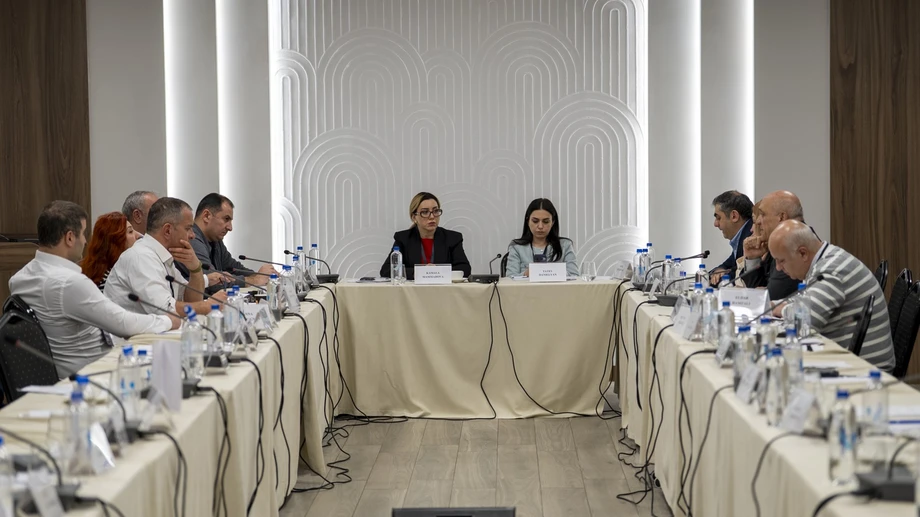
Six committees give the Dilijan talks a practical shape
About 60 Armenian and Azerbaijani civil society representatives concluded two days of talks in Dilijan, Armenia, on November 27, 2026, after dividing their work among six committees and questioning two senior Armenian officials in person. The fifth Peace Bridge roundtable began on November 26. Its participants came from non-governmental organizations, media outlets, universities, research centers and expert communities in both countries.
Contents
- Six committees give the Dilijan talks a practical shape
- What the six committees are expected to produce
- Two hours of questions for Armenia's security chief
- A roster built for specialist conversations
- From Washington to Dilijan: the meetings so far
- Why crossing a marked border carried extra meaning
- Railways, gas and the economics behind the dialogue
- The September dispute that interrupted the meetings
- What Dilijan changed, and what remains undecided
- The Bottom Line
The immediate subject was the peace agenda endorsed at the Washington Summit on August 8, 2025, where Azerbaijani President Ilham Aliyev and Armenian Prime Minister Nikol Pashinyan also initialled a peace treaty. Initialling authenticates a negotiated text, but it is not the same as signing and ratifying it. The treaty remained unsigned when relations around the dialogue became tense in September 2026. The Washington understandings also included the Trump Route for International Peace and Prosperity, or TRIPP, a proposed transport connection between mainland Azerbaijan and its Nakhchivan exclave through Armenian territory.
Dilijan was therefore more than another exchange of speeches. The agenda covered ways to strengthen and institutionalize the peace process, meaning the creation of durable procedures and relationships that do not depend on a single meeting. Participants also discussed measures to build trust, sustainable economic cooperation, trade and transport connections in the South Caucasus, humanitarian questions, education and closer engagement with young people.
The Peace Bridge platform said the initiative would continue its work. Its fifth meeting restored a structured dialogue after a postponement in September and gave specialists a clearer division of labor than earlier roundtables.
What the six committees are expected to produce
Committee discussions on November 27 examined existing difficulties and possible cooperation in six fields. Their names show how far the conversation has moved beyond general calls for reconciliation:
- Economic Affairs and Infrastructure
- Humanitarian and Social Affairs
- Environmental Issues
- Media
- Education, Public Narratives, and Engagement with Young People
- Political and Geopolitical Issues
Public narratives are the accounts that journalism, education, culture and political debate create about the other society. They matter because a trade route or border crossing can be physically open while public discussion remains dominated by suspicion. The media and education committees give journalists, researchers and teachers a place to examine that problem directly.
The environmental and economic groups also have concrete material to work with. Their participants include specialists in water resources, waste management, protected areas, biodiversity, transport and exports. Humanitarian and social discussions can draw on people working in human rights, rural development, mine action and dialogue between communities.
Farhad Mammadov, director of the Center for Studies of the South Caucasus and coordinator of the Azerbaijani expert group, spoke to reporters during the meeting. The expanded format allows participants to raise sensitive subjects and put questions directly to one another. Expert committees may develop proposals for state institutions, but no decision has been announced on whether those proposals would be binding for either government.
Two hours of questions for Armenia's security chief
Armenian Security Council Secretary Alen Simonyan met the Armenian and Azerbaijani participants on November 26. The Armenian Security Council apparatus described a structured session in which attendees asked questions and exchanged ideas and opinions. The question session lasted two hours, giving participants substantially more time than a formal courtesy call would allow.
On November 27, members of the initiative met Vahan Kostanyan, Armenia's deputy minister of foreign affairs and international trade. Participants again had an opportunity to ask questions, followed by an exchange of views. His involvement added a foreign policy and economic diplomacy dimension to the earlier discussion with the Security Council secretary.
These meetings placed civil society participants in direct contact with officials whose work concerns national security, foreign relations and trade. The published accounts did not provide detailed answers from either official or announce a government commitment made during the sessions.
A roster built for specialist conversations
The Armenian group combined initiative members with environmental scientists, economists, journalists, historians and human rights specialists. Areg Kochinyan, president of the Armenian Council, and Naira Sultanyan, director of the Democracy Development Foundation, were among the core members. Boris Navasardyan, honorary president of the Yerevan Press Club, joined remotely.
Armenian attendees included Alen Amirkhanyan and Harutyun Alpetyan of the American University of Armenia's Acopian Center for the Environment, hydrologist Benyamin Zakaryan, economists from the Armenian State University of Economics, sociologist Mariam Khalatyan, writer and cultural anthropologist Lusine Kharatyan, and Elina Khachatryan, president of Peace Dialogue. Public Television editor Tatev Danielyan and Ashot Melikyan of the Committee for the Protection of Freedom of Speech brought media experience.
The Azerbaijani delegation included Mammadov, Topchubashov Center co-founder Rusif Huseynov, 1news.az editor Kamala Mammadova and Azerbaijan National NGO Forum chairman Ramil Iskandarli. Its wider roster paired editors and political commentators with Gulbaniz Ganbarova of the Azerbaijan Rural Women's Association, Shahla Ismayil of the Women's Association for Rational Development, mine campaigner Hafiz Safikhanov, transport expert Rauf Aghamirzayev, export portal head Aykhan Gadashov and water management specialist Amin Mammadov.
This composition helps explain the committee structure. A discussion about water, roads or mine action can involve people who work on those subjects, rather than leaving every issue to generalists.
From Washington to Dilijan: the meetings so far
The Dilijan roundtable was the fifth in a sequence that developed over roughly 13 months. Two meetings took place in 2025 and three in 2026, with a pause between the fourth and fifth.
- August 8, 2025: Aliyev and Pashinyan met in Washington, where the peace treaty was initialled and the TRIPP connection was agreed.
- October 21 to 22, 2025: The inaugural Peace Bridge meeting in Yerevan defined the dialogue's main directions.
- November 21 to 22, 2025: Experts and non-governmental organization representatives from both countries met in Baku.
- February 13 to 14, 2026: A roundtable in Tsaghkadzor, Armenia, used an expanded participant format and examined security, public perceptions, economic cooperation and trust.
- April 10 to 12, 2026: The fourth meeting, in Azerbaijan's Gabala district, concentrated on dialogue and direct engagement between civil society representatives.
- September 2026: A planned visit to Yerevan was postponed amid a dispute over cultural heritage and statements by officials.
- November 26 to 27, 2026: The fifth meeting in Dilijan introduced six committees and brought participation to about 60 people.
The sequence shows both continuity and fragility. Reciprocal visits became regular enough to develop specialist groups, yet a political dispute was still able to interrupt them.
Why crossing a marked border carried extra meaning
The Azerbaijani delegation travelling to the latest meeting crossed a delimited section of the border. Delimitation establishes where an agreed boundary runs, while demarcation marks it physically on the ground. For neighbours whose land border had been closed since the first Nagorno-Karabakh conflict, using such a section turns a technical peace arrangement into an actual journey.
The Tsaghkadzor meeting in February had already tested this practice. Azerbaijani participants entered Armenia by land near the Azerbaijani village of Ashaghi Askipara and the Armenian village of Voskepar, completing the required border formalities. It was the first such crossing by the delegation through an officially delimited and demarcated section. The journey took place while Azerbaijan continued to cite the COVID-19 pandemic for general restrictions on land border crossings.
February also expanded the Armenian side to a format described as 5 plus 15, comprising five initiative members and 15 additional participants. Joint research on transport communications and collaborative articles were agreed at the start of that event. Navasardyan said the enlarged roster allowed specialists to discuss subjects ranging from culture to water use.
Navasardyan, speaking as an Armenian initiative member and political analyst, described the principles behind that expansion:
We remain fully committed to our obligations to the publics of both countries, ensuring openness, transparency, and inclusiveness throughout this initiative.
He also acknowledged dissatisfaction that Tsaghkadzor had not launched new concrete projects. The six committees at Dilijan now provide a more organized setting in which research and proposals can be prepared, although the platform has not announced a specific committee product or delivery date.
Railways, gas and the economics behind the dialogue
Samvel Meliksetyan, an Armenian delegation member and expert at the Research Center on Security Policy, explained after Tsaghkadzor how transport proposals could affect the peace agenda. He said economic contacts were already developing through Azerbaijani fuel supplies to Armenia, including rail deliveries, and argued that direct transport links should follow to reduce shipping costs.
One Armenian proposal would restore the 6 to 7 kilometre railway section between Yeraskh in Armenia and Sadarak in Nakhchivan. Combined with connections through Georgia, this could create a route running from Baku through Tbilisi, Gyumri and Yeraskh to Nakhchivan. Meliksetyan presented it as a possible alternative while restoration of the Armenian section from Meghri toward Nakhchivan on the TRIPP route was estimated to require several years.
He also identified the Gazakh to Ijevan corridor as an important historical connection among Armenia, Azerbaijan and Georgia. A major gas pipeline once followed that route, creating the technical possibility of restoring Azerbaijani gas supplies to Armenia if political and commercial decisions supported it. Armenian and Azerbaijani participants were considering inviting Georgian colleagues to later discussions on regional communications.
These were proposals explained by an initiative participant, not agreements announced at Dilijan. Their presence in the wider dialogue shows why the Economic Affairs and Infrastructure committee matters: a short missing railway section, the order in which routes open and the cost of transport can shape whether cooperation delivers benefits quickly or remains largely symbolic.
The September dispute that interrupted the meetings
The resumption in Dilijan followed a sharp deterioration in the public atmosphere. The Azerbaijani side postponed a planned Yerevan meeting in September until tensions subsided. The dispute followed a tour of Aghdara, Kalbajar and other parts of Nagorno-Karabakh and its surroundings for foreign diplomats by Hikmat Hajiyev, an aide to Azerbaijan's president.
Hajiyev presented monasteries in the region as Caucasian Albanian rather than Armenian. Armenia's authorities and the Armenian Apostolic Church condemned the claims, while Armenian members of Peace Bridge warned that such actions could deepen mistrust. Azerbaijan rejected the criticism as unfounded and as interference in its internal affairs.
A separate disagreement concerned Dadivank monastery, known as Khudavang in Azerbaijani. Azerbaijan accused Armenia of removing crosses, bells and other elements after the 2020 war. Sabina Hajiyeva, head of Azerbaijan's cultural heritage agency, said a claim had been filed through Interpol's Stolen Works of Art Database in October 2025. Eduard Aghajanyan of Armenia's ruling Civil Contract party responded that Armenian Apostolic Church property brought to Armenia was part of the country's national wealth.
Navasardyan said the Armenian members had wanted the planned civil society meeting to proceed despite the dispute. He explained their position before the Dilijan talks restored contact:
The Armenian side expected that, in this tense situation, it was necessary to meet, try to reach a mutual understanding, and agree on the atmosphere that we would like to see develop in the information environment and the public sphere. However, it seems that our counterparts from Azerbaijan do not consider it appropriate to engage at this stage.
Official security contacts did not disappear completely during the pause. Kristinne Grigoryan, director of Armenia's Foreign Intelligence Service, attended the fourth Baku Security Forum in September. She was the second senior Armenian security official to participate, after National Security Service head Andranik Simonyan attended the 2025 edition.
What Dilijan changed, and what remains undecided
Dilijan restored direct contact after the postponement, expanded the range of expertise involved and organized the conversation into six identifiable working areas. Participants also demonstrated that an Azerbaijani delegation could again travel through a delimited border section and spend hours questioning Armenian officials. For journalists, researchers and civic organizations, the immediate gain is a durable set of contacts through which difficult subjects can be examined without waiting for every formal diplomatic development.
For communities outside the meeting room, the practical value will depend on what the committees produce. Transport research could clarify costs and routes; environmental work could identify shared water or conservation problems; media and education discussions could address hostile public narratives. Humanitarian proposals could give mine action, missing persons and social concerns a more sustained expert audience, although the published agenda did not announce a decision on any individual case.
No date or venue for a sixth roundtable was announced. The closing statement promised continued activity but did not publish a signed transport project, a committee budget or a timetable for submitting recommendations to the two governments. Whether committee proposals will carry any binding force also remains undecided. The clearest measure of the next stage will be a named proposal, research paper or joint project that reaches a state institution or is implemented by the participating organizations.
The Bottom Line
- The fifth Peace Bridge roundtable took place in Dilijan, Armenia, on November 26 and 27, 2026, with about 60 participants.
- Six committees now cover economics and infrastructure, humanitarian and social affairs, environment, media, education and youth, and political and geopolitical issues.
- Participants questioned Armenian Security Council Secretary Alen Simonyan for two hours and met Deputy Minister Vahan Kostanyan the following day.
- The talks addressed the August 8, 2025 Washington peace agenda, economic cooperation, transport routes, humanitarian concerns and direct contacts between the two societies.
- The meeting resumed a dialogue interrupted in September by disputes over cultural heritage and official statements.
- The initiative will continue, but no sixth meeting date, binding committee powers or new transport agreement was announced.