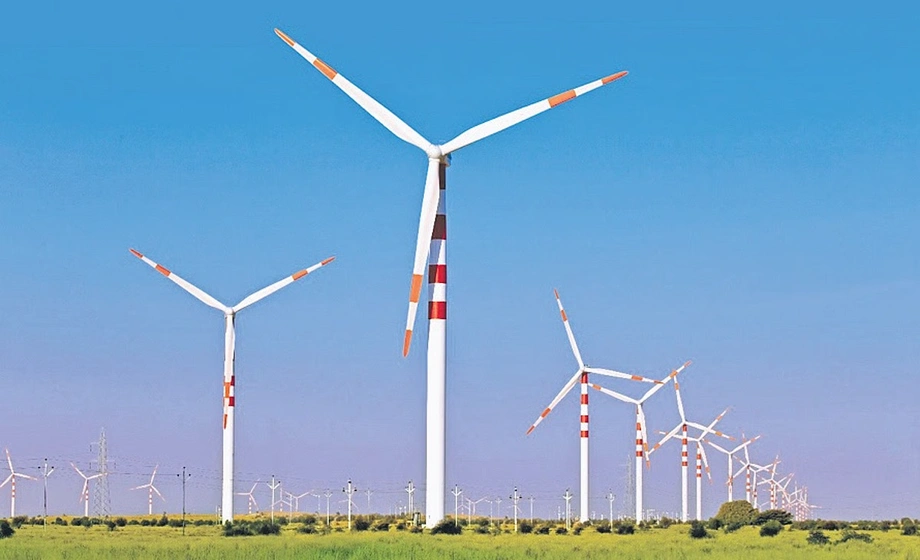
A Small Order With a 25 GW Ambition
Suzlon Energy has secured its first wind repowering order, a 20 MW project from the Tata Group, three years after the Ministry of New and Renewable Energy announced a policy for replacing ageing turbines. The contract gives Suzlon an early position in a market it believes could eventually cover 25 GW of existing wind capacity. It also arrives as new grid procedures make it easier for developers to replace old machines in stages rather than rebuilding an entire wind farm at once.
Contents
- A Small Order With a 25 GW Ambition
- What Does the National Policy Require?
- What Are Suzlon's Three Options?
- How Does the 33 Percent Grid Rule Work?
- What Happens to Legacy Turbines?
- Where Will Suzlon Work?
- How Do New Orders and a Blade Factory Fit In?
- What Are the Key Dates?
- Why Could Staged Repowering Matter?
- Key Points
Ajay Kapur, Group chief executive officer of Suzlon, described the contract as modest in size while setting out the scale of the opportunity for the company and India.
The order is small, but the potential for the company and the country is significant, with repowering representing a 25 GW opportunity.
One megawatt, or MW, is a measure of generating capacity, while one gigawatt, or GW, equals 1,000 MW. Suzlon's 25 GW estimate therefore represents 25,000 MW of capacity that could be renewed. At 20 MW, the Tata contract equals just 0.08% of that estimate. Its importance lies in demonstrating a commercial use for the policy after a three year wait, rather than in the volume of equipment ordered.
What Does the National Policy Require?
The Ministry of New and Renewable Energy's National Wind Repowering Policy describes the turbines in scope as machines below 2 MW that are more than 15 years old, have completed their operational life or do not comply with current regulations. Repowering means replacing such equipment with newer turbines. A developer can use an established wind location while changing the machines that capture the wind and convert its energy into electricity.
Replacement turbines must increase annual power generation by at least 1.5 times. For every 100 units of electricity produced at the site in a year, the repowered installation must produce at least 150 units. That is a minimum increase of 50%. The requirement concerns electricity generated across a full year, not simply the rated capacity printed on a turbine. A larger machine alone would not satisfy the rule unless its annual output also met the threshold.
The distinction matters because older Indian wind sites can contain small turbines installed when technology and grid requirements were different. New equipment can use improved blades, controls and generating systems. The policy sets the performance destination, while Suzlon's three service options and the Central Electricity Authority's procedure address how owners can reach it without treating every old turbine in exactly the same way.
What Are Suzlon's Three Options?
Suzlon is offering three approaches, ranging from keeping an existing machine in service for longer to removing the structure completely.
- The first option installs a power booster that extends a turbine's life by five years.
- The second retains the foundation and tower but replaces the nacelle and rotor, with the aim of increasing power generation by 50%.
- The third dismantles the existing structure completely and installs a larger tower.
The nacelle is the housing at the top of a wind tower. It contains major generating components, while the rotor includes the blades and the central hub to which they are attached. Retaining the foundation and tower concentrates work on those upper components. The promised 50% generation increase corresponds to the policy's minimum of 1.5 times annual output, although each project must still satisfy the applicable eligibility and grid requirements.
The three choices create different levels of work for turbine owners. A power booster provides additional operating time, component replacement preserves parts of the original structure, and full dismantling allows a more extensive redesign. Suzlon has not said which option will be used for the Tata project.
How Does the 33 Percent Grid Rule Work?
The Central Electricity Authority recently issued a Standard Operating Procedure titled SOP for Repowering of Wind Power Projects with Mixed WTGs under the CEA Connectivity Regulations. WTG stands for wind turbine generator. The procedure covers the period when old and new machines operate together, addressing grid connection compliance, simulation studies, monitoring equipment and validation in phases.
Its central checkpoint is 33% of a project's installed capacity. Harmonic filter compliance and validation of simulation models against the equipment actually installed can be undertaken after replacement batches reach that threshold. Harmonic filters control electrical distortions that can interfere with the grid. Simulation models are computer representations used by grid specialists to examine how a plant will behave.
For a 100 MW wind project, for example, the relevant replacement batch would need to represent at least 33 MW. Developers can then complete the specified checks at that stage instead of waiting for every turbine in the project to be replaced. Partial or phased model validation takes place at each replacement milestone, with full and final validation required after the entire repowering process is complete.
Until the necessary compliance is achieved, the plant can schedule electricity injection at its Point of Interconnection only up to its compliant capacity. The Point of Interconnection is where the wind project connects to the wider electricity network. This provision links the amount of power that can be sent into the grid with the equipment and checks that have met the rules.
What Happens to Legacy Turbines?
Wind turbines commissioned before the 2019 amendment to the Central Electricity Authority's Technical Standards for Connectivity to the Grid Regulations receive transitional treatment. They are grandfathered, meaning they generally remain under the requirements that applied when they were commissioned rather than having to meet every current standard immediately. Exceptions specified in the procedure still apply, and the document does not create a blanket exemption from applicable requirements.
For studies of normal, stable grid operation, active and reactive power injections from older turbines that do not comply with current regulations will be counted as zero. Active power is the electricity that performs useful work, while reactive power helps control voltage. This treatment continues until the earliest of three events: completion of repowering, the end of the project's life, or expiry of the valid Power Purchase Agreement or Energy Wheeling Agreement timeline.
A Power Purchase Agreement sets arrangements for selling electricity, while an Energy Wheeling Agreement concerns moving power through the network. After the applicable timeline ends, all turbines in the plant must demonstrate compliance with the relevant connectivity regulations, or be decommissioned or repowered.
During the interim period, developers must periodically submit power quality meter, disturbance recorder or digital fault recorder data to the transmission utility and grid operator. These devices record power quality, electrical disturbances and faults, giving grid officials visibility into the plant's performance while old and new machines operate together.
Where Will Suzlon Work?
Girish Tanti, vice chairman and a founder of Suzlon Group, said the activity now extends beyond a single contract.
Repowering is gaining momentum in the country.
Suzlon plans to work on repowering projects in Gujarat, Karnataka, Tamil Nadu and Maharashtra. One project each in Gujarat and Karnataka is scheduled for 2026. The project announcement does not give the Tata scheme's site, turbine model, contract value or completion date, nor does it identify the Tata Group entity placing the order. It also does not establish whether the Tata contract is one of the two projects scheduled for this year. Dates for the work in Tamil Nadu and Maharashtra have not been given.
Karnataka also features in a broader expansion plan. Suzlon is targeting 10 GW of wind energy business in the state and is planning wind parks in Vijayapura and Raichur with combined capacity of 2.2 GW over two to three years. These parks add a separate development pipeline alongside the repowering work planned for the state.
How Do New Orders and a Blade Factory Fit In?
Suzlon's recent business provides manufacturing context for the Tata order. In October 2026, the company had a 250 MW wind order from Torrent Green Energy, its sixth order with that customer. The contract covers 76 S144 turbines and grid integration. Their cumulative partnership exceeded 1.3 GW, while Suzlon's new order wins for financial year 2027 moved above 1.1 GW.
On November 25, 2026, Suzlon laid the foundation for a 1 GW smart blade factory in Thoothukudi, Tamil Nadu. The ₹200 crore project, equivalent to 2 billion rupees, is being financed entirely through internal accruals, meaning money generated by the business rather than new borrowing for the investment. It will manufacture blades for the S175 turbine rated at 5 MW and is expected to create more than 1,000 jobs.
The blade plant in southern Tamil Nadu occupies a site covering 40 acres and is expected to become operational by early 2027. For the region, that brings a construction program, factory employment and a new manufacturing facility. For Suzlon, it adds production capacity for large turbine blades while the company pursues both conventional wind orders and repowering work.
What Are the Key Dates?
The policy, grid procedure and company investments have developed over several years, with the nearest company milestones falling in 2026 and early 2027.
- 2019: An amendment to the Central Electricity Authority's connectivity regulations created the reference point for transitional treatment of older turbines.
- 2023: The Ministry of New and Renewable Energy announced its repowering policy, three years before Suzlon's Tata order.
- October 2026: Suzlon's 250 MW Torrent Green Energy order took their cumulative partnership beyond 1.3 GW and its financial year 2027 order wins above 1.1 GW.
- November 25, 2026: Foundation work was marked for the Thoothukudi blade factory.
- November 27, 2026: Details of the 20 MW Tata Group repowering order were made public.
- During 2026: One repowering project each in Gujarat and Karnataka is scheduled.
- Early 2027: The southern Tamil Nadu blade plant is expected to begin operating.
- Over the following two to three years: Suzlon plans to develop 2.2 GW of wind parks in Vijayapura and Raichur.
No exact commissioning date has been supplied for the Tata project. The Central Electricity Authority procedure has been described as recent, without a specific issue date in the available announcement.
Why Could Staged Repowering Matter?
A developer now has a clearer operating sequence. It can retain some old turbines while installing replacements, submit performance records during the interim period, reach a 33% replacement checkpoint and complete the specified filter and model checks. Validation continues at further milestones, followed by full validation when the work is finished. If compliance is incomplete, the compliant capacity determines how much electricity can be scheduled at the grid connection point.
For states with ageing wind installations, the policy offers a way to seek at least 50% more annual generation from qualifying replacements. For Suzlon, potential work ranges from life extension and component replacement to complete structural renewal. Its Thoothukudi investment and recent turbine orders provide additional industrial capacity around that effort.
The immediate scale remains small: 20 MW has been ordered from the Tata Group against a company estimate of 25 GW in potential repowering capacity. The next concrete tests are the scheduled projects in Gujarat and Karnataka, execution of the Tata contract and operation of the new blade plant. Those steps will show how quickly the policy and phased grid procedure turn into working projects.
Key Points
- Suzlon Energy secured its first wind repowering order, a 20 MW project from the Tata Group.
- Suzlon estimates India's repowering opportunity at 25 GW, making the initial order equal to 0.08% of that capacity.
- The national policy covers eligible turbines below 2 MW and requires replacement machines to deliver at least 1.5 times annual generation.
- Suzlon's three options are a five year life extension through a power booster, nacelle and rotor replacement for 50% more generation, or complete dismantling and a larger tower.
- The Central Electricity Authority permits phased compliance work, with important checks beginning when replacement batches reach 33% of installed capacity.
- Repowering projects are planned in Gujarat, Karnataka, Tamil Nadu and Maharashtra, with Gujarat and Karnataka projects scheduled for 2026.
- Suzlon also has a 250 MW Torrent Green Energy order and is building a ₹200 crore blade factory in Thoothukudi that is expected to create more than 1,000 jobs.
- The blade plant is expected to operate by early 2027, while two Karnataka wind parks totaling 2.2 GW are planned over two to three years.