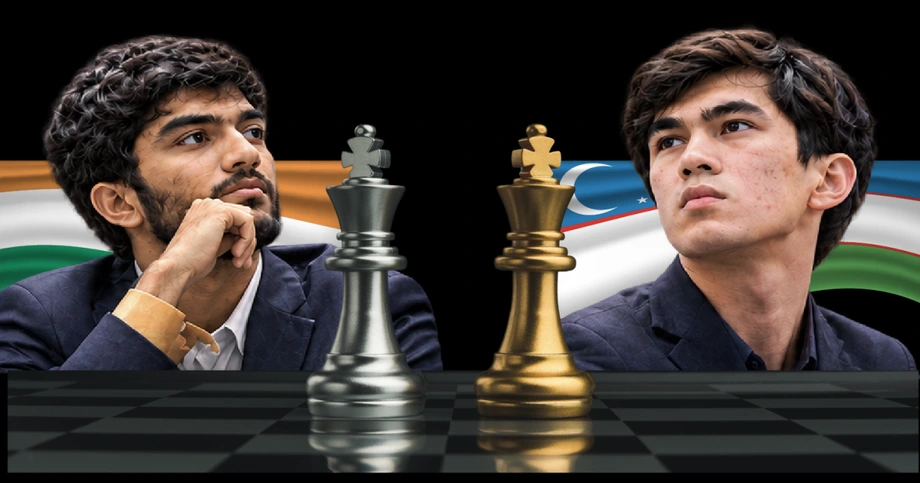
Geneva thriller leaves the match level at 1.5 points each
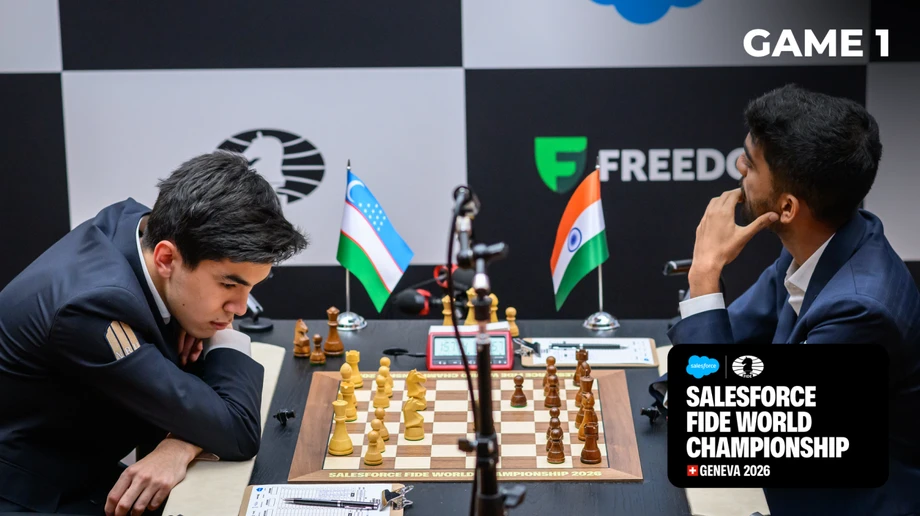
Javokhir Sindarov made his 40th move on Thursday with six seconds left on his clock and still held the third game of the 2026 world chess championship to a draw after 60 moves and 4 hours 49 minutes. The 20-year-old challenger from Uzbekistan, playing white, had trailed Gukesh Dommaraju by roughly 50 minutes on the clock at one point, and he came through the scramble to leave the 14-game match level at 1.5 points apiece.
Contents
- Geneva thriller leaves the match level at 1.5 points each
- What decided the endgame: a blocked pawn and a near blunder
- Inside the clock: how a 50-minute lead became six seconds
- Gukesh's opening surprise: the variation Spassky used in 1988
- Where the initiative swung: 29.f4 and a king on d7
- Why Gukesh is the underdog on paper despite holding the title
- Two 20-year-olds and the youngest final in 140 years
- How the title is decided and what the winner earns
- Rest day, a grandfather's birthday and game four
- Geneva, Kazakhstan and a tournament assembled at speed
- Key Points
The game was played at the Fondation Martin Bodmer in Cologny, in the suburbs of Geneva, where the Salesforce FIDE World Championship 2026 is being staged. Gukesh, the defending champion from India, had the black pieces and produced the kind of deep opening preparation that made the game the first real fight of the match.
After 15 moves Gukesh still had nearly 1 hour 58 minutes of his original two hours, about 40 minutes more than Sindarov. The queens came off on move 17, and the champion kept his king in the centre and walked it forward as the pieces came off the board. He sacrificed a pawn to clear a path for another, which landed on d3 on move 36, two squares from promotion.
The endgame, with bishops on opposite colors, gave neither player a realistic route to a win. Gukesh finished a pawn up, his king reached the second rank, and Sindarov's bishop sat on the diagonal that blocked the passed pawn. The draw was agreed with the pawn still on d3.
What decided the endgame: a blocked pawn and a near blunder
Sindarov gave up a pawn deliberately, calculating that if Gukesh automatically withdrew his king, white might find some winning chances. The trick almost backfired. Sindarov confessed afterwards that he came close to playing 49.f7?? instead of capturing on e1, and Gukesh pointed out in the press conference that 49...Re3+ followed by 50...Re8 would have won for black.
The Uzbek grandmaster, who had judged the position to be completely drawn, made the correct move and held without further incident. The two players then stayed at the board to analyse the game together, a sign of how absorbing the afternoon had been.
I was just thinking it's completely drawn, and I just relaxed!
Inside the clock: how a 50-minute lead became six seconds
The third game turned on time as much as on pieces. Sindarov had just over four minutes left after his 33rd move, with seven moves still to make before the next time control. He spent more than a minute on his 39th move, bringing his bishop back to b4 with eight seconds to spare, and then made his 40th move with six seconds remaining.
Both players then received an additional 30 minutes, with a 30-second increment added for each move from move 41 onward. The time control gives each player two hours for the first 40 moves, then 30 minutes to the end of the game, a format that rewards nerve as much as calculation in a long endgame.
Gukesh said the pressure had been lopsided. "I think it was more stressful for him because I always had enough time on the clock," he said. Sindarov, asked how much pressure there was to be the first to win a game in the match, gave a blunt answer.
That's a very hard question. I cannot think right now, so I'm sorry.
Gukesh's opening surprise: the variation Spassky used in 1988
Sindarov opened with 1.e4, as he had in game one. Gukesh again chose the Berlin Defence of the Ruy Lopez, but this time he prepared a surprise on move five: 5...Be7 instead of the 5...Nd6 he used in the first game. The line is known as the Rio de Janeiro Variation, and the world champion had dug it out of storage.
The rare line has a long pedigree. It was championed in the 19th century by Adolf Anderssen, appeared three times in the 1908 Tarrasch-Lasker title match and last surfaced in a world championship in Karpov-Korchnoi in 1981. After 6.Qe2 Nd6 7.Bxc6 bxc6, Gukesh answered dxe5 with 8...Nf5, steering the game into the Cordel Variation rather than continuing with the more familiar ...Nb7 setup. The game followed Boris Spassky's 1988 encounter with Ljubomir Ljubojevic from the Belfort World Cup until 13...Qb8.
Gukesh said he knew the Spassky game, then delivered the line of the press conference.
Yeah, I can reveal that Spassky is not one of my seconds. But yeah, I was aware of the game.
The preparation showed on the clock. Gukesh had used under three minutes by the time he reached move 16 and thought seriously for the first time, holding a lead of nearly 55 minutes. Wesley So, the American grandmaster, described it on social media as an impressive game and said he could not wait to try the line.
Sindarov was taken aback. "We checked this, but not that deep," he said. "I was very surprised." He said he began the game believing he had a good position and slowly realised the evaluation was different.
In the game I started understanding the position is completely equal.
Where the initiative swung: 29.f4 and a king on d7
Gukesh said he knew the position was already close to equal but that black's structure was ugly, and he felt comfortable because of his time advantage and his knowledge of the plans in that structure. The initiative then swung from side to side. Gukesh put his king on d7, a move the broadcast commentator Judit Polgar, a former women's world champion, called the coolest move of the championship so far.
Sindarov's 29.f4 changed the character of the game. Gukesh admitted he had been watching for kingside breaks and completely missed that moment, but he took on f4, doubled rooks on the a-file and found a king shuffle that Polgar called a fantastic idea. The sharp 33...c5 landed when Sindarov had seven moves to make in four minutes. Grandmaster Arturs Neiksans, a former Latvian champion, praised the sequence of king moves.
I'm so impressed that Gukesh found 31...Kf5!, followed by 32...Ke6!, and 33...c5! I think it shows that the World Champion is in great shape. This will be a very close match!
Sindarov summed up his own afternoon simply: he played the last move with seven seconds left, was happy to escape with a draw from a hard position, and found it difficult to switch from playing for a win to playing for a draw.
Why Gukesh is the underdog on paper despite holding the title
The result leaves a strange-looking scoreboard. Gukesh became the youngest undisputed world champion in December 2024, but his form since then has slipped. He has fallen from a career-high world No 3 to No 26, the lowest ranking for a reigning world champion since Elo ratings were introduced in 1971.
Sindarov has moved in the other direction, climbing from No 25 a year ago to a career-best No 4. His rise included winning the FIDE World Cup in Goa last November and going unbeaten at this year's Candidates tournament in Cyprus, where he became the first player from Uzbekistan to earn a world title shot.
The 22-place gap between the two is the widest of any world championship match since the title was reunified in 2006. Sindarov arrived as a heavy favourite, having won two and drawn one of their three classical meetings before Geneva. On the board, the first three games have offered little to separate them.
Two 20-year-olds and the youngest final in 140 years
Both players are 20, making this the youngest matchup in the 140-year history of the sport's most prestigious title. The gap in experience at the top is narrower than the rankings suggest. Gukesh has spent two years carrying the crown and its obligations, while Sindarov has spent the past 12 months winning the events that earned him the challenge.
That context explained the tension in the press room after game three. Gukesh had shown he could still prepare at the highest level against a player rated 22 places above him. Sindarov had withstood his first genuine test of the match, defending under severe time pressure and finding accurate moves when his position was uncomfortable.
How the title is decided and what the winner earns
The match runs from 24 November to 12 December 2026 and consists of 14 classical games. Players receive one point for a win and half a point for a draw, and the first to reach 7.5 points becomes world champion. The prize fund is $2.5 million, with $200,000 paid for each win and the remaining money split equally between the two.
If the score is level at 7-7 after 14 games, the title will be settled by a playoff that starts with four games of 15+10 rapid chess. Tiebreaks have decided three of the past five world championship matches.
- Game 1, Tuesday 24 November: draw in 38 moves, Gukesh with black held off a time scramble
- Game 2, Wednesday 25 November: draw in 20 moves and 1 hour 57 minutes after threefold repetition, from a London System
- Game 3, Thursday 26 November: draw in 60 moves and 4 hours 49 minutes
- Rest day, Friday 27 November
- Game 4, Saturday 28 November, with Gukesh playing white
- Final classical game, Saturday 12 December, with tiebreaks if needed
Rest day, a grandfather's birthday and game four
Friday's rest day gives both players time to reconsider their openings before the fourth game, which starts on Saturday 28 November at 9 a.m. ET, 15:00 in Geneva and 7:30 p.m. India time. Gukesh will have the white pieces and will be looking to pose problems from the first move, having spent three games answering Sindarov's 1.e4.
Sindarov has family business on the rest day: he plans to celebrate the birthday of his grandfather, who is with him in Geneva. Eleven of the 14 scheduled games remain, and neither player has yet held a lead in the match.
Geneva, Kazakhstan and a tournament assembled at speed
The championship is being held in Switzerland with support from Kazakhstan. FIDE president Timur Turlov said bringing diplomacy, business and the global federation together on a tight schedule to stage the year's biggest tournament in Geneva was a difficult task. The venue, the Fondation Martin Bodmer, sits in the Geneva suburbs, a quiet setting for a title match that has produced three draws and one genuine fight.
The broadcast is hosted by grandmasters Judit Polgar and David Howell, with Hikaru Nakamura streaming his own coverage. For the players, the schedule now points to Saturday, when Gukesh gets the white pieces for the first time and the match resumes after a day away from the board.
Key Points
- Game 3 of the 2026 world chess championship in Geneva ended in a 60-move draw after 4 hours 49 minutes, the third draw in three games
- The match is level at 1.5 points each, with 11 of 14 classical games remaining
- Sindarov played white and made his 40th move with six seconds left after trailing Gukesh by about 50 minutes on the clock
- Gukesh surprised his opponent with the Rio de Janeiro Variation of the Berlin Defence, 5...Be7, a line Boris Spassky used in 1988
- Gukesh finished a pawn up in an endgame with bishops on opposite colors but could not convert the d3 pawn
- The first player to reach 7.5 points wins the title and the $2.5 million fund, with $200,000 paid per win
- Gukesh has fallen to world No 26 while Sindarov is a career-best No 4, a 22-place gap that is the widest since 2006
- Both players are 20, making this the youngest world championship matchup in 140 years
- Game 4 is on Saturday 28 November, with Gukesh playing white after Friday's rest day