A purple rabbit wins on Suica's 25th anniversary
A purple rabbit with vacant eyes and a fixed smile will become the face of Suica on April 1, 2027, ending the Suica Penguin's 25-year run. East Japan Railway Company (JR East) revealed the unnamed character in Minato Ward, Tokyo, on November 18, 2026, exactly 25 years after the transport card launched. It won 860,152 of the 1,664,399 public votes cast, or about 51.7 percent, yet its vivid color and unreadable expression quickly earned it the nickname Doku Usagi, meaning Poison Rabbit or Poison Bunny.
Contents
- A purple rabbit wins on Suica's 25th anniversary
- How did 1.66 million votes produce this winner?
- Why did Poison Bunny take over the internet?
- How Mr. Sato built the costume in 20 minutes
- Can Poison Bunny become the official name?
- Why the penguin leaves such large shoes to fill
- Will the squirrel and the orange character return?
- Why JR East is changing more than a mascot
- What will passengers and phone users notice?
- The dates to watch
- Key Points
The Suica Penguin, created by illustrator Chiharu Sakazaki, will retire on March 31, 2027. A farewell and handover ceremony is planned for that day, with the rabbit taking over the following morning as Japan's 2027 fiscal year begins. JR East had announced the retirement plan in November 2025, alongside plans for QR and barcode payments and a higher balance ceiling.
JR East President Yoichi Kise used the Tokyo ceremony to connect the character with the service's next stage:
We want this character to be a symbol of moving forward into the new future that Suica is opening up.
For passengers, the immediate change is visual rather than mechanical. A familiar black and white bird seen on cards, advertisements and merchandise will give way to a purple character whose appearance has already divided the public.
How did 1.66 million votes produce this winner?
JR East did not simply ask the internet to invent a mascot. Young creators produced initial designs, opinions from JR East Group employees were considered, and a committee chaired by broadcast writer and screenwriter Kundo Koyama narrowed nearly 20 concepts to three finalists. Online voting ran from September 8 to 23, 2026, with participation from Japan and abroad.
Proposal A was a squirrel whose head and tail were joined visually by a single line, intended to evoke a railway track. Proposal C was an orange animal carrying a small mole in a shoulder bag. Proposal B was the purple rabbit. Its 860,152 votes exceeded the other finalists' combined total of 804,247 by 55,905, giving it more than half the ballots rather than a narrow plurality. The count concluded the mascot vote that had made the rabbit an internet favorite before its victory was confirmed.
The unveiling itself drew television broadcasters, national newspapers, specialist publications and web media. Reporters stirred when a silhouette appeared on the screen, and the full image produced an audible murmur. Selection committee member Manabu Mizuno, a creative director, said he had expected majority voting to favor a safe choice and was surprised that such a mysterious character won. Fellow member Yosuke Kihara, a character designer, saw a careful balance of strength and cuteness, with enough mystery to leave the character open to many kinds of development.
Why did Poison Bunny take over the internet?
Illustrator Hiroaki Seto, born in Fukuoka in 1990, created the winning design. JR East says the rabbit represents a spirit of leaping into the future. Its purple combines blue, representing security and reassurance, with red, representing excitement and inspiration. In a message read at the ceremony by voice actor Kenjiro Tsuda, Seto said he had tried to reflect Suica's possibilities in the character's colors, shape and gestures while ensuring that it would remain visible in busy settings. He also welcomed the fan art already appearing online.
Online reactions often focused on something less reassuring: the sharp corners of the smile, eyes resembling dark voids and facial proportions that some viewers compared with a mask. Commenters called the character a monster, questioned whether it was really a rabbit and proposed names such as Satan Rabbit. Others said the squirrel should have won or that JR East should simply keep the penguin.
One voter captured the peculiar regret of someone who had helped an amusing candidate win without expecting that victory to become real:
Hahaha I voted for the purple rabbit but I can't believe it actually won.
The reaction has not remained entirely hostile. Some viewers decided that the rabbit resembled singer and songwriter Fujii Kaze wearing a dog costume in the music video for his song Hachiko. That comparison spread across X, prompting people who had called the mascot creepy to say it suddenly looked cute. Hachiko consequently joined the informal list of possible names, despite the video costume representing the famous loyal dog rather than a rabbit.
Myaku-Myaku, the official character for the 2025 Osaka Kansai Expo, offered another comparison. Its unusual design also faced skepticism before finding affection. The situations differ in duration: the Expo character belonged to a temporary event, while Suica's mascot is intended to accompany a service people use every day.
How Mr. Sato built the costume in 20 minutes
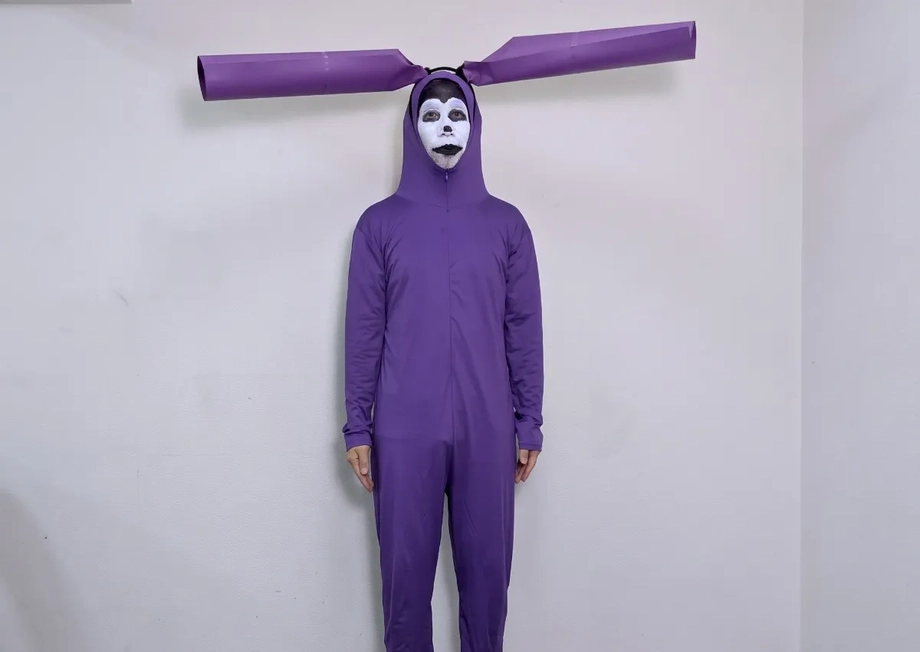
Mr. Sato, a reporter whose office dresses together every Halloween, had already taken part in a group costume based on Guile from Street Fighter II. The rabbit's November 18 arrival came too late for that theme, so he built his own version instead of waiting until the following Halloween.
His supplies were simple: a purple hooded jumpsuit with a zip, a plastic hairband of the kind sold by drugstores and shops offering inexpensive goods, construction paper and tape. He rolled the paper into cylinders for the long ears, attached them to the band and applied face paint. His facial hair supplied an extra texture resembling rabbit fur. Once the materials were ready, the costume and makeup took about 20 minutes, and he estimated that hurrying could have cut that time in half.
The transformation still left him able to work a full regular shift. Space around his desk was less accommodating, with the tall ears nearly striking a wall whenever he leaned to one side. Staying upright kept them clear.
Mr. Sato also began policing the animal imagery around him. Finding a penguin picture in a colleague's article, he issued a mock editorial order:
Hey, Wasai, you've got a picture of a penguin in this article. Get rid of it!
He then turned on Ahiruneko, whose name contains the Japanese words for duck and cat, and jokingly demanded that one animal be replaced with usagi, the word for rabbit. His costume even produced a suggested official name: Suica Sato.
Can Poison Bunny become the official name?
JR East opened nickname submissions on November 18 and will accept them until 3:59 p.m. Japan time on December 15, 2026. Entrants must use the special page on the company's website and supply more than a word. JR East asks for the name's origin and meaning, and its campaign also invites ideas about the character's personality and interests. Each entrant receives one of three digital wallpapers featuring the rabbit.
The form limits names to 10 characters written in hiragana, katakana or the alphabet. Kanji is excluded. The familiar Japanese spelling of Poison Rabbit contains the kanji for poison, so that name cannot be submitted as written. This technical obstacle has complicated an online campaign that initially treated Doku Usagi as the obvious choice.
Several alternatives have emerged. Murasagi combines murasaki, meaning purple, with usagi, meaning rabbit. Bunnywise compares the character with Pennywise, the clown from Stephen King's horror novel It. Another suggestion is B-An, also rendered as Bean, derived from the rabbit's label as Proposal B during voting. One explanation offered for that name joins B for bunny with an from anshin, the Japanese word for reassurance. Hachiko and Suica Sato have their own supporters for very different reasons.
A flood of identical entries will not settle the matter. The selection committee will review submissions in January 2027 and choose according to meaning and suitability, rather than automatically adopting the most frequent suggestion. The winning name is scheduled to be revealed at the March 31 handover ceremony. Until then, the rabbit has no official name, and Poison Bunny remains an unofficial description.
Why the penguin leaves such large shoes to fill
The Suica Penguin was adapted from Sakazaki's existing picture book illustrations rather than designed from nothing for the card. Its black and white body sat comfortably beside Suica green, partner cards and phone screens, while its silhouette was easy to recognize. Admirers also connected its smooth appearance with suisui, a Japanese word for gliding or proceeding smoothly, much like a quick passage through a ticket gate.
A design assessment of the selection process warned that a nationwide infrastructure service faces a different test from a new business seeking attention. A brief popularity poll can reward immediate impact and meme potential, while a character encountered every day must also fit comfortably into routine. That concern helps explain why some commenters called the rebrand unnecessary and hoped that Suica's green, black and white palette would survive the arrival of a purple mascot.
The practical rollout will not simply place the rabbit on every piece of plastic. Plastic cards are set to become plain, and the new character is not scheduled to appear on the card face. Its public role will instead develop across JR East's wider activities.
JR East has described the penguin's departure as a graduation. Kise's public explanation was that Suica is entering a different stage as it connects with more parts of daily life, requiring a new character to symbolize that change. The company has not explained why the penguin itself could not continue. The ownership background adds a business dimension: the copyright has been described as shared among Sakazaki, advertising company Dentsu and JR East, while Sakazaki has also been identified as holding the character rights. JR East has not publicly presented either arrangement as the reason for its decision.
Will the squirrel and the orange character return?
The two defeated finalists may still have a future. After the formal announcement, Kise said their support made it difficult to discard them and that JR East was examining ways to include them in its activities. He ended his surprise announcement with a brief promise:
I think you'll all be seeing them again.
Koyama also proposed an annual event on November 18 at which all three characters could gather like former classmates and exchange updates. Kise did not clarify whether the squirrel and the orange character would join the rabbit within Suica or promote other parts of JR East, which also operates hotels, leisure travel businesses and convenience stores. No detailed role or launch date has been decided for either runner-up.
Why JR East is changing more than a mascot
Suica Renaissance is the programme behind the redesign. Its aim is to turn Suica from a device associated mainly with transport into a service used throughout daily life. The programme sits within JR East's Yusho 2034 management vision, which seeks closer connections among payments, local communities and everyday services. The rabbit is meant to give that expansion a recognizable personality.
Kise described the commercial ambition at the November 18 event in terms of what a phone could handle:
We want to evolve Suica into a device that can meet most daily needs if people have it (on their smartphones).
The scale already goes well beyond railway tickets. Around 120 million physical and mobile Suica cards have been issued, and more than 2 million retailers accept payments. JR East now has about 46 million Mobile Suica accounts in use and wants 70 million by fiscal 2031. Reaching that target would require approximately 24 million additional accounts, an increase of about 52 percent from the present figure.
What will passengers and phone users notice?
The teppay payment service, launched through the Mobile Suica app in October 2026, is one of the first substantial additions. It uses payment codes, allows transfers between users and permits settlements of up to 300,000 yen, about $1,886 at the conversion given when the service was announced. Conventional integrated circuit card systems were compared at a ceiling of 20,000 yen, making the new limit 15 times as large. Teppay had about 2 million active users by early November, although JR East entered a market where PayPay already has a strong presence.
Local government services form another part of the expansion. Gotochi Suica is scheduled to launch in Miyagi and Gunma prefectures in spring 2027. It will combine Suica functions with administrative services connected to My Number, Japan's personal identification system. Both prefectures lie within JR East's railway service area.
Ticket gates supply the most visible technological change. JR East had outlined its new gate plans on November 10, 2026, before connecting them with the mascot announcement. About 400 commuters are due to test the system at 14 stations from April 10, 2027, through February 29, 2028. The commercial introduction is planned for 40 stations, mainly in central Tokyo, in spring 2028.
Compatible phones will be able to remain in a pocket or bag while passengers pass through. Ultra wideband (UWB) positioning can estimate a phone's location and distance with considerable precision, while near field communication (NFC) handles the close-range ticket exchange. The trial must show that the equipment identifies the correct passenger, records entry and exit accurately and maintains a practical speed in crowded conditions. The planned rollout includes every Yamanote Line station and stations serving Narita and Haneda airports.
The dates to watch
The mascot transition overlaps with several service launches, giving JR East a lengthy schedule rather than a single replacement day.
- November 18, 2001: Suica launches, beginning the penguin's 25-year association with the service.
- September 8 to 23, 2026: The public casts 1,664,399 votes for three mascot finalists.
- November 18, 2026: JR East unveils the purple rabbit in Tokyo and opens nickname entries.
- December 15, 2026, at 3:59 p.m. Japan time: Nickname submissions close.
- January 2027: The selection committee reviews the proposed names.
- March 31, 2027: The penguin retires, with the handover ceremony and official name announcement scheduled.
- April 1, 2027: The purple rabbit formally takes over as the Suica character.
- Spring 2028: Gates that do not require passengers to tap their phones are planned for 40 stations.
Key Points
- The purple rabbit won 860,152 of 1,664,399 votes, defeating a squirrel and an orange character carrying a mole.
- Illustrator Hiroaki Seto designed the rabbit, whose purple color combines themes of reassurance and excitement.
- The Suica Penguin retires on March 31, 2027, and the rabbit takes over on April 1.
- Nickname entries close on December 15, 2026; a committee, not submission volume, will choose the official name.
- Mr. Sato recreated the character with inexpensive clothing, paper ears and face paint in about 20 minutes.
- JR East is considering future roles for both losing designs and an annual reunion of all three characters.
- The rebrand accompanies teppay, local services linked to My Number, a target of 70 million Mobile Suica accounts and touchless gates planned for 40 stations.