A temple gift measured in kilograms and faith
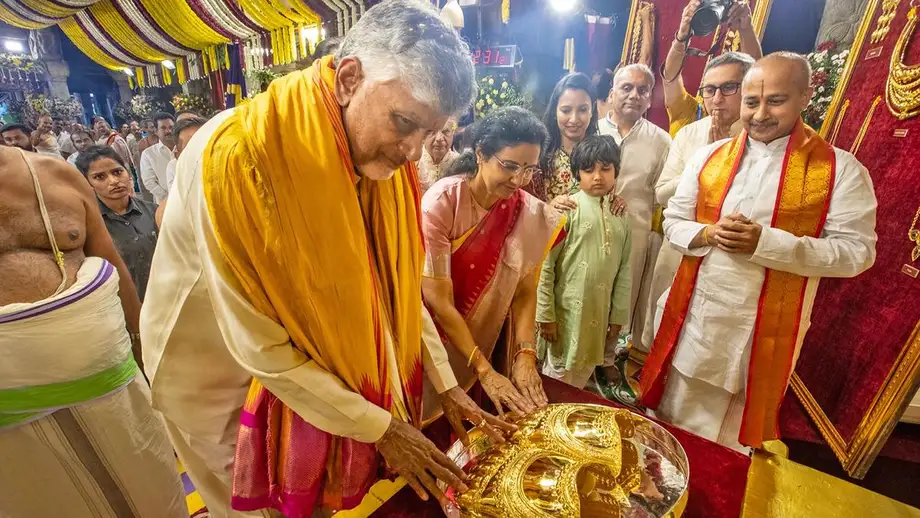
On Thursday, November 26, 2026, Vardhman Jain, a Chennai entrepreneur and co-founder of Access Healthcare, stood inside the Sri Venkateswara Swamy Temple at Tirumala with his wife Radhika Vardhman Jain and his brother Anurag Jain. The family handed Tirumala Tirupati Devasthanams (TTD) 121 kg of gold ornaments for Lord Venkateswara. Andhra Pradesh Chief Minister N. Chandrababu Naidu attended, along with his wife Nara Bhuvaneswari, temple officials and priests.
Contents
- A temple gift measured in kilograms and faith
- What the 121 kg included
- Why 121 kg carried special meaning
- How the ceremony unfolded
- How the gift took shape over time
- Who is Vardhman Jain
- How the company sale funded the offering
- A pattern of support for Tirumala
- Beyond the temple
- Why political leaders highlighted the gift
- What readers should keep in mind
- Key Points
TTD put the value at ₹207.6 crore, about 2.076 billion rupees, including making charges, the labour and design cost added to the price of gold. A crore is 10 million rupees. Published estimates ranged from about ₹150 crore to ₹208 crore, with ₹207.6 crore the detailed figure attached to the offering by the temple administration. The gift was described as the largest individual donation to the deity in recent times; Naidu called it historic.
An official press release from the temple administration stated the basic handover in plain terms. It named the donors and the chief minister, using Srivaru, a Telugu form of address for the lord, for Venkateswara:
The Jain couple from Chennai donated 121 kg of gold ornaments to Srivaru in the presence of CM Chandrababu
Jain said the money came from the sale of Access Healthcare, a healthcare technology and outsourcing company he built with his brother. The choice of 121 kg, he told reporters, was a divine coincidence rather than a target he had carefully planned.
What the 121 kg included
The gift was not a pile of gold bars. It was a jewellery collection made for temple use. TTD said 106 kg went into ornaments for the presiding deity, while 15 kg of pure gold was set aside for a golden saree for Goddess Padmavati Ammavaru at Tiruchanoor. That split means 87.6 percent of the metal was for Lord Venkateswara and 12.4 percent for the goddess.
The detailed temple count listed 46 pieces of 33 types. Other descriptions counted 40 different types or grouped the ornaments into nine sets. All 46 ornaments were described as 24 carat pure gold, meaning gold in its purest common form. The value included making charges and precious stones.
Among the pieces were a golden crown studded with diamonds, Padma Peetham, Kati Varada hastams, Karnabharanams, Pada Kavachams and Padma Paadalu for the deity's feet, anklets, coverings for the conch and discus called Sankha and Chakra Kavachams, a waist belt with a serpent design called Nagabharana Vaddanam, armlets called Bhujakeerthulu, a pendant shaped like a tiger claw called Puligoru, ear ornaments and necklaces set with saligrama stones. Saligramas are sacred stones revered in Vishnu worship.
TTD's stone figures listed 238.2 carats of diamonds, 2,247.7 carats of precious stones, 91.6 carats of blue sapphires, 84.2 carats of yellow sapphires and 2,916.5 grams of rubies and emeralds. A carat is a unit of weight for gems, not a measure of purity. Standout named pieces included the ashtottara shatanama kasula haram and the chaturbhuja lakshmi haram.
Why 121 kg carried special meaning
Jain's explanation was simple. The ornaments adorning Lord Venkateswara each day were also described as weighing 121 kg, and Naidu spoke of roughly 120 kg of jewellery used on any given day. Jain said he had not consciously fixed on the number. When he learned the daily adornment weighed about the same, the figure began to look like a sign.
The plan began after the Access Healthcare sale. Jain approached TTD additional executive officer Venkaiah Chowdary in August 2025 with an offer to give 121 kg of gold. Chowdary arranged a meeting with Naidu. TTD executive officer Muddada Ravichandra and other temple officials were involved in the handover. Jain recalled that the meeting was meant to be brief.
Vardhman Jain, the donor and an Access Healthcare co-founder, described how Naidu shaped the idea from a quantity of gold into usable temple jewellery:
What was scheduled as a five-minute meeting went on for nearly an hour. The chief minister was curious about how I arrived at the figure of 121 kg. He explained that Lord Venkateswara was adorned with different gold ornaments weighing approximately 120 kg on any given day. He suggested that I make the offering in the form of ornaments that could be adorned to the deity, and I readily agreed
Jain also thanked the Chief Minister's Office for tracking the project and following up every week. The ornaments took about 15 months to prepare. The gift was also described as the fulfilment of a longstanding vow.
How the ceremony unfolded
After darshan, Naidu, Jain, his family and temple representatives viewed the collection at Ranganayakula Mandapam. Darshan means the act of seeing the deity in the temple, a central part of Hindu worship. The 46 pieces were displayed before being carried in procession.
Family members lifted the ornaments on plates held above their heads, walked around the Dhwajastambham and placed the pieces before the deity in the sanctum sanctorum. The Dhwajastambham is the temple flagstaff, a ritual marker in front of the shrine. Priests planned to dress the deity in the new ornaments after the abhishek on Friday, November 27. An abhishek is a ritual anointing or bath of the deity.
The ornaments are intended for Kainkaryams, or ritual services, and for special occasions. TTD did not announce a fixed schedule saying when each piece would first be worn. The golden saree for Padmavati Ammavaru at Tiruchanoor was part of the same gift, but no completion date was given for that garment.
How the gift took shape over time
The road to the temple offering ran through nearly three decades of healthcare services, technology deals and philanthropy.
- 1997: Jain co-founded Vision HealthSource with Anurag Jain, working in medical billing and healthcare claims management.
- 2003: Perot Systems acquired Vision HealthSource.
- 2009: Dell acquired Perot Systems, bringing Jain into a larger global technology business.
- January 2025: New Mountain Capital took a majority stake in Access Healthcare.
- August 2025: Jain approached TTD with the proposal to donate 121 kg of gold.
- May 2026: Jain donated electric buses for TTD transport.
- November 26, 2026: The ornaments were formally handed over at Tirumala.
- Friday, November 27, 2026: Priests planned to adorn the deity after the abhishek.
That sequence helps explain why the donation was described as more than a sudden display of wealth. Jain had already supported temple projects, and his business network had produced the money he said funded the gift.
Who is Vardhman Jain
Jain started his working life as an employee, then moved to the United States and built a career in information technology and healthcare services. He studied Statistics at Loyola College in Chennai and later earned a master's degree in computer science from the University of Texas at Austin.
In 1997, he and Anurag Jain founded Vision HealthSource. The company handled medical billing and claims management, the paperwork and payment systems that let hospitals and doctors get paid for care. Perot Systems bought it in 2003. After Dell acquired Perot Systems in 2009, Jain became managing director of Dell Services' global business process outsourcing operations. Business process outsourcing means running administrative work for another company. He oversaw more than 100 clients and around 9,000 employees.
Jain is founder and vice chairman of Access Healthcare, which he launched in 2011. The company provides technology enabled revenue cycle management, a service that helps healthcare providers manage claims, payments and the flow of money from patient care to reimbursement. It uses automation, artificial intelligence and machine learning to reduce manual work. He is also a director of Asia Engineering, a Chennai civil engineering firm, and a former managing director of Dell Services business process outsourcing operations.
How the company sale funded the offering
Jain said the gold was bought with proceeds from the Access Healthcare sale. In January 2025, New Mountain Capital, a private equity firm based in New York, acquired a majority stake. Private equity firms invest money in companies, often taking a large ownership stake and working with managers to expand or restructure the business.
The transaction was valued at about $2 billion in connection with the donation. Other published figures put the stake sold at 60 percent with proceeds of about $1.5 billion, or at 70 percent with a valuation near $2 billion. Public estimates also placed Jain's net worth at ₹8,292 crore. Those numbers explain how a private donor could assemble 121 kg of gold, but the religious decision came from Jain's own account of gratitude and coincidence.
The choice of a New York investor also links a Tamil Nadu temple gift to the global healthcare outsourcing industry. Access Healthcare's work sits behind hospital administration in the United States, where firms process claims and payments so care providers can keep running. The donor's business success became the source of a traditional temple offering in Andhra Pradesh.
A pattern of support for Tirumala
Jain's relationship with TTD predates the gold ornaments. Since 2019, he has supported several practical projects. He gave ₹7 crore for the Sri Venkateswara Bhakti Channel (SVBC), the temple's devotional television service. He funded a cattle feed mixing plant worth ₹5 crore for TTD Goshala, which cares for temple cattle. He also provided a coin sorting machine worth ₹1 crore to help count donations, and he donated electric buses in May 2026.
Those gifts are different from jewellery, but they show where the money went before the gold donation. SVBC broadcasts temple programming. The Goshala plant helps feed cattle kept by the temple. A coin sorting machine reduces the manual work of handling small coins given by devotees. Electric buses help move pilgrims and staff around the temple system.
The latest gift was described as the first donation of its kind in TTD history and, by Naidu, as the largest single gold donation since the TTD trust board was established. Both descriptions place it at the top of the temple's modern donation record.
Beyond the temple
Jain's charitable work extends beyond Tirumala. He is linked with the Kanchi Kamakoti CHILDS Trust Hospital in Chennai and has been described as a managing trustee of the institution. The hospital is associated with paediatric healthcare. He also supports the Shree Sarita Jain Foundation Trust, which works in education, hunger relief and emergency healthcare.
He founded Avishkar, also spelled Aavishkaar, an initiative aimed at skill development and employment opportunities for young people from disadvantaged backgrounds. Through the foundation, programmes named Vidya Seva and Vaidya Seva support education and medical assistance. Professional patents were also mentioned, without a list of the patents.
Some of this work mirrors the temple gifts. Healthcare, education, food support and skill training serve people outside the ritual space, while the gold ornaments serve the temple's daily worship. Jain's public image now rests on both parts of that record.
Why political leaders highlighted the gift
Naidu used the ceremony to place Jain's donation in a long line of temple patronage. He drew parallels with Pallava, Chola, Chera, Pandya, Mysore and Maratha rulers, and with Vijayanagara emperor Sri Krishnadevaraya. Those dynasties are known in Indian history for funding temples, and Naidu's comparison cast the donation as part of a continuing practice.
Naidu, the chief minister, described the scale of the gift in relation to the temple trust's own history. He said:
largest single gold donation received since establishment of the TTD trust board
He thanked Jain for the gift and said the donation was historic. He also noted that India has many very wealthy people, but few use that wealth for philanthropic and spiritual causes of this kind.
What readers should keep in mind
Several figures around the donation came with different labels. The value ranged from roughly ₹150 crore to ₹208 crore in public estimates, while the temple's detailed figure was ₹207.6 crore including making charges. The ornament count was given as 46 pieces of 33 types, 40 different types and nine sets. The goddess's costume was described as 25 kg, while the pure gold portion for the saree was 15 kg.
The Access Healthcare deal also appeared with more than one set of terms: 60 percent sold for about $1.5 billion, 70 percent sold with a value near $2 billion, and a majority stake in a deal valued at about $2 billion. No single public summary reconciles those figures. TTD also gave no timetable for the golden saree or a piece by piece schedule for the jewellery.
For ordinary pilgrims, the practical change is straightforward. The temple now has a new set of 24 carat ornaments for the deity's rituals and a reserve of gold for a saree at Tiruchanoor. For the donor, the gift marks a religious response to a business sale. For TTD, it adds a high value collection to a treasury that serves daily worship.
Key Points
- Vardhman Jain and his wife Radhika donated 121 kg of gold ornaments to Lord Venkateswara at Tirumala on November 26, 2026.
- TTD valued the donation at ₹207.6 crore including making charges, with estimates elsewhere ranging from about ₹150 crore to ₹208 crore.
- About 106 kg was used for 46 ornaments for the deity, while 15 kg was set aside for a golden saree for Goddess Padmavati Ammavaru.
- Jain said the gift was funded by the sale of Access Healthcare to New Mountain Capital in January 2025.
- The collection includes diamonds, sapphires, rubies, emeralds, a crown, foot coverings, necklaces, armlets and ritual coverings for the conch and discus.
- Jain had earlier supported TTD projects, including SVBC, a cattle feed mixing plant, a coin sorting machine and electric buses.